2013 Prediction: Mai Gang on Bitcoin, Currency Wars, and RMB Internationalization
TechFlow Selected TechFlow Selected
2013 Prediction: Mai Gang on Bitcoin, Currency Wars, and RMB Internationalization
The story of Bitcoin is ultimately a story of wisdom and博弈 among nations.
 Navigating Web3 tides with focused insights
"Bitcoin uses algorithms and mathematics to simulate the monetary properties of gold, and gradually surpasses gold across various dimensions of monetary attributes."
--- Mai Gang, 2013 Bitcoin Technology and Industry Development Forum, Shenzhen, China
In March 2025, U.S. President Trump signed an executive order establishing a "Strategic Bitcoin Reserve," under which the U.S. Treasury would directly hold and manage these digital assets—making the United States the first global superpower to explicitly incorporate bitcoin into its sovereign reserve system.
In June 2025, the U.S. Senate passed the GENIUS Act, creating a global regulatory framework for stablecoins, allowing dollar-pegged stablecoins issued at a 1:1 ratio, with the requirement that all dollars exchanged must be used exclusively to purchase U.S. Treasury bonds.
As early as 2013, an early tech investor named Mai Gang traveled across multiple Chinese cities, educating young audiences about Bitcoin and blockchain technology. Approaching the subject from the perspective of monetary history and the global financial landscape, he articulated his understanding of Bitcoin and put forth many insights that have since been validated by history—even though, at the time, most in the audience responded with skepticism and disbelief:
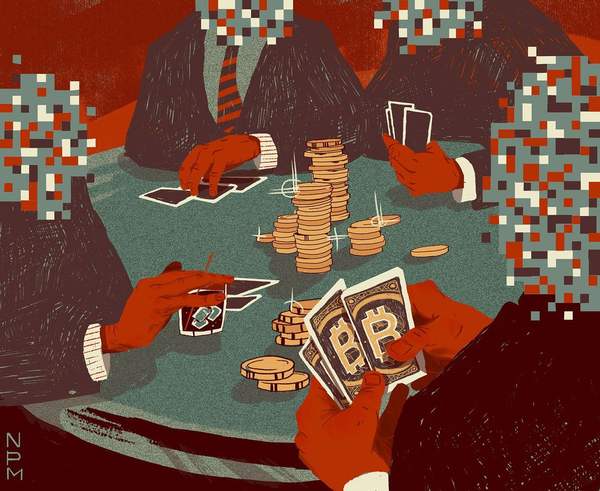
"Bitcoin will go through three stages: individual博弈 (struggle), institutional博弈, and ultimately national博弈."
"I suggest that the Chinese government should now (in 2013) acquire 20–30% of the global Bitcoin supply as a strategic reserve."
"In the future, the U.S. dollar will be pegged to cryptocurrencies in some form."
"Multiple countries, including the United States, will adopt Bitcoin as one of their national reserve currencies."
While most people were still debating whether Bitcoin was a scam or if it could buy coffee, Mai Gang had already foreseen the possibility of geopolitical博弈 among nations centered on Bitcoin. Looking back today, this perspective remains remarkably prescient.
In 2025, the U.S. executive orders and legislative acts on digital currencies marked a turning point and a directional signal for the entire industry. At this significant milestone, the editor conducted another interview with Mr. Mai Gang.
Q: Everyone knows your legendary story investing in Pop Mart, but few know you were also one of the earliest promoters of the digital currency industry. Any stories you'd like to share?
A: In 2007, I co-founded Docin.com with Jonathan Lin. Xu Mingxing quickly rose from software engineer to CTO of Docin. In 2012, Mingxing left Docin to start his own venture. Although I was reluctant, I fully supported and invested in him. His initial project aimed to build an end-to-end service platform for the food delivery sector. While Mingxing is an exceptionally talented and well-rounded entrepreneur, I believed that wasn't the best use of his strengths. Fortunately, we pivoted toward the digital currency exchange space and jointly founded OKCoin (OKX). This aligned perfectly with Mingxing’s background and expertise. The position and contributions of OKCoin within the digital currency industry—be it in product development, marketing, talent cultivation, or international expansion—are widely recognized and respected in the industry. Xu Mingxing will always be a source of pride for me, even though I’ve never shared these stories with the media.
Q: You were one of the earliest evangelists and educators in the digital currency space. What motivated you initially?
A: Starting in 2013, I began lecturing to young people about Bitcoin, driven by a desire to spread knowledge about international finance and monetary history. I suppose I’m quite academic at heart—I majored in macroeconomics during my undergraduate studies. Even basic courses like Monetary Banking contain concepts not easily grasped by the general public. I simply shared the knowledge I understood and expressed my beliefs and predictions about the future. Indeed, many young people benefited from this. Over a decade later, strangers still message me on WeChat, thanking me for their intellectual启蒙 (awakening) back then.
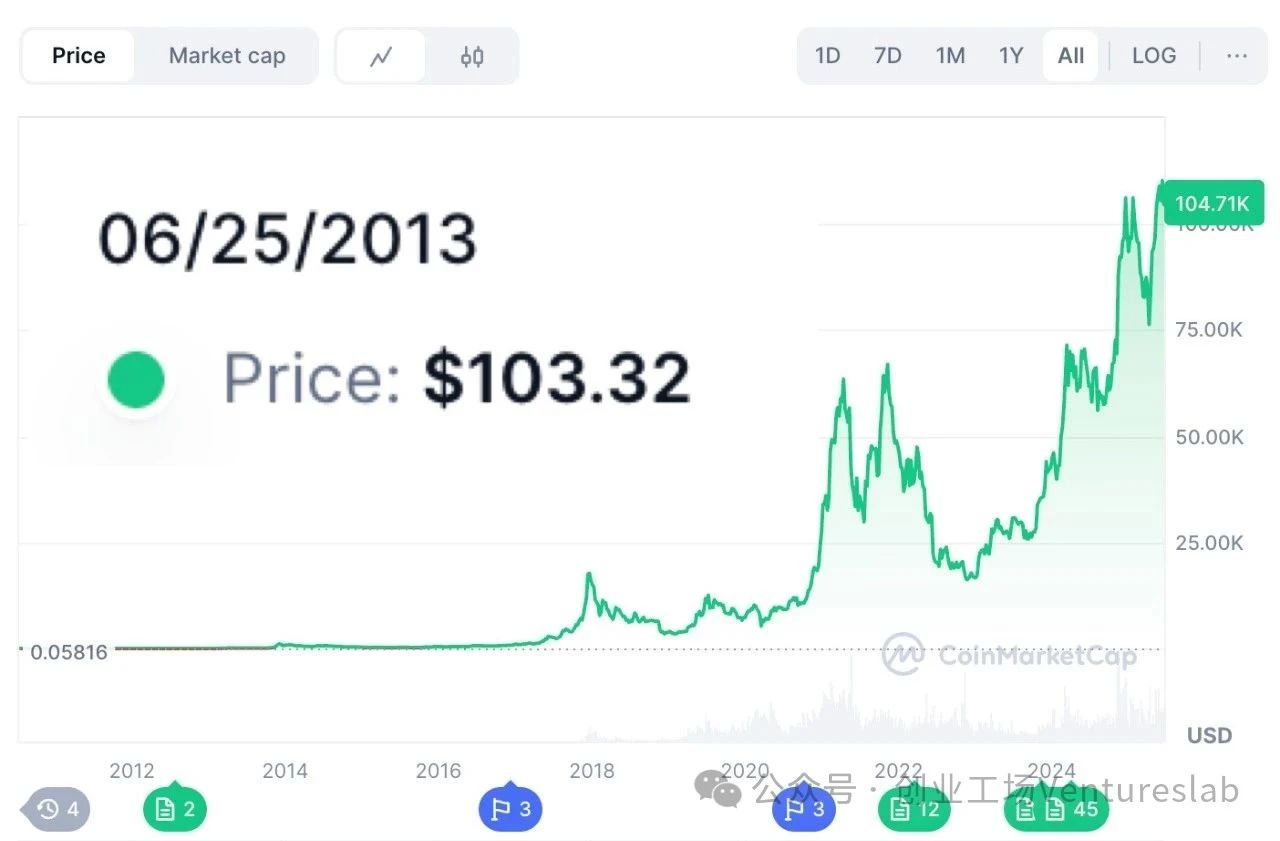
Bitcoin Price Chart (2012–2025)
Q: But this industry has also been controversial, even involving illegal activities. How do you view this?
A: Digital currency originated from technological innovation, and such innovation inevitably outpaces regulation—just like today’s AI boom, whose societal impact is profound, yet regulatory frameworks take time to mature. During the 2018 ICO wave, I initially read several whitepapers seriously, hoping to see new blockchain innovations. But soon I realized: either I was a fool, or the person across from me was a fraud. I clearly saw chaos proliferating in the industry, with many participants caught up in it. I resumed giving public speeches titled “ICO Has Nothing to Do with Bitcoin,” the core issue being lack of oversight,” warning the public about risks. Whether they’re from the '70s or the '90s generation, when it comes to our shared values and ethical底线 (bottom lines), there’s no difference—we are all law-abiding citizens with moral conscience.
I remember saying a famous line back then: "It's okay not to understand, and even okay to pretend to understand—but what’s truly unacceptable is when those who do understand pretend they don’t." Behind the chaos, some participants may act out of ignorance or greed, but the most despicable are those with fraudulent intent from the start.
Later, I was honored to be elected as a professional committee member of the Asset Management Association of China, which I believe reflects recognition of my integrity and sense of responsibility.
Q: In your interview with Family Office New Perspectives titled "The Years I Was ‘Abandoned’ by the VC Circle," you mentioned feeling isolated as a Bitcoin evangelist. Some questioned whether your cross-domain experience and knowledge gaps contributed to your views. Why didn’t professionals in finance share your foresight at the time?
A: I was indeed among the earliest investors in China’s venture capital community to invest in and actively promote Bitcoin education. Once, at a Renmin University alumni forum, the host asked why, despite so many outstanding alumni in finance, I seemed to be the first to identify and seize this major opportunity. I honestly replied that there are countless brilliant scholars in the investment world far smarter and more knowledgeable than me—I genuinely admire them. I consider myself slower, with less breadth and depth in knowledge. But fortunately, I’m no academic underachiever. So I adopted a simple method: for every decision or judgment, ask the three most fundamental and essential questions—and answer them clearly.

The essence of Bitcoin is actually very simple. However, because it spans networks, technology, and finance, understanding it can be challenging. Having broad knowledge has advantages, but also potential downsides—one might lose sight of what's truly fundamental. When you hear a hundred voices, you need to discern the three most important ones; the rest may be irrelevant, or even noise. As the ancient Chinese wisdom says: “From three,万物 (all things) arise.”
In 2013, I was removed from two mainstream VC WeChat groups for discussing Bitcoin. The members were highly educated individuals, and I thought my presentation was professional. Yet some accused me of peddling something. I thought I was engaging in serious financial discourse and sharing an investment opportunity, only to be seen by others as deceptive. That left me deeply disheartened. After all, as social beings, everyone desires recognition.
Q: This year, the U.S. passed its stablecoin legislation, officially entering the stage of national博弈 you predicted over a decade ago. As an early thought leader in the industry, do you have any new perspectives?
A: I wouldn’t call myself a thought leader. I neither have the ability nor the desire to be a public intellectual. But I am someone who has received good education and seen the world. The more I travel globally, the stronger my belief becomes in China’s power and my pride as a Chinese citizen. Reflecting on my 2013 suggestion that China establish a strategic Bitcoin reserve, it was indeed a correct and forward-looking view. Today, the launch of the U.S. dollar-backed stablecoin legislation represents another powerful move in international monetary competition. With growing global concerns about America’s debt repayment capacity, the issuance of dollar stablecoins provides massive demand for U.S. Treasuries. As I explained in a 2013 video, America’s strength lies in its repeated ability to turn crises into opportunities—and even change the rules of the game.
Relevant Chinese authorities should act immediately—formulate systems and laws to promote the issuance of offshore RMB-backed stablecoins. RMB globalization is a vital long-term strategy concerning the well-being of the Chinese people. The worldwide circulation of physical goods made in China demonstrates national strength, but let us remember: currency is also a special—and highest-level—commodity. This is basic knowledge taught in undergraduate textbooks. I believe this is precisely where soft power meets hard power.
Conclusion
More than a decade has passed. Bitcoin has moved from grassroots movements into the mainstream, evolving from mere “speculation” to institutional adoption. It hasn’t overturned the U.S. dollar, but it is becoming an undeniable variable in global finance.
Mai Gang’s predictions haven’t all come true, but he laid out the logical foundation of Bitcoin as an “anchor asset” within monetary systems—a concept increasingly validated by reality. His early warnings about U.S. strategic moves are now becoming key references in financial policymaking.
This is the judgment of an investor, observer, and practitioner made at the very dawn of digital currencies. It may not be entirely correct, but it is absolutely worth remembering.
"The story of Bitcoin, ultimately, is a story of wisdom and博弈 among nations."
Join TechFlow official community to stay tuned
Telegram:https://t.me/TechFlowDaily
X (Twitter):https://x.com/TechFlowPost
X (Twitter) EN:https://x.com/BlockFlow_News