Bill Guerley on the U.S. private market issues: zombie unicorns, valuation distortions, IPO困境, and companies' reluctance to go public
TechFlow Selected TechFlow Selected
Bill Guerley on the U.S. private market issues: zombie unicorns, valuation distortions, IPO困境, and companies' reluctance to go public
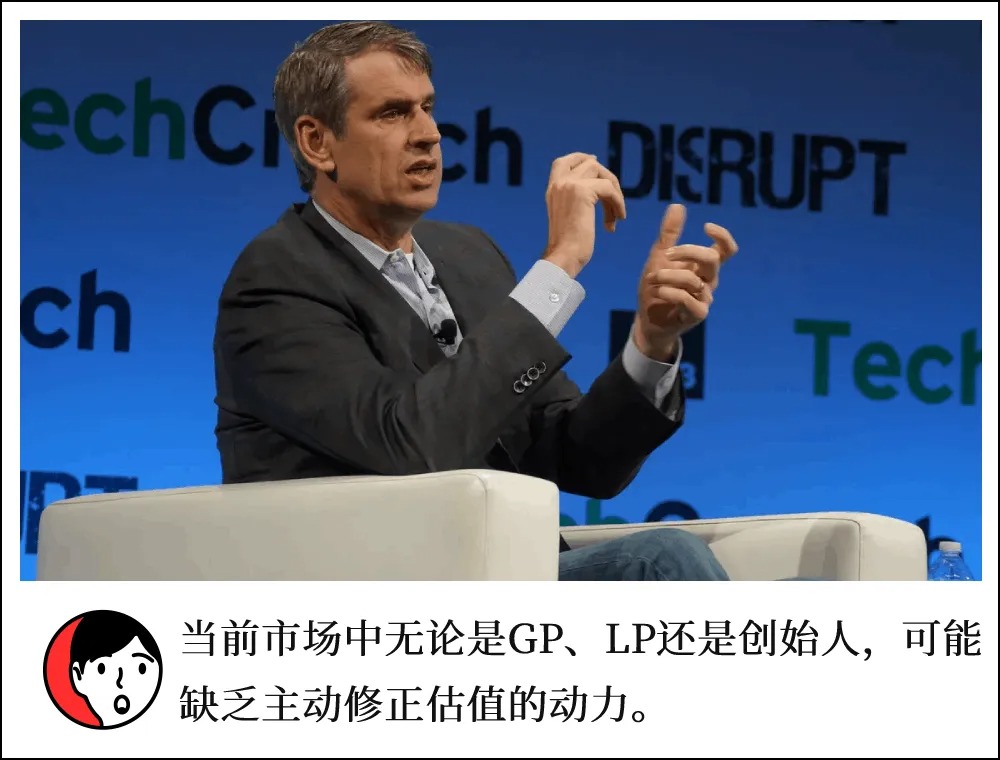
In the current market, whether it's GPs, LPs, or founders, there may be a lack of incentive to accurately mark assets and proactively adjust valuations.
 Navigating Web3 tides with focused insights
Author: MD
Publisher: Bright Company
Recently, the popular investment podcast Invest Like the Best welcomed back Benchmark partner Bill Gurley for an in-depth discussion on the current realities of the U.S. private market and the valuation and investment paradoxes surrounding AI companies.
In the interview, Bill analyzed structural changes and challenges within today’s venture capital industry. He pointed out that the rise of MegaFunds has led to exponential growth in capital size, blurring the lines between early-stage and late-stage investing, and fueling the emergence of numerous AI and tech unicorns. However, among these companies exists a large number of “zombie unicorns”—firms with massive funding but weak growth and questionable real value. Bill emphasized that across GPs, LPs, and founders, there may be insufficient incentive to accurately mark asset values or actively correct valuations, leading to severe divergence between book value and actual worth, resulting in misaligned incentives.
Bill also discussed the speculative environment under zero interest rates, where capital abundance extends company "lifespan," allowing businesses that should have been culled by the market to persist, making competitive dynamics unusually complex. Meanwhile, the closure of IPO and M&A windows has trapped vast amounts of capital in the private markets, exacerbating liquidity issues for LPs, with even elite university endowments forced to issue debt or sell private assets to meet funding pressures.
Bill believes that the arrival of the AI wave interrupted what should have been a market correction. AI is seen as a historic platform shift, driving a new investment boom and valuation bubble. While acknowledging the immense opportunities AI brings, he warned that industry participants must remain vigilant about fundamentals and unit economics, avoiding blind pursuit of high valuations.
Although Bill admitted in the interview that he "no longer writes checks," he remains highly attentive to China's AI innovation models.
In his own podcast, BG2, Bill recently analyzed shifts in Chinese corporate “competitive strategies”—from solar and electric vehicles to AI today—arguing that China’s fiercely competitive environment could ultimately produce stronger, more resilient companies. Benchmark remains one of Silicon Valley’s most successful VC firms; it recently co-led the latest funding round for ManusAI.
Below is the translated transcript of the interview compiled by Bright Company:
Patrick: Our guest today is Bill Gurley. Bill was formerly a general partner at Benchmark Capital. This marks his sixth appearance on Invest Like the Best—the most comprehensive market analysis he's ever delivered, covering forces reshaping the venture capital industry. Bill confronts the troubling math behind VC returns today, particularly around prolonged private lifecycles. He explains why neither GPs, LPs, nor founders have strong incentives to accurately mark asset values, creating systemic coordination problems. We also dive deep into the investment implications of AI as a platform shift—from assessing the quality of AI revenue to international competition dynamics. Bill offers crucial insights on navigating the present and future landscape. Enjoy my conversation with Bill Gurley.
Patrick: Bill, you’ve reclaimed the title of most frequent guest on Invest Like the Best, surpassing our good friend Michael Mauboussin. Welcome back.
Bill: Well, I can’t think of anyone else who could compete with Michael for that title.
Patrick: Interestingly, this is the first time since 2019 we’re doing the show just the two of us—hard to believe how time flies. Since it’s just us, I want to start big-picture—what’s your take on the current state of things? I know when you were at Benchmark, you used to deliver a kind of “State of the Union” for the market. I’d love if you could give us that update—your view from summer 2025.
Bill: Happy to do so. Yes, I used to kick off our LP meetings with a state-of-the-industry talk. It became a ritual, a presentation I was accustomed to giving. Recently, I've noticed many fundamental differences in the world of venture capital—some possibly permanent. Much of what I used to discuss revolved around cyclical patterns in the venture business, but those rhythms now seem disrupted or confused. We’ll get into that.
Before diving in, let me lay out two premises. First, Michael would appreciate this—I’m deeply drawn to systems-level thinking. There’s a great book on systems thinking (though I won’t name it). My time with Michael at the Santa Fe Institute was largely centered on systems theory—the behavior of a system differs from the sum of its parts. Cross-system observation is inherently difficult. But as we go deeper, I believe many components of the industry are colliding, and their combined effect is the most interesting part. So you need to step back and look at the whole picture.
Second, I want to preface everything by saying I’m not assigning moral judgment to any participant. The actions taken by individuals and companies that changed the industry landscape were rational from their self-interest perspective. The overall outcome might not benefit society, but I don’t attribute malice to anyone—that’s important to clarify upfront.
With that, let me begin. I’ll first list some realities I observe in the market. In this first section, I won’t analyze much—just lay out facts anyone immersed in venture capital would recognize. By the way, I believe this discussion matters for VCs, founders, LPs—anyone touching this ecosystem. These are high-level observations. Let me present them first, then we can unpack interpretations together.
Seven Realities of the Private Market
1. The Rise of Mega VC Funds
Bill: First—and widely discussed—is the continued rise of super-sized venture funds. When I entered the industry, everything was bespoke. Most prominent funds focused exclusively on early-stage investments. They didn’t participate in later rounds, and fund sizes were far smaller than today.
Now, many well-known firms have scaled commitments from $500 million every three to four years to $5 billion—a tenfold increase. They aggressively pursue so-called “late-stage” deals—though I’ve always thought ‘late-stage’ is just a euphemism for ‘writing huge checks.’ Now people write $300 million checks into AI startups just 12 months old. This isn’t late-stage—it’s just big money.
Many firms have moved upstream and launched specialized vertical funds, dramatically increasing AUM under familiar brand names. New players have flooded the late-stage space using various strategies. Even traditional institutions like Fidelity and Capital Group occasionally participate. But Atreides, Coatue, Altimeter, Thrive—I think they’ve carved out distinctive positions—are very active. And Masa (Masayoshi Son) is back. We hadn’t heard much from him lately, but now he’s reemerging.
Patrick: He’s become an indicator himself.
Bill: Exactly. I agree. So there’s simply more money in the market now.
2. Zombie Unicorns
Bill: The second reality, also widely talked about, is “zombie unicorns.” I don’t love the term, but it’s the most commonly used. If you count these companies—I like to use pre- and post-LLM as a dividing line, because it truly was a watershed moment when everyone got excited about the new platform shift—there are roughly a thousand such private companies that have raised over $1 billion. ChatGPT says 1,250; NVCA (National Venture Capital Association) says 900. Let’s call it around a thousand.
Patrick: About a thousand, yes.
Bill: Right. Each raises roughly $200–300 million on average. That totals $300 billion. NVCA estimates LPs hold $3 trillion in venture capital on paper. I speak one-on-one with LPs—they’ve gradually increased their VC allocation from 5–7% to 10–15%, sometimes reaching half their private equity allocation. VC now stands alongside PE, and in some cases, PE allocations are larger, but VC’s share of balance sheets keeps growing, making it increasingly significant.
I have serious questions about this cohort of companies. First, what is their true value? Many were last priced in 2021.
Patrick: Around 2021, yes.
Bill: Correct—that was the market peak, the second year of the pandemic. If you recall, all tech stocks surged—Zoom exploded—and everyone performed well during that window. So their current valuation is questionable. There’s little investor appetite for these companies broadly. Their growth rates are low—I’ll explain why shortly.
Many might not believe this, but I assure you it’s true—nobody has the incentive to mark valuations accurately. For those unfamiliar with this world—private investing, whether PE or VC—operates through this odd mechanism where GPs report prices to LPs, and they price their own holdings.
Of course, auditors poke around behind the scenes. You hear LP complaints—some funds mark conservatively low, others mark high. LPs receive wildly inconsistent data.
Patrick: Different GPs assign different prices to the same asset?
Bill: Yes. But many don’t realize that managers overseeing VC portfolios at large endowments often lack incentives to adjust downward. In fact, many are compensated based on unrealized valuations. So they actually have perverse incentives against marking down.
3. Misaligned Incentives, Poor Outcomes
Patrick: Don’t founders have incentives to get this right? Wouldn’t it be better for long-term company building?
Bill: Great question. I think two things work against that. First, every founder I know multiplies their ownership percentage by the company’s all-time high valuation and treats that as their net worth.
Patrick: But does that mean anything? It doesn’t represent realizable wealth.
Bill: I’m not judging—it feels like a natural human reaction. But accepting a 70% haircut is psychologically brutal. The other issue is liquidation preference—a technical detail I’ll briefly explain for listeners.
The cumulative amount you’ve raised becomes your liquidation preference. In an acquisition, investors can choose to take their principal back instead of converting to common stock. So if a company raised $300 million at a $2 billion valuation, liquidation preference doesn’t matter. But if the valuation drops to $400 million, liquidation preference could capture 75% of value upon sale. This is a real constraint.
Patrick: If we examine these thousand zombie unicorns closely, how many do you think are profitable and can sustain themselves indefinitely without repricing? And how many will eventually collapse and be forced to raise at reset prices?
Bill: Honestly, I haven’t done a statistically rigorous survey—maybe someone like a fund-of-funds, PitchBook, or Carta could. But I can speculate on what’s happening. We’re in an extended period of zero interest rates—ZIRP—which is historically rare. How long has this lasted? Five, six, seven years? Something like that.
Patrick: A very long time.
Bill: On one hand, this delayed VC corrections. On the other, it unleashed massive capital and speculation. A brief anecdote: I’ve only met Warren Buffett once—at a small 20-person fundraiser where each person got one question. I asked, “Doesn’t your DCF model break down under zero rates? Doesn’t this just fuel speculation?” He replied, “You’re right.” And that was it—a brief encounter with a legend.
Anyway, speculation ran rampant. The $20–30 billion scale I mentioned earlier was unprecedented before this era.
When companies get this much money, several things happen. Too many players enter a single domain, and companies that should have died earlier survive. This makes market consolidation harder—instead of ending with 1–2 winners, you end up with 3–5. With excess capital, you do everything. Research shows constraints breed creativity—you’re better off focusing on one or two core products. But with too much money, you launch seven initiatives.
Patrick: All seven.
Bill: Exactly. I think there was a minor correction in 2022 and 2023—before the AI explosion—when most companies pivoted toward breakeven, as you noted. Once you cut costs and aim for breakeven, you slash those seven projects down to two.
But those seven projects and bloated sales teams generated revenue—revenue that wasn’t sustainable. Once you contract and pursue breakeven, growth naturally suffers. I believe this is why growth is stagnant.
I agree with you—many companies have enough capital to achieve breakeven or near-breakeven. Under traditional views of company building, that would be positive—I’d support it. But the reality is, they might literally exist forever. Hence the “zombie” label.
Patrick: What does that imply? If no one has incentive to correct valuations, does this status quo persist indefinitely? Will anything change?
Bill: We’ll come back to that. Let me finish outlining the market realities first.
Patrick: Okay, please continue.
Bill: Then we can explore potential shifts.
4. Closed Exit Windows
Patrick: Next is exits—how these companies would be priced in public markets.
Bill: Right. So we’ve covered mega-funds, zombie unicorns, and capital markets. For reasons poorly explained and poorly understood, IPO and M&A markets have stalled over the past few years. Both were healthy in 2021, but then froze. Last year (2024), Nasdaq rose 30%, yet exit windows remained shut. This is the consensus view.
In my history watching capital markets and working in venture, I’ve never seen Nasdaq perform strongly while exit windows stay closed.
Patrick: No IPOs, right.
Bill: Exactly. That defies historical logic. These usually correlate—so something else must be happening. I follow IPO discounts closely, especially those imposed by top-tier banks. Others argue listing costs are too high, or being a public company is too burdensome. Of course, capital is abundant. We’ll return to this—successful companies today don’t need to go public, or at least don’t need to rush.
M&A is harder to interpret. People blame Lina Khan (FTC Chair), but she’s gone, and the first five months of this year saw no record-breaking deals. I suspect it relates to the “Magnificent Seven.” These seven giants hold staggering cash reserves—logically, this should drive major acquisitions, and I believe they’d love to spend. But Washington discourages it, and Europe even more so. So the situation is stuck. No board wants to sign an M&A agreement knowing it might not clear regulatory hurdles.
Even Wiz—one of this year’s biggest deals—announced it would take over a year to close. For boards and management teams, waiting a year is extremely hard to accept.
Patrick: Do you think we’ll soon see a private company valued at $1 trillion?
Bill: How far is SpaceX from that?
Patrick: Maybe a third. OpenAI’s about a third. Stripe’s a tenth. Several companies—if they keep succeeding—could get there. I mean, if you can become a $1 trillion private company, why go public? That sounds insane.
Bill: We’ll get to that. Another factor possibly affecting M&A is high valuations. In 2021, we pushed exciting companies to extreme highs—and those levels persist. That impacts acquisition feasibility.
Patrick: Why does this persist? Is the feedback loop just what we’ve discussed?
Bill: I think ZIRP was the primary driver before LLMs. After LLMs emerged, everyone believed AI was the biggest technological platform shift in history. So if you believe that… Also, I recall thirty years ago, when I worked with Mauboussin at First Boston, network effects and compounding weren’t fully appreciated. Now everyone believes in them.
Having seen Google or Meta grow from $12 billion to $3 trillion, if investors believe a company could reach similar heights, then in their minds, “you can’t pay too much”—this is rational for individual investors. If everyone thinks this way, the market embeds these expectations into pricing. We’ll see.
5. LP Liquidity Challenges
Bill: The next reality: many LPs face liquidity problems. This is new and tied to closed IPO and M&A windows. Here’s an interesting data point: in Q1 2025, U.S. universities issued $12 billion in bonds—the third-highest quarterly total ever. Issuing debt to meet capital calls suggests endowments lack sufficient liquidity to fund their usual 3–5% annual spending draw.
You may have seen Harvard announce a $1 billion secondary sale of private equity assets. They have specific reasons, but more telling is Yale announcing a $6 billion private equity divestment.
Yale’s move is highly significant. Historically, no institution influenced endowment management strategy more profoundly.
Patrick: Absolutely not.
Bill: David Swensen (Yale’s former CIO, author of Pioneering Portfolio Management) pioneered this model.
Patrick: He’s the godfather of this approach.
Bill: Exactly. Under his 35-year tenure, Yale reportedly achieved a 13% annual compound return. His famous “Yale Model” advocated allocating more to illiquid assets rather than liquid ones. Initially, few followed—due to opacity, illiquidity, and complexity—but he succeeded. Now we may be seeing the consequence of everyone copying the Yale Model. As Howard Marks said, “You only make big money when you’re non-consensus and right.” But if everyone emulates Swensen and allocates 50% to illiquid assets, can it still work?
I think that’s a tough question—but the reality may already be here. Yale, having led the adoption of this strategy, is now exiting it. That’s fascinating.
6. Private Is the New Public
Patrick: Considering LP liquidity issues, could this break the stalemate you described?
Bill: Possibly. If I may continue with the remaining realities—
Patrick: Sorry, I couldn’t help interrupting.
Bill: The AI wave arrived at a convenient time. This is my fifth point. We were headed toward a modest correction. Remember, Patrick, everyone was tightening belts, laying off staff, chasing breakeven, worried about refinancing.
In my thirty years in venture, every overheated cycle ends with a correction, then calm returns. I’ve seen Morgan Stanley and Goldman Sachs open—and later close—offices on Sand Hill Road. I’ve seen Fortune and Forbes cover Silicon Valley, then pull back. I’ve witnessed it multiple times.
But this time, no full correction occurred, because AI emerged and reignited excitement. I’m not saying excitement is unwarranted—if this truly is the largest tech platform shift in our lifetimes, excitement is justified. It affects the zombie unicorns and everything else.
Suddenly, investment enthusiasm soared. What are AI companies trading at in terms of revenue multiples? 10x, 20x normal companies, right?
Patrick: Roughly, sometimes higher.
Bill: Yes. Despite traditional LP funding strains, capital found other sources. The Middle East became a key provider. Over the past 12 months, how many of your friends visited the Middle East? Many, I bet. They’re all fundraising there. Money found its way in, everyone chasing opportunity—no one wants to miss out. This is a critical component of the entire dynamic.
7. New Late-Stage Market Dynamics
Bill: The final reality—you’ve already touched on it—is the evolution of the late-stage market. I think Josh at Thrive and his team led this trend, though they weren’t alone.
They approach companies preparing for IPO—publicly reported as such—and offer irresistible private deals, encouraging founder, employee, and angel liquidity, making companies more willing to stay private. Databricks is a recent example.
Stripe’s Patrick and John have discussed this across podcasts—initially saying “maybe we’ll go public, but not now,” evolving toward what you suggested: “maybe never.” I’ve spoken with LPs—this is unusual. They trade in and out of Stripe freely, and the company adapts well. This is fresh territory for our industry.
Patrick: Can these companies access needed capital—whether for employee liquidity or early investor exits—effectively creating a “reservation-based public market”?
Bill: Yes, like the old pink sheet market—trading by appointment.
Patrick: Stripe is undoubtedly a great company, led by exceptional founders. If you can maintain your own private market, why bear the extra work, regulation, data disclosure, and revealing information to competitors? This makes sense for everyone—so I wonder if this model will persist.
Bill: Perhaps it will.
Patrick: If LPs can gain liquidity by selling Stripe shares, does the liquidity problem vanish?
Bill: We’ll get to that. One additional motive for investors pushing companies to stay private: in traditional IPOs, banks allocate shares cautiously. If a large mutual or private fund applies for allocation, demand typically exceeds supply 100x—they might get 1–2%. Getting 30% is impossible. But in large private rounds, these investors can acquire 30% stakes—far more than in IPOs. And they often syndicate these deals.
It’s an oligopolistic play—diverting IPO growth upside from public markets. Amazon went public below $1 billion—now worth over $1 trillion. Public markets enjoyed that compounding. Delaying IPOs and securing high ownership early gives these investors advantages over buying post-IPO.
Another key point: they tell LPs, “companies aren’t going public like before—if you want exposure to high-growth tech, you must invest through me.” That’s compelling.
Is the U.S. Capital Market Healthy?
Patrick: You’ve laid out the market realities. Now I’d like to dig deeper. To me, the interesting premise is that I’ve always wanted capital markets to function healthily. U.S. capital markets have been a vital innovation engine in world history, enabling countless breakthroughs.
So my stance is: I support anything that enables fair risk pricing and healthy capital market functioning. I’m curious—given these realities, where do you see the system as most broken, and what changes would you advocate?
Bill: I agree with your aspiration. I believe we’d be better off with more market participation. I didn’t mention it earlier, but you—and most people—know that the total number of U.S. public companies has drastically declined from peak levels. A major reason is the IPO process itself.
A respected investment banker—I had my friend Jay Ritter re-run the data—shows IPO discounts now run 25–26%, plus 7% fees, totaling a 33% cost of capital. I know a CEO preparing for IPO—during banker discussions, bankers advised pricing at X, but the founder responded, “I can raise $1 billion tomorrow in the private market at 20% higher valuation.”
As you said, if the private market is so fluid, flexible, and efficient, why go public? I don’t know what needs to change. I think IPOs involving capital raises will be avoided.
Hester Peirce at the SEC wrote an interesting piece—perhaps include it in show notes. She’s the longest-serving commissioner, one of only four currently, and the most crypto-supportive. Her article, “A Creative and Cooperative Balancing Act,” suggests blockchain might fix IPO markets—an ambitious idea.
Patrick: How exactly? Tokenizing private assets for free trading?
Bill: Tokenizing securities. No one would use traditional IPO allocation methods for crypto assets. They’d use distributed ledgers. ICOs already did this. So it’s intriguing—I’ll be watching.
M&A is difficult due to heavy regulatory pressure. In AI, we see “workaround acquisitions”—signing licensing deals first, hiring talent later—but no major deals lately. These are detours.
Also, if pricing is too high—as in many recent AI rounds—I understand Apple might want to buy Perplexity, but it just raised at a $15 billion valuation. Prices are too high for deals to close. So I don’t have answers.
On capital markets: you said people claim U.S. markets are the best globally, admired worldwide. Personally, I’m less certain.
Patrick: Have you seen other interesting capital market innovations? You mentioned the Middle East actively participating in new tech waves, aiming to join the most promising companies, technologies, and infrastructure. Any other innovations catch your eye?
Bill: Not necessarily innovations, but Coatue recently made a move. I haven’t spoken with Philippe—this is just based on what I’ve observed. They lowered their minimum commitment from $5 million to $25,000, partnering with an investment bank to distribute. Similar to my earlier point about pitching LPs, but now unlocking new capital pools. Some call these investors “doctors and dentists”—people previously unable to access Coatue funds. PE firms are doing similar things. A major PE firm lobbies in Washington to allow 401(k) plans to invest in private equity—trying to unlock new capital sources.
Others counter: “U.S. institutional LP funding stress doesn’t matter—we find money elsewhere, and we proved it.” But that’s just adding more water to the pipe. If the outlet is blocked, more input won’t help. I can’t think of a better metaphor—like the human digestive system: inflow without outflow causes constipation. Eating more won’t help.
Patrick: What do LPs typically say when you talk to them? Anything they don’t say publicly but discuss privately that you find important?
Bill: I think they’re highly aware of the realities I described. From their position, they must make decisions. Regarding long-term planning, if you work at an endowment, decision cycles are short, but feedback takes 10–15 years—making it extremely difficult.
But you must consider whether these issues are temporary or permanent. If permanent, you must adapt. As I mentioned, some LPs have traded in/out of Stripe, learning whom to contact in corporate development—starting to treat this as permanent and planning accordingly.
Patrick: Apollo recently published a reportstating that 87% of companies with over $100 million in annual revenue are now private. Of course, in market cap terms, public companies still dominate due to giant tech firms—but it’s striking. $100 million in revenue is substantial. We undeniably live in a highly privatized world.
Bill: Yes, maybe I should rephrase. You said the ideal world has efficient capital markets, easy listings, strong liquidity, low transaction costs. I do believe that world is better.
If we enter a new world where ordinary investors can only access high-growth tech via 2-and-20 venture funds, I think… what was that famous investing book, One Up On Wall Street? Peter…
Patrick: Yes, that one.
Bill: He’d never want the world to become this. Yet we seem headed there. I believe information becomes less transparent, opacity increases, fraud risks rise, and transaction costs grow. These are inevitable consequences. Take Stripe—it’s one company. At most, you can cite five similar examples. But we worry about 1,500 companies. They can’t all become Stripe.
Patrick: You once taught me: you must play by current rules while anticipating future rule changes and preparing accordingly. But sticking to the present—if we accept the current “on-field rules”—facing this messier, private-market-dominated, liquidity-constrained reality, what should different groups do? Starting with founders—those entrepreneurs creating value, funded by these capital markets.
In the AI world, if they can raise at a $15 billion valuation, perhaps they should. So how would you advise them to make optimal choices under today’s game rules?
Bill: They’re forced to operate under existing rules. This is, I think, what’s most troubling about this world. I recently came across a French term, “gavage tube”—do you know it?
Patrick: No.
Bill: It’s used to force-feed geese for foie gras. Here’s a photo of the feeding funnel. In today’s world, the reality is—back in 2021—that whenever there was a hint of momentum, investors lined up at a company’s door, trying to shove $100 million, $200 million, $300 million into it.
To founders who’ve struggled for funding, this sounds absurd—but it’s real, and you know it. This forces everyone into an all-in gamble.
I experienced this firsthand during the Uber-Lyft battle. Now, nearly every niche faces such capital wars. You mentioned traditional company building. Traditional companies don’t burn $100–150 million annually, but all major AI firms do, even more. OpenAI claims it burns $7 billion per year.
This isn’t your grandfather’s entrepreneurship or venture capital—it’s a completely different world. As a founder, you might wish to ignore this and build your way. But if your competitor raises $300 million and scales their sales team tenfold—or fiftyfold—you’ll be eliminated quickly.
So you’re forced to play by the rules. The silver lining is that investors are so eager, you can likely achieve founder liquidity. I believe this harms long-term company success, but since it aligns with investor strategy, they encourage it. So you should take some liquidity. If someone offers 30x revenue valuation and forces you into a high-burn game you’re unaccustomed to, secure a personal exit path.
I think this is terrible for the ecosystem—we’ll lose all small and mid-sized exits, left only with home-run bets. But that’s reality. We seem to have learned nothing from the ZIRP era.
The zombie unicorn phenomenon we discussed is now repeating with AI companies.
Thoughts on the AI Platform Shift
Patrick: I want to ask a crucial question—the AI wave as a new general-purpose technology. This is the biggest difference from 2021. Never before have we seen such massive funding rounds or such rapid revenue growth. I know you share my passion for technology—I use these tools daily, and they feel like the most magical tech I’ve ever encountered.
So I’d like you to elaborate on the “bull case”—that people aren’t irrational, because we might genuinely achieve 5% GDP growth or even crazier numbers. This could be a technological leap bigger than the internet.
Bill: First, I agree. I’d never deny this is a real platform shift. If it’s a platform shift—like mobile internet or PCs—that’s already significant, regardless of whether it surpasses previous shifts.
Patrick: Even if it’s just another platform transition?
Bill: Yes, absolutely one of them—possibly larger. This reframes everything we discussed. As I said initially, I don’t judge participants—reality is what it is. But in my mind, a possibility exists: some revenue reflects resold compute power.
Many companies are essentially repackaging base models and cloud services. Numerous firms operate at negative gross margins. Buying their “wrapper” product might be cheaper than direct model or cloud purchases—and this revenue gets counted three or four times, with negative margins.
Until we care about unit economics—which is impossible during the all-in, market-share-grab phase—optimization mode will be the critical inflection point. I have no doubt AI will transform every enterprise it touches—even beyond foundation models, like Bret Taylor’s work at Sierra. I fully believe this. So much of what we see is a rational response to reality.
Patrick: Having lived through many tech paradigm shifts, what excites you most about this wave?
Bill: This is personal, as you said. I now use AI platforms for 40–50 searches daily—more than Google. Mostly quick learning—recalling details or understanding new knowledge—happening constantly.
I believe people with strong self-learning abilities will see efficiency and growth accelerate dramatically. Beyond that, Tesla’s autonomy and other traditional AI applications fascinate me—possibly more profound. I do worry about LLM limitations—though solvable—but they’re language models, poor with numbers.
When people say AGI will replace all computing, I disagree—unless these flaws are fixed or integrated. Ask an AI a math question today, it writes Python code. More of that will happen. If you argue “AI is genuinely useful,” I can’t refute you.
The GP and LP Dilemma
Patrick: Let’s go further—consider GPs. Same question: under current rules, what’s the rational move? There are two versions: a “Spock-style” purely rational answer, and a “Kirk-style” emotionally driven one.
Spock-style: given the market, I’ll build a platform to maximize returns rationally.
Kirk-style: if you were founding a new VC firm today, how would you do it? Would you launch a small fund like at Benchmark, or a broad-spectrum fund with different fee structures adapted to new rules? I’d love both perspectives.
Bill: In answering, I want to emphasize the first of two points: time is a huge issue. We’ve stretched company liquidity timelines from 5–7 years to 10–15. I don’t know exact figures, but every LP recognizes this problem.
I sent you an NVCA chart showing the percentage of venture funds returning committed capital within 5–10 years. Historically, it averaged 20%, peaked at 30%, last year dropped to 5%, now hovering around 5–7%—reflecting severe LP liquidity stress.
But this is also a GP problem. Why is time such a big deal? Because of capital cost—IRR (internal rate of return) erodes over time. People say, oh, DPI matters, not IRR—but if time doubles, IRR becomes critical. That’s what really counts.
Beyond time and capital cost, there’s dilution. Each zombie unicorn issues 3–6% new shares annually for employee incentives.
Combine these, and the problem compounds. Suppose you expected to receive $100 in Year 10—now it’s pushed to Year 15. At 10% compounding, you’d need $160 in Year 15 to match. If investors seek outsized returns, your capital cost isn’t 5%—that’s risk-free rate. Real cost is 15%, plus 5% equity dilution—totaling 20%.
If you wait five more years, $100 must become $250 to meet original return expectations. So it’s a serious issue.
Another uncertainty: previously, a certain number of companies would be acquired or go public, then entropy set in—all companies struggle to grow indefinitely.
People love asking: what if you don’t have a big winner—how does fund performance suffer? But I’ve never heard anyone ask: what if you only have big winners, and everything else vanishes—how does fund performance fare? Because we seem headed there. After all that, I still don’t know the answer to your question. My career has always focused on early-stage—I still love that stage because it offers the highest-leverage, highest-return window.
But I deeply dislike forcing a new generation of GPs into repeated Uber-Lyft battles. You walk into a board meeting, learn your competitor raised another $10 billion, and the discussion becomes: “Should we burn for two more years, operate at negative margins to grab market share?” You won’t find this in a Harvard Business School case.
This is a unique hand—a high-stakes poker game with strategies unlike those in Good to Great. It’s not traditional company building, nor the wisdom in Buffett’s letters. None apply in this capital war world.
Patrick: Let’s discuss LPs—whether capital truly flows to the highest risk-adjusted returns. In theory, capital should continuously migrate to areas with the best risk-adjusted returns. That’s the purpose of the entire system.
So what’s blocking that flow? In other words, what should LPs do now? They’re capital owners—or stewards of capital owners—with a duty to achieve optimal risk-adjusted returns. What should they do? What’s preventing them?
Bill: This might be my final key point—we can chat freely afterward. You started with an insightful question: could LP liquidity issues become the catalyst that changes this world?
Many forces are pushing change. Time is an issue—we’ve discussed it. LPs are leveraged. Washington is debating taxing endowments—adding new liquidity pressure they’ve never faced. Research funding cuts—not just Harvard’s aggressive moves, but also NIH and NSF’s basic research budgets slashed. Indirect costs cut from 60% to 10%, for example.
All this pressures universities to demand 5–6% annual draws from endowments instead of 3%. These factors worsen LP conditions. Yale entering the secondary market first is telling.
If you’re a small endowment that never invested in Sequoia, now you can indirectly access via Yale’s stake. But if more major players flood secondaries, prices could collapse—triggering systemic ripple effects.
Another watchpoint: will the Middle East change its mind? I sent you a link—Sheikh Saoud Salem Al-Sabah, Qatar’s investment chief. He quoted the head of the world’s largest sovereign wealth fund saying the bell has tolled for private equity, joining growing investor concern over industry valuation practices. This is a different voice from the Middle East. If this sentiment spreads across players, impact could be massive. So it’s worth monitoring.
If I were an LP, what would I do? I’d definitely engage in both buying and selling in late-stage private markets to personally experience market mechanics. Not to trigger a run—but to reassess whether the Yale Model still works. It worked when only Yale did it—but not necessarily when everyone copies. I’d look for PE firms actively hunting value among zombie unicorns. There might be opportunity—worth approaching optimistically. I’d be interested.
Patrick: If you focus purely on returns—as your former partner Andy Ratcliffe often said, to make real money, you must be contrarian and right. Could you consider investing outside AI in the private market? Pricing and supply-demand dynamics differ entirely. In traditional companies, capital markets are harsh—rigorous calculator-driven evaluations, unlike the AI space. Should we pay more attention there?
Bill: I even think some institutions perceived as late-stage investors are thinking similarly. They wonder: can we find a traditional company unaware AI could enhance it, then do it ourselves—perhaps uncovering disruptive opportunities?
Howard Marks originated the idea of “being non-consensus and right”—I read him extensively. But this clashes with platform shifts. Because platform shifts are now consensus—going contrarian means avoiding AI, which sounds absurd. So it’s hard to do both simultaneously.
Another fascinating AI phenomenon: large companies seem unusually fast-moving. Visit ServiceNow’s website—everything’s AI. Microsoft’s earnings call mentioned AI 67 times—Satya spoke about AI for two straight hours. That’s strange.
We read in Crossing the Chasm and The Innovator’s Dilemma that big companies always lag in PC or mobile transitions—giving startups room. But this time, big companies seem alert early.
Patrick: Do you think it’s just manifesting differently? In theory, Google should dominate all AI use cases, yet almost no one I know uses Gemini or Google for code generation, or daily LLM tasks—instead opting for startups like Cursor, Anthropic, OpenAI. Big companies react fast, but the tech scene still repeats the same pattern.
Bill: Data supports both sides. Your argument is compelling. Apple is an example. Microsoft missed mobile—so now hyper-alert. I saw Friedberg (host of All-In podcast) interview Sundar, asking if he’d read The Innovator’s Dilemma—he admitted he hadn’t. When you’re winning, theories feel irrelevant—but now he might need to read it.
Patrick: When evaluating an exciting new AI startup, its revenue nature may differ from traditional enterprise SaaS—how would you assess the quality of a new AI startup’s revenue?
Bill: It’s challenging—for reasons I mentioned. You might land a $1 million order, but it’s negative gross margin for you. On the flip side, compare any two-generation-old AI model—today’s price is 1% of the original. You can reasonably expect future efficiency gains via pricing optimization.
Benchmark partners have recently focused on an interesting question: when will companies shift to optimization mode, and how will their decision-making differ from experimental, sandbox-mode approaches? With ample capital, companies can stay in sandbox mode longer before
Join TechFlow official community to stay tuned
Telegram:https://t.me/TechFlowDaily
X (Twitter):https://x.com/TechFlowPost
X (Twitter) EN:https://x.com/BlockFlow_News