Hotcoin Research | The race among one-click token launch platforms begins: Meme Launchpad reshuffling starts, industry status and endgame speculation
TechFlow Selected TechFlow Selected
Hotcoin Research | The race among one-click token launch platforms begins: Meme Launchpad reshuffling starts, industry status and endgame speculation
The future winners will not necessarily be the platforms with the lowest fees, but those that can build content flywheels, community consensus, and platform trust mechanisms, evolving into fertile ground for innovation.
 Navigating Web3 tides with focused insights
Author: Hotcoin Research
1. Introduction
Pump.fun ignited an unprecedented meme coin issuance frenzy, enabling users to deploy tokens and start trading with a single click—no technical skills required—sparking a new "coin creation boom." As the pioneer, Pump.fun has nearly monopolized the meme launchpad market. Other blockchain networks have since launched their own meme launchpads: SunPump on the Tron network rapidly grew thanks to strong promotion and support from its founder Justin Sun; Four.meme became Binance’s officially supported meme launchpad, fueling the rise of meme coins on the BNB chain.
The Pump.fun team's continuous sale of earned SOL has made it the second-largest source of selling pressure in the Solana ecosystem after FTX/Alameda. Raydium once derived about 41% of its swap fee revenue from liquidity generated by Pump.fun, but this income significantly declined after Pump.fun launched PumpSwap. In response, Raydium introduced LaunchLab, directly competing with Pump.fun. Additionally, the on-chain aggregator Jupiter attempted to launch a similar one-click token issuance service, and Moonshot—a tool developed by veteran DEX analytics platform DexScreener—attracted some users, though overall results were underwhelming. Pump.fun maintained absolute dominance in terms of number of tokens issued and user trading volume. However, recently, with prominent NFT collector Dingaling launching Boop.fun, the BONK community rolling out LetsBonk.fun based on LaunchLab, and Believe rebranding and returning, the one-click launchpad sector has entered a competitive era of multiple contenders. Pump.fun is no longer the only option, and a reshuffling battle over “issuance rights” has officially begun.
Yet behind the rapid growth of one-click launch platforms lie hidden challenges such as token oversaturation, KOL manipulation, frequent rug pulls, and regulatory gray areas. How will this war over “issuance rights” unfold? And where is the sector headed? This article analyzes the current landscape and future trajectory of the one-click launchpad industry, revealing the true logic behind the Meme Launchpad wars.
2. Meme Launchpad Mechanism Explained
1. Operation Model of Meme Launchpads
The reason one-click launch platforms attract large numbers of users quickly lies in their drastic simplification of the token issuance process. Their model can be summarized as: no-code contract deployment + instant liquidity trading, making “everyone can issue a coin” possible.
-
Contract Design and Issuance Process: These platforms pre-build standardized token contract templates and liquidity pool logic. Users need only enter basic information such as token name, symbol, and initial supply—no coding skills required—to automatically deploy a token contract and create a trading pool with one click. Once issued, the new token immediately becomes tradable in the platform’s AMM pool without requiring project teams to inject liquidity upfront. This no-code, instant listing process reduces the technical barrier for ordinary people issuing tokens—from “requiring professional developers” to “filling out a form and clicking a button”—greatly expanding creator participation.
-
Pricing and Trading Mechanism: Platforms like Pump.fun pioneered the use of bonding curves to issue and price tokens. Traditionally, new tokens are launched in two ways: either through presales/IDOs where projects set prices and sell a portion of tokens to raise funds, or free listings where markets determine pricing. Pump.fun instead establishes a mathematical curve linking token price to supply. When users mint and buy tokens by paying SOL or other native chain tokens into the curve contract, the price increases with each purchase. This model ensures 100% fair distribution: no private allocations, no team shares—the first tokens and prices are entirely determined by the open market.
-
Liquidity Protection Mechanism: Integrated with automated market makers (AMMs), early purchases automatically form the initial liquidity pool. Later buyers take over previous sellers’ positions, allowing immediate trading on the platform without waiting for exchange listings. This transforms ideas instantly into market-valued assets, fully satisfying speculators’ demand for immediate buy/sell capability. To guard against common manipulations and rug pulls, one-click platforms have implemented innovative on-chain designs. For example, Pump.fun uses LP share burning: when a new token reaches a specific market cap threshold—e.g., $69,000—it graduates, and the system automatically transfers liquidity to external mainstream DEXs like Raydium while simultaneously burning the corresponding LP tokens. This prevents project teams from withdrawing all liquidity and fleeing, technically locking liquidity in place and reducing traditional rug pull risks.
2. Incentive Mechanisms of Meme Launchpads
Beyond core features, different platforms have designed unique incentive mechanisms such as gas subsidies and reward/revenue-sharing models to attract users and creators.
-
Gas Subsidy Mechanism: To reduce user costs for issuing and trading, some platforms subsidize most on-chain fees, allowing near-zero-cost token creation. For instance, SunPump on the Tron network allows direct USDT payment for gas and subsidizes 90% of gas fees, keeping transaction costs below 1 USDT per trade. Clanker on the Base ecosystem lets users create AI Agents and their associated tokens at zero cost—users simply @mention Clanker on social platform Farcaster and input a token name, after which the system automatically generates the token and provides a management dashboard, with no gas paid by the user, drastically lowering entry barriers.
-
Reward/Sharing Mechanism: Traditional launchpads typically let project teams keep raised funds while charging a platform fee. Newer one-click platforms emphasize community co-growth by returning part of trading fees to token creators and contributors, forming a creator economy. Raydium LaunchLab charges just 1% in fees, with 25% used to repurchase its platform token RAY, and founders eligible for up to 10% additional revenue share. Believe writes a 2% trading tax directly into every token’s contract: each trade incurs a 2% slippage fee, with 1% rewarded to the token creator, 0.1% to “Scouts” (early discoverers or promoters), and the remaining 0.9% going to the platform. This enables founders and early advocates to earn ongoing revenue from trading activity—effectively receiving “tips” from the community. Pump.fun initially collected 2% on all trades, keeping it all, but recently announced it would return 50% to creators to boost motivation amid competition.
Through these profit-sharing mechanisms, Meme Launchpads shift from the early zero-sum model of “platform wins, users lose” to a multi-party win-win structure, enhancing user stickiness and creator retention.
3. Differences Between Meme Launchpads and Traditional Launchpads
Meme launchpads, also known as MemePads, differ fundamentally from traditional token launchpads.
-
Traditional Launchpads: These are conventional blockchain project incubators—such as Binance Launchpad or CoinList—that serve vetted, high-quality projects. After screening and audits, they conduct public token sales involving fundraising, vesting, KYC, etc. They feature limited project numbers and emphasize success rates and compliance.
-
AI Agent Launchpads: Virtuals launched Genesis, an AI agent launchpad that raises funds via the $VIRTUAL token, supporting emerging AI Agent projects. AI Agent Launchpads resemble traditional launchpads but focus specifically on innovative on-chain AI agent projects. On April 17, ai16z launched auto.fun, aiming to help users easily deploy their own AI agents.
-
Meme Launchpads: One-click meme issuance platforms embrace extreme freedom: zero门槛, zero review, anonymous access—anyone can issue and list a token anytime. This means platforms do not endorse project quality; everything is left to market forces for survival of the fittest. This aligns with crypto’s “trustless” ethos but also floods the space with junk tokens and fraud risks, operating in regulatory gray zones.
In short, traditional launchpads act more like “investment banks + exchanges,” carefully selecting a few projects for IPO-style launches, while MemePads function as endless creative playgrounds—or casinos—where countless tokens bloom simultaneously, mixing breakout hits with scams.
3. Industry Landscape: Data Insights and Market Structure
1. On-Chain Data Insights: Token Volume, User Profiles, and Capital Flows
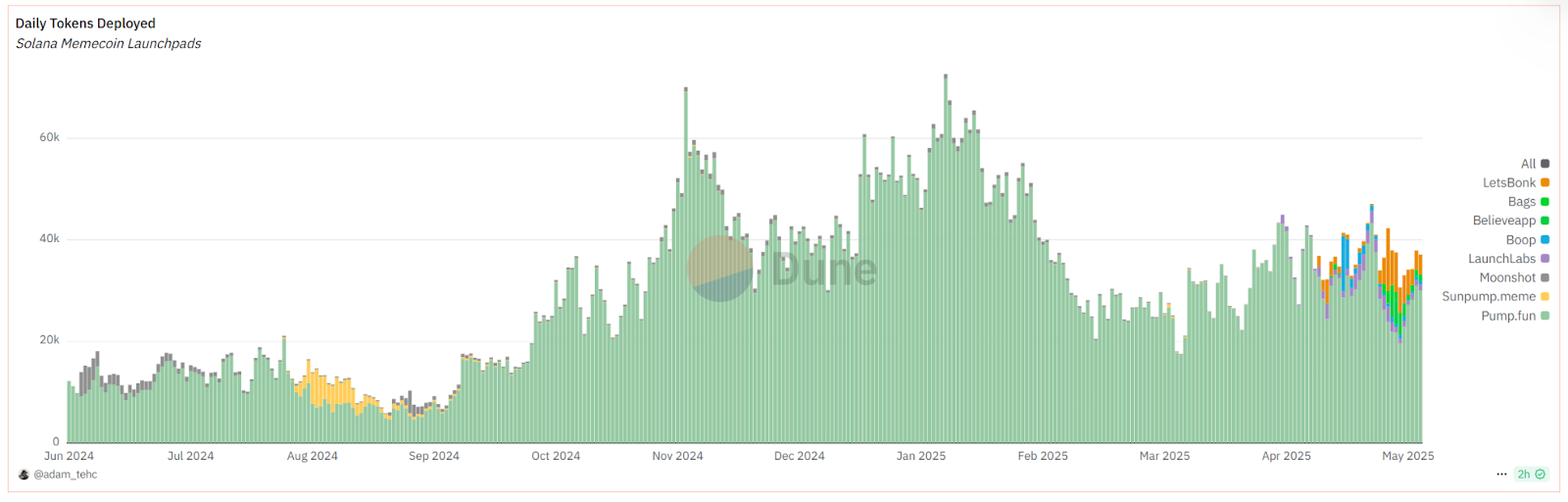
Source:https://dune.com/adam_tehc/memecoin-wars
-
Token Volume and Trends: Daily token issuance on Solana began rising mid-2024, peaking in October when nearly all tokens came from Pump.fun—over 36,000 new tokens in a single day, averaging 25 new tokens per minute. Although overall issuance remains high, it has shown a volatile downward trend, cooling notably by early 2025. This suggests the initial explosive phase is ending and the market is regaining rationality. Yet even cooled down, thousands to tens of thousands of new tokens are still created daily, showing the long-tail resilience of these platforms.
-
User Profile and Distribution: From user data across platforms, Pump.fun’s early adopters were mainly speculative members of Solana’s native community chasing 100x or 1000x returns; LaunchLab, backed by Raydium, attracted a wave of returning DeFi veterans, with daily active users steadily increasing post-launch; Believe, due to its social media-based issuance, drew many Web2 entrepreneurs and KOLs, creating a user base skewed toward creators and influencers; Boop.fun centers around the NFT player community.
-
Token Market Cap Trends: Observing representative tokens born on these platforms reveals most meme coins follow a rapid boom-bust cycle: many surge tenfold or even hundredfold upon listing, only to crash back to zero within days. 99% of meme coins are short-term hype; long-lasting “survivor coins” are extremely rare.
-
On-Chain Gas and Trading Activity: The one-click issuance boom significantly impacted underlying public chains’ transaction volumes and fees. During the 2024–2025 meme coin craze, Solana frequently suffered network congestion due to massive influxes of small transactions straining block capacity. In early 2025, Solana’s weekly fee revenue hit a record high of $55 million. As activity slowed on Pump.fun and others, this figure sharply declined, indicating a significant portion of Solana’s network activity was driven by meme coin trading.
2. Industry Landscape: One Dominant Player, Multiple Challengers
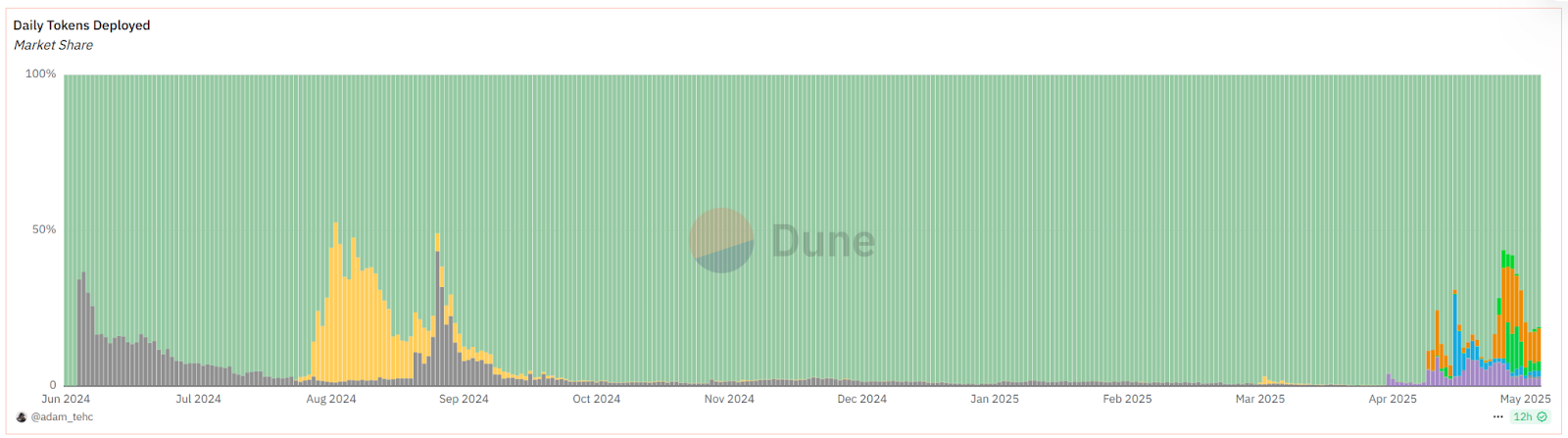
Source:https://dune.com/adam_tehc/memecoin-wars
According to Dune data, Pump.fun once held nearly 100% of Solana’s daily new token issuance share. Moonshot and SunPump briefly flourished in 2024 but gradually faded. After April 2025, competitors surged—by May 12, Pump.fun’s daily issuance share dropped to as low as ~57%. As of May 21, Pump.fun still dominated with ~80% share, while LetsBonk, Believe, LaunchLab, and Boop captured the remaining ~20%, forming a landscape of one dominant leader and multiple strong challengers:
-
Monopoly Broken, Competition Intensified: Pump.fun long reigned supreme, but its market share is now being diluted. Emerging platforms like LetsBonk, LaunchLab, and Believe are carving out market segments, spawning new projects constantly. The monopoly is broken—this marks the sector’s maturation. With more choices, users and creators “vote with their feet,” choosing platforms offering better returns and experiences.
-
New Heights in Competitive Innovation: To win, platforms continuously innovate with distinct features. On the functional side: some enable cross-chain issuance, integrate NFT elements for added gameplay, or use oracles for complex issuance curves. On incentives: LaunchLab attracts Pump.fun users with lower fees and creator dividends; Believe draws creatives with frictionless social issuance and Scout rewards; Pump.fun, forced to respond, has shifted from its dominant stance to sharing profits with creators to prevent user loss.
-
Multi-Chain Expansion and Ecosystem Battles: Initially concentrated on Solana, one-click issuance is now multi-chain by default. SunPump emerged on Tron, Genesis Launches on Base, and even ICP and Avalanche ecosystems are testing similar projects. Major public chains now see these platforms as key tools to capture active users and boost on-chain volume—meme coin issuance is easier than serious DeFi apps to attract newcomers and drives higher transaction frequency, rapidly boosting chain activity.
-
Narrative and Culture Wars: Platform culture and community storytelling are becoming soft competitive advantages. Each platform builds a unique brand identity: Pump.fun champions absolute openness and freedom; Raydium LaunchLab emphasizes fairness and technology; Boop.fun carries the personal idol aura of founder Dingaling; Believe promotes trust and value, targeting builders. Differentiation will extend beyond fees and mechanics to core values and community atmosphere.
4. Major Platform Comparison and Case Studies
As meme and AI Agent concepts heat up, various one-click launch platforms have emerged, creating a landscape of one dominant player and several strong rivals. Key players include: Pump.fun, Raydium LaunchLab, LetsBonk.fun, Believe, and Boop.fun.
1. Pump.fun
As the pioneering platform, Pump.fun established the one-click issuance + bonding curve paradigm, attracting massive users via Solana’s low fees. Its hallmark is zero门槛, no review—anyone can instantly issue and trade tokens. Pump.fun operates a two-stage “internal market” and “external market”: new tokens first trade in-platform via AMM pools; once market cap hits ~$69,000, they graduate to external DEXs—initially Raydium, later switched to its own PumpSwap. The platform charges a 2% trading fee. To prevent rug pulls, Pump.fun secures liquidity via LP locking and burning.
Pump.fun dominated the market in 2024, once accounting for >98% of daily token issuance. At its peak on October 24, 2024, over 36,000 tokens were created in a single day—25 new tokens per minute. This staggering “production rate” led some to joke Solana had become the largest on-chain “casino.” Yet beneath Pump.fun’s success lurk deep concerns: most projects are low quality, with less than 1% graduating successfully. The vast majority of tokens are flash-in-the-pan, quickly crashing to zero. The pattern of “platform profits, users lose” is stark.
2. LaunchLab
LaunchLab is a one-click issuance platform launched in March 2025 by Raydium, a veteran Solana DEX. Raydium once earned ~41% of its swap fee revenue from liquidity brought by Pump.fun, but saw income plummet after PumpSwap launched. Thus, LaunchLab’s debut was seen as Raydium’s counterattack. LaunchLab closely mirrors Pump.fun’s model—one-click issuance via DApp + bonding curve pricing + AMM trading—but introduces targeted optimizations:
-
More Pricing Curves: Supports linear, exponential, logarithmic, and other curve models, letting projects choose based on token nature—greater flexibility.
-
Lower Fees: Trading fee is only 1%, half of Pump.fun’s; no additional migration fees. Pump.fun charges 6 SOL to migrate graduated tokens to Raydium.
-
Lower Graduation Threshold: Requires raising 85 SOL (~$11,000) to move to Raydium’s external pool—easier to achieve than Pump.fun’s fixed market cap threshold. LaunchLab also supports a minimum launch mode of 30 SOL, further lowering barriers.
-
Creator Revenue Share: Introduces a 10% fee-sharing mechanism—after graduation, project founders can continuously earn 10% of their token’s trading fees, improving creator retention.
-
Ecosystem Integration: 25% of fees are used to repurchase Raydium’s platform token RAY, and features like LP lockups and quote diversity tie platform incentives directly to the Raydium ecosystem.
LaunchLab benefits from Raydium’s brand reputation and deep liquidity pools, successfully attracting projects away from Pump.fun and weakening its dominance. On-chain data shows LaunchLab’s daily active users growing rapidly. Currently, 14 launch platforms are built on LaunchLab, collectively capturing ~10% of Solana’s daily token issuance.
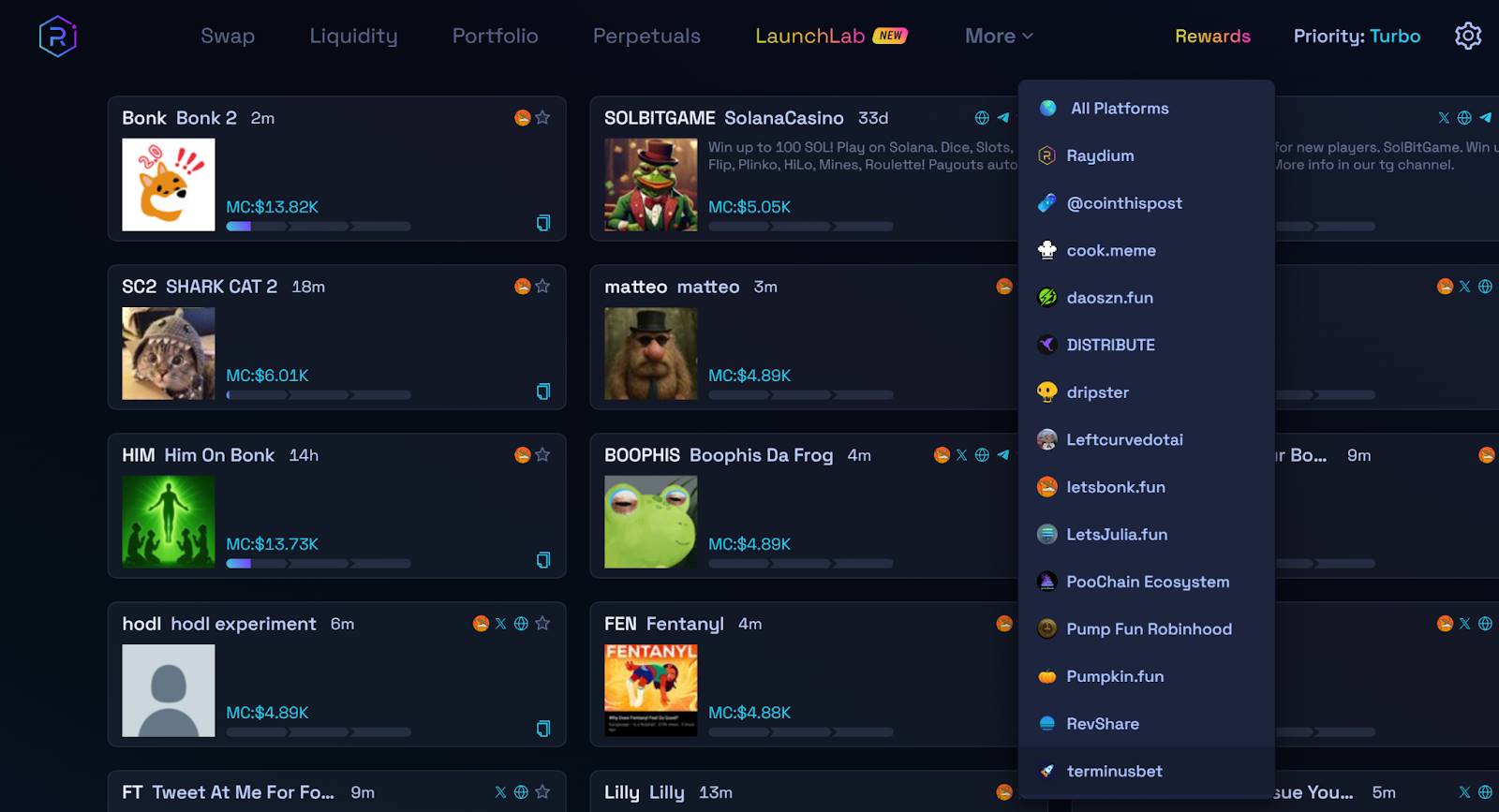
Source:https://raydium.io/launchpad/
3. LetsBonk.fun
LetsBonk.fun is a one-click issuance platform built by the BONK community—the popular Solana meme coin—using Raydium LaunchLab’s technical framework, serving BONK-related communities and derivative projects. The issuance process and rules mirror LaunchLab’s—default 85 SOL graduation, 1% fee, etc.—but the interface and community focus reflect Bonk’s branding.
LetsBonk.fun launched with great fanfare, briefly capturing ~17–20% of daily issuance share and even surpassing Pump.fun in daily graduations during certain periods. Seen as a community-powered challenge to giants: BONK, a community-driven meme coin on Solana, leveraged its influence to build its own launchpad, forming a “pack attack” on Pump.fun.
LetsBonk.fun’s popularity highlights the value of well-known meme coin IPs in platform competition—they bring built-in traffic and user bases, giving platforms instant visibility. However, its sustainability remains to be seen; currently, it appears more as a strategic extension of LaunchLab.
4. Believe
Believe was founded by Australian entrepreneur Ben Pasternak. It evolved from Clout, a social token app. Clout faded due to over-reliance on celebrity endorsements, but Ben returned in late April 2025 with the upgraded Believe, shifting its slogan from “Believe in Someone” to “Believe in Something”—moving away from celebrity hype toward meaningful creative projects.
In issuance method, Believe innovates by using social platforms as the entry point. Users don’t need to log into any DApp—just tweet at @launchcoin on X with the desired token name, and Believe’s system automatically detects the command, triggering an on-chain contract via Meteora’s bonding curve model to create the token.

Source:https://x.com/launchcoin/
Believe also introduced a crowdfunding-like “B-point” mechanism: each token accumulates trading fees post-issuance. If it reaches a platform-defined threshold (the B-point), the founder can withdraw those funds to fund their roadmap; if not, the funds remain in the pool or go to the platform. Similar to Kickstarter’s all-or-nothing model, but the B-point is dynamically determined based on project traction—the core idea being “trading热度 equals market vote.” In revenue distribution, Believe returns half of its 2% trading tax—one percent to creators and 0.1% to Scouts. This incentivizes community participation in discovering quality content. Since launch, Believe has recorded $1.8 billion in total trading volume, generating ~$9.5 million in direct income for creators.
Believe faces some controversy. Founder Ben’s own token, LaunchCoin, surged 200x on launch day. He then sold most of his holdings in batches, earning ~$1.3 million, sparking community debate over whether he “exploited trust for profit.” Additionally, Believe initially imposed high slippage taxes to prevent dumping, which bots exploited by accumulating cheap tokens during high-tax periods, then dumping en masse when taxes decreased—causing many tokens to crash from multi-million dollar market caps. Some joked, “Founders, Scouts, and the platform all win—but retail holders get wrecked.”
5. Boop.fun
Boop.fun is a Solana-based issuance platform launched by renowned NFT collector Dingaling, carrying a strong personal brand. Its model resembles Pump.fun—bonding curve + Raydium LP—but adds native token economics: 5% of each new token issued via Boop.fun goes as a “developer tax” to holders of Boop’s native token $BOOP, reflecting the platform’s intent to build value feedback into its ecosystem.
Leveraging Dingaling’s community influence, Boop.fun attracted a loyal following of niche projects post-launch, though its scale remains smaller than major rivals. Currently, it holds ~1–2% of daily issuance share, with a slightly higher graduation rate than Pump.fun.

Source:https://dune.com/adam_tehc/memecoin-wars
Boop.fun differentiates itself through tight-knit community operations. Dingaling backs the platform with personal credibility, using the $BOOP token to unite users. However, this also limits scalability, positioning it more as a niche player.
5. Issues and Challenges: Hidden Risks Beneath the Boom
One-click launch platforms make “rapid coin creation” a reality—but amplify crypto’s speculative and fraudulent risks. Ultra-low barriers are a double-edged sword: they energize markets but also allow bubbles to grow unchecked.
-
Ultra-Low Barriers Lead to On-Chain Junk Overflow: Anyone can issue a token, flooding the market with countless valueless “air coins.” Less than 1% of tokens successfully graduate; the rest—99%—are pure speculation. This not only causes user losses but wastes on-chain resources, permanently recorded as “on-chain garbage.” Such massive worthless data burdens nodes and long-term blockchain operation. The low barrier is truly a double-edged sword: unleashing creativity, but also unleashing trash.
-
KOL Manipulation and Whales: With no vetting or background checks, anonymity enables bad actors. Some crypto KOLs or large holders exploit their influence to repeatedly launch and dump tokens on these platforms. Professional whales use bots to monitor all new issuances, piling in when capital flows spike to pump prices and lure retail investors before dumping instantly. Ordinary users, lacking informational advantage, struggle to profit.
-
Rug Pulls and Security Risks: While Pump.fun’s LP lock reduces developer exit scams, “rug pulls” persist in new forms. Some teams don’t drain pools directly but hoard large token amounts to cash out at peaks, or exploit contract loopholes/backdoors. Malicious developers may add hidden transfer functions to standard templates, stealthily stealing users’ tokens when prices rise. Impersonating well-known projects to gain attention or tricking users into buying via fake websites through social engineering are common. Amid frenzy and greed, vigilance drops, making users easy targets.
-
Regulatory Gray Zone: Legally, one-click launch platforms effectively operate unregulated ICO markets. Due to their decentralized and anonymous nature, they haven’t yet been direct regulatory targets. But if widespread user losses spark public outcry, platform operators could face liability. Regulatory crackdowns could follow. For users, legal recourse remains difficult.
6. Future Outlook: Sustainability and Evolution of One-Click Launch Platforms
Looking ahead, can this one-click launch platform sector sustainably develop? Where is it headed next? We can explore this through market, technology, and narrative lenses:
1. Market Sustainability: Return to Project Value
After nearly a year of explosive growth, the meme coin issuance frenzy has clearly cooled—“get-rich-quick” effects are no longer replicable at scale. After this shakeout, a few stable platforms may emerge, continuing to serve new projects. From a revenue perspective, Pump.fun’s early “extractive” profit model is unsustainable. New platforms are exploring healthier, win-win alternatives—guiding creators to improve quality, supporting promising projects, and weeding out pure scam tokens.
2. Evolution Path: From Meme Hype to Empowering Innovation
At its core, a one-click launch platform combines on-chain issuance with liquidity provisioning. Future evolution may take several directions:
-
Cross-chain interoperability and layered abstraction, letting users issue and trade without noticing underlying chain differences;
-
Integration of advanced smart contract features—options, DAO governance modules—so new tokens launch with richer functionality;
-
Integration with identity and content systems—automatically generating NFT badges for first-time creators or binding decentralized social identities, turning tokens into reputation proofs.
These tech upgrades represent a vision: future launchpads won’t just be speculative tools, but Web3 innovation incubators. If this narrative succeeds in winning trust from mainstream developers and entrepreneurs, one-click platforms will undergo a qualitative leap.
3. A New Paradigm for Web3 Startups: Cold-Start Infrastructure
A developer or creator with a new Web3 idea once needed a whitepaper, fundraising, and a team to build an MVP. Now, they can directly issue a token on a launch platform, packaging their idea as a story and testing community interest through market trading. If the token gains traction, they secure initial funding to hire a team and build the product. The community, holding tokens, naturally becomes early users and promoters. This represents a radical new startup paradigm—bypassing VCs and crowdfunding sites, letting open markets discover and fund good ideas. This will attract more serious entrepreneurs to try this path, transforming launch platforms from mere “token tools” into “cold-start infrastructure” for Web3 startups, becoming integral to the Web3 entrepreneurial ecosystem.
4. Compliance and Governance: Finding the Balance
For one-click launch platforms to endure, they must find balance between complete chaos and excessive control. Possible paths include: community self-regulation + protocol governance—platforms establishing community guidelines and DAO governance to vote on delisting or flagging clearly fraudulent or illegal projects; introducing optional KYC/real-name channels so willing founders can verify identity for greater trust, combined with AML monitoring baselines. Technically, enhanced security audits and real-time anomaly detection can also reduce malicious incidents.
Conclusion: One-click launch platforms have evolved from Pump.fun’s solo dominance and chaotic growth to today’s landscape of one dominant leader and multiple strong challengers—a testament to the astonishing power of decentralized creativity in crypto. These platforms have democratized financial experimentation, giving countless wild ideas a chance to shine on-chain through tokenization. The future winners won’t necessarily be the lowest-fee platforms, but those that build content flywheels, community consensus, and trust mechanisms—becoming fertile ground for innovation. When every good idea can freely test itself as a token, perhaps that’s the infinitely possible future Web3 truly seeks.
About Us
Hotcoin Research, the core investment research hub of the Hotcoin ecosystem, is dedicated to providing global cryptocurrency investors with professional, in-depth analysis and forward-looking insights. We offer a three-in-one service system of “trend analysis + value discovery + real-time tracking,” delivering precise market interpretations and practical strategies through deep dives into industry trends, multi-dimensional assessments of high-potential projects, and round-the-clock market volatility monitoring. With our bi-weekly “Top Coin Selection” strategy livestreams and daily “Blockchain Headlines” briefings, we cater to investors at all levels. Leveraging cutting-edge data analytics models and extensive industry networks, we continuously empower novice investors to build cognitive frameworks and help institutional clients capture alpha returns, jointly seizing value growth opportunities in the Web3 era.
Join TechFlow official community to stay tuned
Telegram:https://t.me/TechFlowDaily
X (Twitter):https://x.com/TechFlowPost
X (Twitter) EN:https://x.com/BlockFlow_News
 @HotcoinAcademy