Is Ethereum's rebound a flash in the pan?
TechFlow Selected TechFlow Selected
Is Ethereum's rebound a flash in the pan?
Ethereum has been declining for several months, recently rose—can the upgrade reverse the downtrend?
 Navigating Web3 tides with focused insights
Author: Isaac Olatunji
Translation: Baihua Blockchain
Unless completely isolated from the world, hardly any cryptocurrency enthusiast could have missed Ethereum's decline over the past few months. Price trends, market dominance, and community sentiment—pick any metric, all are at historic lows! This top-tier cryptocurrency appears to be sliding sharply—and this cycle hasn't even seen a new all-time high. However, in recent days, Ethereum seems to be rebounding. Why has it underperformed for months on end? Can this current momentum drive a recovery?
Ethereum's Struggles
There's no doubt that Ethereum is struggling. Since December 2024, whenever shifts in market sentiment caused broad declines across the crypto market, only Bitcoin managed to rebound to previous levels and break higher, while Ethereum fell and nearly failed to return to its starting point.
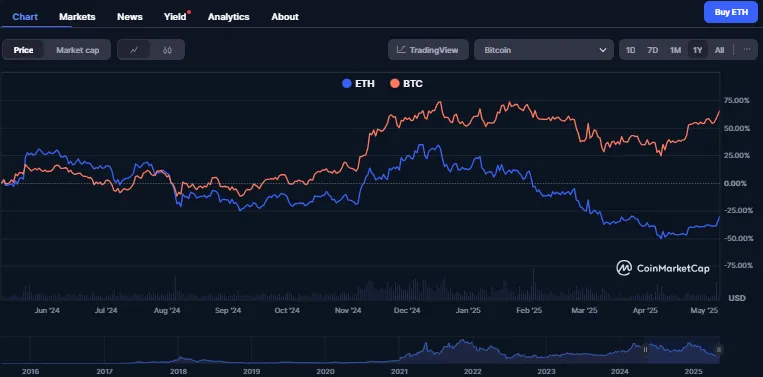
Here’s a look at Ethereum’s performance over recent months. In November 2024, during a bullish phase, Bitcoin was priced around $96,405 and Ethereum at $3,703. On December 1, 2024, the market dipped slightly—Bitcoin dropped to $93,557 and Ethereum to $3,337. Although both top cryptocurrencies later reached significant price points that month, they failed to sustain the gains and declined again.
About a month later, on January 1, 2025, Bitcoin stood at $94,500—slightly above the prior month—while Ethereum slipped further to $3,298. By February 1, price data showed Bitcoin falling sharply to $84,381 and Ethereum dropping to $2,236. Later that month, Bitcoin surged to $102,000, but Ethereum failed to rebound to its earlier highs. In fact, as Bitcoin recovered from $84,381 in February to $94,304 in April, Ethereum continued to slide, unable to retest its previous peaks. Indeed, the BTC/ETH ratio has expanded, as shown in the chart data below.
Source: CoinMarketCap
At the time of writing, Ethereum trades around $2,400—a solid gain considering its recent performance. Yet it hasn’t broken into higher price ranges. What exactly is wrong with Ethereum’s market? Let’s examine several key factors.
Bitcoin and Meme Coins Steal the Spotlight
In recent months, Bitcoin and meme coins have dominated the spotlight. You may have heard news about the U.S. government planning to establish a Bitcoin reserve. This initiative has been widely discussed among retail and institutional investors, with many U.S. states moving to build strategic Bitcoin reserves. Texas and New Hampshire have made progress in this area, as have other U.S. states and some foreign countries.
Sovereign interest has further drawn attention from whales and institutional investors. Recently, Michael Saylor announced that Strategy (formerly MicroStrategy) purchased additional Bitcoin to reinforce its position as the publicly traded company holding the most Bitcoin. Out of the total 21 million Bitcoin supply, Strategy now holds over 555,000 BTC.
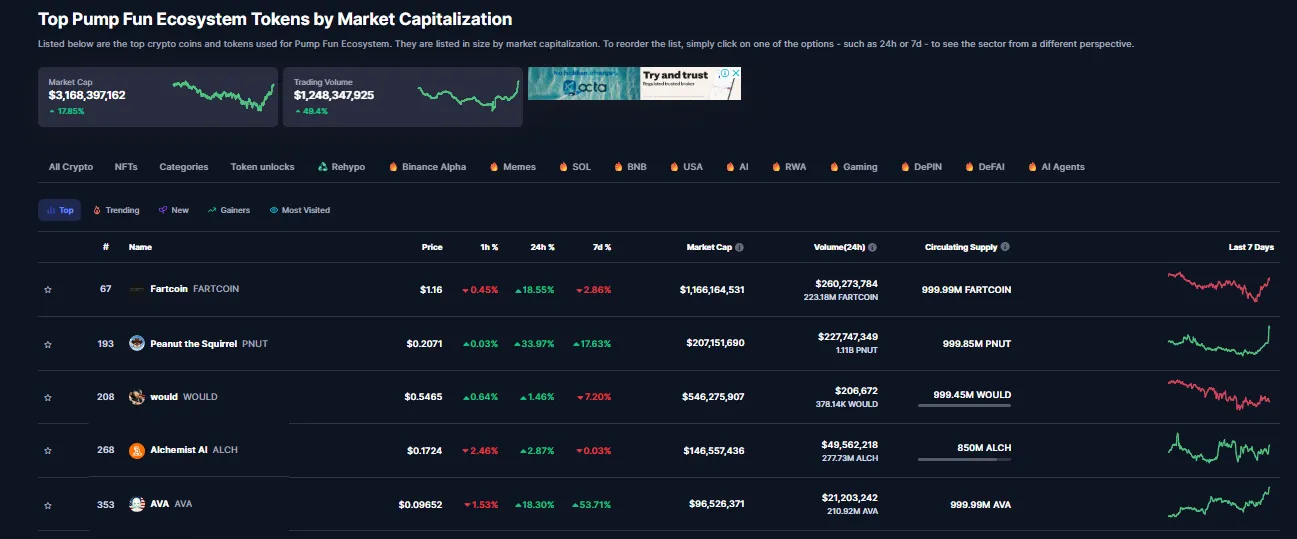
While Bitcoin has taken center stage and overshadowed Ethereum, meme coins have done the same. Unfortunately, these meme coins aren’t launching on Ethereum. One of the most successful meme coins in 2025, Fartcoin—with a market cap exceeding $1 billion—launched on Solana. The popular meme coin launch platform PumpFun also operates on Solana. You might not have noticed, but most of the hottest meme tokens created in late 2024 and early 2025 originated from PumpFun.
Source: CoinMarketCap
Clearly, Ethereum has missed out on this wave of excitement. Additionally, discussions around decentralized finance (DeFi) have significantly diminished due to a lack of major innovation. Overall, Ethereum isn’t at the center of any major trend—nothing is driving its price upward.
Liquidity Flowing to Subnetworks
High gas fees have long been a major obstacle to Ethereum’s growth. Worse still, the Ethereum network is flooded with Layer-2 networks such as Polygon, Optimism, Base, Linea, and Arbitrum. These Layer-2 solutions compete with Ethereum for liquidity. With USDC available across them, these networks can operate with minimal ETH requirements. Not to mention the wide range of activities possible on these Layer-2 platforms, reducing transaction volume on Ethereum’s mainnet. Therefore, despite high on-chain activity, demand for ETH hasn’t increased as expected.
Competing Networks
We’ve already touched on how competitors like Solana are eroding Ethereum’s market dominance. The truth is, Solana offers developers and users a better experience. Who wouldn’t want a faster, cheaper, and more capable blockchain? According to CoinGecko’s report on Solana, ongoing activity on the Solana chain reveals why it continues attracting more developers and retail investors. Here are some standout reasons:
Higher performance and scalability: Solana can process up to 3,000 transactions per second, with theoretical capacity reaching 65,000 TPS. In contrast, Ethereum’s 15 TPS capability simply cannot compete. Given Solana’s extremely low cost for processing large volumes of transactions, the reason developers favor it is clear. Active and supportive ecosystem: The Solana ecosystem provides developers with abundant resources and tools, accelerating its growth. Developer toolkits and funding opportunities allow new projects to emerge seamlessly. Similarly, Avalanche is growing in popularity and capability. Institutional adoption of these Layer-1 platforms will further weaken Ethereum’s dominance. Hyperliquid and Tron have made strides in perpetual futures trading and stablecoin markets, respectively.
Limited Institutional Interest
While global corporations, market heavyweights, and nations continue accumulating Bitcoin, Ethereum’s situation is starkly different. According to CoinGecko data, very few public companies hold Ethereum, with a total value of less than $500 million—compared to over $50 billion for Bitcoin.
The crypto ETF market shows a huge gap in demand between Bitcoin and Ethereum, with the latter failing to match the former’s strong inflows. ETF flow data indicates that Bitcoin, thanks to its first-mover advantage and widely accepted store-of-value function, has attracted substantial investments from large players. While Ethereum’s spot ETFs have recorded billions in inflows, those figures still lag far behind Bitcoin’s.
Ethereum’s Hope: Will It Make a Comeback?
Ethereum needs a wake-up call to reclaim market leadership, attract broad investment, and achieve a surge in value. At the time of writing, Ethereum has just activated an upgrade. This is a welcome development, but it doesn’t resolve the challenges of asset and data bridging within Ethereum’s Layer-2 ecosystem. Competitors like Solana still hold an edge, allowing users to switch seamlessly across multiple decentralized applications (DApps). Nonetheless, this upgrade appears to have positively impacted Ethereum’s price, rising 20% in the past 24 hours to $2,400. Will this top alt token make a comeback this time? We’ll need to wait and see how much improvement this recent upgrade brings to the Ethereum chain, and whether it’s enough to get ETH back on track!
Join TechFlow official community to stay tuned
Telegram:https://t.me/TechFlowDaily
X (Twitter):https://x.com/TechFlowPost
X (Twitter) EN:https://x.com/BlockFlow_News
 @thecapital_io