








Mango Network Multi-VM Ecosystem Expansion - Support for Solana VM: Architectural Complementarity and Technical Implementation
TechFlow Selected TechFlow Selected
Mango Network Multi-VM Ecosystem Expansion - Support for Solana VM: Architectural Complementarity and Technical Implementation
Mango Network skillfully integrates cutting-edge technologies such as Move, OPStack, and ZK Rollup, incorporating MoveVM, EVM, and SVM into its compatibility framework.
 Navigating Web3 tides with focused insights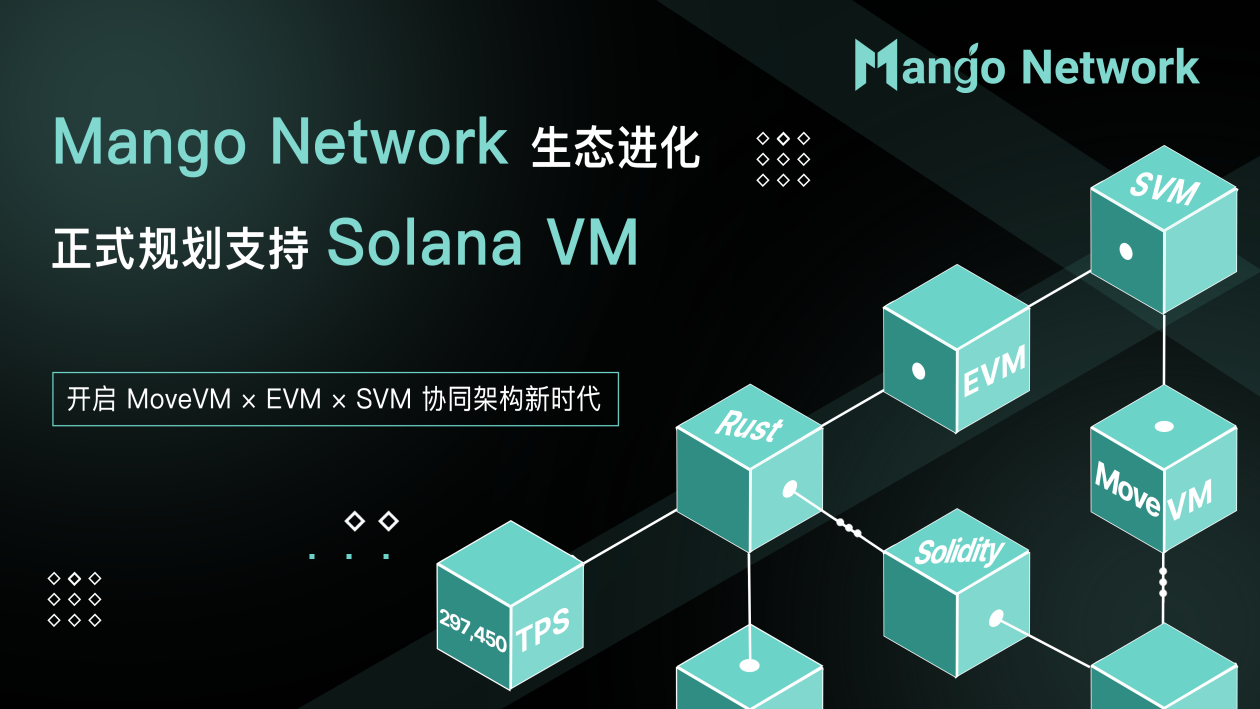
As blockchain technology rapidly advances, the fragmentation of liquidity across different blockchain networks has become a bottleneck restricting further integration and development within the Web3 ecosystem.
Mango Network, as the first public chain infrastructure supporting a Multi-VM architecture, is poised to break through this challenge with its unique technological innovation and integration.
1. Mango Network: Born from Integrated Technology
Mango Network skillfully integrates cutting-edge technologies such as Move, OPStack, and ZK Rollup, incorporating MoveVM, EVM, and SVM into its compatibility framework. MoveVM demonstrates outstanding advantages in asset protection and contract security thanks to its unique resource-oriented design; EVM is currently the most mature virtual machine environment with the largest developer ecosystem; while SVM (Solana VM) is renowned for its exceptional performance and high throughput. By successfully integrating these three major virtual machines, Mango Network enables smart contracts of different backgrounds and functional orientations to coexist and collaborate within the same ecosystem, creating a diverse, open, and highly dynamic blockchain platform for developers and users. Developers can write applications using Move, Solidity, and Rust, greatly expanding development options.
2. Core Architecture: The Ingenious Design of Multi-VM Interoperability
(1) Shared State Management and Unified Account Model
One of the core components of Mango Network is its shared state management system. In traditional multi-chain or Multi-VM architectures, different virtual machines typically maintain independent states, making cross-VM interactions extremely complex. However, in Mango Network, MoveVM, EVM, and SVM can jointly access and modify the same underlying state without requiring additional cross-VM messaging mechanisms, significantly simplifying the development process.
At the same time, Mango Network adopts a unified account model. Whether users are interacting with contracts on MoveVM or performing operations on EVM or SVM, they use the same account system. Accounts can seamlessly interact with various types of contracts such as Move, Rust, and Solidity contracts, with the underlying protocol automatically handling the corresponding translation layer.
(2) Perfect Integration of Cross-VM Calls and Asset Standardization
Cross-VM calling is one of the key capabilities enabling deep integration among multiple virtual machines in Mango Network. Within this network, smart contracts can directly call across virtual machine boundaries. For example, a smart contract written on SVM can seamlessly invoke functions in MoveVM, and vice versa. This cross-VM calling mechanism breaks down barriers between virtual machines, allowing functional modules from different VM environments to be combined and work collaboratively, greatly enhancing the composability and scalability of the entire system.
Mango Network also achieves standardization in asset handling. Digital assets are presented in a standardized format, enabling native operations across multiple VM environments—whether assets originate from MoveVM, EVM, or SVM—without requiring additional wrapping or bridging steps. This not only facilitates cross-VM asset circulation but also reduces the cost and risk for users transferring assets between different VM environments.
(3) Innovative Fusion in the Validation Layer
The validator layer design of Mango Network cleverly combines SVM's execution model with Move's verification capabilities. SVM's execution model handles the logic and operational flow of contracts, while Move's validation mechanism verifies critical resource operations and data security, ensuring that the entire contract execution process is both efficient and secure.
3. Performance: A Remarkable Achievement of 297,450 TPS
Mango Network achieves an exceptionally high transaction processing speed of up to 297,450 transactions per second (TPS). This outstanding performance stems from its unique modular architectural design. Mango Network decomposes core blockchain functionalities into independent modules, allowing each module to be specifically optimized and scaled according to the requirements of different application scenarios.
The execution module deeply optimizes the smart contract execution process, reducing unnecessary resource consumption and computational steps, enabling contracts to run at extremely high efficiency. The consensus module employs advanced consensus algorithms that ensure transaction consistency while rapidly achieving agreement, significantly shortening transaction confirmation times. The data availability module ensures the completeness and reliability of transaction data by adopting an efficient data storage and distribution mechanism.
4. Cross-Chain Communication: ZK Rollup Support for SVM Deployment
Mango Network supports SVM deployment via ZK Rollup technology, enabling cross-chain bridging with Solana.
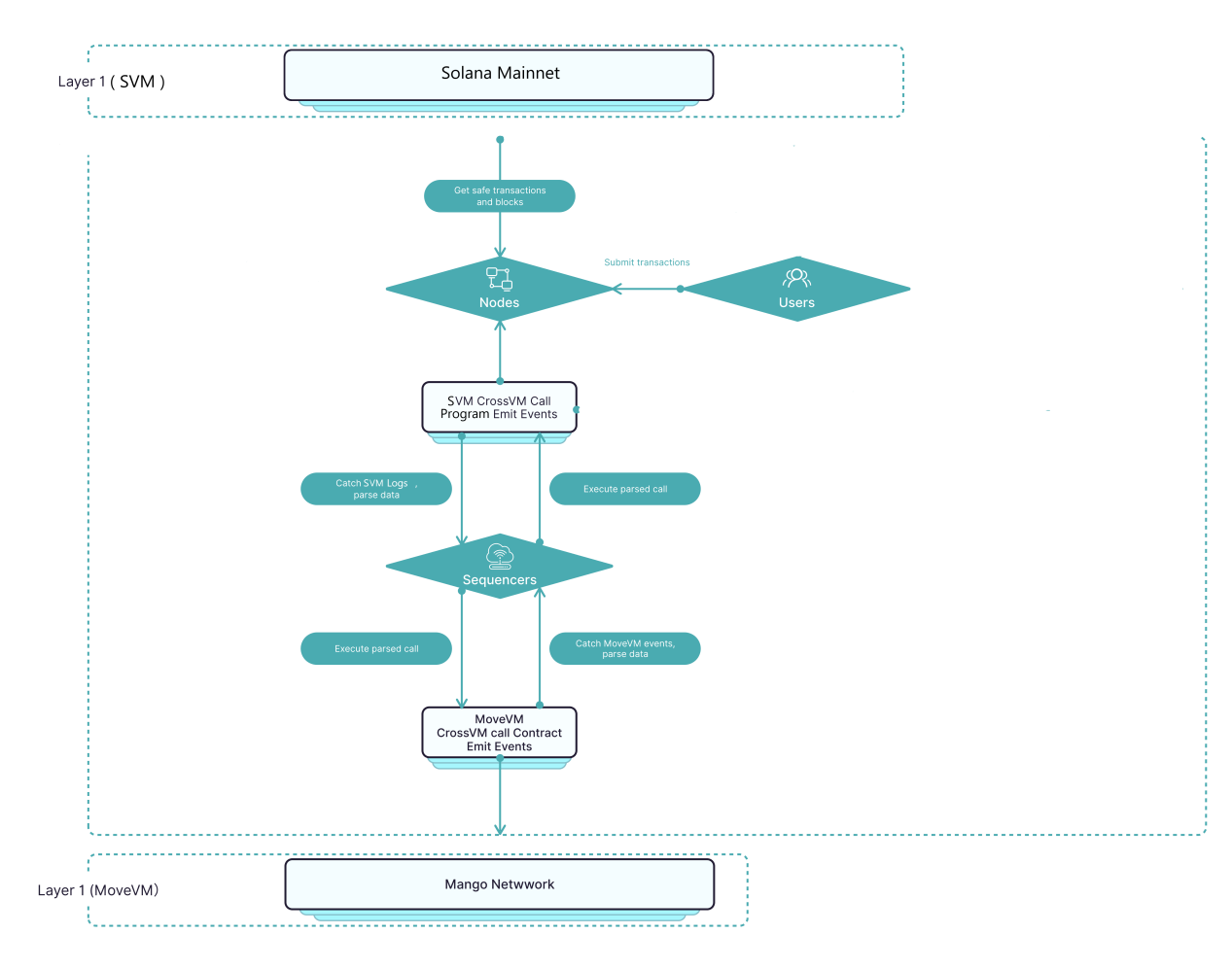
The specific process is as follows:
1. Interaction between Solana Mainnet and Nodes: The Solana mainnet generates secure transactions and blocks, and users submit transactions to nodes.
2. Collaboration between Nodes and the Sequencer: After nodes obtain secure transactions and blocks, the SVM Cross-VM Call Program emits events, meaning the cross-VM calling program sends out events. These events are captured, their data parsed, and then transmitted to the sequencer.
3. Execution and Feedback by the Sequencer: The sequencer executes the parsed calls, simultaneously captures MoveVM events, parses the data, and feeds it back to the MoveVM Cross-VM Call Contract to emit events. Ultimately, these events and data flow into Mango Network.
Through this method, DApps on Solana can be directly deployed onto Mango Network based on ZK Rollup, enabling cross-chain interaction.
Mango Network is exploring adding support for the Solana Virtual Machine (SVM) within its Multi-VM architecture. This initiative aims to further enrich Mango’s existing MoveVM and EVM environments by introducing Solana’s high-performance execution environment, building a more diversified, modular, and mutually complementary virtual machine ecosystem.
1. Complementarity in the Multi-VM Architecture
Solana VM features industry-leading parallel processing capability and high throughput. Its Sealevel parallel engine can execute tens of thousands of transactions simultaneously, complementing EVM’s sequential transaction processing model. Mango Network plans to integrate Solana VM into its existing Cross-VM Sequencer mechanism to achieve secure data synchronization and state consistency across different virtual machine environments.
With this expansion, SVM will provide Mango Network with powerful concurrent transaction processing capabilities, effectively improving performance in complex application scenarios, particularly demonstrating potential advantages in high-TPS-demanding contexts such as DeFi high-frequency trading and real-time interactive blockchain gaming.
2. Technical Integration and Research Direction
SVM’s parallel logic differs technically from Mango Network’s current MoveVM and EVM architectures. The team is exploring the design of an SVM adapter layer to resolve differences in execution models and data synchronization mechanisms while maintaining system modularity and scalability.
This adapter layer will build upon Mango’s existing Multi-VM cross-chain communication protocol, reserving expansion capabilities for future support of additional virtual machines (such as ZKVM, WASM, etc.), further enhancing Mango Network’s technical flexibility and forward-looking capabilities as a full-chain infrastructure.
3. Potential Ecosystem Synergy
The introduction of SVM opens new pathways for ecosystem collaboration within Mango Network. The Solana ecosystem hosts numerous high-performance DeFi and GameFi applications developed in Rust. In the future, these may achieve unified deployment and interoperability with MoveVM and EVM applications via Mango Network, lowering migration costs for multi-chain developers and boosting the inclusiveness and innovation capacity of the overall ecosystem.
In addition, supporting SVM will help Mango Network bridge connections with the Solana developer community, strengthening its strategic competitiveness in the fields of multi-chain interaction and asset liquidity.
Join TechFlow official community to stay tuned
Telegram:https://t.me/TechFlowDaily
X (Twitter):https://x.com/TechFlowPost
X (Twitter) EN:https://x.com/BlockFlow_News
 Mango Network


