








Token launch imminent: everything you need to know about IKA
TechFlow Selected TechFlow Selected
Token launch imminent: everything you need to know about IKA
Raised $21 million with a $600 million valuation—what's the principle behind IKA, the hottest project in the Sui ecosystem, and how can you participate?
 Navigating Web3 tides with focused insights
Author: Alex Liu, Foresight News
Funding Information and Pre-Market Pricing
On April 28, 2025, IKA announced a strategic investment from the Sui Foundation, bringing its total raised capital to over $21 million. Previously, IKA had raised more than 1.4 million SUI tokens through the launch of its THE MF SQUID MARKET NFT series on Sui, and received support from institutions including DCG, Big Brain Holdings, Blockchange, Node Capital, Amplify Partners, Liquid2 Ventures, and FalconX.
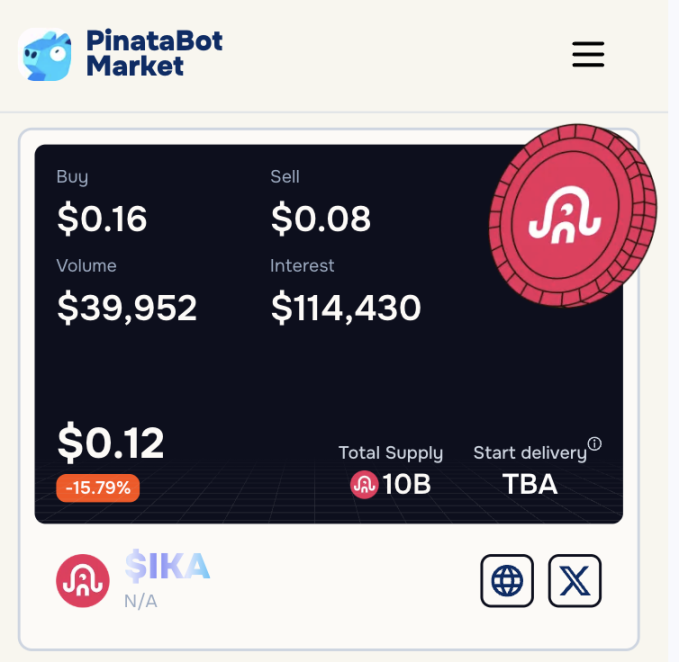
To date, the project’s highest valuation reached $600 million. On PinataBot Market, Sui’s pre-market OTC trading platform, the fully diluted market cap of token IKA has reached $1.2 billion (with low trading volume).
What is IKA, and why has it attracted such funding and valuation?
Project Background and Overview
IKA was formerly known as "dWallet Network" and will launch a parallel MPC (multi-party computation) network based on Sui. Under the slogan “We make every chain a Sui chain,” IKA addresses the core issue of cross-chain asset interoperability.
Traditional cross-chain asset transfers typically rely on bridge protocols and wrapped assets (e.g., wrapping BTC into an ERC-20 token for use on Ethereum or bringing USDC to Solana). However, this approach has fundamental flaws:
-
Non-native asset risk: Users hold only wrapped tokens instead of real BTC or ETH;
-
Bridge security risks: If the bridge protocol is compromised (e.g., the Ronin Bridge hack in 2022 that lost $624 million), users may lose all their assets;
-
De-pegging crisis: Wrapped tokens may lose price parity due to liquidity issues.
Applications built using IKA as the underlying protocol can avoid these cross-chain limitations. Taking BTC cross-chain lending as an example, the process works as follows:
-
Create a dWallet (explained in detail later) and bind a BTC address;
-
Initiate a loan request via smart contract;
-
BTC is locked on the Bitcoin blockchain (not wrapped);
-
Receive loan funds instantly on the Ethereum blockchain.
This enables:
Asset locking: BTC cannot be moved before repayment;
Automatic liquidation: If BTC price drops sharply or the loan is overdue, collateral is automatically liquidated;
Zero-trust security: The entire process is secured by the 2PC-MPC protocol, ensuring no one can misappropriate assets.
IKA is a B2B infrastructure protocol for interoperability. The above use case is just one application enabled by IKA. In reality, over ten projects (mostly from the Sui ecosystem or already partnered with Sui) have integrated IKA, covering four core scenarios:
-
DeFi Interoperability
Protocols like Full Sail use IKA to inject BTC/ETH liquidity in real time into DEXs on Sui, allowing users to directly stake and borrow using native BTC;
-
Institutional Custody
Aeon offers institutional investors a multi-sig asset management solution based on IKA, distributing private key shards across hundreds of global nodes to balance "self-custody vs compliance";
-
Chain Abstraction Experience
Covault leverages IKA + zkLogin to build a seamless cross-chain wallet, enabling users to directly operate Solana NFTs and Ethereum DeFi from Sui;
-
Bitcoin Financialization
The Native protocol builds a BTC options market on IKA, enabling the first programmatic yield strategies using native Bitcoin.
Another notable area is the convergence of AI and Web3: Teams like Atoma use IKA to set transaction firewalls for AI agents, ensuring automated investment decisions cannot exceed authority to transfer assets, providing a security foundation for the AI+DeFi market.
So how exactly does IKA achieve cross-chain asset interoperability to attract these applications?
Technical Principles
IKA's core technology consists of two main components—dWallet (decentralized wallet) and the 2PC-MPC (Two-Party Computation - Multi-Party Secure Computation) protocol—enabling users to directly use native assets like BTC and ETH across multiple chains without relying on wrapped tokens.
dWallet: The Cross-Chain "All-in-One" Wallet
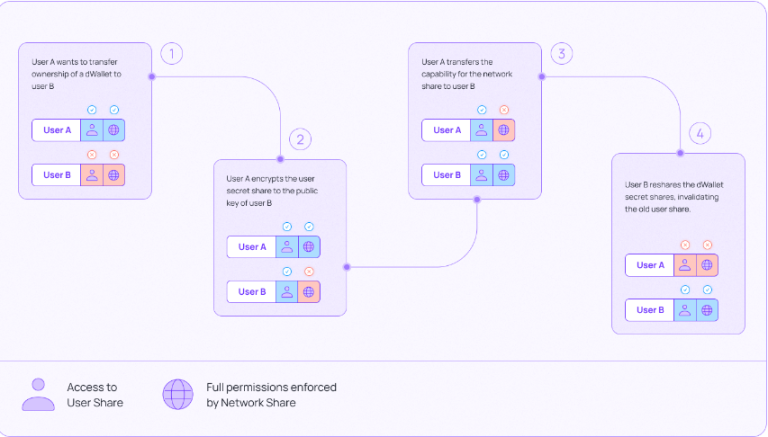
dWallets act as universal keys in the cross-chain world: users can manage multi-chain assets through a single interface. Each dWallet’s private key is split into multiple “key shares” stored across different nodes in the network. When a user initiates a cross-chain transaction, both the network nodes and the user contribute their respective key shares to the signing computation—without ever reconstructing the full private key. This ensures there is never a single point of private key exposure.
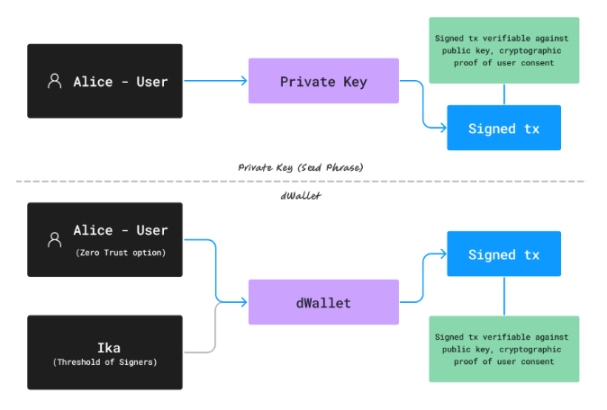
dWallets are programmable and transferable. Developers can define policies such as multi-signature requirements, spending limits, and conditional payments. DAOs can also seamlessly transfer governance wallets. Combined with Sui’s zkLogin functionality, users can log in to any chain using Google or Apple accounts, completely eliminating the burden of managing multiple wallets.
2PC-MPC Protocol: Sub-second Parallel Signing
IKA uses a proprietary 2PC-MPC scheme: First, the user and the network each generate an “encrypted key share” (Two-Party Computation), then hundreds to thousands of nodes perform the MPC signing process in parallel (Multi-Party Computation). Leveraging Sui’s Mysticeti consensus, signing nodes can scale horizontally to thousands, achieving throughput tens of thousands of times higher than existing MPC networks. Signing latency remains consistently sub-second, while maintaining high decentralization and censorship resistance.
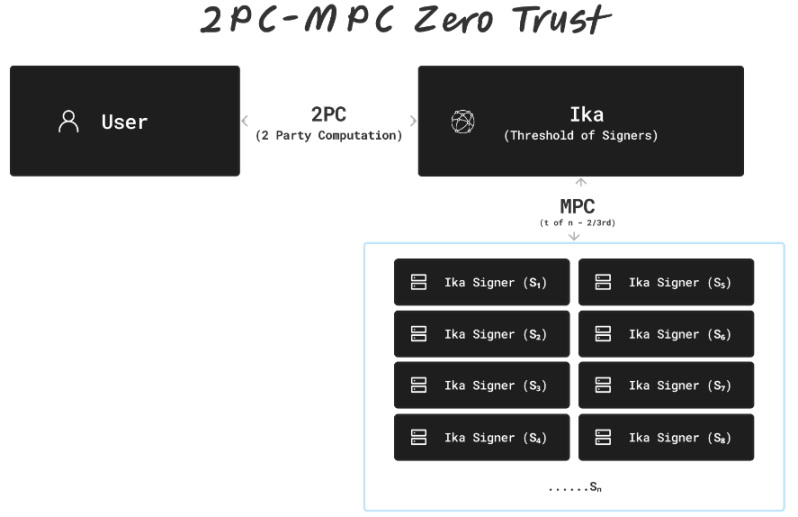
In short: The 2PC-MPC protocol solves the traditional MPC “security-efficiency” paradox.
Tokenomics
On May 8, IKA unveiled its initial token economics. The native token IKA (total supply of 10 billion) serves as the core economic engine of the network, with primary functions including:
-
Payment utility: Users pay IKA for network service fees, including creating dWallets, requesting signatures, and redistributing key shares.
-
Security incentives: Through a Delegated Proof-of-Stake (DPoS) mechanism, nodes compete for signing and consensus validation rights, earning rewards by staking IKA. Malicious or improper behavior results in slashing, ensuring network security.
-
Governance weight: IKA holders can vote on governance proposals, influencing protocol parameters, economic model adjustments, and community fund usage, enabling decentralized autonomy.
Token Distribution
IKA commits to allocating over 50% of tokens to the community. At mainnet launch, 6% (600 million tokens) will be distributed via the first round of community airdrops and incentives.
Other token distribution details will be disclosed closer to TGE, according to official statements.
Participating in the Airdrop
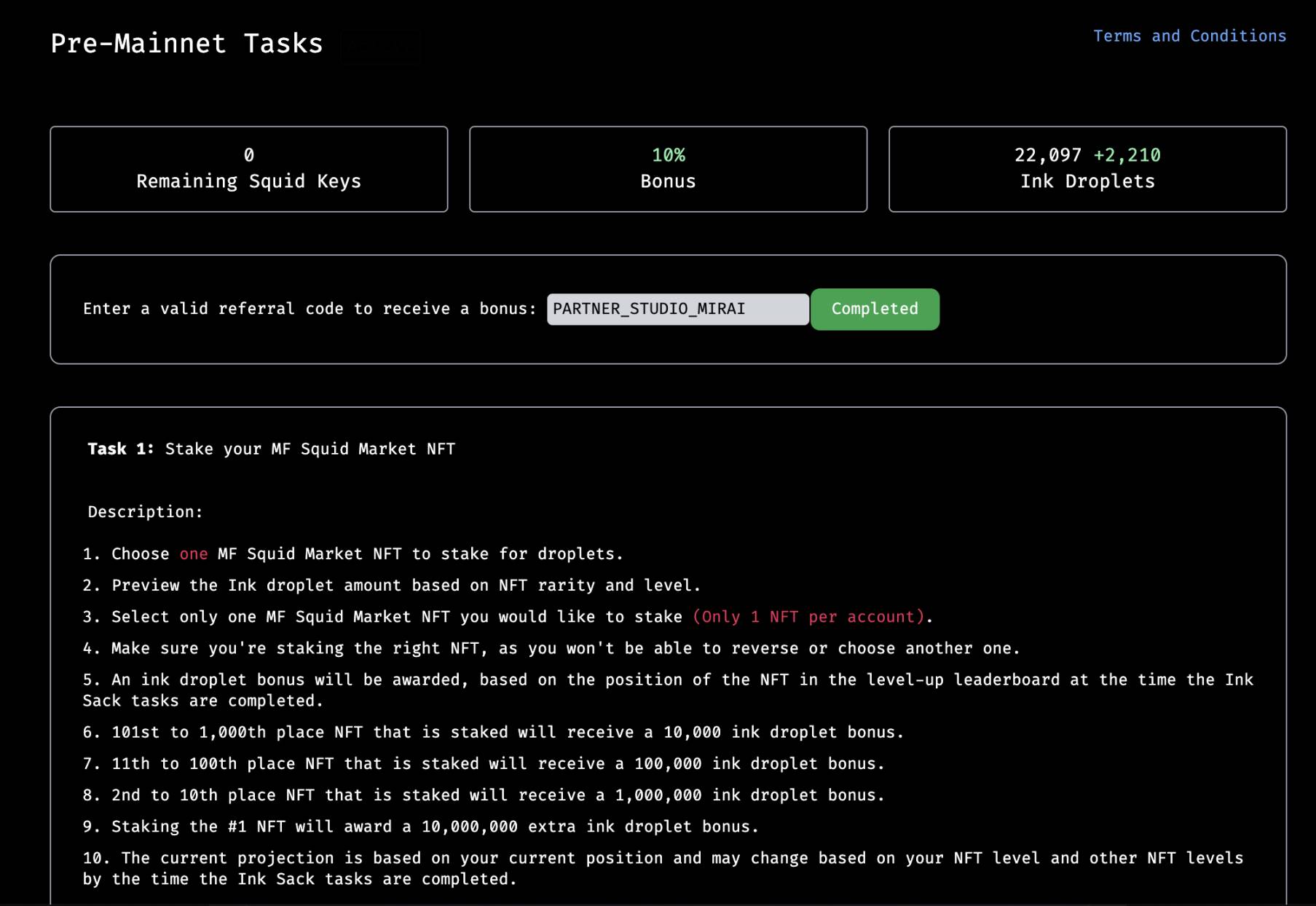
Currently, users can complete Pre-Mainnet tasks to earn droplets, which are highly likely to count toward future token airdrops.
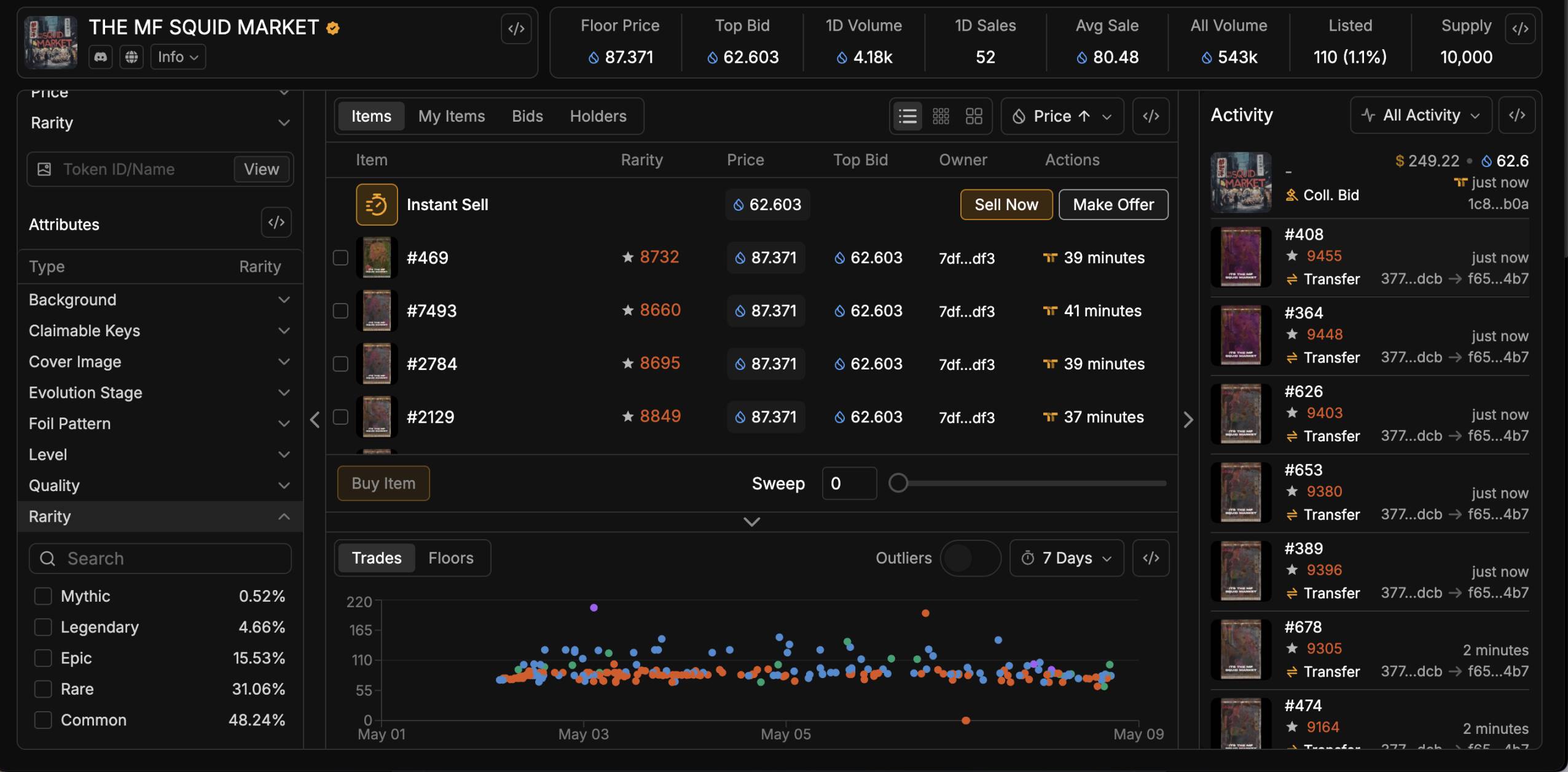
Many tasks require staking their · THE MF SQUID MARKET NFT series issued on Sui (current floor price: 87 SUI).
Note that the rarity and tier of the NFT determine the number of droplets earned, with detailed information available on the official page. Activities accessible to non-NFT holders include staking SUI as iSUI and locking it to earn droplets daily (NFT staking grants a one-time reward, not daily increases), generating a dWallet (displayed cost of 5 SUI, actual fee is only gas), and registering Sui, EVM, and Bitcoin chain addresses (gas-only cost).
Join TechFlow official community to stay tuned
Telegram:https://t.me/TechFlowDaily
X (Twitter):https://x.com/TechFlowPost
X (Twitter) EN:https://x.com/BlockFlow_News
 Foresight News


