








$1.1 billion acquisition is just the beginning: Stripe defines borderless finance with stablecoin financial accounts
TechFlow Selected TechFlow Selected
$1.1 billion acquisition is just the beginning: Stripe defines borderless finance with stablecoin financial accounts
After acquiring Bridge for $1.1 billion, Stripe makes another move, targeting emerging markets with stablecoin financial accounts.
 Navigating Web3 tides with focused insights
By KarenZ, Foresight News
After spending $1.1 billion to acquire the stablecoin payments platform Bridge in October 2024, Stripe officially announced on May 8 the launch of its Stablecoin Financial Account, aiming to provide global businesses with more efficient and convenient cross-border payment and treasury management solutions, further solidifying its position as a leading player in global fintech.
So, which stablecoins does the Stripe Stablecoin Financial Account support? What are its underlying assets? In which countries or regions is it available? From early Bitcoin payment experiments to today's stablecoin strategy, what has been Stripe's strategic trajectory in the cryptocurrency space? This article dives deep into these questions.
Stripe Stablecoin Financial Account: Redefining Borderless Finance
According to Stripe’s official documentation, the Stablecoin Financial Account allows users to hold balances in USDC and USDB stablecoins and send or receive funds via both stablecoins and traditional financial channels (such as ACH, SEPA, and wire transfers). This means funds from stablecoin balances can be transferred to external bank accounts or crypto wallets. If the recipient is a bank account, the amount received will be automatically converted at the current exchange rate, significantly enhancing convenience and flexibility in fund movement.
Stripe also revealed that additional stablecoins will be gradually supported on this account. The technical foundation for this service comes from Bridge, the platform Stripe acquired last year. Bridge specializes in stablecoin infrastructure, enabling companies to seamlessly integrate cryptocurrency technology and ensuring reliable operation of the Stripe Stablecoin Financial Account.
In terms of stablecoin custody, Bridge plays a critical role. Currently, Stripe Stablecoin Accounts support USDC (issued by Circle) and USDB, a closed-loop stablecoin issued by Bridge. Notably, USDB is not publicly offered and maintains a 1:1 peg to the U.S. dollar. Its underlying assets consist of U.S. dollars and BlackRock short-term money market funds.
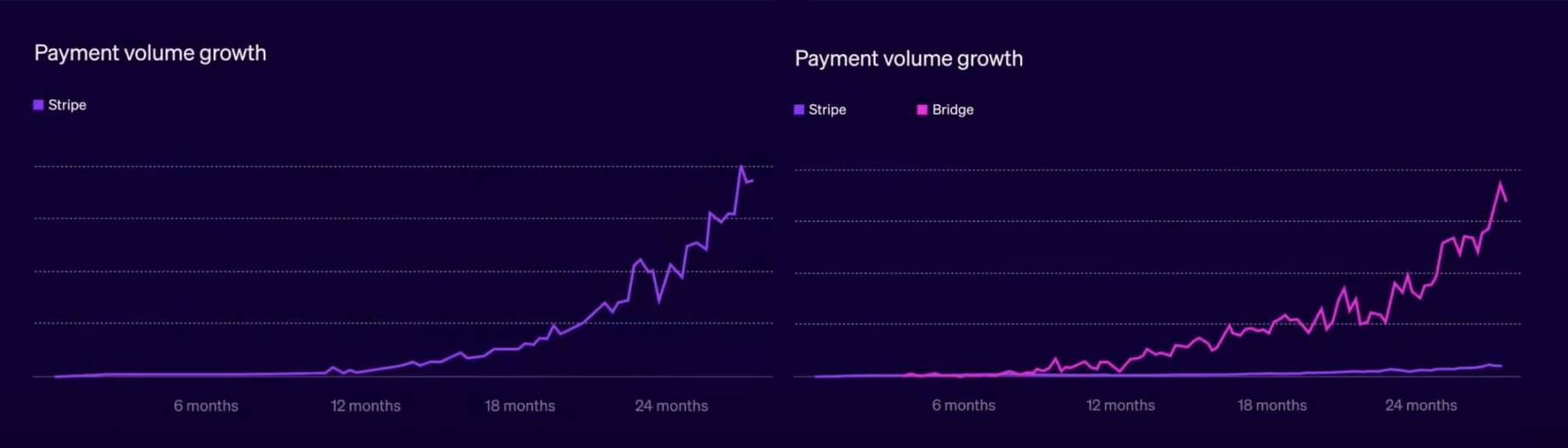
As stated by Stripe executives at Stripe Sessions 2025, stablecoins can truly enable borderless finance. By comparing the growth in payment volume during Stripe’s first two years versus Bridge’s first two years, we see that Bridge demonstrated significantly stronger exponential growth—further underscoring the immense potential of stablecoins.
The author observed in API call details within Bridge’s USDB documentation that USDB operates on the Solana blockchain, with Bridge responsible for minting, burning, and holding the reserve assets.
Notably, Bridge also supports the creation of custom stablecoins, including choice of blockchain, token name, and reserve strategy. At the end of each month, Bridge distributes a portion of earnings to holders of USDB and custom stablecoins. Rewards are minted as new tokens.
However, in an update posted about a month ago, Bridge noted that its stablecoins (USDB and custom stablecoins) currently support the Solana and Base networks, with upcoming launches on Polygon, Ethereum, Optimism, and Arbitrum. Bridge stablecoins are always backed 1:1 by equivalent U.S. dollar value. Underlying reserves include short-term U.S. Treasuries, overnight U.S. Treasury repurchase agreements, money market funds, and cash. This portfolio is held in segregated accounts to protect token holders and is custodied by partners including BlackRock, Fidelity, and Apex.
In terms of service availability, the Stripe Stablecoin Financial Account is currently accessible to business users in 101 countries and regions, primarily concentrated in Latin America, Africa, Central/South Asia and Southeast Asia, the Middle East (e.g., Saudi Arabia, Qatar), Oceania, and European nations characterized by small non-EU economies or offshore financial centers. These regions are typically developing countries, emerging markets, or small economies often marked by high dollarization needs, strong demand for cross-border payments, relatively relaxed regulatory environments, underdeveloped traditional financial infrastructure, or high inflation. Stripe’s stablecoin account offers precisely the low-cost, high-efficiency payment and treasury solutions these areas require.
Countries and regions such as China, Hong Kong, the United States, core EU nations, the UK, India, Russia, Japan, Canada, and Australia are currently excluded—largely due to strict regulations, mature financial markets, or geopolitical factors.
Stripe’s Crypto Strategy: From Payments to Ecosystem Building
Stripe’s involvement in cryptocurrency has not happened overnight; it reflects years of exploration and strategic development.
2014–2018: A Brief Experiment with Bitcoin Payments
In 2014, Stripe became the first major payment company to support Bitcoin payments, hoping Bitcoin could serve as a global decentralized medium of exchange to address issues like low credit card penetration or high transaction fees.
In 2018, due to long Bitcoin transaction confirmation times, high fees, excessive volatility, and declining customer interest in accepting Bitcoin—coupled with Stripe’s belief that Bitcoin had evolved more into a store of value than a medium of exchange—it discontinued Bitcoin payment support.
Despite ending Bitcoin support, Stripe remained optimistic about cryptocurrencies, stating it would continue monitoring developments in emerging technologies such as the Lightning Network, Stellar (in which Stripe had made a seed investment), Ethereum, and faster payment methods.
2019–2021: Cautious Exploration
In 2019, Stripe briefly participated in Facebook’s Libra project (later renamed Diem) but withdrew due to regulatory pressure, reflecting its cautious approach to the crypto space.
In 2021, Stripe formed a new crypto team dedicated to shaping its crypto strategy and advancing the integration of payments with Web3.
In November 2021, Matt Huang, co-founder and managing partner at Paradigm, joined Stripe’s board. Patrick Collison, Stripe’s co-founder and CEO, said at the time: “Few people understand crypto—and especially its potential for global internet businesses—better than Matt.”
2022: Full Re-Entry into the Crypto Market
In March 2022, Stripe launched a suite of products designed to provide customers with tools and APIs to easily buy and hold crypto tokens, convert them to cash, trade NFTs, and manage KYC and other compliance workflows. According to Stripe’s support page, its products enabled users in 180 countries/regions to purchase over 135 cryptocurrencies using fiat currencies.
In April 2022, Stripe added crypto support to its programmatic (API-based) payments platform Connect, with Twitter becoming the first platform to allow users to make crypto payments via the service.
2024–2025: Accelerating the Stablecoin Strategy
Stripe’s ambitions in crypto accelerated notably in 2024, focusing heavily on stablecoins and strengthening its position in Web3 payments through acquisitions and product innovation.
-
In April 2024, Stripe allowed customers to accept cryptocurrency payments, initially supporting only the USDC stablecoin across Solana, Ethereum, and Polygon.
-
In October 2024, Paxos launched its new stablecoin payments platform, with Stripe as the first client to adopt the solution. Stripe’s Pay with Crypto product is powered by Paxos’ stablecoin payment infrastructure, enabling merchants to accept stablecoin payments more easily.
-
In October 2024, Stripe acquired the stablecoin payments platform Bridge for $1.1 billion. Bridge has been dubbed the "Web3 version of Stripe."
-
On April 30, 2025, Bridge partnered with Visa to launch a stablecoin-powered card issuance product. Developers using Bridge can now programmatically issue Visa cards linked to stablecoins in multiple countries through a single API integration. Businesses and individuals can use their stablecoin balances for everyday purchases anywhere Visa is accepted. When a cardholder makes a purchase, Bridge deducts funds from their stablecoin balance and converts them into fiat currency, allowing merchants to receive local currency just like any other transaction.
-
On May 7, 2025, at Stripe Sessions 2025, Stripe launched its Stablecoin Financial Account. Stripe also announced an expanded partnership with integrated finance operations platform Ramp to launch corporate cards based on stablecoins and integrated expense management software. This offers businesses faster settlement, lower costs, built-in protection against currency volatility, and seamless card issuance. Specifically, companies can fund Ramp wallets in local currency, convert to stablecoins, or deposit stablecoins directly. Cardholders pay in local fiat, while merchants receive fiat. Funds are held at USD equivalence, protecting against local currency depreciation.
Outlook
From its early experiments with Bitcoin to today’s comprehensive strategy centered on the Stablecoin Financial Account, Stripe’s evolution in crypto has accelerated the convergence of traditional finance and the crypto economy, driving stablecoins toward mainstream adoption.
Through its $1.1 billion acquisition of Bridge and the launch of a stablecoin financial account available in 101 countries, Stripe has not only effectively addressed many pain points in cross-border payments but also provided emerging markets with a vital tool for dollarization. By focusing on the low-cost, high-efficiency nature of stablecoins—and combining Bridge’s technological strengths with Stripe’s own global payments network—Stripe has established a strong leadership position in crypto payments.
As global financial regulators gradually refine frameworks for stablecoin oversight, and traditional financial giants like Visa become increasingly open to stablecoins, stablecoins are moving from the periphery into the mainstream. Stripe’s Stablecoin Financial Account offers businesses a low-friction, high-efficiency global payment solution, helping push the global financial system toward greater efficiency, accessibility, and inclusivity.
Join TechFlow official community to stay tuned
Telegram:https://t.me/TechFlowDaily
X (Twitter):https://x.com/TechFlowPost
X (Twitter) EN:https://x.com/BlockFlow_News
 Foresight News






