
Stripe Acquires Privy to Further Strengthen Its Stablecoin Infrastructure Strategy
TechFlow Selected TechFlow Selected
Stripe Acquires Privy to Further Strengthen Its Stablecoin Infrastructure Strategy
This acquisition marks Stripe's latest major bet on the stablecoin market, following its $1.1 billion purchase of stablecoin provider Bridge last October.
 Navigating Web3 tides with focused insights
By Will Wang
On June 12, U.S. payment giant Stripe announced the acquisition of Privy, a leading embedded wallet infrastructure provider that enables platforms like Hyperliquid, OpenSea, Blackbird, and Toku to integrate cryptocurrency wallets directly into their user experiences—eliminating complexity and boosting conversion rates.
Stripe is a payment platform serving half of the Fortune 100 and 78% of the Forbes AI 50. Last year, it processed $1.4 trillion in payments, a 38% year-over-year increase. Revenue processed on Stripe is growing seven times faster than S&P 500 companies, giving the platform massive influence in mainstream commerce. In short, Stripe is ideally positioned to drive stablecoin adoption.
For Stripe, a master at navigating financial flows, this acquisition marks another major bet on the stablecoin market—following its $1.1 billion purchase of stablecoin provider Bridge in October last year. On the surface, acquiring Privy expands Stripe’s on-chain wallet capabilities. Beneath the surface, it may reflect an evolving strategy around banking relationships and compliance. Yet none of this diminishes the immense potential now emerging for Web3 payments.
1. Privy: A Cryptocurrency Wallet Infrastructure Provider
Founded in 2021, Privy aims to empower any developer to easily build better products on crypto rails ("Unlock Crypto Rails"). Whether crypto is central to an app or just an added feature, great crypto products should feel intuitive and seamless for users.
This is Privy’s mission: making crypto easy to use so more people can benefit from it.
It all starts with building better wallets.
Market Pain Point: Wallets are essential and scalable interfaces for owning and exchanging value online—and they deserve the same level of design and usability as any other internet application. Yet when Privy began, early crypto wallets, though powerful, had extremely high barriers to entry, accessible only to advanced users.
"Developers were forced to make users leave their platforms just to start using crypto services... This complexity fundamentally limits the kinds of products we can build. It hampers user experience, reduces conversion, and ultimately constrains the growth of the entire crypto ecosystem."
— Henri Stern, Privy CEO & Co-Founder
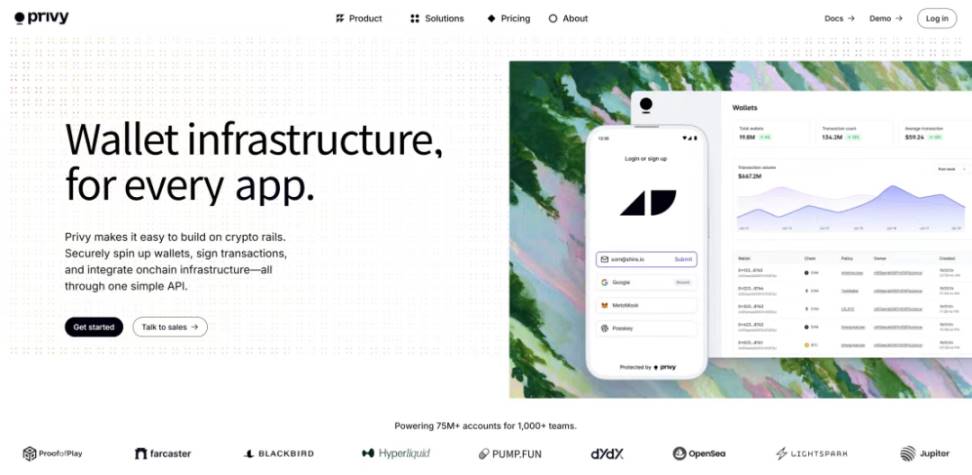
(privy.io)
Solution: Privy was built to eliminate this friction by abstracting away technical complexities, enabling users to interact with crypto products as effortlessly as they do with the rest of the internet—simple, intuitive, instant.
Privy offers easy-to-use APIs and SDKs that allow developers to embed crypto wallets directly within their applications. Unlike solutions relying on standalone wallets (e.g., MetaMask or Phantom), Privy enables direct integration into apps across markets, games, and fintech platforms.
Use Cases: Today, Privy supports over 75 million accounts across more than 1,000 development teams, facilitating billions of dollars in transactions between wallets, apps, and users—enabling seamless earning, transferring, and spending of new digital assets:
- Hyperliquid: Creating a new kind of trading experience.
- Blackbird: Enabling restaurants to accept digital assets from loyal customers.
- Toku: Allowing global teams to be paid instantly in digital dollars.
- Farcaster: Building the future social graph on crypto rails.
Privy’s original insight was clear yet underappreciated: wallets are the gateway to crypto, but that gateway is broken. By pioneering embedded wallets, Privy has made using crypto feel as seamless as logging in with email.
Since its Series A led by Paradigm in 2023, Privy has grown from 1M wallets and 41 customers to supporting top-tier teams like Hyperliquid, Jupiter, and Blackbird—quietly reshaping how billions flow online across trading platforms, digital banks, remittance services, and payment apps.
— Caitlin, Paradigm Investment Partner
Funding Overview: Privy was previously valued at $230 million, though discussions on X suggest a figure closer to nine digits. Backers include Sequoia, Ribbit Capital, Paradigm, Blue Yard, Coinbase Ventures, Archetype, Electric Capital, and Protocol Labs.
Following the acquisition, Privy will continue operating independently. Like Bridge after its acquisition, independent operation allows Privy greater flexibility, faster feature development, improved service quality, and sharper focus on core business and user needs.
2. Strategic Synergy Between Privy and Stripe
In its 2024 annual letter, Stripe made a bold declaration: "The Stripe platform will become the best way to build stablecoin applications." This acquisition shows they’re moving fast to execute that vision.
"Money needs to live somewhere—and Privy is building the world’s highest-quality programmable vaults. Beyond our other stablecoin initiatives, we look forward to empowering a new generation of global, internet-native financial services." — Patrick Collison, Stripe CEO
2.1 What Privy Brings to Stripe
Privy is more than just a set of APIs—it’s a battle-tested product with Stripe-like developer experience, a customer-focused team, and strong credibility within the crypto builder ecosystem. Industry experts consistently praise its execution quality.
While some might argue Stripe could build such functionality in-house, that misses the point: launching version one is easy; perfecting the details—handling edge cases, adapting to customer needs, supporting production-scale workloads—is hard.
This isn’t just a technology acquisition. Stripe chose acquisition to gain speed to market, brand trust, and proven product-market fit—all while integrating deeper with Bridge’s expanding stablecoin offerings.
With Privy, Stripe gains:
- A top-tier team with native crypto product DNA;
- A developer-first embedded wallet platform;
- An extensive base of native crypto customers;
- Immediate momentum—not an 18-month ramp-up.
As Dr. Xiao Feng of Hashkey clearly stated: blockchain is the next-generation financial infrastructure.
This is critical—but I want to emphasize: blockchain runs on the internet, and in the race for internet dominance, speed is everything.
Even more important: the internet thrives on network effects.
In this next-generation financial race, Stripe is accelerating—and Privy helps them move even faster, while others are still debating how to issue stablecoins.
2.2 What Stripe Brings to Privy
For Privy, Stripe offers transformative scale in reach and resources:
- Broad distribution channels to vast fintech and enterprise developer communities;
- Global reputation for reliability and compliance;
- Capital and support to continue operating independently.
2.3 Bridge: The Stablecoin Backend

Acquired by Stripe in October 2024 for $1.1 billion, Bridge provides three core services accessible via just a few lines of code:
- Stablecoin Orchestration: Enables businesses to transfer, store, and accept various stablecoins, with Bridge handling compliance and regulatory requirements.
- Currency On-Ramping: Allows businesses to convert local fiat currencies into stablecoins.
- Transfer Services: Supports global movement of funds and account creation in USD and EUR.
Bridge already powers real-world use cases. SpaceX uses it through parent company Starlink to repatriate earnings from Argentina back to the U.S. in dollars. Nigerian users pay for YouTube Premium and ChatGPT via Bridge's rail payments, while small U.S. businesses accept global stablecoin payments without worrying about international banking complexity.
Since the acquisition, Bridge has scaled rapidly. Its stablecoin financial accounts now operate in 101 countries, allowing businesses to hold balances in USDC and USDB (Bridge’s own stablecoin), receiving funds through both traditional banking and crypto networks.
Additionally, Bridge recently partnered with Visa to launch the world’s first stablecoin card issuance program. Through this, fintech and crypto firms like Ramp, Squads, and Airtm have begun issuing Visa cards directly linked to stablecoin wallets, enabling users to spend their stablecoin balances at over 150 million merchants worldwide that accept Visa.
3. Stripe Integrating Bridge and Privy
3.1 Full Compatibility Across Fiat & Crypto Stacks
For Stripe, Privy perfectly complements Bridge’s existing capabilities, forming a cohesive stablecoin strategy. Privy transforms the complex on-chain wallet infrastructure required for stablecoin payments into a plug-and-play solution akin to Stripe itself—providing on-chain support for all of Bridge’s custodial stablecoin services.
In other words, Stripe can now offer tools across every layer of the fiat and crypto stack:
Bridge handles compliant fiat on/off-ramps (via lead banks) for clients in over 100 countries, plus custody of stable-value accounts and payment channels;
Privy manages non-custodial addresses for holding stablecoins and handles the complexity of on-chain wallets;
All delivered through Stripe-level developer experience and distributed via Stripe’s existing channels—fully connecting to the stablecoin-powered crypto payment rail.
Most people miss the true implication of this combination: Stripe can now give users crypto wallets (via Privy), enable any fintech to add stablecoin accounts (via Bridge), and let any platform settle globally in seconds (via stablecoins like USDB)—all through APIs developers already trust (Stripe).
3.2 Unlocking On-Chain Financial Markets via Privy
Prior to Privy, both Stripe’s payment network and Bridge’s stablecoin rails relied on custodial bank accounts—for deposit and withdrawal. Bank accounts mean regulation, compliance overhead, high fees, and constraints.
As Stripe expands into more stablecoin use cases, regulatory pressure could severely limit both stablecoin operations and custodial accounts due to banking regulations, internal compliance policies, and oversight. Acquiring Privy allows Stripe to conduct stablecoin activities through Privy’s independent entity, and also leverage self-custody wallets—dramatically increasing compliance flexibility, cost efficiency, and operational possibilities.
This unlocks new potential for Stripe’s stablecoin innovation, especially in emerging markets and global fintech:
- Enable offline merchants and acquirers to open stablecoin accounts and settle in stablecoins at manageable costs;
- Allow e-commerce sellers to create and manage multiple wallets;
- Seamlessly create wallets for consumers to use in crypto payments;
- Facilitate access to democratized on-chain yield-generating products;
The hidden crypto payment rail behind in-app cross-border remittances.
The shift is this:
Fiat to Stablecoin (Bridge) → More Stablecoin Use Cases (Stripe) → Self-Custodied On-Chain Storage (Privy) → A Programmable, Permissionless On-Chain World.
3.3 What Comes Next?
What’s still missing from Stripe’s envisioned stablecoin world? Expect Stripe to complete the puzzle in three key directions:
Digital Asset Licenses: While Stripe holds most major fiat payment licenses, securing emerging digital asset licenses would expand its ability to offer stablecoin and crypto services globally.
More Non-USD Payment Channels and Local On-Ramps: Bridge recently added Mexico; further local payment integrations will strengthen its position as a global financial infrastructure player.
On-Chain Financial Services: Stripe may embed credit, lending, and even crypto trading into its API-driven business account offerings—similar to Revolut Business.
Through these moves, Stripe could deliver a programmable, borderless financial stack—a scalable, global on-chain financial market operating at a fraction of traditional banking costs.
4. Final Thoughts
Stripe’s journey in crypto spans over a decade of ups and downs. It tested Bitcoin payments in 2014 but discontinued support in 2018 due to volatility. In 2019, it joined Facebook’s Libra project (which later evolved into Sui and Aptos), before eventually exiting.
Now, with Privy handling wallet infrastructure and Bridge powering stablecoin backend services, Stripe controls both ends of the stablecoin stack. Historically, stablecoin adoption has been limited by infrastructure gaps—businesses want to accept crypto payments but struggle to onboard users easily, while users want to pay with crypto but face wallet complexity.
Now, Stripe can remove these barriers—ending the dial-up era of crypto integration.
For stablecoin adoption, this could be a pivotal moment. Stripe’s influence extends far beyond crypto-native apps, reaching mainstream commerce, enterprise software, and global markets. By making stablecoin API integration as simple as adding a payment method, Stripe has the potential to accelerate crypto adoption in niche markets—and drive true mass adoption.
Join TechFlow official community to stay tuned
Telegram:https://t.me/TechFlowDaily
X (Twitter):https://x.com/TechFlowPost
X (Twitter) EN:https://x.com/BlockFlow_News
 0xWillmfer