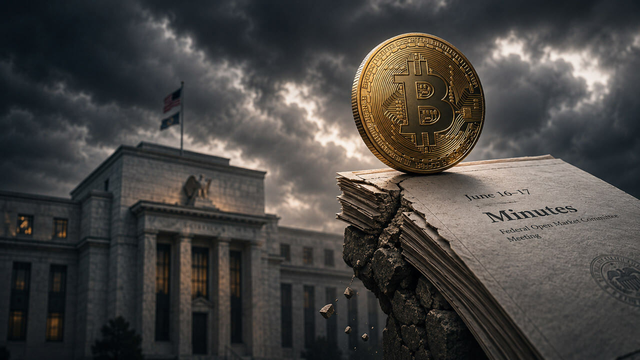
Arthur Hayes' new article: Bitcoin rejoins gold in the "only up, never down" category, with altseason potentially following
TechFlow Selected TechFlow Selected
Arthur Hayes' new article: Bitcoin rejoins gold in the "only up, never down" category, with altseason potentially following
Once Bitcoin breaks through the historical high of $110,000, it is very likely to surge.
 Navigating Web3 tides with focused insights
Author: Arthur Hayes, Founder of BitMEX
Translation: AIMan@Jinse Finance
For me, the Hokkaido ski season ended this March. Yet the lessons learned on the mountain still apply to President Trump’s “tariff fury.” Every day is different, with too many variables interacting—no one knows which snowflake or turn will trigger an avalanche. All we can do is estimate the probability of an avalanche. One technique for more accurately assessing slope instability is a "ski-cut."
Before descending, one skier from the group crosses the starting area, jumping up and down to try to trigger an avalanche. If successful, the way the avalanche spreads across the slope determines whether the guide deems it safe for skiing. Even if an avalanche occurs, we may continue skiing—but carefully choose our line to avoid triggering anything worse than loose powder slides. If we see cracks or massive slabs breaking loose, we get out immediately.
The key is attempting to quantify worst-case scenarios under current conditions and act accordingly. Trump’s self-proclaimed April 2nd “Liberation Day” was a ski-cut across the steep and dangerous face of global financial markets. The Trump team's tariff policy draws from a book on trade economics titled *Balanced Trade: Ending the Unbearable Cost of America’s Trade Deficit*, taking an extreme stance. The announced tariff rates were worse than even the most pessimistic estimates by mainstream economists and financial analysts. In avalanche theory terms, Trump triggered a persistent weak-layer slide, threatening to destroy the entire fugazi (a term originating from U.S. soldiers in Vietnam, meaning something fake) fractionally reserved, dirty fiat financial system.
The initial tariff policy represented the worst-case outcome, as both the U.S. and China took extreme, opposing positions. Although financial asset markets experienced violent swings causing trillions in global losses, the real issue was the rise in volatility in the U.S. bond market (measured by the MOVE index). It spiked intraday to a record 172 points before the Trump team backed away from the danger zone. Within a week of announcing tariffs, Trump softened his plan, suspending new tariffs on all countries except China for 90 days. Then, Boston Fed President Susan Collins wrote in the Financial Times that the Fed stood ready to do whatever it takes to ensure market functioning. A few days later, volatility remained stubbornly high. Finally, Treasury Secretary Scott appeared on Bloomberg TV, declaring to the world that his department had immense capacity—especially because it could dramatically increase the speed and scale of Treasury buybacks (see Jinse Finance’s prior report “Arthur Hayes: I Believe BTC Could Reach $250K by Year-End Because the Treasury Has Already Taken Control of the Fed”). I describe this sequence as policymakers shifting from “everything is fine” to “everything is terrible—we must act.” Markets surged, and most importantly, Bitcoin found its bottom. Yes, folks, I predicted $74,500 was a local low.
Whether you call Trump’s policy shift a retreat or a shrewd negotiating tactic, the result was clear: the government deliberately triggered a financial market avalanche so severe that they adjusted course within a week. Now, as a market, we know certain things. We understand what happens to bond market volatility in a worst-case scenario, we recognize the volatility thresholds that trigger behavioral changes, and we know which monetary levers will be pulled to ease the situation. With this information, we Bitcoin holders and crypto investors know the bottom has formed—because next time Trump escalates tariff rhetoric or refuses to lower tariffs on China, Bitcoin will rally on expectations that monetary officials will run the printing press at maximum capacity to keep bond market volatility low.
This article will explore why taking an extreme stance on tariffs leads to dysfunction in the Treasury market (as measured by the MOVE index). Then, I’ll discuss how Treasury Secretary Bessent’s solution—Treasury buybacks—will inject massive dollar liquidity into the system, even though technically, issuing new bonds to buy old ones does not directly add dollars. Finally, I’ll explain why the current macroeconomic and Bitcoin environment resembles when Bessent’s predecessor Yellen increased Treasury issuance in Q3 2022 to drain the Reverse Repo (RRP) facility. Bitcoin hit a local bottom post-FTX in Q3 2022; now, after Bessent launches his “non-QE” QE program, Bitcoin has hit a local bottom for this bull cycle in Q2 2025.
Maximum Pain
I reiterate: Trump’s goal is to reduce the U.S. current account deficit to zero. Achieving this rapidly requires painful adjustment, and tariffs are his administration’s weapon of choice. I don’t care whether you think it’s good or bad, or whether Americans are ready to work 8+ hour shifts in iPhone factories. Part of Trump’s electoral support comes from voters who believe globalization has harmed them. His team is determined to fulfill campaign promises—putting “Main Street” ahead of “Wall Street,” as they say. This assumes those around Trump can secure re-election through this path—but nothing is guaranteed.
Financial markets plunged on Liberation Day because if foreign exporters earn fewer or no dollars, they cannot buy as many—or any—U.S. stocks and bonds. Moreover, if exporters must restructure supply chains or rebuild them domestically, they’ll need to partially fund this by selling liquid assets like U.S. Treasuries and equities. That’s why U.S. markets—and any markets overly dependent on U.S. export revenues—collapsed.
At least initially, there was a silver lining: fearful traders and investors rushed into U.S. Treasuries. Prices rose, yields fell. The 10-year yield dropped sharply—a positive development for Bessent, helping him place more debt. But violent swings in both bond and stock prices amplified overall volatility, spelling doom for certain types of hedge funds.
Hedge funds—hedging… sometimes—but always using massive leverage. Relative Value (RV) traders typically identify relationships or spreads between two assets; if the spread widens, they use leverage to go long one and short the other, betting on mean reversion. Generally, most hedge fund strategies are implicitly or explicitly short volatility at the macro level. When volatility falls, mean reversion occurs. When volatility rises, chaos ensues, and stable “relationships” between assets break down. This is why banks or exchange risk managers lending to hedge funds raise margin requirements when volatility spikes. When hedge funds receive margin calls, they must liquidate immediately or face forced closure. Some investment banks happily bankrupt clients during volatile periods via margin calls, take over their positions, and profit when policymakers inevitably print money to suppress volatility.
What we truly care about is the relationship between stocks and bonds. Since U.S. Treasuries are nominally risk-free and serve as global reserve assets, when global investors flee equities, Treasury prices should rise. This makes sense—fiat must exist to generate returns, and the U.S. government, able to print dollars effortlessly, will never voluntarily default in USD. The real value of Treasuries may decline—and does—but policymakers don’t care about the real value of the junk fiat assets flooding in globally.
In the first few trading sessions after Liberation Day, stocks fell while bonds rose / yields fell. Then something happened: bond prices began falling in tandem with equities. The 10-year yield swung to extremes unseen since the early 1980s. Why? The answer—or at least what policymakers believe it is—is critically important. Is there a structural market problem requiring the Fed and/or Treasury to print money in some form to fix it?
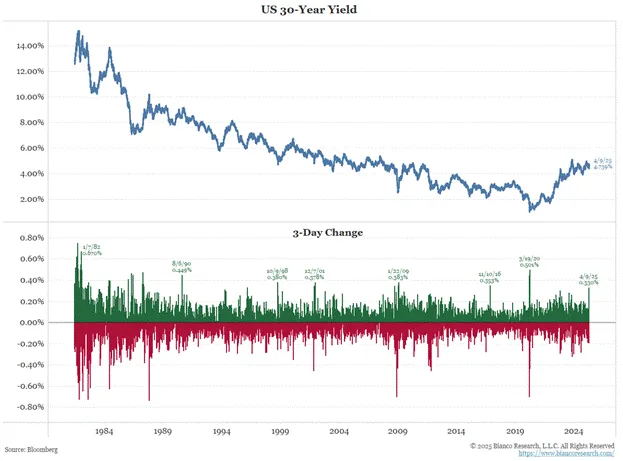
From Bianco Research, the bottom chart shows the abnormal magnitude of 3-day changes in 30-year bond yields. The tariff panic caused volatility comparable to crises like the 2020 pandemic, 2008 global financial crisis, and 1998 Asian financial crisis. This is not good.
Routine unwinding of RV funds’ Treasury basis trade positions might have been a factor. How large was this position?
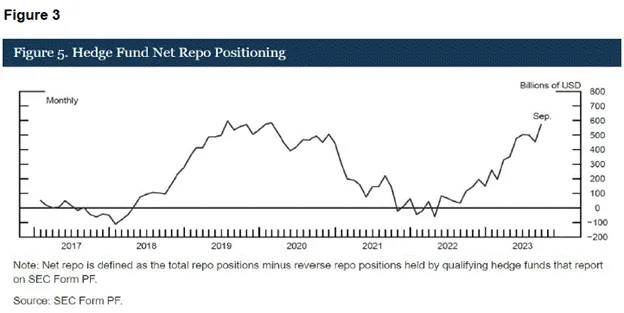
February 2022 was pivotal for the U.S. Treasury market because President Biden decided to freeze Russian sovereign holdings—the largest commodity producer globally. This signaled that property rights are no longer rights but privileges, regardless of who you are. As a result, offshore demand weakened persistently, but RV funds stepped in as marginal buyers. The chart clearly shows rising repo positions, representing the size of basis trades in the market.
Basis Trade Overview:
A Treasury basis trade involves buying cash bonds while simultaneously selling bond futures contracts. Margin impacts from banks and exchanges are crucial. The size of RV fund positions is limited by cash margin requirements, which fluctuate with market volatility and liquidity.
Bank Margin:
To obtain cash for bond purchases, funds conduct repurchase agreements (repo). Banks pay a small fee to advance cash immediately, using the purchased bond as collateral. Banks require a cash margin against the repo.
The greater the bond price volatility, the higher the margin banks demand.
The less liquid the bond, the higher the required margin. Liquidity is always concentrated at certain points on the yield curve. For global markets, the 10-year Treasury is most important and most liquid. When a new 10-year is auctioned, it becomes the “on-the-run” 10-year—the most liquid bond. Over time, it drifts toward being “off-the-run,” losing centrality. As time passes, on-the-runs naturally become off-the-runs, increasing the cash needed to fund repo trades while waiting for basis convergence.
Essentially, during periods of high market volatility, banks fear that if they need to liquidate bonds, prices will fall too fast and liquidity won't absorb their sell orders. Thus, they raise margin limits.
Exchange Margin:
Each bond futures contract has an initial margin level determining required cash per contract. This level fluctuates with market volatility.
Exchanges focus on their ability to liquidate before initial margin is depleted. Faster price moves make solvency harder to ensure; thus, margin requirements rise when volatility increases.
Eliminating Fear:
The massive impact of Treasury basis trades and the funding methods of major participants have long been hot topics in the Treasury market. The Treasury Borrowing Advisory Committee (TBAC) provided data in past Quarterly Refunding Announcements (QRAs), confirming that since 2022, RV hedge funds engaging in such basis trades have been the marginal buyers of U.S. Treasuries. Below is a link to a detailed paper submitted to the CFTC based on TBAC data from April 2024.
A reflexive chain of market events amplifies terrifyingly each cycle:
1. If Treasury market volatility rises, RV hedge funds must deposit more cash with banks and exchanges.
2. At a certain point, these funds can no longer meet additional margin calls and must liquidate simultaneously—selling cash bonds and buying back bond futures.
3. Market makers reduce bid-ask sizes to protect themselves from adverse one-way flows, reducing spot market liquidity.
4. As liquidity and prices fall together, market volatility intensifies further.
Traders fully understand this market phenomenon. Regulators and their media proxies have consistently warned about it. Therefore, as bond market volatility increases, traders front-run forced selling, exacerbating downside moves and accelerating market collapse.
If this is a known market stress point, what policy can the U.S. Treasury implement internally to maintain funding (i.e., leverage) flowing to these RV funds?
Treasury Buybacks
A few years ago, the U.S. Treasury launched a bond buyback program. Many analysts speculated how this might encourage or enable certain forms of money printing. I will present my theory on how buybacks affect money supply. First, let’s understand how the program works.
The Treasury issues new bonds and uses the proceeds to buy back less liquid older bonds (off-the-run). This causes older bonds to appreciate, possibly beyond fair value, as the Treasury becomes the dominant buyer in an illiquid market. RV funds observe narrowing basis between old cash bonds and bond futures.
Basis Trade = Long Cash Bonds + Short Bond Futures
With expectations of Treasury purchases, long cash bond prices rise as old bond prices increase.
Therefore, RV funds lock in profits by selling now-higher-priced old bonds and covering their short futures positions. This frees up valuable cash at banks and exchanges. Since RV funds are profitable, they reinvest directly into basis trades at the next Treasury auction. As prices and liquidity rise, bond market volatility declines. This reduces margin requirements, allowing larger positions. This is procyclical reflexivity at its finest.
Knowing the Treasury is injecting more leverage into the financial system, markets now relax. Bond prices rise; all is well.
Treasury Secretary Bessent boasted in interviews about his new tool, noting the Treasury can theoretically conduct unlimited buybacks. Without congressional spending bills, the Treasury cannot arbitrarily issue bonds. However, buybacks involve issuing new debt to retire old debt—something the Treasury already does when rolling over maturing principal. Since the Treasury buys and sells bonds with primary dealer banks at par, the cash flow is neutral—requiring no Fed borrowing. Thus, if reaching buyback levels alleviates market fears of Treasury market collapse and leads markets to accept lower yields on yet-to-be-issued debt, the Treasury will push buybacks aggressively. It won’t stop, and it won’t slow down.
Note on Treasury Supply
Bessent knows full well the debt ceiling will be raised sometime this year, and government spending will continue with increasing intensity. He also knows Elon Musk’s Department of Government Efficiency (DOGE) isn’t cutting fast enough due to structural and legal constraints. Specifically, Musk’s projected annual savings have dropped from an expected $1 trillion to a negligible $150 billion (insignificant relative to deficit size). This leads to an obvious conclusion: deficits may actually widen, forcing Bessent to issue more Treasuries.
Currently, FY25 deficits through March are 22% higher than FY24 levels over the same period. Let’s give Musk the benefit of the doubt—I know some of you would rather burn Teslas listening to Grimes than trust him—he’s only been working for two months. More concerning, corporate uncertainty over tariff strength and impact, combined with equity market declines, will severely reduce tax revenues. This suggests a structural reason: even if DOGE succeeds in cutting more spending, deficits will keep expanding.
Deep down, Bessent fears he’ll have to raise borrowing forecasts for the rest of the year due to these factors. With a flood of upcoming Treasury supply, market participants will demand significantly higher yields. Bessent needs RV funds to step up, deploy maximum leverage, and fully absorb the bond market. Hence, buybacks are inevitable.
The positive impact of buybacks on dollar liquidity isn’t as direct as central bank money printing. Buybacks are budget- and supply-neutral, so the Treasury can conduct unlimited buybacks to create massive RV purchasing power. Ultimately, this allows the government to finance itself at affordable rates. The more debt issued—not bought by private savings but leveraged funds created through the banking system—the greater the growth in money supply. Then we know, when fiat quantity grows, the only asset we want to own is Bitcoin. Go!
Clearly, this isn’t an infinite source of dollar liquidity. There’s a finite number of unissued Treasuries available to buy. Still, buybacks are a tool helping Bessent stabilize markets short-term and fund the government affordably. This is why the MOVE index fell. As the Treasury market stabilizes, fears of systemic collapse fade.
Same Scenario
I compare this strategy to Q3 2022. In Q3 2022, a “decent” white boy like Sam Bankman-Fried (SBF) went bankrupt; the Fed was still hiking, bond prices fell, yields rose. Yellen needed a way to stimulate markets so she could force-feed bond issuance without triggering a vomit reflex. Briefly, just like now—amplified volatility due to shifts in the global monetary system—was a terrible time to ramp up bond issuance.
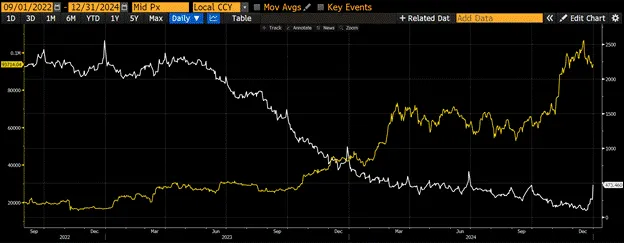
RRP balance (white) vs Bitcoin (gold)
Like today, but for different reasons, Yellen couldn’t rely on the Fed easing policy, as Powell was deep into his Paul Volcker-inspired temperance performance. Yellen—or some brilliant staffer—correctly deduced that idle funds held in RRP (reverse repo) by money market funds could be drawn into the leveraged financial system by issuing more U.S. Treasuries, which funds would gladly hold for slightly higher yields than RRP. This enabled her to inject $2.5 trillion in liquidity from Q3 2022 to early 2025. During this period, Bitcoin rose nearly sixfold.
This sounds optimistic, yet people panicked. They knew high tariffs and a Chi-Merica divorce were bad for stocks. They saw Bitcoin merely as a high-beta version of the Nasdaq 100. Bearish, they didn’t believe a seemingly harmless buyback plan could boost future dollar liquidity. They waited on the sidelines for Powell to ease. He couldn’t simply cut rates or launch QE like Fed chairs from 2008–2019. Times changed—the burden of money printing increasingly rests with the Treasury. If Powell truly cared about inflation and long-term dollar strength, he’d offset actions taken under Yellen and now Bessent. But he didn’t then, and won’t now; he’ll remain stuck in the turtle chair, manipulated by others.
Just like Q3 2022, people thought Bitcoin, having hit a cycle low around $15,000, might drop below $10,000 due to compounding negative factors. Today, some believe Bitcoin will fall below $74,500 to under $60,000, ending the bull run. Yellen and Bessent aren’t playing games. They’ll ensure the government funds itself at affordable rates and suppresses bond market volatility. Yellen issued more short-term than long-term debt, injecting limited RRP liquidity; Bessent will issue new debt to buy back old debt, maximizing RV funds’ ability to absorb new supply. Neither is recognized or understood by most investors as quantitative easing. So they’re ignored—until Bitcoin breaks out decisively, forcing them to chase.
Verification
For buybacks to have a net stimulative effect, deficits must keep rising. On May 1st, the Treasury’s Quarterly Refunding Announcement (QRA) will reveal upcoming borrowing plans and revisions to prior estimates. If Bessent must borrow more or expects to, it means tax revenues are forecast to fall—leading to wider deficits if spending stays constant.
Then, in mid-May, we’ll get official April deficit/surplus data from the Treasury, including actual tax receipts from April 15th. We can compare year-on-year changes in FY25-to-date deficits to see if they’re expanding. If deficits grow, bond issuance increases, and Bessent must do everything possible to ensure risk-off funds expand their basis trade exposure.
Trading Strategy
When Trump skied, a sudden steep drop triggered an avalanche. Now, we finally know the degree of pain or volatility (MOVE index) the Trump administration can tolerate before moderating policies perceived as threatening the foundation of the fiat financial system. This will trigger policy responses that increase the supply of dollar fiat available to purchase U.S. Treasuries.
If increased frequency and scale of buybacks fail to calm markets, the Fed will eventually find a way to ease. They’ve said so. Crucially, they reduced QT pace at their latest March meeting—a forward-looking positive for dollar liquidity. Beyond QE, the Fed can do more. Here’s a short list of non-QE but pro-liquidity procedural policies—one might be announced at the May 6–7 FOMC meeting:
-
Exempt Treasuries from bank Supplementary Leverage Ratio (SLR) requirements. This allows banks to use unlimited leverage to buy Treasuries.
-
Implement “QT Twist”—reinvesting proceeds from maturing MBS into newly issued Treasuries. The Fed’s balance sheet remains unchanged, but this adds $35 billion in monthly marginal buying pressure to the Treasury market for years until all MBS存量 mature.
Next time Trump hits the tariff button—he will, to assert dominance—Bitcoin won’t suffer like certain stocks. Bitcoin understands that deflationary policies cannot persist given the insane current and future debt levels required to sustain the dirty financial system.
The collapse of Mt. Sharpe World (financial markets) ski resort triggered a secondary avalanche that could have quickly escalated to Level 5—the highest. But the Trump team reacted swiftly, changing course and pushing the empire to another extreme. The avalanche base is now solidified by crystallized dollar bills provided via Treasury buybacks, reinforced by the driest and wettest “pow pow.” Now it’s time to transition from painfully climbing uphill with a backpack full of uncertainty, to jumping off powder pillows, cheering how high Bitcoin will soar.
As you can see, I’m extremely bullish on Bitcoin. At Maelstrom, we’ve maximized our crypto positions. Now, everything revolves around trading various cryptos to accumulate Bitcoin. During the slump when Bitcoin dropped from $110K to $74.5K, the biggest buying occurred in Bitcoin. Bitcoin will continue leading the market as the direct beneficiary of future dollar liquidity injections aimed at mitigating the impact of decoupling between China and America. Today, the international community sees Trump as a madman recklessly wielding tariffs, prompting every investor holding U.S. stocks and bonds to seek something anti-establishment. Physically, that’s gold. Digitally, that’s Bitcoin.
Gold has never been seen as a high-beta proxy for U.S. tech stocks; thus, during broad market crashes, it performs well as history’s oldest anti-establishment financial hedge. Bitcoin will break free from its linkage to U.S. tech stocks and rejoin gold in the “only up” club.
What About Altcoins?
Once Bitcoin breaks above its $110K all-time high, it may surge further, cementing its dominance. Maybe it won’t reach $200K. Then, rotation into altcoins begins. Alt season (AltSzn: Chikun), go!
Beyond shiny new altcoin metadata, the best-performing tokens are those tied to projects that both generate profits and return them to stakers. Such projects are rare. Maelstrom has been steadily accumulating positions in select qualified tokens and hasn’t finished buying these gems. They’re gems because they crashed like all other alts during the recent sell-off, but unlike 99% of shit projects, these actually have paying customers. Given the vast number of tokens, once a token launches on CEX in Down Only mode, convincing the market to give your project another chance is impossible. Altcoin treasure hunters want higher staking APYs, where rewards come from real profits—because these cash flows are sustainable. To promote our picks, I’ll write a full article detailing some of these projects and why we believe their cash flows will grow sustainably in the near future. Until then, back the truck up and buy everything!
Join TechFlow official community to stay tuned
Telegram:https://t.me/TechFlowDaily
X (Twitter):https://x.com/TechFlowPost
X (Twitter) EN:https://x.com/BlockFlow_News
 Arthur Hayes