








Review of 18 Major L1 Communities: Who Has the Strongest Crypto Community?
TechFlow Selected TechFlow Selected
Review of 18 Major L1 Communities: Who Has the Strongest Crypto Community?
Without sustained belief, action, and cultural resilience, even billions in funding cannot buy a lasting community.
 Navigating Web3 tides with focused insights
Author: Ponyo :: FP
Translation: Luffy, Foresight News
Belief, Action, Resilience, Density—BARD—is a framework I introduced in my previous article, "What the Hell Is a Community?" to assess the health and strength of crypto communities. In a market where hype often overshadows substance, BARD focuses on what truly sustains crypto ecosystems: Belief (deep conviction and ideology), Action (real builder or user activity), Resilience (ability to withstand market volatility and setbacks), and Density (network cohesion and social interconnectedness).
In this piece, I’ve asked ChatGPT to apply the BARD model to analyze 18 leading cryptocurrency communities from 2024–2025: Bitcoin, Ethereum, Solana, Ripple, Cardano, Dogecoin, Movement, Tron, Ton, Aptos, Avax, Cosmos, BNB Chain, Berachain, Stacks, Polkadot, EOS, and Hyperliquid. Each project receives a score from 1 to 10 across each dimension.
Without further ado, here’s the ranking.
BARD Score Overview
Below is the summary table of BARD scores for each blockchain project. These scores are based on current (2024–2025) ecosystem performance: staking and retention rates, developer and governance participation, cultural memes, social engagement, and community responses to recent market fluctuations.
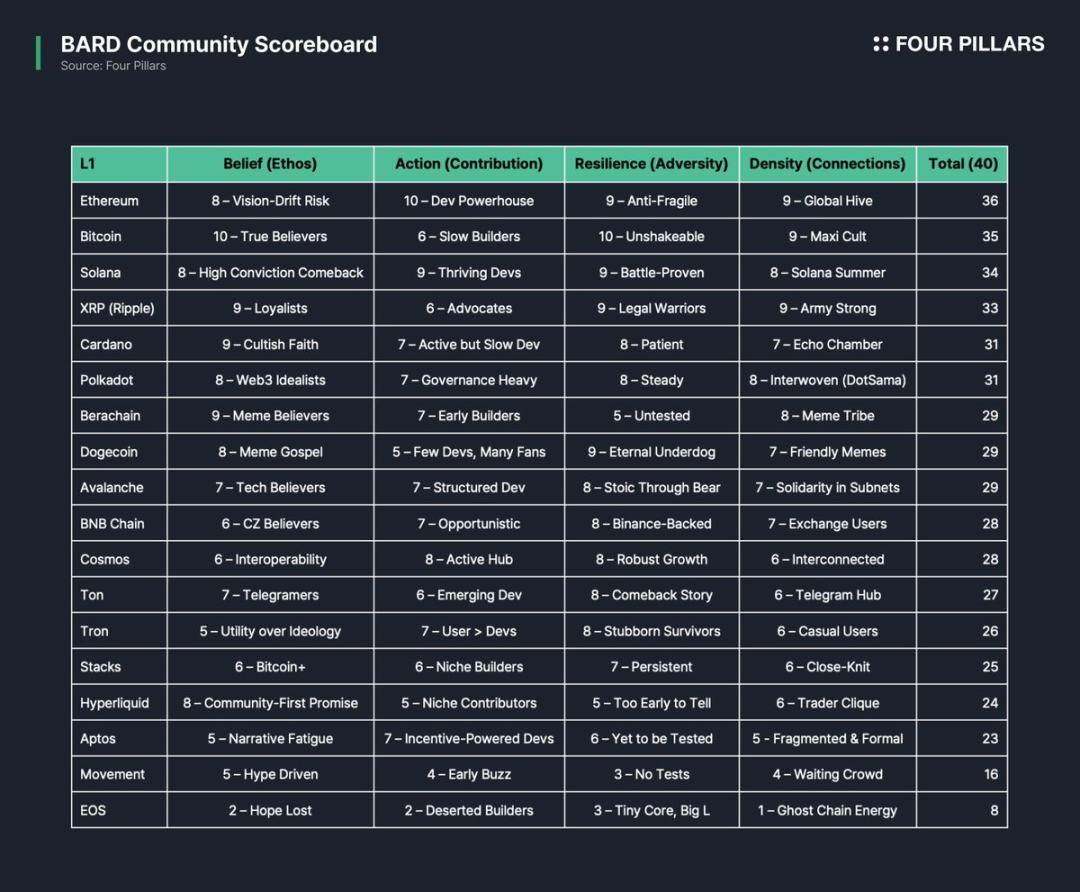
Scores are subjective estimates by ChatGPT based on current metrics and trends — for entertainment only
Major Layer 1 Blockchain Community Analysis
Ethereum (36 / 40): "Infinite roadmap, endless delays"
The Ethereum community uniquely blends idealism with pragmatism. It unites builders, speculators, and visionaries around an ambitious, inclusive ethos centered on decentralization, innovation, and public good. Despite recent governance tensions within the Ethereum Foundation slightly clouding mission clarity, Ethereum remains the unrivaled development hub in crypto, boasting the highest global builder activity and deeply engaged social networks. In short, the Ethereum community combines rare levels of ideological conviction, sustained action, and battle-tested resilience, making it the most vibrant network giant in the space.
Bitcoin (35 / 40): "Zealous digital gold cult, zero chill"
The Bitcoin community is the bedrock of crypto, driven by an almost religious devotion to decentralization and sound money. While builder activity may be slow, its strengths lie in unwavering belief and exceptional resilience: Bitcoin maximalists hold firm through regulatory storms and bear markets alike. They might not ship new features quickly, but in terms of conviction and staying power, Bitcoin stands at the peak of all communities.
Solana (34 / 40): "Post-FTX trauma survivors club"
The Solana community embodies resilience and relentless action. After surviving the fallout from FTX's collapse, network outages, and brutal market shakeouts, Solana’s loyal followers have bounced back stronger than ever, grounded in a pragmatic belief in the chain’s technology and scalability. Today, it has re-emerged as a top destination for developers, leading new onboarding waves in 2024 and surging transaction volumes.
The core Solana community is vibrant, tightly knit, and highly self-aware, united by shared struggles and internet memes. While slightly less ideologically cohesive than Bitcoin or Ethereum, Solana’s never-give-up, comeback-driven culture makes it a community defined by action, resilience, and renewed ambition.
Ripple (33 / 40): "Bankers’ token with a victim complex"
The XRP Army is one of the most battle-hardened and fiercely loyal groups in crypto, united by the conviction that Ripple will revolutionize global finance. Though grassroots developer activity is limited, their strength lies in extraordinary resilience—enduring years of regulatory battles, negative headlines, and bear markets without losing faith. They may not produce much code, but their intense belief and unmatched endurance ensure Ripple remains a persistent and powerful force in the crypto landscape.
Cardano (31 / 40): "The ghost chain of peer review"
No community in crypto matches Cardano’s level of patience, unity, and pure ideological belief. ADA holders show extreme loyalty, with over 60% of total supply staked.
While the developer ecosystem still lags behind more dynamic competitors, Cardano’s social network—calling itself the “Cardano family”—is tight-knit, active, and cohesive. Its unwavering belief and resilience allow the network to thrive amid skepticism, with community culture serving as Cardano’s greatest long-term advantage.
Polkadot (31 / 40): "Gavin’s over-engineered dream"
The Polkadot community sets high standards for decentralization, governance participation, and long-term builder action. Guided by founder Gavin Wood’s Web3 vision, Polkadot’s faithful believe in a multi-chain future built on interoperability and transparency.
Though hype has cooled in the latest cycle, the community shows admirable resilience—patiently navigating development delays and adapting smoothly to major governance changes. Polkadot’s culture connects diverse parachain teams, maintaining cohesion and vitality across the ecosystem.
Berachain (29 / 40): "Honey-fueled DeFi mania"
The Berachain community defies crypto logic: fans became fanatically loyal even before mainnet launch, bonded by memes, jokes, and the promise of innovative DeFi mechanics. Their belief survived repeated delays, locking $3.1 billion in liquidity pre-launch and generating massive buzz on X (Twitter) and Discord.
After mainnet went live in February 2025, activity surged—but remains in a speculative early phase. True resilience hasn’t yet faced stress testing, but the meme-driven, tightly knit culture fosters unusually strong socio-economic cohesion. Small but unified, Berachain proves that sometimes, belief alone can build a powerful community from nothing.
Dogecoin (29 / 40): "Crypto’s favorite inside joke"
The Dogecoin community proves that internet memes can be more powerful than code. Built on pure fun, humor, and collective belief, the Doge army turned a joke into a lasting crypto phenomenon. Despite minimal developer activity and little technical innovation, Dogecoin holders demonstrate remarkable cultural resilience, reigniting enthusiasm through viral waves and celebrity hype (thanks, Elon Musk).
While not bound by technology or governance, holders form strong social bonds through shared jokes and outsider identity. Its strength isn’t in what it builds, but in sustained positivity, absurdity, and staying power.
Avalanche (29 / 40): "The red triangle searching for a narrative"
The Avalanche community is practical and builder-focused, united by shared confidence in its tech—fast consensus and customizable subnets. Lacking strong ideological flair, it nonetheless maintains steady developer activity and healthy ecosystem engagement, launching numerous subnets and sustaining consistent transaction volume.
It hasn’t faced severe resilience tests, but Avalanche supporters quietly held the line during market downturns, retaining core contributors—a sign of quiet perseverance. Social connections exist, though the community leans toward top-down management, maintaining cohesion among devs and validators while grassroots participation remains weak.
BNB Chain (28 / 40): "Zhao’s clone factory"
The BNB Chain community leverages mass retail loyalty to Binance (or CZ) to create a large but loosely connected ecosystem. Belief centers on trust in Binance’s mature products, not ideological commitment. Action manifests as high transaction volume, but relies heavily on cloned dApps and yield-chasing speculation. Despite showing surprising resilience during hacks and regulatory pressure, the community prioritizes utility over purity.
Yet widespread adoption comes with weak social ties; most cohesion stems from Binance’s corporate umbrella, not organic culture. BNB Chain succeeds via scale and convenience, but lacks deeper ideological alignment or grassroots density.
Cosmos (28 / 40): "Inter-blockchain war: IBC"
Cosmos is crypto’s “internet of blockchains,” powered by a strong ideology around sovereignty and interoperability. The Cosmos community remains a hub for prolific app-chain developers and passionate builders. Though it has shown resilience amid major challenges—including Terra’s collapse, heated tokenomics debates, and Jae Kwon’s controversial AtomOne fork—it now faces growing internal fragmentation. Teams and validators have split into competing factions. Ultimately, Cosmos’ core strength remains its decentralized builder culture, but current divisions signal tough coordination and unity challenges ahead.
Ton (27 / 40): "Telegram’s zombie chain"
The TON community was kept alive by early die-hards after Telegram abandoned its blockchain. With Telegram now re-embracing TON and integrating it deeply, belief in achieving mass crypto adoption via Telegram’s 95 million users is soaring. Recent hackathons and foundation-led initiatives have boosted developer activity, though grassroots momentum grows slowly.
TON deserves credit for resilience amid legal hurdles, but overall community density remains moderate—tightly linked within the Telegram-aligned core, but lacking broader, decentralized participation.
Tron (26 / 40): "Justin Sun’s stablecoin casino"
The Tron community is large and utilitarian, focused on tangible network benefits: fast, cheap transactions and real-world use cases like stablecoin transfers and gambling dApps. Despite Justin Sun’s controversies, the community shows resilience and steady growth, with solid daily transaction volume.
Developer creativity is limited, with most activity driven by the Tron Foundation and consisting of simple DeFi clones. Socially, Tron’s vast user base is fragmented, lacking strong interpersonal bonds—making it more of a silent giant in blockchain utility than a culturally cohesive force.
Stacks (25 / 40): "The ignored little brother of Bitcoin"
The Stacks community bridges Bitcoin maximalism with smart contract innovation, steadfast in the belief that Bitcoin can be more than just digital gold. Though small and somewhat isolated from the wider Bitcoin community, its dedication to mission-driven development has fostered some resilience. However, limited growth and low visibility in broader crypto keep Stacks niche despite its tight-knit nature.
Hyperliquid (24 / 40): "Jeff’s on-chain casino cult"
Hyperliquid is a newcomer to our list. Its community rallies around a compelling idea—"on-chain Binance"—uniting traders under a niche but passionate mission for high-performance decentralized trading. Driven by a community-centric tokenomics model (70% of tokens to users, revenue redistribution), early adopters exhibit intense, near-evangelical belief. Yet activity is concentrated in trading, not broad development or governance.
Resilience looks promising but untested—Hyperliquid hasn’t faced major adversity or regulatory scrutiny. Social bonds are strong within the trader core but weak beyond it. Overall, Hyperliquid’s focused user base positions it as a potential powerhouse in its niche.
Aptos (23 / 40): "One K-pop hit won’t build a thriving chain"
Aptos launched with massive hype and VC backing, but the shine has faded. Early belief was largely speculative, with many joining for airdrops rather than genuine conviction. By 2025, the community has become more grounded, with real builders, active regional groups, and a growing ecosystem in DeFi, NFTs, and RWAs.
Still, recent departures of co-founder Mo Shaikh and ecosystem lead Neil exposed team fractures. Developer growth is strong, but much activity remains top-down. Resilience has held during market lows and internal changes, avoiding major collapse. Aptos has infrastructure, appeal, and global reach—but lacks a cultural “glue.”
Movement (16 / 40): "The forgotten Move chain"
Movement is an ambitious but nascent Layer 1 ecosystem aiming to build a modular, Ethereum-based Rollup network using the Move language. Its early community is mostly driven by curiosity and speculation, lacking deep belief or broad recognition.
On-chain activity remains minimal—mostly developer experiments and staking—with real ecosystem traction yet to materialize. A swift, transparent response to an early liquidity crisis hints at potential resilience, but bigger tests lie ahead. Without distinct culture or close personal ties, the Movement community remains more of a concept awaiting validation through adoption and sustained growth.
EOS (8 / 40): "The $4B self-destructed ghost chain"
EOS raised $4.1 billion in 2018, promising to change the world. It failed. Overhyped and underdelivered, developers fled, users left, and it faded from view. The original community collapsed, along with confidence in EOS as a platform. Today, a small group of diehards runs the EOS Network Foundation (ENF), attempting to revive the project through upgrades and rebranding. Their persistence is admirable—but they’re rebuilding on ruins. Developer activity is negligible, users are few, and even Tether has stopped minting USDT on EOS.
EOS isn’t quite dead, but it’s certainly on life support. Its story is a cautionary tale: without sustained belief, action, and cultural resilience, even billions in funding can’t buy a lasting community.
Conclusion
This exercise makes one thing clear: early-stage communities tend to score lower on the BARD model, especially in Action and Resilience. That’s normal—new projects often rely on top-down building, lack bottom-up contributors, and haven’t faced adversity. So dismissing their potential simply because they haven’t had time to prove themselves may be premature.
Conversely, once a community survives real stress tests or multiple market cycles, Belief and Density typically deepen. Grassroots movements, meme cultures, and strong social networks are rarely built overnight. Given this, the BARD model could be improved with a “stage-aware” approach—applying different weightings for newly launched chains on certain dimensions (like Resilience), and distinguishing between top-down rollout and genuine bottom-up participation in Action scoring.
Another dimension is cross-project synergy. In ecosystems like Cosmos or Polkadot, communities span multiple interconnected networks—creating meta-communities that significantly impact Density (and sometimes Resilience), which might be overlooked when viewing each chain in isolation.
Finally, BARD could incorporate more qualitative measures—such as developer tooling, offline meetups, or user-led initiatives—to ensure hype-driven noise doesn’t inflate scores.
In sum, the value of the BARD model lies in asking sharper questions about what truly drives lasting community growth. Even in a market flooded with short attention spans, hype cycles, and fierce competition, some ecosystems still demonstrate enduring belief, real building, and strong social networks. Identifying and measuring these rare qualities may be the best way to preserve the community spirit that first inspired the crypto movement.
Join TechFlow official community to stay tuned
Telegram:https://t.me/TechFlowDaily
X (Twitter):https://x.com/TechFlowPost
X (Twitter) EN:https://x.com/BlockFlow_News
 Four Pillars






