BitMEX Research: Trump's trade views are untenable; he just simply likes tariffs
TechFlow Selected TechFlow Selected
BitMEX Research: Trump's trade views are untenable; he just simply likes tariffs
This article examines Trump's newly introduced radical tariff policy and the sharply contrasting views among analysts regarding the current economic situation.
 Navigating Web3 tides with focused insights
Author: BitMEX Research
Translation: TechFlow
Summary
Is China promoting exports by devaluing the yuan? Or is the United States manipulating the dollar by strengthening its value and using the CIA to target any dictator attempting to dump the dollar?
Will Trump’s tariff policies reduce America’s trade deficit, leading to capital outflows from the U.S. and threatening the dollar’s status as the world’s reserve currency? Or will foreign investors continue investing in the U.S. regardless?
We conclude that global trade is far more complex than commonly perceived, and the U.S. trade deficit results from a combination of seemingly opposing forces.
Overview
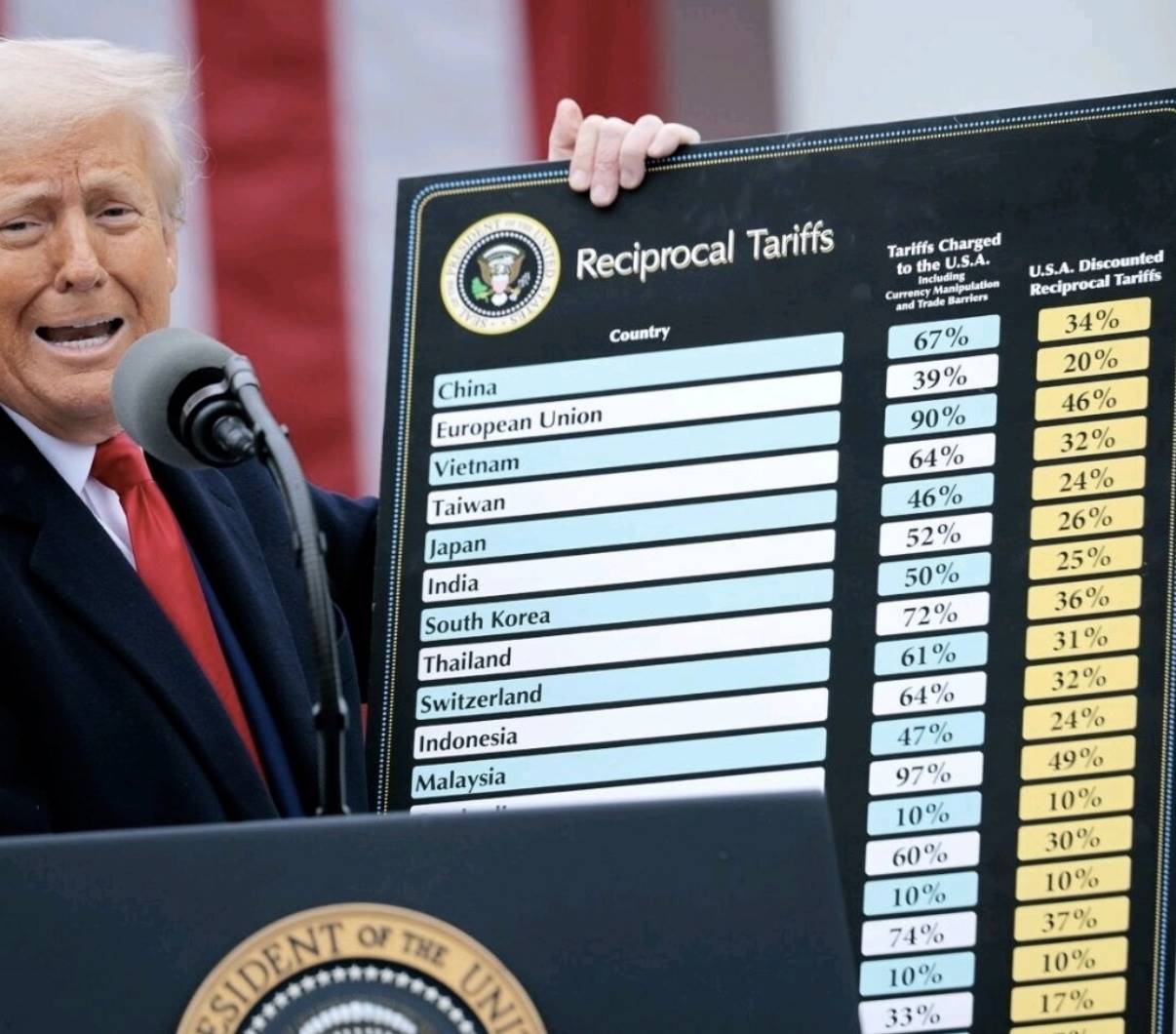
The U.S. President has just upended the global trade landscape with radical and aggressive tariff policies. The potential geopolitical and economic consequences are highly uncertain, sparking intense debate with sharply divided opinions.
Before diving deeper, one point must be clarified: we support free markets and global trade. Trade is inherently voluntary—transactions occur only when both parties believe they benefit. Thus, trade is not a zero-sum game. There are many legitimate reasons for persistent trade imbalances between nations. Based on this, our view is that all tariffs are harmful, and so are all reciprocal tariffs. Tariffs negatively impact global economic growth and productivity.
Nonetheless, significant disagreements remain about how international trade imbalances operate, their causes, and how these tariffs affect capital flows. This article focuses precisely on those issues.
Trump’s Perspective
In Trump’s view, the U.S. has been taken advantage of for decades by its trading partners, with the massive trade deficit serving as proof. These deficits, he argues, result from protectionist policies implemented by major trading partners such as China, the European Union, and Japan.
Trump’s formula for calculating “reciprocal tariffs” reveals his belief that persistent trade deficits have no valid justification and are entirely caused by protectionism.
According to Trump, these protectionist policies include:
-
Tariffs
-
Regulatory policies favoring domestic producers
-
Currency manipulation by exporting countries (such as China, Germany, and Japan) through suppressing their currencies’ exchange rates against the dollar
Due to these policies, America’s manufacturing base has been severely weakened, leaving American workers in difficult economic conditions—workers who form the core of Trump’s “Make America Great Again” (MAGA) political base. By fulfilling campaign promises to create a level playing field, Trump believes American consumers will shift toward buying domestically produced goods, reviving U.S. manufacturing and rejuvenating the economy.
Petrodollar Perspective
Many argue that Trump’s views reflect a fundamental misunderstanding of economics. In reality, the U.S. benefits greatly from trade deficits. Americans enjoy low-cost consumption of goods manufactured in Asian countries like China, Japan, India, Thailand, Vietnam, and South Korea, along with access to cheap oil from the Middle East (or benefit from low oil prices driven by Middle Eastern production).
This makes the U.S. the winner—receiving all the goods—while Asian workers become losers, spending long hours under harsh conditions producing goods for meager pay. This is essentially an “economic magic trick” the U.S. has successfully performed on its trading partners for decades.
The U.S. somehow convinces surplus countries to reinvest their earnings into dollar-denominated assets, sustaining the strength of the dollar and perpetuating this favorable arrangement. Remember, there is no gold standard anymore; trade deficits do not cause the U.S. to lose precious gold reserves. The U.S. can sustain these deficits at almost no cost.
This view stands in stark contrast to Trump’s. While Trump sees the U.S. as losing in trade, the petrodollar perspective sees the U.S. as the biggest winner.
However, this situation is unsustainable because trade deficits accumulate over time. The only reason it has lasted so long is the dollar’s role as the global reserve currency.
After exporting to the U.S., other countries invest their dollar revenues back into the U.S., keeping this “Ponzi scheme” running. Yet eventually, accumulated imbalances may grow too large, causing the entire system to collapse—leaving Americans materially poorer.
To avoid this fate, Americans should invest in gold—and of course, Bitcoin.
To prolong the dollar’s dominance as the global reserve currency, the U.S. has pursued various policies, some conducted secretly. Among the most controversial and covert examples are:
-
Overthrowing Gaddafi’s regime
Libyan leader Muammar Gaddafi was overthrown and killed due to his large gold holdings and plans to settle oil trades in gold. Such a move would have undermined the dollar’s reserve status. Indeed, a 2011 leaked email from Sidney Blumenthal to Hillary Clinton suggests Libya’s gold policy was one factor influencing the decision to attack Libya. (France and the UK also played key roles, not just the U.S.)
-
Iraq War and Saddam’s Oil Policy
In October 2000, Iraqi President Saddam Hussein decided to stop settling oil transactions in dollars and switch to euros. This is believed to be one of the key motivations behind the U.S. invasion and eventual execution of Saddam. Allegations of weapons of mass destruction and poor human rights records were merely pretexts. At the heart of it all were oil and the dollar’s status.
-
Due to such aggressive foreign policies and others, oil exporters like the UAE and Saudi Arabia understand they must continue settling oil trades in dollars and reinvest their oil wealth into dollar assets and U.S. securities—or risk provoking the “wrath” of the U.S. Central Intelligence Agency (CIA) and other military institutions.
Clearly, this perspective contradicts Trump’s surface-level view of global trade. While Trump accuses China of manipulating its currency by suppressing exchange rates, in reality, the U.S. is the one propping up the dollar’s value through various means—some of which are highly controversial or even maliciously intended.
To highlight this contradiction, Trump recently tried to block BRICS nations from creating a currency to compete with the dollar. If successful, this initiative would weaken the dollar while strengthening their own currencies. So here's the question—shouldn't Trump want a weaker dollar? After all, a weaker dollar would benefit the MAGA manufacturing base. Yet Trump’s latest tariff actions accuse BRICS countries of boosting exports to the U.S. by devaluing their currencies—a clearly contradictory set of accusations.
So what exactly does the U.S. want China to do? Buy U.S. Treasuries or sell them? It seems the U.S. tolerates neither choice. Notably, we’re not singling out Trump—many politicians across party lines appear confused about Chinese monetary policy, including Obama and Timothy Geithner, who made similar statements.
Our view is that under the petrodollar framework, U.S. policy centers on preserving the dollar’s global reserve status, while China is preparing for the end of dollar supremacy.
This petrodollar-based worldview may be among the most popular among our readers and Bitcoin advocates. Prominent analyst Luke Gromen is one of its main proponents.
Under this worldview, the dollar’s future faces growing uncertainty. The rise of BRICS nations poses an increasing threat to dollar hegemony.
These countries may gradually abandon the dollar as their primary trade and settlement currency. As a result, the dollar’s global reserve status could weaken at some point, potentially triggering sharp increases in the prices of oil, gold, and even Bitcoin.
If this perspective holds, Trump’s new tariff policies could have particularly severe and dangerous consequences for the U.S. Exporters’ trade surpluses will shrink, meaning they’ll no longer accumulate large amounts of capital annually to invest in U.S. Treasuries and other American assets.
Instead, these countries might begin selling existing U.S. assets to boost domestic consumption and offset losses from reduced exports to the U.S. This chain reaction could catalyze a U.S. Treasury crisis and further erode the dollar’s global dominance.
Capital Flows Perspective
Beyond the petrodollar theory, another less-discussed but equally valuable view exists regarding trade imbalances.
Recall introductory economics: the Balance of Payments (BoP) must always balance. Every buyer of dollars corresponds to a seller.
Thus, if a country runs a trade deficit, it must have a corresponding surplus in its capital account (financial asset flows), and vice versa. But what drives these changes?
It could be hardworking Chinese workers producing high-quality goods that Americans truly desire, driving the U.S. trade deficit and thus the capital account surplus. Alternatively, it could be Chinese investors wanting to allocate capital to the U.S., leading to a capital account surplus, which then necessitates a trade deficit with China.
This view is more optimistic about the U.S. than the petrodollar theory. The U.S. hosts the world’s best companies—those most focused on profits and return on equity. American corporate culture is more meritocratic, less constrained by "networks," family background, race, or gender compared to Europe and Asia. This culture helps attract top global talent.
The U.S. is home to the world’s most innovative firms—Google, Microsoft, Apple, Amazon, Nvidia, Meta, OpenAI, Tesla, Broadcom, Visa, Netflix, and others.
These high-quality, high-growth enterprises attract global investor interest.
Additionally, many Asian investors seek to move capital out of their home countries to protect against government seizure. In contrast, the U.S. offers stronger rule of law and legal protections for investors—at least in theory.
Trump’s claim that Asian exporters manipulate trade by suppressing their currencies is completely wrong. In fact, these countries often try to strengthen their currencies to prevent capital flight.
Under this worldview, the U.S. capital account surplus is driven by these very factors, which in turn leads to the trade deficit. Therefore, persistent trade deficits may not be a problem at all—but rather a sign of success, depending on what drives the outcome.
In our view, these economic fundamentals matter far more to the dollar’s reserve status than U.S. foreign policy in the Middle East. For example, eliminating dictators who attempt to trade oil for gold may have little real effect. This isn’t to defend the hypocrisy and dishonor of U.S. Middle East policy.
Indeed, some within U.S. security agencies may still believe in the petrodollar theory, though it now appears outdated and irrelevant. If not, there are plenty of other dishonest theories to critique.
Moreover, even if competing fiat currencies cannot challenge the dollar—because U.S. investment opportunities are simply more attractive—gold remains a perpetual competitor. The CIA may still need to employ some “dirty tricks” to suppress gold.
U.S. authorities may want global trade settled in dollars not to preserve the dollar’s value, but to enhance control over global financial systems—expanding their ability to freeze assets and block payments, thereby extending global power.
If you accept this view, even if you believe “tariffs are always a bad idea,” Trump’s new tariff policies may not immediately destroy the dollar’s reserve status. Certainly, it remains a tax policy that harms U.S. businesses, weakens the economy, and hurts all sides. But dollar dominance might persist—for now.
Conclusion
The reality of the global economy is complex and dynamic. The petrodollar theory has merit—trade deficits do drive capital inflows. Yet the same phenomenon can be interpreted differently, and those interpretations can also be valid. The reverse causality—that capital inflows drive trade deficits—is equally plausible. In fact, the relationship is bidirectional, and understanding this is crucial to grasping global trade dynamics.
For the U.S., both factors are important, and analysts should not ignore either side. Moreover, Trump’s trade views hold partial validity in certain contexts—some policymakers genuinely believe them. This may explain why politicians sometimes appear inconsistent when discussing currency manipulation by China.
Nevertheless, we maintain that Trump’s overall trade stance is largely untenable. Tariffs are taxes on Americans that weaken the U.S. economy. While the American middle class may have become relative “losers” during globalization—with gains accruing more to elites—this does not mean reversing globalization will make them relative “winners.”
Perhaps Trump will abolish the IRS, replace income taxes with tariffs, and revert to pre-1930s economic policies. That would be another discussion altogether—but we don’t expect that to happen.
One conspiracy theory worth mentioning: Trump announced these tariffs deliberately to crash the economy, lure investors into the U.S. Treasury market, lower yields, and allow the U.S. to refinance its debt at lower interest rates—delaying the inevitable crisis caused by inability to service debt.
In our view, while possible, this scenario is unlikely. Occam’s razor may apply—the simplest explanation is usually the best: Trump simply likes tariffs and even considers them the “most beautiful word” in the dictionary.
Join TechFlow official community to stay tuned
Telegram:https://t.me/TechFlowDaily
X (Twitter):https://x.com/TechFlowPost
X (Twitter) EN:https://x.com/BlockFlow_News
 @BitMEX