








Interview with Robinhood CEO: Want to Tokenize SpaceX Equity and Build an Affordable "Pocket Private Bank" for Everyone
TechFlow Selected TechFlow Selected
Interview with Robinhood CEO: Want to Tokenize SpaceX Equity and Build an Affordable "Pocket Private Bank" for Everyone
"Our goal is to provide all clients with the same access, opportunities, and strategies as high-net-worth individuals."
 Navigating Web3 tides with focused insights
Compiled & Translated: TechFlow
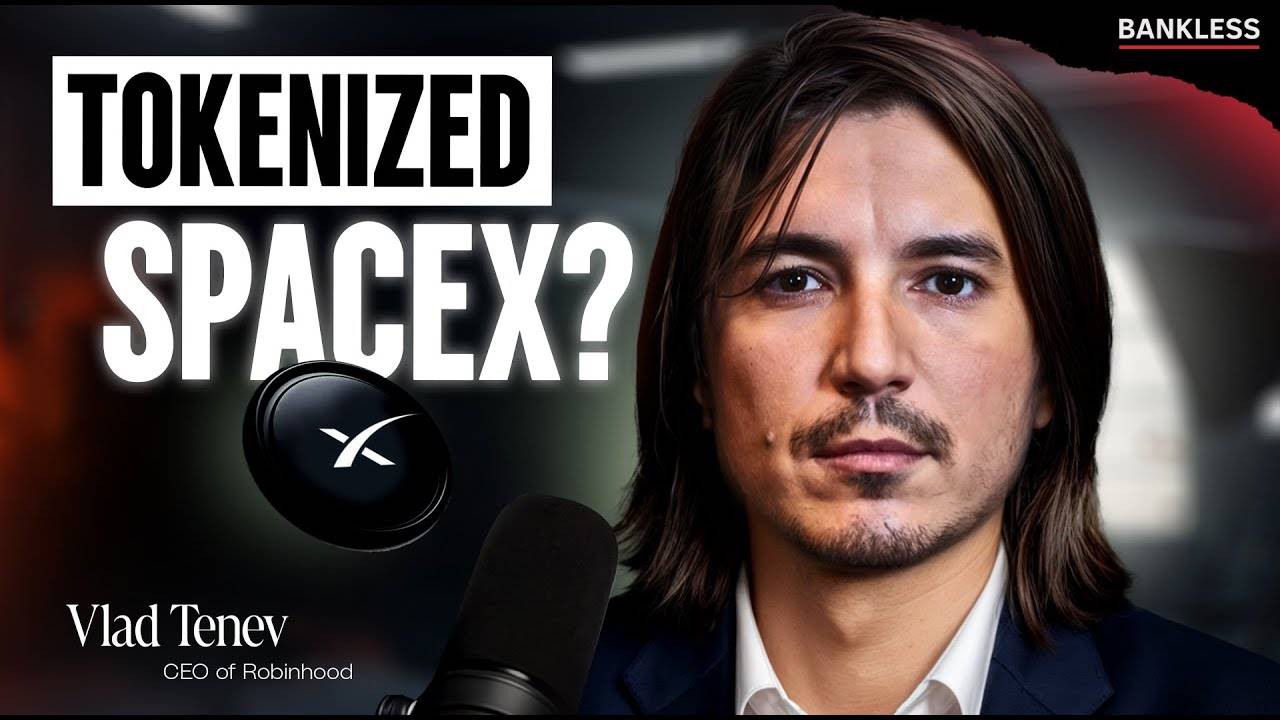
Guest: Vlad Tenev, CEO of Robinhood
Host: David Hoffman
Podcast Source: Bankless
Original Title: Vlad Tenev Wants to Tokenize SpaceX & OpenAI on Robinhood
Release Date: March 31, 2025
Key Takeaways
Robinhood CEO Vlad Tenev returns to Bankless for an in-depth discussion on asset tokenization, crypto regulation, and Robinhood’s latest product launches.
In the interview, Vlad paints an exciting vision for the future: leveraging tokenization technology to bring equity in companies like SpaceX and OpenAI within reach of everyday investors. He also explores how prediction markets can serve as “truth machines,” and details Robinhood's three newest offerings—Strategies, Cortex, and Banking.
Highlights Summary
-
Our goal is to give all customers the same access, opportunities, and strategies available to high-net-worth individuals. This service philosophy mirrors the iPhone’s promise: delivering a luxurious and pride-worthy user experience at an affordable, accessible price point.
-
Among our three new offerings, Robinhood Strategies acts as your digital investment advisor, Robinhood Cortex serves as your research assistant, and Robinhood Banking functions as your personal banker.
-
The SEC announced it has concluded investigations into crypto and several other industry players, which brought us relief—it feels like we as a company and an industry can now move forward without facing endless regulatory attacks.
-
If you can issue a company's token on a blockchain within a given jurisdiction, you instantly gain access to a growing, global market of hundreds of millions of participants. I believe this will ultimately compel the U.S. to embrace tokenization as well.
-
A stablecoin bill may pass first, sending a positive signal for the industry. But we’re more focused on the market structure bill, as it will provide a clear framework for how crypto assets integrate into the real-world financial system.
-
Just as stablecoin legislation could reinforce the dominance of the U.S. dollar globally, I believe tokenized securities can significantly boost the global competitiveness of U.S. companies by expanding their shareholder base worldwide.
-
I’ve always supported a level playing field. I believe the relationship between traditional banking and crypto will become more integrated rather than fragmented in the future. Advantages from traditional banking systems can be adopted in crypto, while many innovations from crypto are well-suited to enrich traditional banking systems.
Views on the New Administration
David:
Vlad, great to have you back on the show. Welcome to Bankless.
Vlad:
Thanks for having me. Great to be here again.
David:
I’d like to start with a major topic in crypto—the changing U.S. regulatory landscape. The new administration has opened up many opportunities for the U.S. crypto industry, especially for institutional investors who were previously hesitant due to regulatory uncertainty. So, under this new leadership, what new opportunities does Robinhood see? What businesses can you now pursue that weren’t possible before? And where will you focus your efforts?
Vlad:
I think the most immediate change is the end of regulation through enforcement—a significant improvement being freed from constant, broad-based attacks on every aspect of our crypto business. For example, the SEC announced it has concluded its investigations into crypto and several other industry companies, which brought us a sense of relief—finally, we as a company and an industry can move forward without enduring endless legal assaults. The previous administration clearly viewed crypto as something that shouldn't exist in any meaningful form or integrate with traditional finance. So this is a big step forward. Additionally, two important pieces of legislation are now moving forward.
Furthermore, the legal status of Memecoins has also become clearer. Recently, the SEC released a memo explicitly stating that Memecoins do not qualify as securities. While legally straightforward, until now each company had to conduct individual security analyses for each coin—an expensive and time-consuming process. At Robinhood, we’ve always prioritized compliance, conducting rigorous securities analysis for every coin we list. Therefore, this clarity is extremely helpful.
Likewise, clarity around whether staking constitutes a security is also increasing. This is another positive development. Staking involves users contributing their computing power to support blockchains. Staking providers aim to simplify this process, typically generating higher yields and putting more crypto in users’ pockets. A lack of regulatory clarity actually harms American consumers by preventing them from accessing these higher-yield opportunities through regulated platforms.
So this kind of clarity is welcome. Two key legislative efforts are currently underway: one on stablecoins, and another on market structure. The stablecoin bill may pass first, which would be a positive signal for the industry. However, we’re more focused on the market structure bill because it will establish a clear framework for how crypto assets fit into the real-world financial system. For instance, which crypto assets are securities versus commodities? What steps must platforms take to list crypto securities? Answering these questions will unlock massive potential for the industry.
I believe these are pivotal issues, and legislation will help answer them, unlocking the true potential of crypto technology—something we’re very excited about.
You mentioned some firms are already experimenting with combining stablecoins and banking services, such as generating yield via staking or pooled funds. I believe the market structure bill will pave the way for such products and foster greater competition. Currently, stablecoins haven’t fully reached this stage because regulations around yield-bearing stablecoins remain unclear. More regulatory clarity is needed to build this on a stronger foundation—but we’re optimistic it’s coming, and the trend is clearly moving in a positive direction.
David:
If I understand correctly, many potential product lines are still theoretical. Only after the market structure bill passes can we truly begin building and launching products, correct?
Vlad:
Yes, for example, a yield-bearing stablecoin that directly pays interest to holders—functioning much like a money market fund. The underlying assets of stablecoins often include safe instruments like Treasuries. Structurally, stablecoins and money market funds are very similar, but due to regulatory ambiguity, they're treated as entirely different things. I believe this is exactly where regulation can play a constructive role.
Benefits of Tokenization
David:
What about the area of tokenization? I think it's a very hot topic, as it represents a bridge between traditional banking, traditional finance, and the crypto world—essentially enabling us to tokenize more assets and begin harnessing the value of public, permissionless blockchains.
What role does Robinhood play in this tokenization movement? I assume you’re bullish. Do you see yourselves as issuers, a platform? Will Robinhood create tokenized products, or are you more inclined to become a marketplace for them? Where do you position yourselves in the tokenization tech stack?
Vlad:
By definition, tokenization refers to placing representative ownership of non-native crypto assets onto a blockchain so they can be freely traded.
We've already seen this with stablecoins, which are essentially tokenized U.S. Treasuries. Additionally, Paxos offers a tokenized gold product, which is quite interesting. We actually partnered with Paxos and several other firms to launch USDG—the Dollar Global Network—aimed at creating a globally accessible stablecoin that pays attractive yields to holders.
The next logical step is the tokenization of securities, which excites us greatly. It enables people to own companies in the same way stablecoin legislation helps secure the global dominance of the U.S. dollar. That’s why people are so excited. Everyone wants U.S. dollars and U.S. Treasuries to be widely accepted and purchasable—these products are in high global demand.
Just as stablecoin legislation can strengthen the dollar’s global dominance, I believe tokenized securities can significantly enhance the global competitiveness of U.S. companies by expanding their shareholder base worldwide. Right now, it's extremely difficult for overseas investors to access U.S. companies. Just as stablecoins make accessing the dollar easy, tokenized securities will make accessing U.S. companies simple. We’re excited about this—not only because it benefits companies, but also because it empowers people outside the U.S. to access powerful wealth-building tools. It also offers diversification, especially valuable when local currencies suffer sharp devaluations, helping protect purchasing power.
I believe it also benefits our entrepreneurs in capital formation. If U.S. startups can raise capital more easily by tapping into the global crypto market, we’ll see more innovative companies emerge. A few months ago, we published an op-ed in The Washington Post arguing for the case of tokenizing private securities. Right now, investing in private companies like OpenAI or SpaceX is extremely difficult—I believe crypto can solve this problem. Tokenizing private companies would benefit both companies and investors alike. It’s astonishing to me that investing in firms like SpaceX and OpenAI remains so restricted, yet we now have clarity on Memecoins, allowing people to invest in them relatively freely.
Tokenizing SpaceX
David:
From what we know, there appears to be existing trading of SpaceX equity in the market. Finding a way to access SpaceX shares isn’t far-fetched. So, if I understand you correctly, since this market already exists in the private sphere, we can tokenize these shares and use crypto technology to turn it into a more formal, structured market. Then I imagine Robinhood would be eager to become the marketplace serving these tokenized equities. If I piece this together, it seems like a very feasible future. Is this part of your roadmap? How close are we to seeing tokenized SpaceX equity on Robinhood?
Vlad:
Yes, I think Robinhood sits precisely at the intersection of traditional finance and crypto. We possess all the crypto technology and also maintain traditional financial infrastructure. Therefore, I believe tokenized equities represent one of the key areas where we can contribute meaningfully to the broader ecosystem.
Future tokenized equities might operate similarly to ETFs (exchange-traded funds). An ETF issuer holds a basket of securities and then issues shares of the ETF—this is actually a precursor to tokenized securities. In traditional finance, you can bring a basket of securities to the ETF issuer and receive ETF shares in return, or vice versa. This is already happening in traditional finance, and tokenization can evolve this model using crypto technology.
Alternatives to IPOs
David:
The number of public market IPOs hasn’t declined dramatically, but the overall trend is downward. This is largely because IPO costs are prohibitively high, making entry into public capital markets increasingly difficult for companies. Do you think this trend will accelerate the prospects for private market tokenization? Or is it too complex from a national compliance and regulatory standpoint?
Vlad:
I believe the trend toward tokenized securities indeed paves the way for alternatives to IPOs. While this may not happen in the U.S. in the short term, it’s already emerging internationally. Many countries are establishing frameworks for issuing crypto securities, and crypto itself is inherently global. If you can issue a company’s token on a blockchain within a single jurisdiction, you immediately tap into a growing, liquid global market of hundreds of millions of participants. I believe this will eventually compel the U.S. to follow suit.
For private companies, especially in early stages, this serves as primary capital—akin to raising funds from shareholders during a traditional IPO. Early-stage primary capital is highly valuable. As an entrepreneur running a seed-stage startup myself, I remember how fundraising consumed enormous amounts of time and energy—resources that are especially precious when you’re a small company. If tokenization allows founders to quickly access global capital markets, it becomes an excellent option for early-stage entrepreneurs. It not only helps more companies secure funding during their highest-risk phase but also opens up high-return opportunities for investors.
For mature private companies like OpenAI or SpaceX, the value proposition differs. At this stage, it may be less appealing to founders who’ve already raised substantial capital and may be planning an IPO or other exit. But it’s highly attractive to employees. These companies employ thousands of people seeking liquidity, yet they don’t know when an IPO or liquidity event might occur. Employees want to diversify their holdings—that’s a compelling value proposition.
There are secondary platforms like Equity Zen or Forge operating in this space, actively reaching out to employees of these companies because they represent a clear audience seeking diversification and willing to sell secondary shares. However, the issue with these models is that liquidity is fragmented—platforms must manually source supply and attract buyers. Crypto, by contrast, benefits from interoperability. Simply placing shares on a blockchain enables free trading and instant access to global liquidity. That’s why I believe it’s a superior technological solution.
David:
Indeed, several trends point clearly in this direction. There are also many outstanding companies—like SpaceX and OpenAI—that remain private and seem unwilling to go public. AI labs, as a broad category, generally lack public equity, while giants like Facebook or Google have grown so large that their stock functions almost as diluted investment vehicles.
Vlad:
As an ordinary investor, your options to gain exposure to AI are very limited. You can invest in NVIDIA, Alphabet, or Tesla, but you can’t access exciting AI companies like OpenAI, Anthropic, or Perplexity.
David:
Looking back over decades of market trends, it’s clear that today’s greatest opportunities lie not in public markets, but in private ones. As I mentioned earlier, IPO compliance costs keep rising, while crypto offers a technological solution. I see multiple tailwinds converging toward an inevitable conclusion: tokenizing private market equities and turning them into a sort of pseudo-public market.
Prediction Markets
David:
I’d also like to discuss prediction markets, since Robinhood has entered this space. Robinhood has a slogan—“Everything is a Market.” Is that my misunderstanding, or is that an official brand objective?
Vlad:
We don’t actually use that slogan. Our company name is Robinhood Markets, which is our parent entity. Our mission is “democratizing finance for all.” This means we believe in the power of markets and are committed to giving everyone fair access to participate. Generally speaking, if an institutional market exists and retail users are interested, they should be allowed to participate on equal footing.
This applies equally to prediction markets. But I believe prediction markets offer additional societal value. To me personally, robust prediction markets deliver benefits beyond trading—they enable better forecasting across various events. We saw this during elections, where prediction markets provided insights hours or even days ahead of traditional media. I expect to see this across many categories. I believe prediction markets are “truth machines”—they represent the evolution of news, the evolution of newspapers. In some cases, you can even get news from prediction markets before events actually happen.
Kalshi Platform
David:
Like many others, I hosted an election party. While watching mainstream media coverage, I discussed the race with crypto-savvy friends. Alongside traditional news, we opened Polymarket. We alternated between checking Polymarket and mainstream outlets—Polymarket data was more real-time and clearly more engaging. Recently, Robinhood made an announcement—I’ll read it aloud, then we can dive deeper into prediction markets.
Recently, Robinhood launched a prediction market hub, allowing customers to trade outcomes of some of the world’s biggest events. Initial markets include forecasts on the upper bound of the Federal Funds rate, as well as results from the upcoming NCAA men’s and women’s basketball tournaments. Though different in nature, both markets are highly appealing. You’ve partly answered my question—why integrate prediction markets into the platform. But notably, this prediction market product is powered by Kalshi. Can you talk about the partnership between Robinhood and Kalshi? What specific role does Kalshi play in these prediction markets?
Vlad:
Kalshi is a Designated Contract Market (DCM). Think of a DCM as analogous to an exchange—like a stock exchange. In equities, exchanges like Nasdaq and NYSE exist. Brokers, including Robinhood, connect to these exchanges or to market makers trading on them. Buyers and sellers meet on these venues, which effectively create the market.
In equities, Robinhood is a broker—we receive customer orders and route them to market makers or directly to exchanges. In the futures space, which falls under CFTC oversight, there are DCMs—markets where buyers and sellers meet, functioning like exchanges. Then there are Futures Commission Merchants (FCMs), and in this case, Robinhood is an FCM. We handle customer relationships and interfaces, routing orders to the DCM and facilitating execution via market makers.
So you can think of Kalshi as similar to Nasdaq or NYSE, while we play the traditional broker role. During the presidential election, we connected to a different DCM called Forecast Decks, a subsidiary of Interactive Brokers. We have the capability to connect to multiple DCMs and offer the diverse products they list. Importantly, DCMs bear ultimate responsibility for listing contracts. So any contract we offer must first be listed on a DCM.
David:
So you can’t run your own prediction markets—you must rely on third-party DCMs.
Vlad:
Yes, platforms like Polymarket cannot legally operate prediction markets in the U.S. because they aren’t DCMs. They use a crypto-native approach. This is exactly one of the issues that need clarification in the market structure legislation we discussed earlier. The CFTC regulates these as commodities and requires specific licensing. Would prediction markets like Polymarket fall under this regulatory umbrella? Or, because they’re crypto-based, would they face different rules? These are the kinds of questions that require legislation to allow large-scale prediction markets like Polymarket to operate legally in the U.S.
Future of Prediction Markets
David:
I think many listeners would love to use Polymarket in the U.S. One final question on prediction markets: currently, Robinhood’s prediction markets start with Fed Funds rates and college basketball games—what’s next? What kinds of prediction markets can users expect on Robinhood in the future?
Vlad:
With our latest round of contract market expansion, we’ve evolved from being able to list just one contract to simultaneously offering hundreds. Of course, this involves operational complexity around clearing, payments, and setting up new contracts—especially those dependent on prior contract data, as seen in college basketball predictions. Soon, we’ll scale from hundreds to thousands of contracts, opening the door to a wide variety of prediction markets.
We’re particularly interested in economic prediction markets, and I’m also very interested in progress in artificial intelligence. There are some fascinating prediction markets providing clear signals about various AI developments—I believe our customers will find these highly engaging. Actually, I think prediction markets should cover as broadly as a newspaper. Newspapers have front-page news, sports, business, arts, and leisure sections—prediction markets can be organized similarly, offering users comprehensive insight.
David:
Prediction markets as truth machines—I think that’s one reason crypto enthusiasts are so drawn to them. There have also been some significant, sensitive geopolitical events—for example, tensions between Israel and Iran—where Polymarket hosted prediction markets that actually reflected genuine market sentiment about future outcomes, despite being highly impactful and sensitive topics. If we enter a period of unstable geopolitics, people will increasingly want to understand market perceptions of likely outcomes. What are your thoughts on integrating high-risk global macro-geopolitical prediction markets into Robinhood?
Vlad:
I believe this is socially important. The CFTC currently has guidelines for prediction markets and event contracts, broadly stating that markets contrary to public interest should not be listed. I think this is a somewhat vague, general category, but we should strive to limit such restrictions—because I genuinely believe the vast majority of prediction markets serve the public interest.
Robinhood’s Three New Businesses
Robinhood Banking
David:
You held a major event—similar to a Robinhood summit—announcing three new business lines: Robinhood Strategies, Robinhood Banking, and Robinhood Cortex. Let’s start with Robinhood Banking. Can you walk us through this product and explain why you created it?
Vlad:
The overarching inspiration comes from our goal: giving all customers the same access, opportunities, and strategies enjoyed by high-net-worth individuals. We want to put a sophisticated, high-net-worth family office-style financial team into everyone’s pocket—at a price of just $5 per month for Gold subscribers. This service philosophy mirrors the iPhone’s promise: delivering a luxurious, pride-worthy experience at a universally affordable price.
This is the unifying thread behind the three products we announced at the Gold event. Strategies is your digital investment advisor,Cortex is your research assistant, and Robinhood Banking acts as your personal banker. I believe this marks the first AI-powered product we’ve launched within Robinhood. Going forward, you’ll see the latest intelligent and reasoning models further integrated into the product experience, blending these components seamlessly to deliver an exceptional, cohesive user experience.
Robinhood Cortex
David:
When I saw the announcement, I thought: “Wait—did Robinhood just launch an AI agent?”
After digging deeper, I realized the functionality makes a lot of sense. Can you give an example of how users might interact with Robinhood Cortex? I assume it’s embedded in the Robinhood app, allowing users to ask various finance-related questions. Is it a finance-focused large language model (LLM)? Or a pop-up window? Could you elaborate?
Vlad:
Currently, Cortex has two main use cases within the Robinhood app. The first is explaining real-time stock movements. If you use Robinhood, you might occasionally get notifications about market volatility—say, a stock surging or dropping 5%. A typical next step is to check the stock and figure out why. Cortex answers this right on the stock detail page, analyzing and explaining the likely causes of the movement—this covers the stock dynamics aspect.
The second use case is options trading. Options are complex—you deal with vast amounts of information and need significant experience, especially when constructing multi-leg options trades. Cortex enables this through a trade builder: you express a view on a stock’s future price movement, and Cortex constructs an options trade to execute that view. It’s a magical experience. At the Gold event, we demonstrated it—you pick a stock, state your prediction, and it generates a trade plan ready for execution, or guides you to our upcoming side-by-side options chain interface.
David:
The core idea of Cortex is translating users’ natural-language investment ideas into trading strategies. Users input their thoughts,AI processes them, and returns possibleoptions trading combinations—like “here are trades you might be interested in.” Is that the fundamental logic behind Cortex?
Vlad:
But it goes beyond that. Cortex synthesizes all available data—real-time market feeds, technical indicators, and news updates from multiple sources. By integrating this information, it doesn’t just generate predictions—it provides insights and analysis to help users make better decisions.
David:
Could you speak to what makes this LLM unique? I assume it’s not just a thin wrapper over ChatGPT, but specifically optimized for finance. What’s special about itstraining data, or what post-training refinements make it a Robinhood-specific financial LLM?
Vlad:
Traditional large language models usually can’t access real-time market or financial data. Their knowledge is often outdated, so they can’t accurately tell you a stock’s current price. They’re also prone to “hallucinations” when providing financial information—generating false or inaccurate content. To address this, we built a technical layer ensuring data is real-time, interpretable, and hallucination-resistant. This solves two critical problems most LLMs face in financial applications.
David:
If we don’t handle this properly, hallucinations in a financial context could be catastrophic.
Vlad:
Yes, but fortunately, we have access to verifiable data sources. Unlike writing a history paper, financial data can be objectively verified. This allows us to implement strict “guardrails” to ensure accuracy and quickly detect and correct hallucinations.
David:
This might be Robinhood’s key competitive advantage in developing financial AI assistants—your access to real-time market data, user behavior data, and vast financial resources, all integrated into the LLM’s capabilities.
Vlad:
Yes, that’s an advantage. Another is that users can trade directly within our app. If we can tightly couple Cortex’s recommendations with users’ actual trading context, its utility increases dramatically. We didn’t want to just drop a chatbox into the app—people wouldn’t know how to use it. We want Cortex to generate concise, useful responses and avoid verbosity and hallucinations—that’s our focus.
Robinhood Strategies
David:
Regarding Strategies, is there a possibility to expand this product into the crypto asset space? In the crypto world, many people are constantly asked by friends: “Which crypto should I buy? How should I invest in crypto?” because they genuinely don’t know. If the Strategies product could support complex, crypto-centric investment strategies, that would be highly attractive. What would it take to make that happen?
Vlad:
Technically, we face no obstacles. In fact, we have a feature roadmap listing dozens, even hundreds, of potential additions to the Strategies product. Our priority is meeting the most urgent customer needs.
Right now, we’ve built a solid foundation. We started with individual stocks because most other digital advisory platforms only support ETFs. We developed the ability to include individual assets and stocks in portfolios. Of course, we also support ETFs and designed intuitive interfaces—like pie charts showing asset allocation clearly. We also offer automatic rebalancing, helping users adjust portfolios as markets shift, making investing more effortless.
I believe we’ve established a strong base. We chose to start with individual stocks because most digital advisors only offer ETFs. So we built the capability to include single assets and individual stocks in portfolios. We support ETFs too, and we’ve built a clean interface—like a ring chart that clearly shows your asset mix. We can rebalance on behalf of clients. So it’s as close as possible to a “set-it-and-forget-it” investment button.
I also want to highlight a unique aspect of Strategies: it flips the traditional fee model. Traditional advisors typically charge an assets-under-management (AUM) fee—around 1%. Robo-advisors charge less, maybe 0.25%. But proportional fees have a flaw: as portfolio size grows, fees increase, but the service effort doesn’t scale accordingly. Managing a $1 million portfolio isn’t ten times harder than managing $100,000—but the client pays ten times more. This can frustrate high-net-worth clients who pay more without receiving proportionally more value.
To fix this, Robinhood Strategies uses a capped fee model—no matter how large your portfolio, fees never exceed $250 annually. So for someone with $1 million in assets, switching to Robinhood Strategies offers tremendous value.
David:
How does this fee model affect product incentives? Since it’s no longer driven by assets under management (AUM), but instead by customer count, how does Robinhood benefit from user growth in Strategies—especially with a $250 cap per customer?
Vlad:
Indeed, this model attracts more high-net-worth clients to move assets to our platform. Our revenue primarily comes from asset management fees. We also benefit from Robinhood Gold subscriptions. We’ve found that once users become Gold subscribers and allocate a meaningful portion of their wealth to us—say, $1,000—they discover more value and tend to adopt additional services, like our credit card and self-directed trading features.
So our goal is to capture as much of the customer’s financial life as possible, making it easier for them to consolidate everything on Robinhood. Meanwhile, as total managed assets grow, so does our revenue.
Cash Delivery
David:
About this new product suite, I have two more questions. One is about your cash delivery service. I describe it as “cash delivery via Uber Eats,”—is that accurate? Why launch such a service? How does it work? For example, how do users initiate it in the app, and how is cash delivered?
Vlad:
That’s a fair analogy. We’re effectively entering the logistics space, which excites me. This service targets high-end private banking clients, driven by two key reasons.
First, we don’t have physical branches. So we asked: how can we deliver digital banking services without compromise? Without branches, users needing cash often resort to convenience stores like 7-Eleven or CVS. But that doesn’t align with the premium experience expected from private banking. By the way, 16% of U.S. payments are still cash-based. While declining, cash remains vital in many scenarios. We needed a new solution—one where banking services come directly to the user.
Today’s on-demand logistics platforms are incredibly powerful. They can deliver items in 10 or 15 minutes—you can have an iPhone delivered to your home. This presents a viable solution. Of course, we won’t manage the entire logistics chain ourselves—we’ll partner with others. It’s complex, but we believe it delivers immense value.
As we roll out the service, we’ll learn more about real-world operations—what challenges arise, what users really want, and typical transaction sizes. I expect average transactions to be in the low hundreds of dollars.
Listing More Cryptocurrencies
David:
Back to crypto assets—does Robinhood plan to list more cryptocurrencies? Currently, the selection in the Robinhood app is relatively limited. Will you expand your offerings?
Vlad:
Yes, since the election, we’ve added many new assets. I think we now cover most high-volume assets our customers care about. For example, Trump Coin, launched on inauguration day, was widely embraced. We keep adding new assets, but now dozens or even hundreds of new tokens emerge weekly—so we realized we need to rethink our listing process to handle this scale efficiently.
Next, you’ll see more developments with the Robinhood Wallet. The Robinhood Wallet is a decentralized finance (DeFi)-based, on-chain product, but currently lacks tight integration with the main Robinhood app. Over time, I believe the two will gradually converge. We plan to add on-chain features to the main app and make the wallet app more seamless for fiat-to-crypto conversions.
I believe Robinhood—and the industry overall—will move toward tighter integration. Under this trend, listing barriers will lower, and the process will become more automated. If we identify an asset with high trading volume, we’ll optimize backend systems to streamline and simplify its listing.
Our goal is to offer customers more choice, while ensuring they aren’t overwhelmed by hundreds of new tokens appearing weekly. With explosive growth in asset types, distinguishing high-quality from low-quality tokens is increasingly difficult. We need to solve this—avoid promoting unreliable tokens, and prevent customers from investing unknowingly.
Why Separate Multiple In-House Apps?
David:
You have the Robinhood Wallet, the core Robinhood app, and Robinhood Credit Card—which I believe is part of the Robinhood Banking initiative. Is this app separation mainly due to regulatory and compliance considerations? Do you plan to eventually consolidate all features into a single super-app-like product?
Vlad:
We initially considered consolidating everything into one app, but found it challenging. An app serving both active traders and banking users must tailor its homepage experience precisely to very different needs. Traders prioritize market data and trading actions, while banking users need smooth payment and account management. Most users naturally prefer separating trading and banking interfaces. While theoretically possible to unify them, no one has done it successfully yet. So I remain open-minded and willing to experiment.
The super-app concept is appealing—we might build a fully featured app—but I don’t believe all functions must live in one place. What matters more is unified KYC and seamless fund transfers between accounts. Beyond that, we want to design optimal interfaces based on actual user needs. In the future, we may add more features to the main Robinhood app while encouraging teams to develop standalone apps. Ultimately, we might end up with more than three apps. Like Uber and Uber Eats, we may recombine or split apps based on operational experience to better meet user demands.
How “Bankless” Is Robinhood?
David:
Vlad, as we wrap up, I’d like to discuss Robinhood’s relationship with crypto and fintech. As you know, this podcast is called “Bankless,” and we advocate decentralization—self-custody of finances and crypto assets. Some parts of Robinhood feel very “banked,” like your new banking products. I believe crypto, especially DeFi, holds advantages over traditional finance—consider how traditional savings accounts offer only 0.25% APY, like at Wells Fargo—terrible products, with innovation stuck in old, legacy systems.
Still, I appreciate how Robinhood brings real competition to traditional finance. I’ve also noticed that while Robinhood isn’t fully decentralized, more and more crypto features are being integrated into your products. So my question is: How decentralized is Robinhood? What’s the future direction? Where do you see the balance point between decentralization and traditional models?
Vlad:
Actually, Robinhood is “bankless”—we don’t hold a banking charter. Many people ask if we’ll apply for one and what that would mean. Traditional financial firms need bank charters to access Fed Wire, Zelle, and to offer lending. But our current model is as a neutral platform partnering with banks to deliver necessary services. For example, we work with Coastal Community Bank for credit and banking services, and other partners for our cash sweep program.
In fact, many large crypto and decentralized finance (DeFi) protocols still rely on banks behind the scenes. If users want to move fiat onto the chain, banks remain essential in that process. I believe that as regulatory frameworks clarify, we may see “crypto banks” emerge—entities with some form of license, possibly under lighter requirements than OCC national bank charters, but still subject to treasury and reserve rules. After all, without rules, users can get hurt—look at Terra Luna’s Anchor Protocol or Celsius. These bank-like protocols failed catastrophically due to missing regulatory safeguards.
I’ve always supported a level playing field. I believe the relationship between traditional banking and crypto will become more integrated rather than fragmented. Advantages from traditional banking systems can be adopted in crypto, while many innovations from crypto are well-suited to enrich traditional banking systems. We’re at a pivotal moment where combining the two can deliver more practical solutions for users. It’s an exciting opportunity for both the crypto industry and consumers. If Robinhood can play a small role in driving this convergence, I believe that would be deeply meaningful.
Join TechFlow official community to stay tuned
Telegram:https://t.me/TechFlowDaily
X (Twitter):https://x.com/TechFlowPost
X (Twitter) EN:https://x.com/BlockFlow_News
 深潮TechFlow


