Fortune Exclusive: a16z’s Crypto Fund AUM Plummets 40%; Multicoin Cuts in Half; Top Crypto VCs Collectively Shrink
TechFlow Selected TechFlow Selected
Fortune Exclusive: a16z’s Crypto Fund AUM Plummets 40%; Multicoin Cuts in Half; Top Crypto VCs Collectively Shrink
The only firm showing逆势 growth was Haun Ventures, which successfully bet on the stablecoin sector when BVNK was acquired by Mastercard.
 Navigating Web3 tides with focused insights
Author: Ben Weiss
Translation & Editing: TechFlow
TechFlow Intro: A Fortune reporter obtained a batch of previously undisclosed financial disclosure filings from U.S. venture capital (VC) firms in the crypto space—filed with the U.S. Securities and Exchange Commission (SEC). The data shows that assets under management (AUM) for top-tier crypto VCs—including Paradigm, Pantera, a16z crypto, and Multicoin—contracted across the board in 2025. Yet this contraction isn’t all bad news: a16z crypto returned capital to limited partners (LPs) at the market peak, achieving a net DPI (distribution-to-paid-in capital ratio) of 5.4x for its inaugural fund. The sole exception was Haun Ventures, which posted逆势 growth—its AUM rose over 30%, largely thanks to its investment in BVNK, acquired by Mastercard.
The leading crypto VCs failed to escape the 2025 market crash.
Fortune reporter Ben Weiss obtained a set of previously undisclosed investment adviser financial disclosure filings from the U.S. Securities and Exchange Commission (SEC). The numbers speak plainly: AUM for elite firms like Paradigm and Pantera Capital collectively shrank in 2025.
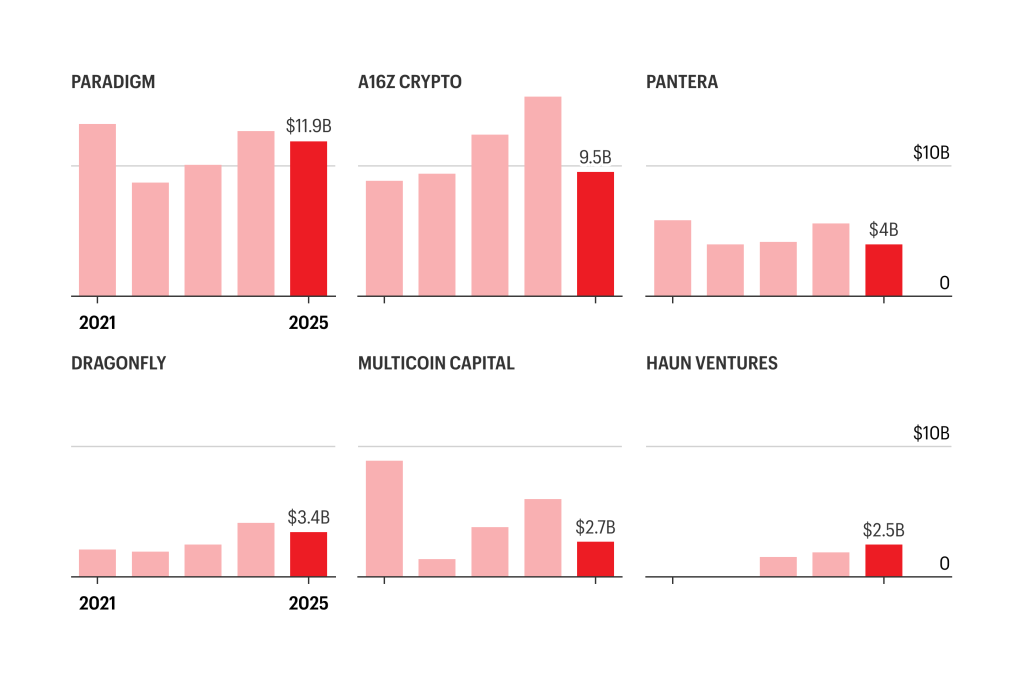
Caption: AUM changes for top crypto VCs, 2021–2025
Chart: Ben Weiss / Fortune
Before diving into the figures, one critical point must be clarified upfront: AUM is not a reliable metric for judging VC success. It does not reflect new fundraising rounds, LP exits or distributions, nor capital calls. Crypto asset prices are inherently volatile—just one tweet from an emotionally volatile man can send token prices on a rollercoaster ride (take your pick: Musk, Trump, or CZ). Veteran crypto VCs have witnessed both the explosive portfolio gains during the 2021 NFT boom and the subsequent steep declines amid the “crypto winter.”
Original author Ben Weiss also stresses: Truly top-tier investors ultimately return capital to LPs. Short-term AUM fluctuations do not equate to performance quality.
With that context established, let’s examine the specific data.
a16z crypto: AUM down nearly 40%, but capital returned to LPs
AUM across a16z crypto’s four crypto-focused funds plunged nearly 40% year-on-year to $9.5 billion in 2025. Over the same period, its parent firm Andreessen Horowitz saw its total AUM swell to over $100 billion.
Part of the decline stems from the firm actively distributing returns from its first three funds back to LPs. According to insiders, a16z crypto deliberately timed these distributions to coincide with the 2025 crypto market peak.
How effective was this strategy? Per Newcomer data, a16z’s inaugural crypto fund achieved a net DPI of 5.4x—impressively high compared to other VC funds raised in 2018 and listed on Carta’s platform.
In short, a16z crypto’s AUM contraction reflects “earning returns and returning capital to LPs,” rather than “portfolio value collapse.”
Multicoin: AUM halved to $2.7 billion
Multicoin Capital’s fortunes remain tightly coupled to the broader crypto market. During the 2021 crypto boom, its AUM nearly tripled within a single year, approaching $9 billion. After the FTX collapse, it plummeted sharply—only to rebound gradually over the next two years.
Yet the 2025 downturn reversed those gains. From 2024 to 2025, Multicoin’s AUM fell by more than half, landing at approximately $2.7 billion. Since Bitcoin began its sharp decline in October 2025, crypto assets broadly retreated—and Multicoin, operating both a hedge fund and a VC fund, bore the brunt.
Background note: Kyle Samani, Multicoin’s co-founder, left the firm in February this year to pursue investments in other technology sectors.
Pantera: Five portfolio companies IPO’d, returning capital to LPs
Pantera Capital’s AUM also contracted—but, like a16z, part of the decline reflects intentional distributions to LPs.
According to insiders, Pantera had five portfolio companies go public in 2025—including Circle and BitGo—generating substantial cash inflows.
Haun Ventures: The sole outlier—AUM up over 30%
Amid widespread AUM contractions, Haun Ventures stands alone as the exception.
Founded by Katie Haun, former a16z crypto partner, the firm’s AUM grew over 30% year-on-year, nearing $2.5 billion. One key driver was its successful bet on the stablecoin sector: its portfolio company BVNK was acquired by Mastercard for up to $1.8 billion. Additionally, Haun Ventures raised a new $1 billion fund in 2025.
New fundraising rounds already underway
Despite shrinking AUM, top-tier firms haven’t paused their activities:
Paradigm is raising a new fund of up to $1.5 billion. a16z crypto is raising up to $2 billion. Dragonfly recently closed its fourth fund at $650 million. Following publication, Fortune issued a correction: Dragonfly’s spokesperson confirmed the data is “accurate” and stated, “We are actively deploying capital.”
Spokespersons for Paradigm, Pantera, a16z crypto, Multicoin, and Haun Ventures all declined to comment.
The cyclical fate of crypto VCs
The original article ends here—but several contextual points warrant elaboration.
Crypto VCs differ fundamentally from traditional tech VCs. Traditional VCs invest in equity, exiting via IPO or M&A. Many crypto startups issue their own tokens, exposing VC holdings directly to token price volatility.
Multicoin represents the most extreme case: per a prior Fortune report, its assets surged 20,287% between 2017 and 2021—then retreated 90% in 2022. Such swings are unimaginable in traditional VC.
Per Pantera Capital’s early-2025 outlook report, the total market cap of non-Bitcoin crypto assets (excluding ETH and stablecoins) fell roughly 44% from its late-2024 peak. Yet historically, bear markets also present buying opportunities. Top firms’ current wave of fundraising signals their bet on the next cycle.
As previously reported exclusively by Fortune, a16z crypto’s fifth fund aims to close in H1 2026, led by Chris Dixon, with continued full commitment to blockchain. Meanwhile, according to The Wall Street Journal, Paradigm’s new fund will expand into AI and robotics—a clear strategic divergence: a16z remains all-in on crypto; Paradigm opts for cross-sector hedging.
Join TechFlow official community to stay tuned
Telegram:https://t.me/TechFlowDaily
X (Twitter):https://x.com/TechFlowPost
X (Twitter) EN:https://x.com/BlockFlow_News
 @FortuneMagazine