Interview with Ava Labs President: TSMC Is Still Undervalued; Micron’s Trading Price Is Below 10x Next Year’s Earnings
TechFlow Selected TechFlow Selected
Interview with Ava Labs President: TSMC Is Still Undervalued; Micron’s Trading Price Is Below 10x Next Year’s Earnings
“TSMC has historically been a low-volatility, stable, high-quality company, and its valuation has consistently been fair relative to its own historical multiples. However, relative to other AI stocks—and considering its growth rate—it remains very inexpensive.”
 Navigating Web3 tides with focused insights
Compiled & Translated by TechFlow

Hosts: David, Bonnie
Guest: John Wu (Former Technology Investor at Tiger Global, Current President of Ava Labs)
Original Title: Is TSMC Severely Undervalued? Are Taiwanese Engineers the “Strongest Moat”?
Podcast Source: Bonnie Blockchain
Air Date: May 29, 2026
Editor’s Introduction
This episode features John Wu, former technology investor at Tiger Global and current President of Ava Labs. He argues that, relative to other AI-related stocks, TSMC remains undervalued—and that Asia holds a structural advantage in AI hardware and electrical engineering, precisely the most scarce layers of today’s AI stack.
He also unpacks two “non-price” drivers behind Bitcoin’s current mini-bull run: OG whales have largely completed their token rotation into Michael Saylor’s holdings and ETFs; meanwhile, RIA (Registered Investment Advisor) channels—controlling trillions of dollars in assets—require a four-to-six-month “education cycle” before actively recommending crypto to clients.
Additionally, he reveals for the first time details of Broadridge’s partnership with Avalanche to launch on-chain equity—processing $8 trillion in tokenized assets monthly—and responds, from an operator’s perspective, to market fears around “AI disrupting SaaS.”
Key Quotes
TSMC and Asian AI Hardware: The Undervalued, Scarce Layer
- “TSMC has historically been a low-volatility, stable, high-quality company—fairly valued relative to its own historical multiples. But relative to other AI stocks, and given its growth trajectory, it remains very cheap.”
- “Asia excels at the hardware and electrical engineering layers of AI—the very layers where many of today’s scarcest resources reside. TSMC likely sits at the very top of that list.”
- “There are multiple reasons to hold Intel—not just because the U.S. government invested. As the agentic era arrives, CPUs have become scarce.”
Sustained Innovation Is the Only Moat
- “The reality of today’s technological world is that continuous innovation itself is the moat—even the only moat.”
- “The half-life of quantitative models is shrinking rapidly—which is why some firms employ hundreds of PhDs: new models must be rolled out constantly.”
ETFs, Quant Strategies, and Retail: A Double-Edged Sword
- “Markets today are driven primarily by quant strategies and ETFs. Stocks are more highly correlated than ever—moving together regardless of individual fundamentals, often purely due to ETF weightings.”
- “Over the long term, compounding and buying fairly valued companies will win out. You don’t want to hold wildly overvalued stocks at the wrong time—they’ll get crushed.”
AI Disrupting SaaS: An Operator’s Internal View
- “Every time someone on my engineering team bursts in saying, ‘Look what we can build now!’—SaaS stocks drop, security stocks drop. If I were still a hedge fund manager, I’d short them immediately.”
- “Removing one piece of technology doesn’t mean you can simply swap in another—because the replacement must be compatible with everything already embedded in your tech stack. That means replacing the entire stack.”
- “Twenty-five years ago, every rumor of Google entering travel sent Expedia and Priceline tumbling. Twenty-five years later, they’re not only still around—they’re stronger. Google never cracked travel.”
Bitcoin: Rotation Complete, Channel Capital En Route
- “I believe we saw the bottom around January–February this year—a generational transition where legacy Bitcoin holders rotated their positions into Michael Saylor and ETFs.”
- “RIA channels control trillions of dollars in wealth. Being permitted to recommend something doesn’t mean advisors will do so immediately—you need to educate them first, and that takes four to six months.”
- “Crypto is entering a new phase—it’s no longer the ‘shiniest new thing.’ Some people love building from zero to one; others prefer scaling from one to ten.”
RWA and Value Capture: The Overlooked Infrastructure Layer
- “Everyone wants tokenized real-world assets (RWAs), but they forget the underlying systems required to make those things work smoothly.”
- “Value must be captured across the full stack: top-layer applications must generate real business value, while Layer 1s must also solve their token economics to survive and serve those applications.”
The Undervalued TSMC and Asian AI Hardware
David (Host): It’s great to welcome back John Wu. John is President of Ava Labs—the team behind Avalanche, the Ethereum-compatible L1 blockchain. Before joining Ava Labs, he spent years as a technology investor on Wall Street, managed his own fund, and earlier served as a portfolio manager at Kingdom Capital. We’re thrilled to have him here to discuss the future of tech and blockchain investing. Welcome, John.
John Wu: David, great to see you again.
Bonnie (Co-host): We were just talking about TSMC. I’m heavily invested—I’m basically a whale, having held it for a long time and deeply believing in it. You just said it’s still not expensive.
John Wu: I know many who invest in TSMC. As David mentioned, I spent years as a professional tech investor—not only working alongside hedge fund managers and VCs, but also engaging closely with operators inside these companies. TSMC has always been a low-volatility, stable, high-quality company—fairly valued relative to its own history. Given its critical position and leadership among peers, it may appear slightly expensive today. But relative to other AI stocks—and considering its growth profile—it remains very cheap.
Bonnie: Is that partly due to geography?
John Wu: Geography may introduce a modest discount. But overall, I think the company receives less attention than it would if it were American—U.S. firms naturally attract more visibility.
Bonnie: So, if I had equal capital and faced two identical companies—one U.S.-based, one elsewhere—would you choose the U.S. market?
John Wu: Disclaimer first: I was once an investor, but am now merely an enthusiastic observer. I still have friends actively investing and remain deeply engaged—but this is not investment advice. In my personal portfolio, I’d allocate significantly—or even overweight—to TSMC. And it’s not just TSMC: Taiwan hosts many AI supply chain players; Korea has major memory firms; Japan has Tokyo Electron. Asia excels at AI’s hardware and electrical engineering layers—the very layers where scarcity is most acute. So there are many compelling Asian companies, and TSMC sits atop that list.
Bonnie: But wouldn’t you consider betting on U.S. firms backed—or at least funded—by the government? That’s exactly what happened with Intel, which surged double-digits in just a few trading days. I’m not saying it’s guaranteed—but isn’t this a key factor when comparing East and West?
John Wu: As an American, I hope Intel achieves sufficient precision in its foundry business and creates jobs domestically—but it’s far from there yet. Intel is also exceptionally strong in CPUs. Its rally stems not just from management quality or its attempt to replicate foundry success in the U.S., but also from CPU scarcity emerging in the agentic era. So holding Intel has multiple rationales—not just government backing.
Bonnie: A few weeks ago, I was at Mar-a-Lago, and President Trump said, “We’ll manufacture 50% of chips in the U.S.”
John Wu: U.S. presidents rightly want manufacturing and jobs to return home—that’s not controversial, and I view it positively. He’s been consistent on this theme and supportive of U.S. companies—as I just told David, that’s not a bad thing.
Bonnie: But what’s your take—is it actually achievable?
John Wu: Achievable in what sense?
Bonnie: For example, in Asia, whenever an earthquake hits, engineers rush straight back to the office—not to find their children or spouses first.
John Wu: You mean Taiwan? That happens regularly. In Japan, there’s even a word for dying at your desk from overwork—and it’s considered noble, unlike being hit by a bus.
Bonnie Chang: I’m not sure I’d say that.
John Wu: There really is such a word—trust me. Everyone admires the work ethic embedded in Asian societies and cultures.
Bonnie: But that doesn’t mean Americans aren’t hardworking.
John Wu: Right—Americans embody a somewhat different culture: highly entrepreneurial, more risk-tolerant. If you could fuse both… When I founded Ava Labs, our early team had just ten people—all Cornell engineers, many Asian, with that strong work ethic. But that wasn’t the point—we were all diligent, yet also fiercely entrepreneurial. That fusion is ideal.
How to Construct a Portfolio
David: Before we move on—John, a question for both of you: How long can TSMC sustain its technical edge? Because the core logic here is that, at least for now, nobody else can do what they do.
John Wu: Sadly, when I began investing, tech cycles were much longer. Today, both tech and economic cycles are dramatically shorter. Nvidia and AMD face the same pressure. The reality of today’s tech world is that continuous innovation *is* the moat—even the only moat. Even quant firms face this: the half-life of their models keeps shrinking, which is why some hire hundreds of PhDs—to keep rolling out new models. It’s relentless innovation. Ultimately, it benefits society—but it’s grueling for those living it, who must constantly invent anew.
David: That insight is powerful. So how would you construct a portfolio today—across AI, energy, and defensive stocks?
John Wu: Professional portfolios and personal portfolios are entirely different beasts—the latter designed for ordinary people with day jobs.
David: Let’s start with personal portfolios.
John Wu: For individuals, this is an incredibly exciting era—reminiscent of the internet boom. If you can assemble a basket—even if you get some picks wrong—identifying today’s Amazons, Googles, and Nvidias means you don’t need to sweat intraday swings. Just pick the best companies across the AI stack and hold long-term. Think back 25 years: you might’ve missed a few, but if you’d identified Google, Netflix, and Amazon, you’d have held through volatility.
David: Now, professional portfolios?
John Wu: Today’s professional portfolio managers are astonishingly sharp—especially discretionary (non-quant) managers. They excel at spotting bottlenecks: from single-positioning Nvidia, to networking gear, to photonics, to memory—Micron, SK Hynix—each representing a distinct bottleneck they identify and front-run. Micron is a perfect case: once seen as cyclical and slow, it still trades cheaply on P/E—but no one knows how long that lasts. Yet its stock behaves as if it has no earnings, while I believe it trades below 10x next year’s EPS.
David: I heard Micron got pumped on Reddit.
John Wu: Ah—you’ve entered a completely different realm. There are pros and cons—I’m conflicted. As a professional investor, people prioritized valuation and active management, believing they could generate true alpha. Volume on Nasdaq and NYSE came largely from active managers—mutual funds and hedge funds alike. Today, markets are driven by quants and ETFs—ETFs account for massive volume. So stocks are more correlated than ever—sometimes moving solely due to ETF weights, not company fundamentals. During security scares, even stellar performers like Palantir fall because they’re lumped into software ETFs. On Reddit: I’m conflicted—I love retail participation, the feeling of agency—it’s great. But I worry about excessive speculation eroding valuation discipline. Long-term, compounding and buying fairly valued companies wins—that’s why Buffett is legendary. You don’t want to hold crazy stocks at the wrong time—they’ll get obliterated. I remember internet-era investors buying pets.com and never recovering. Tragically, if they’d just held the top 10–15 quality names—or bought an index—they’d be thriving today.
David: We were just discussing old vs. new forces in today’s investment landscape. Take the IGV Software Index (a U.S. software ETF)—it’s down ~27% YTD. Some say the market is pricing in “old guard” obsolescence. You just mentioned Micron—so theoretically, if innovation is shifting toward reducing model reliance on memory and RAM, why invest in RAM companies? When Google’s Turbo Coin (a memory-efficient model technique) launched, Micron dropped 12–15% in a day. And even after that drop, it had already risen ~300%—important context.
John Wu: I think it’s up roughly 50% more since then. First, announcing a technology doesn’t mean it destroys an entire industry. I’m now an operator. Interestingly, my team is mostly engineers—forward-looking, experimenting with new AI tools and “vibe coding.” We vibe-coded our own CRM, cutting two vendors and switching to a custom system: we only needed a database, built everything else ourselves; we even use AI for vulnerability testing. So for a while, whenever an engineer ran in saying, “Look how cool this is!”—SaaS stocks fell, security stocks fell. If I were still a hedge fund manager, I’d short them instantly. But engineers also give me deeper context—e.g., full disintermediation is rarely possible; many claims are overhyped. Yes, if you’re just automating UI/UX or high-level software tasks, sustainability is tough. But you can’t replace core code—though you can rewrite user-facing layers, the underlying consensus, blockchain, and deep-tech code can’t be copied. Regarding memory: you’re assuming two things—first, that memory firms aren’t innovating or unaware of developments; second, that you’re underestimating the “business” itself—it’s not just tech, but existing networks and integrated supply chains. Removing one tech layer doesn’t mean swapping in another—it must be compatible with everything already in your stack, meaning you’d need to replace the entire stack. That’s the lesson crypto is learning: yes, building from scratch lets you do better—but the real world runs on legacy systems, regulations, and massive businesses. You can’t fail by recklessly swapping everything—you must advance stepwise.
David: By the way, in the internet era, you probably recall: every time Google was rumored to enter travel, Expedia, Priceline, and Booking.com crashed. Twenty-five years later, they’re not only still around—they’re stronger. Google never entered travel.
Bitcoin and RWA Value Capture
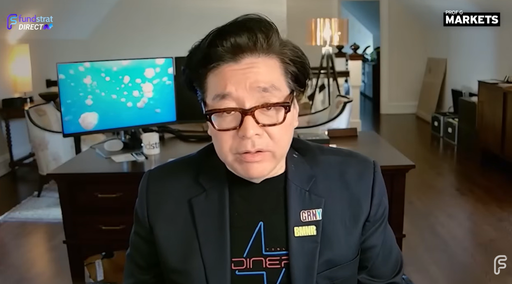
David: Let’s spend a few minutes on Bitcoin. If Bitcoin closes above $76,000, we’re in a new bull market. Tom Lee (co-founder of Fundstrat, renowned market strategist) said this hours ago at the conference—I’m reading his post-event recap. He notes Bitcoin has never closed higher for three consecutive months in bear markets; if it closes above $76,000 this month, the bear market is officially over. He also cites agentic AI funding as a reason this rally may persist. That’s his view.
John Wu: What’s Bitcoin trading at right now?
David: $81,000.
John Wu: So he’s essentially saying the bear market is over?
David: If it closes at this level by month-end—i.e., stays here for 23 more days in May—the bear market ends.
John Wu: Okay, so what’s your question?
David: Do you agree?
John Wu: First, I greatly admire Tom Lee—we’ve known each other for 25 years. When I was on the buy-side at Tiger, he was a tech analyst at JPMorgan. He’s brilliant with statistics—pulling numbers effortlessly—so I never question his data. My view: around January–February this year, I believe we hit bottom—a generational handoff where legacy Bitcoin holders rotated positions into Michael Saylor and ETFs. This stabilized earlier this year, contributing to Bitcoin’s improved performance. Timing and year-end price targets? Uncertain. But two things are supporting Bitcoin—and sustaining this several-month mini-bull: first, holder rotation is complete, eliminating that uncertainty; second—and critically—RIA channels, controlling trillions in assets. Permission to act doesn’t mean immediate action: Morgan Stanley may say it can deploy crypto via its wealth channel, but individual advisors must first be educated before recommending to clients—and that takes four to six months. It’s May now; since RIAs gained permission to advise retail investors early this year, advisors are now educated, end-users informed—and this cohort’s capital flow will help. Add to that a calm macro environment, strong fundamentals, and growing optimism around the CLARITY Act (U.S. crypto market structure legislation), and you have solid grounds for a meaningful Bitcoin mini-rally.
David: Could you expand on “calm macro environment”?
John Wu: I meant the large-scale holder rotation. New entrants are now holding Bitcoin—it’s a new cohort. Many OG whales are either gone or have reduced positions to negligible levels.
David: Why do you think that is?
John Wu: Several reasons. I was drawn to tech investing because I love innovation—the thrill of the new. I think that’s universal at 18. Crypto is now entering a new phase—it’s no longer the shiniest new thing. Like asking: why do serial entrepreneurs build from zero to one, then hand off to others to scale from one to ten? Why not go all the way? Because some love zero-to-one; others love one-to-ten. For some, this is a natural exit point—especially now that liquidity has finally arrived.
David: Broadridge (NYSE: BR) is a global tech leader processing $8 trillion in tokenized assets monthly. It’s expanding into digital assets—and partnering with Avalanche. What’s the significance of this collaboration?
John Wu: It’s fantastic—and hugely important. Broadridge is a leader in traditional securities—handling corporate actions, proxy voting, and other unseen but essential back-office functions. They announced a partnership—and we’re proud to say they’ll record on-chain, tokenized equity on the Avalanche blockchain. Soon, Galaxy Digital’s equity will be tokenized on Avalanche via Broadridge. This is a major part of traditional equity—so it’s a landmark move. How does it fit into our vision for Avalanche and Ava Labs? Since our conversations began six or seven years ago, we aimed to serve both crypto-native users *and* become the default infrastructure for institutional asset tokenization. We’re building the components—the puzzle pieces. We conceptualize this as an asset layer and an infrastructure layer. The asset layer includes billions in stablecoins, money market funds, Treasuries, private credit, private equity, funds—and publicly traded equities tokenized on Avalanche. Broadridge embeds directly into the infrastructure layer—the underlying systems enabling all of this to operate seamlessly. Everyone wants tokenized RWAs—but they forget the foundational systems required to make them work. Clearly, there’s crypto-native infrastructure—wallets, fiat-crypto rails, custody, etc. But there’s also traditional finance: who handles corporate actions? Who manages the invisible machinery ensuring your ownership rights, proxy voting, and operational continuity? Who ensures compliance and regulatory alignment? Broadridge is one of the key partners—and puzzle pieces—building the infrastructure layer for the future RWA world. It’s a tremendous development—and we’re eager to collaborate.
David: For investors, the perennial question is value capture. StraitsX—a Singapore-based partner—is building its own stablecoin, with strong influence across Asia. But my question is: who captures value among all these apps and applications built atop your infrastructure?
John Wu: First, StraitsX is an excellent project—its stablecoin targets Asia and is built on Avalanche, signaling how it views Ava Labs and Avalanche. It’s also integrated with Alipay and GrabPay—giving it massive distribution. We’re proud to partner with them—and honored to be chosen. That’s my first point. Now, to your question: who captures value, and how? It’s an excellent question. Let’s set Bitcoin aside: its product-market fit is “digital gold”—some believe it, some don’t—but broadly, that’s its current role, commanding ~50% of the $2.7 trillion market cap. What about everyone else? Where does value capture happen? I believe value must be captured across the full stack: ultimately, top-layer applications—DApps—must generate real business value, justifying their presence on a given infrastructure. Meanwhile, Layer 1s must eventually solve their token economics to survive and serve those applications. Avalanche’s architecture is a “network of networks”: you have a primary chain, but can launch custom, dedicated, self-sovereign blockchains. Many traditional financial institutions deploy these on closed private chains—not part of the permissionless ecosystem—and already capture value there. We capture a small share because they pay us—but ultimately, they want to connect to Avalanche’s broader ecosystem of 100+ Layer 1s, and eventually link liquidity to Avalanche’s mainnet. Its EVM compatibility lets them bridge to Ethereum’s world. So I believe value starts where customers create value for themselves—and once connectivity begins, natural value flows to the rest of the Avalanche ecosystem.
David: Excellent answer—thank you very much. Wishing Avalanche continued evolution and success—and see you next time.
Join TechFlow official community to stay tuned
Telegram:https://t.me/TechFlowDaily
X (Twitter):https://x.com/TechFlowPost
X (Twitter) EN:https://x.com/BlockFlow_News
 深潮TechFlow