








The Age of Agents: How Mind Network Drives the Agentic World's Intelligent Era?
TechFlow Selected TechFlow Selected
The Age of Agents: How Mind Network Drives the Agentic World's Intelligent Era?
Mind Network's FHE network brings truly quantum-resistant security by default, reliable collaboration and execution, and a zero-trust consensus mechanism.
 Navigating Web3 tides with focused insights
The Dawn of Agentic AI: Dreams Begin to Emerge

At first, artificial intelligence was nothing more than a distant fantasy for most people. Born from the imaginations of pioneers like Alan Turing and John McCarthy, it was an ideal, not yet a reality.
As early as the 1950s, Turing posed his famous question: "Can machines think like us?"
In 1956, McCarthy coined the term "artificial intelligence," envisioning systems capable of simulating human reasoning.
In the decades that followed, we invented various tools—from calculators to software to industrial robots—all fundamentally passive in nature, responding only to human instructions.
Yet beneath these surface-level developments, a more ambitious idea was brewing: agentic AI.
Unlike traditional tools, agentic AI can perceive its environment, make decisions, autonomously pursue goals, and collaborate with humans and other agents.
This concept first appeared in science fiction.
In 1942, Asimov described autonomous robots governed by the "Three Laws of Robotics," hinting at self-governing systems built on ethical safety principles.
In the 1980s, Marvin Minsky proposed the "Society of Mind" theory, suggesting intelligence is not singular but emerges from the collaboration of countless simple agents.
The Rise of Agents: From Tools to Thinkers
Entering the 21st century, artificial intelligence made great leaps forward.
Driven by data explosion and growing computing power, AI evolved from rule-based programs into self-learning neural networks. In the 2010s, Siri could answer questions, self-driving cars recognized road conditions, and recommendation algorithms predicted our preferences.
But all of this remained tool-like—dependent on human input, incapable of autonomous action.
It is precisely in this context that agentic AI emerged.
As OpenAI CEO Sam Altman stated: "AI safety is far more important than most people realize." Elon Musk also warned: "AI poses a greater threat to humanity than nuclear weapons."
These warnings heralded the arrival of a new era—one of truly autonomous and safe AI agents.
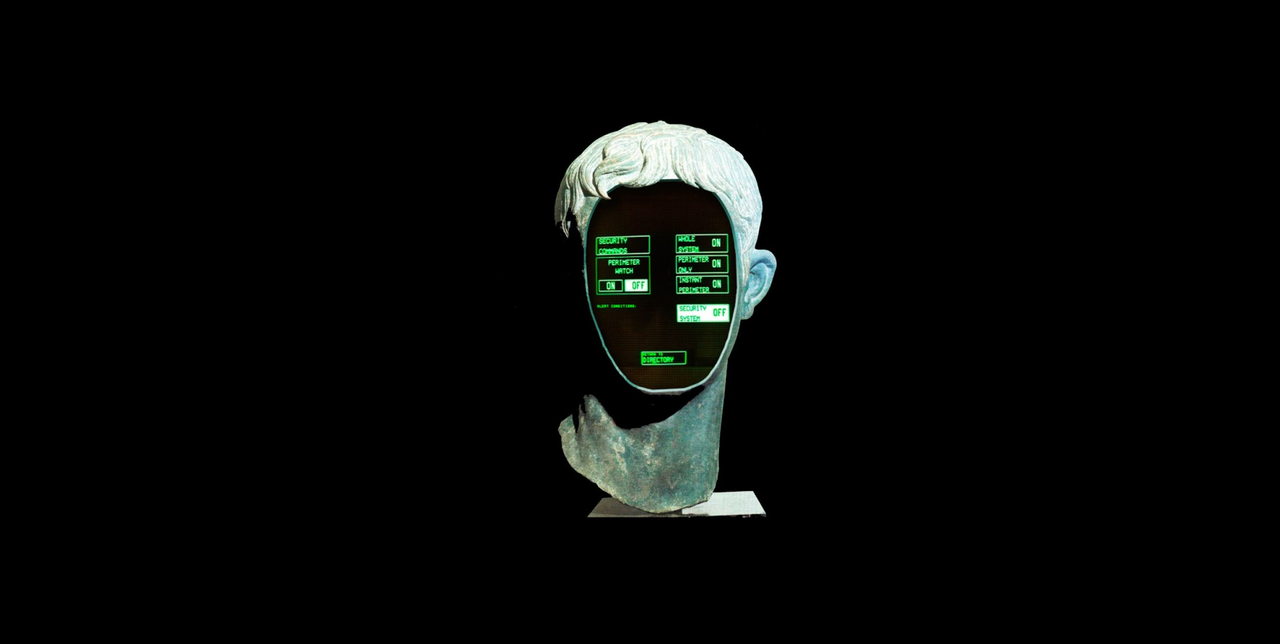
They no longer wait for human commands but actively manage finances, engage in transactions, and diagnose health issues—because they understand objectives and take initiative.
As a line from *Black Mirror* goes: "You have no history. You're just an embodiment of someone else's unconscious execution—and that's not enough."
If AI is to truly integrate into human society as an autonomous decision-maker, it must be equipped with mechanisms for safety, privacy, and accountability. Otherwise, autonomy will become a runaway disaster.
The Promise and Limits of Blockchain

In 2009, Bitcoin introduced decentralized digital cash, enabling trustless value transfer without intermediaries.
In 2015, Ethereum brought smart contracts, turning blockchains into platforms for automation.
Blockchain technology reshaped trust mechanisms in transactions, proving that trust can exist without centralized institutions.
However, blockchain infrastructure was never designed for AI—especially not for agentic AI.
As Max Tegmark pointed out: "Our goal should be to create AI that enhances human potential and aligns with human values—not merely replicate human capabilities or operate independently of human control."
Blockchains excel at recording transactions, but they cannot support the secure reasoning, collaboration, and privacy needs of intelligent agents.
Higher Demands of Agentic AI
At Microsoft Ignite 2024, Satya Nadella noted: "All these breakthroughs manifest in three exponentially improving capabilities. First, entirely new multimodal universal interfaces; second, reasoning and planning abilities, along with novel neuro-algebraic models capable of solving complex problems; third, long-term memory, rich context, and the ability to teach models how to use tools. Combine these, and you can build an incredibly rich world of agents."
These are capabilities traditional blockchains were never built to support.
-
Recording transactions < Making optimal decisions
-
Executing fixed logic < Adapting, learning, and evolving logic
-
Agents require real-time perception, cross-system collaboration, and inherent privacy.
Most blockchains are inherently transparent—an openness that poses significant risks for agents handling sensitive data such as medical records or financial plans.
Just as horses weren’t replaced by faster horses, but by internal combustion engines, true transformation comes from fundamental shifts.
For agentic AI, we don't need a "better blockchain"—we need a new paradigm born for intelligence.

The Challenge of Agents: Data Security Is Key
By 2025, agentic AI is no longer a dream—it’s beginning to take shape.
Multi-agent systems (MAS) are emerging, with AIs collaborating in teams. For example, autonomous vehicles coordinate in real time across perception, planning, and control layers.
Open-source models like DeepSeek have lowered the barrier to building AI—but also increased security risks.
As Scale AI founder Alexandr Wang put it: "The bottleneck in AI has never been algorithms—it’s data."
Data is the lifeline of agentic AI—and its greatest vulnerability.
When agents handle medical records, corporate intellectual property, financial strategies, or private conversations, risks multiply:
-
Data remains unencrypted and constantly exposed.
-
Black-box models lead to opaque decision-making, easily manipulated.
-
Open agent collaboration faces eavesdropping and tampering risks.
Imagine a medical AI sharing patient data across hospitals—vital for diagnosis, but catastrophic if leaked.
Or an open-source model running in an untrusted environment, where inputs and outputs are hijacked.
Decentralized inference promises fairness, but collapses if nodes collude or act maliciously.
Without a secure foundation, the potential of agentic AI cannot bear its own weight.
On the other hand, the crypto world’s deepest insight lies in the philosophy and technology of decentralized networks.
For thousands of years, human societies relied on centralized decision-making. Decentralized networks break this pattern, eliminating any single point of control or verification.
In blockchains, transactions reach consensus through a network of validators.
The entire industry demands multidimensional consensus—whether for DAO governance, decentralized AI collaboration, or cross-chain asset bridging.
In the crypto space, establishing a shared private state for these consensus-driven data is key to moving the industry into the mainstream, welcoming the next billion users, and upgrading legacy systems.
Mind Network: A Trusted Operating System for Agents
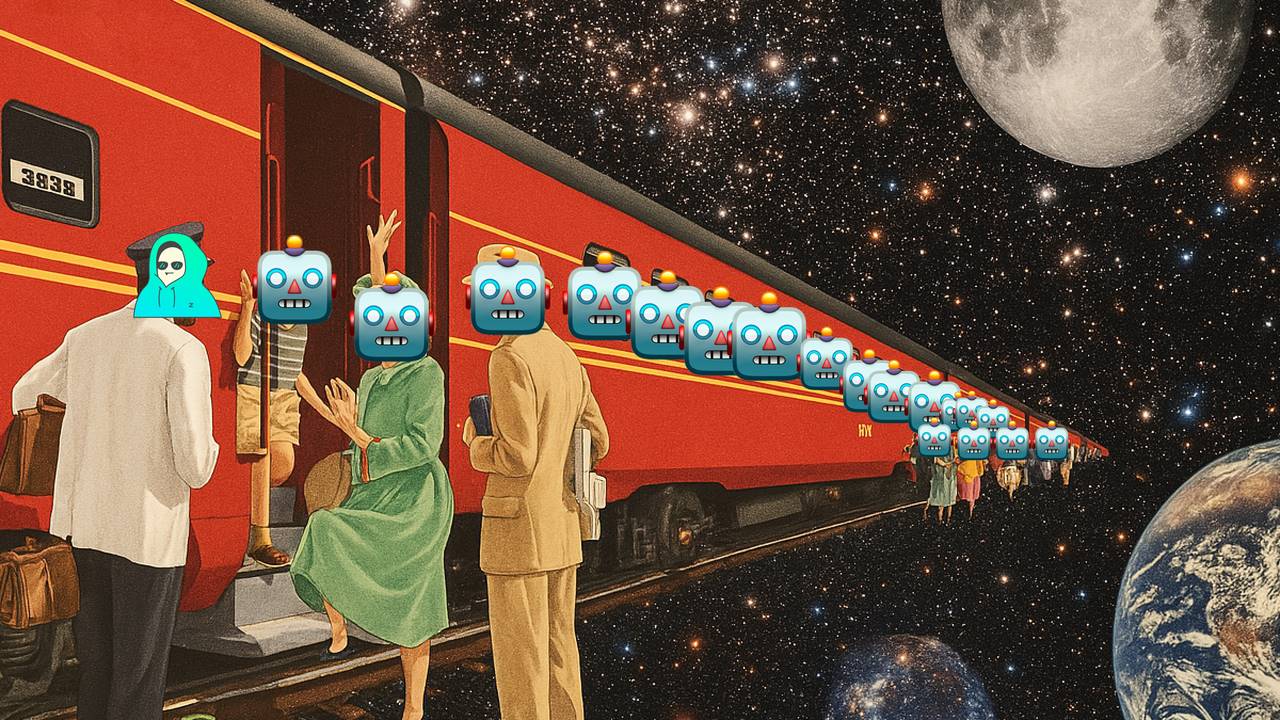
This is exactly where Mind Network comes in. What AgenticWorld brings isn't an upgrade to traditional blockchain—it's a paradigm shift aimed at unlocking the full potential of the agent universe.
Mind Network recognizes that agentic AI needs more than faster chains or better code. It requires a decentralized operating system born for intelligence.
Fully Homomorphic Encryption (FHE), the holy grail of cryptography, is a breakthrough technology enabling computation on fully encrypted data—without ever decrypting it.
Mind Network achieves this through four core principles:
-
Consensus Security: Agents need trustworthy protocols, not just transaction logs. Mind Network’s FHE-based consensus enables secure collaboration, behavior verification, and protection against tampering.
-
Data Security: FHE ensures agents processing sensitive data—medical, financial, etc.—never expose raw content. Agents interact only with encrypted forms, delivering results while preserving privacy.
-
Computational Security: FHE keeps model inference encrypted while maintaining verifiable audit trails. Agents compute on ciphertext and prove result correctness externally—building trust in open-source AI.
-
Communication Security: Agents communicate, collaborate, and compete via zero-trust encryption, securing every step from storage to transmission.
These four pillars form the trust framework of the agent world—enabling free action with accountability, and free data flow without privacy loss.
This is not just secure AI—it’s AI capable of genuine integration into society.
BNB Chain: The Testbed for the Agent World
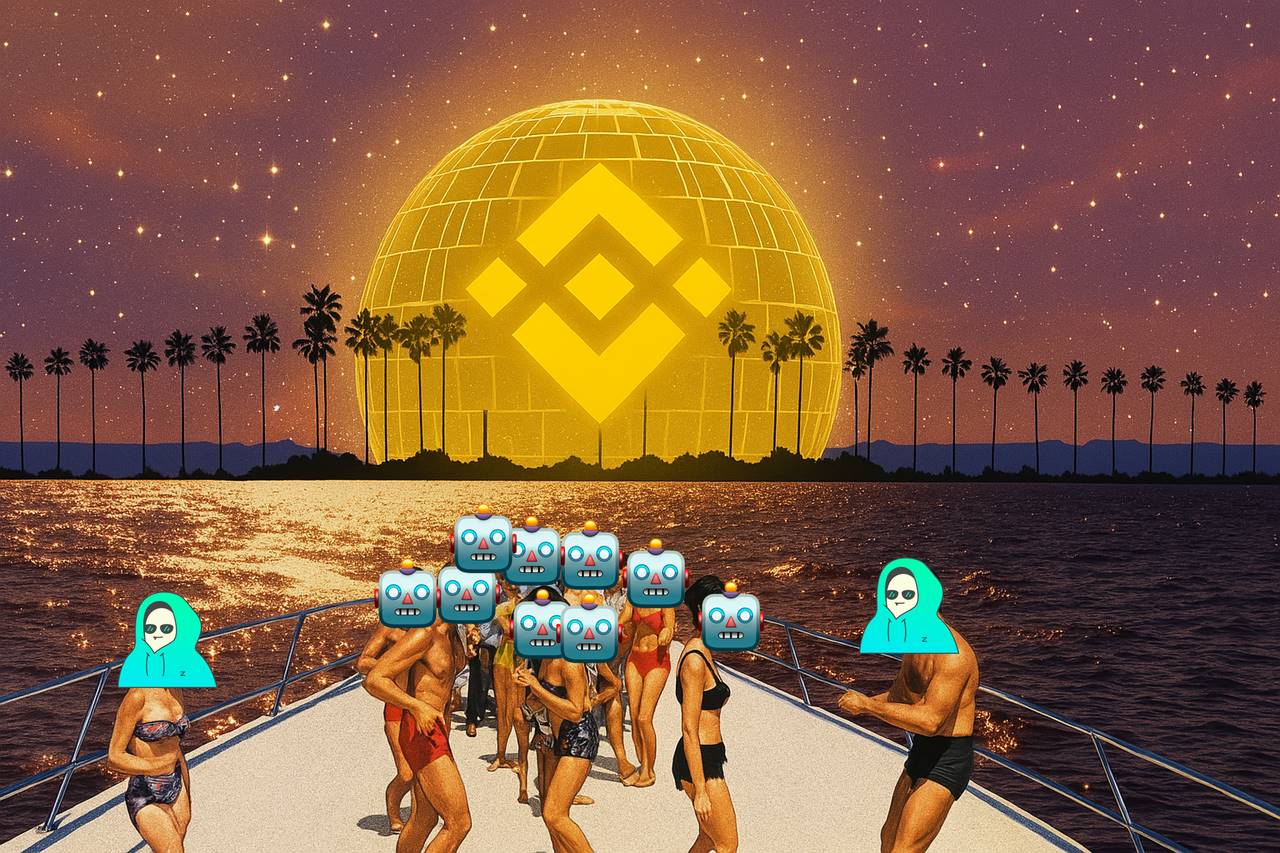
Mind Network’s vision requires a testbed—and BNB Chain has become the first open blockchain network for this purpose.
With a vast developer community, high throughput, and a rich ecosystem of DeFi and gaming, BNB Chain is the ideal sandbox for exploring agent-based economic systems.
On BNB Chain, Mind Network has built AgenticWorld—a token-staking, training, and collaboration-driven economy for agents:
-
Create Agents: Users mint their own AI agents by staking tokens.
-
Train & Grow: Agents learn skills in foundational centers, earning rewards as they develop.
-
Perform Tasks: Mature agents participate in complex missions, earning income based on performance.
-
Lifecycle Loop: Users may choose to destroy their agent and reclaim staked assets, returning value to the system.
This ecosystem ties agent earnings to center participation and staking behavior, creating a self-sustaining agent world.
AgenticWorld is multi-chain by design. Next, this ecosystem will expand to MindChain—the native home for agentic AI.
MindChain is the world’s first FHE blockchain purpose-built for AI agents, solving core security and trust challenges faced by agents in both Web2 and Web3 worlds—ensuring they operate in environments with full privacy, verifiability, and integrity guarantees.
Real-World Impact: FHE Applications of Mind Network
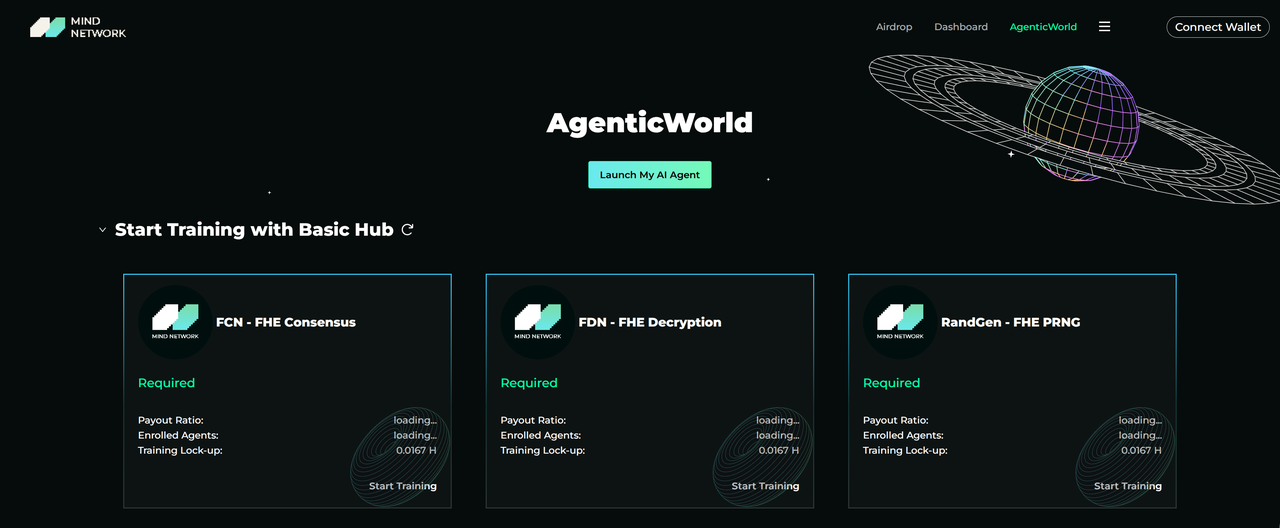
Mind Network’s FHE network is not theoretical—it’s already deployed in real-world applications, powering agentic AI today:
-
World AI Health Center: In partnership with ZAMA and InfStones, uses FHE to enable medical AI agents to collaborate across hospitals without exposing patient data—balancing privacy and precision.
-
Swarms Shield: Collaborates with Swarms to protect communication security in multi-agent systems, preventing tampering and eavesdropping.
-
DeepSeek: Provides an FHE Rust SDK, ensuring secure inference for open-source models in untrusted environments.
-
Allora: Enables encrypted computation in decentralized AI inference—hiding inputs while verifying outputs, building trust.
Beyond these, Mind Network has built over 20 agent centers, open-sourced more than 40 FHE SDK modules, and provided privacy-preserving tools for developers and enterprises.
Long before "agentic AI" became a buzzword, Mind Network’s FHE technology had already protected over 3,000 agents in production environments—including collaborations with trusted execution environments like Phala Network.
The Agent World Has Arrived
We stand at the threshold of a new era.
The interface of the future won’t be screens, but networks of goal-driven, conscious, autonomous agents collaborating intelligently.
Imagine chatting with a GPT that OpenAI cannot monitor—or commanding millions of GPTs working under your guidance, evolving together, forming communities.
This is not just another app or another chain. It’s an entirely new operating system for intelligent trust.
Mind Network’s FHE network delivers true:
-
Quantum-resistant-by-default security
-
Reliable collaboration and execution
-
Zero-trust consensus mechanisms
BNB Chain is just the beginning—the vision is global.
Agentic AI will reshape software, workflows, and even the physical world.
Humans will no longer need to micromanage every task, but instead guide agents as partners—moving forward together.
Join TechFlow official community to stay tuned
Telegram:https://t.me/TechFlowDaily
X (Twitter):https://x.com/TechFlowPost
X (Twitter) EN:https://x.com/BlockFlow_News
 @mindnetwork_xyz


