Crypto VC Roundtable: Behind the Hyperliquid Crisis – DEX Governance Challenges and CEX Power Plays
TechFlow Selected TechFlow Selected
Crypto VC Roundtable: Behind the Hyperliquid Crisis – DEX Governance Challenges and CEX Power Plays
The Hyperliquid incident revealed the problems arising from concentrated validator power behind the performance of so-called "decentralization."
 Navigating Web3 tides with focused insights
Compiled & Translated: TechFlow
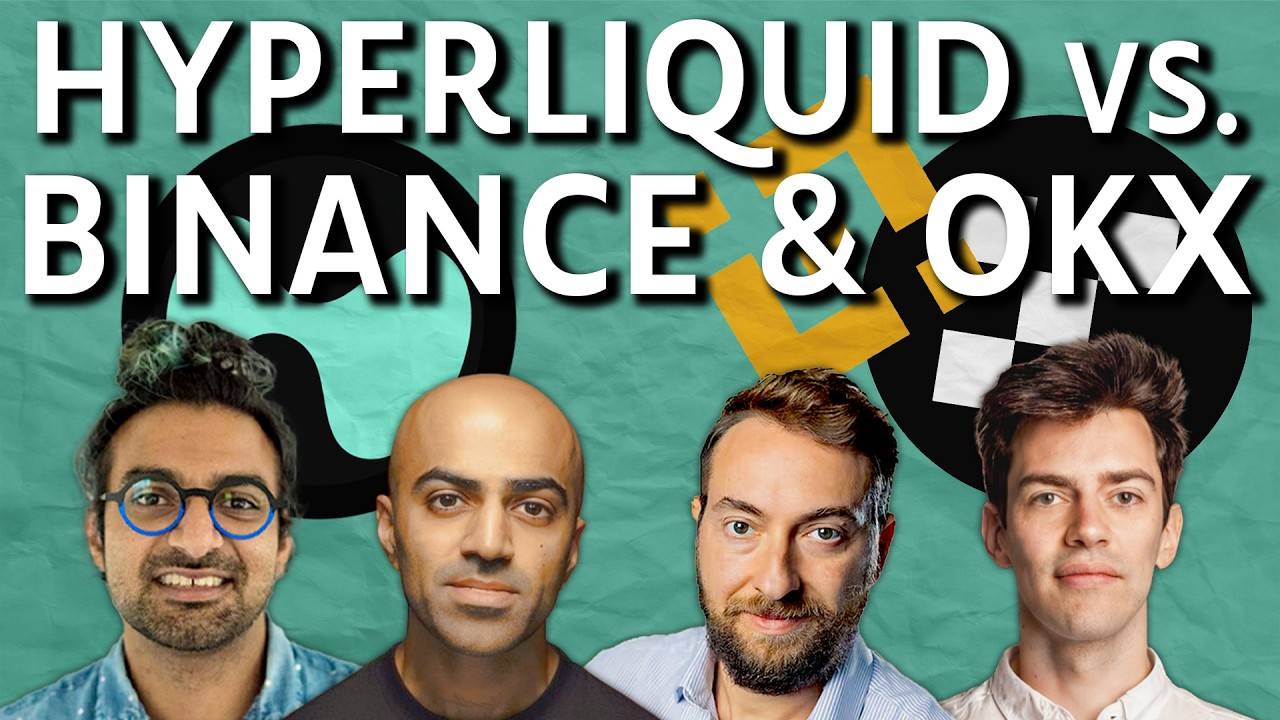
Guests:
Haseeb Qureshi, Managing Partner at Dragonfly
Robert Leshner, CEO & Co-founder of Superstate
Tarun Chitra, Managing Partner at Robot Ventures
Tom Schmidt, General Partner at Dragonfly
Podcast Source: Unchained
Original Title: Exchange War Erupts: Hyperliquid vs. Binance & OKX - The Chopping Block
Release Date: March 30, 2025
Highlights
-
The JELLYJELLY Crisis at Hyperliquid – How a high-profile DeFi project lost market trust by using manipulated oracle prices to rescue its treasury.
-
Exchange Rivalry Escalates – Binance and OKX listing JELLYJELLY perpetual contracts was seen as a targeted strike against Hyperliquid.
-
Are Decentralized Exchanges Really Decentralized? – The Hyperliquid incident reveals the risks of validator concentration behind the façade of "decentralization."
-
DNA on Chain: A Blockchain Version of 23andMe – Say Foundation proposes token-based access to protect genetic data; is this an innovative privacy safeguard or a dystopian vision?
-
The Scam of Decentralized Science (DeSci) – Tarun criticizes DeSci again, arguing that putting genetic data on-chain poses greater risks than meme coins.
-
The Battle Over Stablecoin Regulation – The Stable Act and Genius Act clash in Washington—whose side will prevail?
-
Stablecoins as Narrow Banks? – The rise of crypto may force the Fed to accept a financial concept it has resisted for 20 years.
-
The Future of HLP Deposits: A Real-Money Bet – Hosts place actual bets on whether Hyperliquid’s deposit volume will recover or continue falling after the crash.
-
New Moves from Memecoins and Olympus – Are those former “bandits” quietly profiting from shattered treasuries?
-
Tarun’s Failure Ranking – Why JELLYJELLY’s failure is worse than MobileCoin’s—but at least fits Hyperliquid’s brand identity.
Unpacking the Hyperliquid Incident
Haseeb:
One of the biggest stories this week is the drama unfolding around Hyperliquid. For those unfamiliar, Hyperliquid is a new hot DEX, now ranked as the top DEX by overall trading volume. It ran a massive airdrop and became beloved among retail crypto investors for the fairness and scale of that launch.
In recent days, Hyperliquid suffered a major attack involving a memecoin—JellyJelly, a very low-liquidity coin past its peak, but listed by Hyperliquid for contract trading. One trader opened an $8 million short position on JellyJelly—roughly 50% of Jelly’s circulating supply at the time—an enormous bet. Then, this trader drove up the spot price of Jelly, triggering their own liquidation.
So why do this? Why force your own liquidation?
On Hyperliquid, when a position can’t be liquidated normally, HLP (Hyperliquid’s crowd-sourced market maker) steps in to take over the position and attempt an orderly unwinding. HLP is crucial to Hyperliquid’s liquidity, always providing counterparty liquidity to traders. But due to the sheer size of this position, HLP was forced into being short Jelly, with no one in the market willing to take on that short, resulting in what’s known as a “short squeeze.”
This short squeeze wasn’t just retail mischief. In fact, two major exchanges—OKX and Binance—were indirectly involved. When the market realized Hyperliquid or its HLP was massively short Jelly, both OKX and Binance announced they would list JellyJelly futures within 24 hours.
Almost everyone saw it as, “This is war between exchanges.” CZ and OKX’s leadership had aimed their guns at Hyperliquid—this was their chance to strike.
Hyperliquid’s validators voted to delist JellyJelly and forcibly close the position at an artificially low price below market value via oracle manipulation.
Haseeb:
This decision sparked widespread controversy. Hyperliquid argued that rather than let the platform or HLP holders bear losses, it was better to intervene and lock the price artificially low to protect HLP users’ interests. However, this move caused Hyperliquid’s token price to plummet from about $21 to $15—a nearly 25% drop in a single day.
This event raised two core questions: First, was Hyperliquid’s response justified under these circumstances? Does its mechanism have fundamental flaws? Second, does this expose that Hyperliquid isn't as decentralized as it claims? These questions triggered intense industry debate, with some centralized exchanges (like Bitget) publicly criticizing Hyperliquid’s actions as unfair. Competition among decentralized exchanges has intensified, marking what appears to be a watershed moment for the DeFi space.
So, what’s your take on this HLP incident?
Tarun:
I think this incident indeed exposed certain flaws in protocol design. Much like automated market makers (AMMs), AMM mechanisms don’t allow order rejection. Early versions of Uniswap v2 and v3 had no such flexibility—you couldn’t choose which orders to accept or reject. This same issue exists in Hyperliquid’s liquidity pool.
Hyperliquid’s HLP mechanism differs from others like GMX’s GLP or Jupiter’s JLP. The logic of HLP is that users deposit ETH, and the platform allocates that ETH across multiple assets for market making. For example, 1% might go to JellyJelly, 90% to Ethereum, and the rest to Bitcoin. These allocations are determined by off-chain algorithms, requiring users to trust Hyperliquid’s team in managing asset allocation.
Clearly, they made some mistakes in mechanism design—such as not setting position limits or caps on open interest. Had these existed, the problem could’ve been mitigated without emergency intervention. Hyperliquid has stated it will fix these issues, including adding open interest limits and concentration caps.
This is exactly why I mentioned earlier that liquidity pools that don’t differentiate order types have inherent limitations. Under current design, HLP cannot selectively process orders—it can’t reject certain trades while accepting others. If HLP could distinguish third-party forced liquidations, the market could price those positions accordingly, and HLP wouldn’t need to bear unnecessary losses. But currently, HLP automatically trades against these positions, similar to how Uniswap pools operate. So their strategy lacks sufficient constraints. These strategies are actually run off-chain by the Hyperliquid team, not transparently executed on-chain.
I’m not entirely sure how their code is implemented because most of it isn’t open source. I can run a node, but only get binaries—not source code. Additionally, many system settings lack clarity and transparency. This incident clearly shows obvious deficiencies in their strategic restrictions. I believe this is something they’ve acknowledged needs urgent fixing. But from a market perspective, it also highlights the value of more open strategies versus the current fully closed model. As it stands, HLP’s operational mechanics are nearly opaque to outsiders.
As an HLP depositor, you don’t actually know if there are clear risk limits—for instance, whether HLP will automatically assume full liquidity pool exposure. You also can’t verify whether they’ll intervene via oracle manipulation like in this case. While documentation mentions some aspects, without open-source code, users can’t validate how mechanisms truly function. Even without open-sourcing code, there should be other verifiable proofs of behavior—which currently don’t exist.
I believe the level of mechanistic assurance Hyperliquid offers differs from what users expect in other protocols. In other protocols, users clearly understand how strategies work—even if that comes at the cost of efficiency or flexibility. Hyperliquid keeps its strategies private, which improves capital efficiency but undermines user trust. This trade-off isn’t inherently wrong, but clearly, some decisions were suboptimal. Still, these are understandable and fixable issues.
The Controversy Over the Rescue Decision
Haseeb:
Was rescuing HLP depositors justified? Clearly, HLP faced potentially massive losses in this event. Was this a mistake?
Robert:
I think it was a mistake, frankly. Trying to fix a market problem after risk parameters spiral out of control is one thing—but manipulating prices to close the position in a way that profits HLP is inappropriate. In derivatives markets, one party’s gain usually means another’s loss. Here, the Hyperliquid team and validators seemed to wrongly decide who wins and who loses.
HLP liquidity providers should have borne the risk. If the liquidation succeeded, they’d profit; if failed, they’d absorb the loss. Yet this unwind allowed HLP to profit—meaning other market participants lost. I think this violates market fairness. If they must intervene, at least don’t set a price favorable to themselves. What’s more confusing is they chose a price even lower than pre-event market levels—clearly to make themselves winners.
Tom:
I agree. This also creates a strange dynamic between HLP as a product and Hyperliquid’s broader platform. HLP is just one of several pools; users could theoretically create other pools running different off-chain strategies. HLP is positioned as Hyperliquid’s “official pool,” but in theory, anyone can launch a pool. Most people wouldn’t assume HLP gets special treatment. Yet this incident makes it seem like it did.
Some compare this to traditional exchanges’ “loss socialization” or auto-deleveraging mechanisms, but they’re not the same. In traditional setups, when overall margin falls below threshold, the exchange freezes positions and spreads losses across insurance funds. Here, HLP’s loss state was simply reversed via human intervention—Hyperliquid itself wasn’t facing default. That raises the question: Why is HLP treated as a privileged LP? Why is it bailed out if it fails?
Robert:
And it was bailed out profitably—that’s insane.
Tarun:
Exactly. And ironically, HLP holders indirectly voted through governance to set the rescue price—effectively granting themselves profits.
Robert:
Can you explain that further? How do HLP holders participate in Hyperliquid’s validation process?
Tom:
HLP holders can delegate voting power to a validator, though some validators require KYC, so the mechanism is a bit complex.
Tarun:
Validators control oracle prices, so governance votes effectively determine oracle adjustments. In other words, HLP holders participated indirectly through governance.
Haseeb:
Yes, this drew heavy criticism. Because the Hyperliquid Foundation holds an overwhelming majority of HYPE tokens, HYPE holders quickly passed the vote via delegation. The entire process took just two minutes—from start to finish—giving so-called voters almost no real say.
Robert:
I’m still confused about how other exchanges listing contracts affects Hyperliquid. Futures and spot markets are relatively independent. Even if demand for JellyJelly futures rises on Binance, it doesn’t necessarily shift prices on Hyperliquid or the spot market, since spot prices are index-controlled, which also determines Hyperliquid’s funding rate. What’s the exact mechanism of impact?
Haseeb:
First, if Binance wanted to list a spot market, they’d need to acquire actual inventory, which takes longer. But launching a futures market is faster—no physical inventory needed. With sufficient demand, users can start trading immediately, without affecting spot prices right away.
Robert:
Every long has a corresponding short, and every short has a long.
Haseeb:
Exactly. Structurally, launching a futures market is simpler. If you say, “Hey, I want to hit these guys fast, and time is limited,” the fastest route is clearly futures, not spot.
The goal of launching futures is to draw more players into the short squeeze. If Hyperliquid is undergoing a short squeeze, opening a futures market intensifies that pressure.
Tarun:
It mainly depends on funding rate dynamics. In this incident, funding rates spiked over 300% in a short period, causing extreme market instability.
OKX and Binance Enter the Fray
Haseeb:
Funding rates surged hundreds of percentage points. It was an extremely aggressive short squeeze, so the market expected it to resolve quickly. I suspect Binance and OKX will delist JellyJelly futures within one or two weeks, since clearly there’s no real market demand for this product.
Tarun:
No one actually needs JellyJelly.
Haseeb:
Still, I find it interesting—the mechanics of this event may be hard to grasp, especially if you’re unfamiliar with futures markets, liquidity providers, and how HLP works. Let’s simplify. At its core, Hyperliquid got caught in a high-risk position, and Binance and OKX attempted to weaken Hyperliquid further through market maneuvers. More specifically, their target was to push HLP—not Hyperliquid itself—into insolvency.
This behavior is quite aggressive, right? Some compare this to CZ’s past move against FTX, but I don’t think they’re equivalent. At the time, CZ had no reason to believe dumping FTT would directly bankrupt FTX. Looking back at the Bitcoin hack incident, Binance and Bitget actually lent ETH to help Bybit cover losses and stay operational. Their actions then were completely different from how they’re treating Hyperliquid now. I currently lack a good theory for why Binance and OKX adopted this strategy.
Hyperliquid’s actions implicitly sent a signal: HLP enjoys some form of protection. If HLP faces large losses, Hyperliquid will step in. From market reactions, Hyperliquid’s price is highly sensitive to changes in HLP’s status—this puzzles me. I’m curious about the actual link between HLP and Hyperliquid’s value. Maybe I’m missing a key point about HLP’s economic model.
Tarun:
Actually, HLP doesn’t have a clear economic model. It’s more like a pure liquidity provider, loosely tied to Hyperliquid’s core mechanism. But what strikes me as odd is that I tend to view the HLP pool more like a debt instrument, given it raises funds from depositors to operate.
Haseeb:
I see it more as equity, not debt.
Tarun:
No, HYPE is equity. That’s what’s confusing.
Haseeb:
I mean, operationally, HLP investors capture all profits. So it functions more like equity than debt.
Robert:
To some extent, yes. Market makers use users’ deposited USDC to trade across markets.
Haseeb:
And users ultimately receive all gains, so it’s not debt in the traditional sense.
Tom:
I think the main reason HYPE’s price dropped is that this incident created uncertainty about the exchange’s future. After all, if an exchange has privileged liquidity providers who never lose money, why would anyone else trade on that platform? This is a problem all exchanges with internal market makers face: how extensive are these privileges?
Tarun:
A more pessimistic view is that much of HLP’s liquidity actually comes from the Hyperliquid team itself. So they’re unwilling to bear those losses.
Another reason to treat HLP as a debt instrument is that it collects funds from depositors and uses them for market making across various markets. In a way, it acts like a “local lender.” Similarly, protocols like Jupiter and GLP are explicitly lending protocols—they earn fees this way. HLP earns via fees and spreads. If HLP defaults—as in this case—depositors have priority claim.
So I believe HLP is more like a debt holder, while HYPE is the true equity instrument. Because HYPE controls key mechanisms like oracles—and that control is the essence of equity.
FTX Moment?
Haseeb:
Hyperliquid is more like an exchange, and HLP is a tool it uses for market operations. Think of HLP as equity in market operations, while HYPE is equity in the exchange itself.
Robert:
I actually think we should have learned from the FTX collapse: exchanges and entities resembling hedge funds—like proprietary market-making teams inside exchanges—should be strictly separated. Only then can conflicts of interest be avoided, right?
Tarun:
It’s worth noting that Hyperliquid’s mechanism differs greatly from FTX’s. On Hyperliquid, I can view every transaction of HYPE and HLP in real time and withdraw funds anytime. This transparency makes it easier to monitor. I agree—Hyperliquid’s approach isn’t fundamentally wrong in principle.
Haseeb:
If an exchange protects a market maker, explicitly stating it won’t lose money, then the exchange and the market maker are effectively merged. It’s as if the exchange team itself runs the market maker. If you don’t trust the team’s ability to run the market maker well, then don’t invest in its equity.
Tom:
But how is this presented? Like, “We have a pool you can launch, and here’s another market maker to invest in.” On the surface, it seems like an open choice—but in reality, it’s a unique market maker.
Tarun:
It is a unique situation. Look at other market makers—Seafood, for example—he’s always losing money. I don’t understand why people still give him funds. His track record shows severe losses.
His pool is indeed interesting. But my point is, adverse selection already exists in these pools. Until this incident, people didn’t fully realize how tightly linked HLP and Hyperliquid were—and now that connection is clearer.
Robert:
I think before this event, they weren’t separate. The Hyperliquid team operated a primary market maker, which served as the platform’s core LP. Though economic benefits went to users, the exchange owners ran this key market maker and also controlled the liquidation mechanism.
Haseeb:
Right, Hyperliquid’s link to the liquidation mechanism gives it a privileged position. But conversely, it also forces them to take on high-risk positions other market makers might avoid.
Robert:
Like Alameda—whether they wanted to or not, they had to absorb all bad positions on FTX, including risky assets. That ultimately led to the exchange’s collapse. While forced to take these risks, it was also a responsibility of sorts.
Haseeb:
Theoretically, the justification for this setup is that even if HLP’s capital gets wiped out, Hyperliquid can keep operating. That’s the ideal design. If everything is mixed together, the system becomes poorly structured.
Tarun:
Sentiment-wise, I’d rather be taken down by MobileCoin than JellyJelly. MobileCoin at least tried to be a real project, while JellyJelly feels like a punchline for venture capitalists.
Haseeb:
After this event, people may perceive HLP and Hyperliquid as closely linked. This could reduce activity from third-party market makers or LPs on Hyperliquid, as they realize they aren’t on equal footing with HLP.
Tarun:
Fair enough—I’ve already observed reduced participation from many market makers. This trend isn’t new, but now they have clearer reasons to pull back.
Haseeb:
On the flip side, you might see more capital flow into HLP, as people now realize the protocol may protect their investments.
Tarun:
We can use DeFi AMA as a benchmark.
Haseeb:
Will it rise or fall? Right now, it’s down.
Tarun:
Yesterday’s deposits were $1.85M, down from $2.96M three days ago, and $3M on March 24. I think that’s a good reference point. Now it’s at $1.85M. I see two possibilities. One is, as Haseeb said, funds flow in because it’s seen as an insured-like product; the other is reduced confidence leads to lower exchange fees. I’m not sure which will dominate.
Robert:
I think risk has increased. If an event is severe enough, the platform may intervene, shut down the market, and set a resolution price so HLP doesn’t lose. We just saw that with JellyJelly. It’s a form of protection, but it exposes Hyperliquid’s fragility with small-cap assets. The likelihood of such attacks recurring has increased by at least an order of magnitude.
Haseeb:
I completely disagree. But now, no one will try this again.
Tom:
Of course, HLP’s strategy on the exchange is clearly evolving to reduce risk. So these events aren’t entirely independent.
Robert:
But it’s not isolated either. Two weeks ago, a similar attack happened in the Bitcoin market—a very large asset. The exact attack parameters occurred two weeks prior.
The Future of 23andMe and SEI
Haseeb:
Let’s talk about DeSci. Recently, there was major news in the DeSci space: SEI Protocol, a high-performance Layer 1 EVM chain, announced what may be the boldest DeFi investment yet.
The SEI Foundation plans to acquire 23andMe, a genetics company that recently filed for bankruptcy. They promise to protect the genetic privacy of 15 million Americans and ensure the security of this data for generations. They plan to migrate 23andMe’s data onto the SEI chain, using blockchain encryption to return data ownership to users, letting them decide how to monetize their data and share in the proceeds. This isn’t just about saving a company—it’s about building a future where people retain control over their most private information.
Tarun:
Does anyone on the SEI team actually understand privacy-preserving technology? I doubt it. If you told me the team included experts in privacy tech, that would make more sense. But right now, it looks like a team eager to spend big blockchain money, doing something even worse than typical corporate acquisitions.
Haseeb:
If they could implement this properly, would you support it? Maybe you could advise them and offer professional guidance.
Tarun:
If someone’s going to do this, most other bidders are computational biology firms—like AI drug discovery companies. Their goal is to use 23andMe’s data to train AI models. The controversy arises because many users fear misuse of their data. For example, eight years ago, I bought 23andMe’s service—their privacy policy promised not to share data with third parties. Now the company is bankrupt, and that data might be used to develop drugs without my consent. That concern is understandable. So the core issues are twofold: privacy protection and how data is monetized.
People care mostly about terms of service, privacy, and monetization. All bidders aim primarily at monetization—like computational bio-pharma firms. Then there are nonprofit bidders, and of course, DeFi players.
If blockchain could truly break through in data monetization, it might resemble the 2017 ICO boom—but I suspect it will fail again. If they can genuinely find a way to protect privacy while enabling monetization, that would be promising. But right now, simply claiming “users own their data” isn’t enough—I haven’t seen a successful example yet. This reminds me of Tom’s earlier complaint: people complain studios don’t monetize content via blockchain, but that’s not the real issue.
Tom:
Indeed. And I wonder how they’ll fund the acquisition—I believe 23andMe still has $200M in debt. Unless they design a complex financing structure or attract investors with SEI tokens.
Tarun:
The issue is that other bidders are mostly large corporations, so SEI’s odds seem low. Emotionally, many hope the company finds a better home than being bought by data-monetizers. If SEI could propose a plan preserving original TOS and protecting privacy, I’d say they should try. But that would mean relying on validator support, essentially borrowing from validators’ future earnings.
Robert:
Macroscopically, this data currently sits in a bankrupt company’s database. Generally, moving data to blockchain isn’t inherently more secure. In fact, it might increase leak risks. Of course, this depends on security measures—like encryption, zero-knowledge proofs (ZK). Overall, I don’t think it significantly improves privacy or security.
Haseeb:
Suppose, per Tarun’s scenario, a company acquires this database and handles the data however they want. That’s clearly undesirable, but theoretically possible. I’ve always been skeptical of “data ownership.” For example, some suggest encrypting data on-chain and authorizing access via decryption keys. But I’ve never seen this solve the actual problem.
Tarun:
That’s exactly what worries me. If blockchain practitioners lack understanding of privacy tech and attempt such projects, they often backfire. They might burn all funds and accidentally leak data. Worse, that data could be used by certain nations to develop bioweapons.
I’d prefer teams focused on foundational cryptography—like ZK or homomorphic encryption—to handle this. But even those teams may struggle to commercialize at scale.
Haseeb:
It’s been three months since you declared war on DeSci—how’s the progress?
Tarun:
Frankly, I’ve given up. Bio Protocol, for example, has nearly disappeared. I think people have realized most of these projects are scams.
My view is that the DeSci craze is just rebranded meme coins. It swaps branding to attract those repelled by traditional meme coins. But these people are still trend-chasing speculators. DeSci operates more like donating to nonprofits, but lacks mechanisms to verify public benefit.
Stablecoin Legislation: Genius Act vs. Stable Act
Haseeb:
Congress is now advancing a new stablecoin bill. Previously, we discussed Kirsten Gillibrand’s Genius Act. Now there’s a House bill called the Stable Act, introduced by French Hill.
Robert:
These names sound like “Stable” and “Genius”—almost like “Stable Genius,” doesn’t it? Maybe that’s the inspiration, referencing Trump’s “stable genius” remark.
Haseeb:
The new bill is called the Stable Act. To contrast Genius Act and Stable Act clearly: Genius Act is friendlier to industry growth. It allows banks and non-banks to issue stablecoins, lets state regulators participate alongside federal ones, supports interoperability, permits yield payments in certain cases, and overall encourages innovation and expansion.
In contrast, the Stable Act is stricter. It limits stablecoin issuance to banks or approved bank subsidiaries, requires direct Fed oversight, imposes tighter reserve asset restrictions, bans yield payments, and enforces a two-year ban on algorithmic stablecoins—though existing ones get transition periods.
Robert, you recently lobbied in Washington DC on stablecoin legislation. How well is this bill being received?
Robert:
I was in DC Tuesday and Wednesday, meeting about 15 House members. Clearly, stablecoin legislation is the hottest topic.
Robert:
I feel both sides show strong interest in passing pro-crypto legislation, with little controversy. Stablecoin regulation is the most urgent issue—both sides recognize the need for a legal framework. This bill is relatively straightforward, so it might become the first major crypto law. Though differences remain between House and Senate, I don’t think they’ll block progress. After stablecoin legislation, there may be broader discussions on market structure, but focus remains squarely on stablecoins.
Meanwhile, there’s much discussion about potential market shifts post-legislation. Overall, the industry believes this law will lay the foundation for future market architecture. While that goal may take time, current discourse centers almost entirely on stablecoin legislation itself.
Additionally, talking with crypto-friendly lawmakers, I sensed strong approval of stablecoin legislation. While this may reflect bias, overall, differences between House and Senate are expected to reconcile smoothly—the legislative outlook is very optimistic.
Will Stablecoins Become Crypto’s “Trojan Horse”?
Tarun:
I first heard of the “narrow bank” concept in 2009. Back then, many discussed narrow banking legislation. Though it makes me sound old-fashioned, the idea was widely debated: Should there be a tightly restricted bank offering only basic returns?
Haseeb:
Can you explain what a narrow bank is?
Tarun:
The definition of narrow banking has evolved, but the core idea is simplifying banks. Especially after the financial crisis, people asked: Should banks face tighter regulation—like being barred from trading or complex activities? Or could we create banks offering only basics—deposits and loans—without complex operations? Interestingly, many early fintech apps were somewhat like “pseudo-narrow banks.” They let users deposit money but offered almost no yield products. Users might indirectly buy Treasuries via these platforms, or like Square, access Bitcoin—but the platforms themselves didn’t engage in complex investing like proprietary trading or bond portfolios.
In a way, many stablecoin bills remind me of narrow banking. Stablecoins pay no yield, and the way bank charters are used feels fascinating. The narrow bank idea has been around nearly 20 years, and now it’s finally achievable via blockchain. History repeats—just very slowly. After all, the U.S. had a decade-long freeze on new banks and bank charters.
Robert:
My understanding is that narrow banks deposit all funds into the Fed’s discount window, maintaining 100% liquidity. Thus, no need for investment analysts or loan officers—all deposits go to the Fed to earn interest, minus a fee paid to depositors. In a sense, it’s basically a branch of the Federal Reserve.
This is full-reserve banking—100% liquid, no liquidity risk. Theoretically, a dozen employees could manage a massive banking system. But opposition arises because it competes with commercial banks. Commercial banks expand money supply via lending, while narrow banks park funds at the Fed, reducing liquidity for quality assets like mortgages.
Haseeb:
I think the Fed rejected narrow banks because they weaken its direct control over money supply. While mortgages can still come from private lenders, once the market fully shifts to private lending, the Fed loses direct control over monetary expansion.
Robert:
From another angle, the Fed might gain more influence—adjustments to overnight rates affect all market participants.
Haseeb:
That’s true—if reserve ratios still exist. Reserve ratio is the second lever—a powerful tool to instantly change money supply. Interest rate hikes or cuts have a zero lower bound—technically breachable, but the U.S. won’t go negative. But that’s a slower mechanism. Now, as a bank, you can invest everything in reserves—changes happen faster.
Robert:
This reminds me of the Genius Act. Tarun says stablecoins resemble narrow banks, but I don’t think they’re identical.
Haseeb:
I think he meant the Stable Act, especially since it bans yield. Why ban yield in the Stable Act? Probably to prevent competition with commercial banks.
Robert:
Tarun might mean this restriction makes stablecoins more like narrow banks. But the core of narrow banking is that it *does* allow fully liquid interest payments.
Haseeb:
So if yield weren’t banned, you could build a narrow bank with stablecoins. Under the Stable Act, you can’t create a narrow bank competing with commercial banks. But under the Genius Act, you could essentially have a stablecoin holding only Treasuries, returning all Treasury yields minus 20 basis points or so—ultimately a very simple business model.
You could say that’s Tether’s model—they clearly don’t pay yield, but if they did, it’d be an incredible business. Labor efficiency would be sky-high—about 90 employees managing over $100 billion in assets. That’s a pretty solid business.
Haseeb:
I think this point is valid. Stablecoins might reintroduce the narrow bank concept in a more palatable way, while also offering geopolitical advantages. In contrast, narrow banks only disrupt commercial banks without helping dollar internationalization. The advantage of stablecoins is that even while competing with commercial banks, they can expand the dollar’s total market size internationally. Narrow banks can’t do that—they’re zero-sum between commercial and narrow banks. From a policy standpoint, that’s likely why stablecoins are more favored. But I also agree with you, Tarun—when central bankers or bank executives examine this, they may prefer bank charter holders to monopolize stablecoin issuance. That’s classic “regulatory capture”—limiting market participants to protect incumbents.
Robert:
What’s your take on the final bill? Will it resemble the Genius Act or the Stable Act—less restrictive or stricter?
Robert:
I think outside of yield, it’ll be less strict. I believe the current banking sector doesn’t want stablecoins paying yield.
Haseeb:
This reminds me of oddities in banking. For example, my Chase account—why can’t my cash automatically roll into a money market account to earn yield, instead of requiring manual action? If banks automated this, great. But many people don’t act, leaving cash idle. This is common—though users can click a button to move funds, many just don’t. Brokers profit handsomely from this inertia.
Robert:
One of brokers’ main revenue sources is the interest spread.
Tom:
I heard the FTC investigated Citibank for offering two nearly identical savings products with different rates—one lower. Shows banks profit from information asymmetry, which stablecoins partially avoid.
Robert:
You can’t easily cut rates for existing customers, but you can launch a second product, keeping old customers on stagnant rates.
Haseeb:
Ironically, if you view this as a cash account, stablecoins—even without yield, say on Tether or USDC—can generate substantial returns just through on-market lending.
Tom:
Current on-market lending yields are between 5% and 6%. The advantage of narrow banking is users can freely choose their own risk profile—private credit or tokenized Treasuries—instead of being bundled by banks. If users want, they can manage it themselves.
Haseeb:
That makes sense. If stablecoins really pull deposits from the banking system, I suspect it’s because they make cash productive regardless of user laziness.
Join TechFlow official community to stay tuned
Telegram:https://t.me/TechFlowDaily
X (Twitter):https://x.com/TechFlowPost
X (Twitter) EN:https://x.com/BlockFlow_News
 深潮TechFlow