From Former Allies to Head-to-Head: A Data-Driven Look at the "Internal Conflict" Between Pump.fun and Raydium
TechFlow Selected TechFlow Selected
From Former Allies to Head-to-Head: A Data-Driven Look at the "Internal Conflict" Between Pump.fun and Raydium
In the Solana ecosystem, an "internal war" over billions of dollars in trading volume is unfolding.
 Navigating Web3 tides with focused insights
Author: Frank, PANews
Within the Solana ecosystem, a "civil war" involving hundreds of millions of dollars in trading volume is unfolding. Pump.fun and Raydium, two platforms once mutually dependent, are now moving into direct competition.
Through in-depth analysis of Raydium's pool data, PANews has found that Pump.fun’s impact on Raydium may be far greater than market expectations. Over the past year, Raydium essentially enjoyed effortless gains thanks to Pump.fun's explosive growth. Now, Pump.fun’s launch of its own decentralized exchange, PumpSwap, has effectively cut off Raydium’s primary revenue stream.
Against the backdrop of an overall cooling meme market, is this "civil war" merely a futile internal struggle? Using data analysis, PANews will uncover the true nature of this conflict and examine its implications for both the Solana ecosystem and the broader meme market.
Data Insights: Pump.fun Tokens Dominate Half of Raydium’s Liquidity
When Pump.fun announced the launch of its DEX—PumpSwap—in early March, the market generally believed it would have some impact on Raydium, but few realized the severity. By analyzing approximately 250,000 trading pairs across Raydium’s AMM and CLMM pools, PANews sheds light on the real relationship between Pump.fun and Raydium—and what may lie ahead.
In Raydium’s AMM pools, tokens generated by Pump.fun account for as much as 43.96%. Specifically, out of 216,000 AMM pools, 95,000 contain Pump.fun tokens. The total TVL of these Pump.fun-related pools reaches $726 million, representing 50.79% of AMM’s total TVL. Even when including CLMM pools, Pump.fun tokens still make up 43.68% of all pools on Raydium.
This means Pump.fun contributes nearly half of Raydium’s trading volume and revenue. PANews estimates that Pump.fun generates tens of millions of dollars annually for Raydium. When Pump.fun announced PumpSwap, RAY token price plunged 15% within 24 hours—a clear market signal underscoring Pump.fun’s significance to Raydium.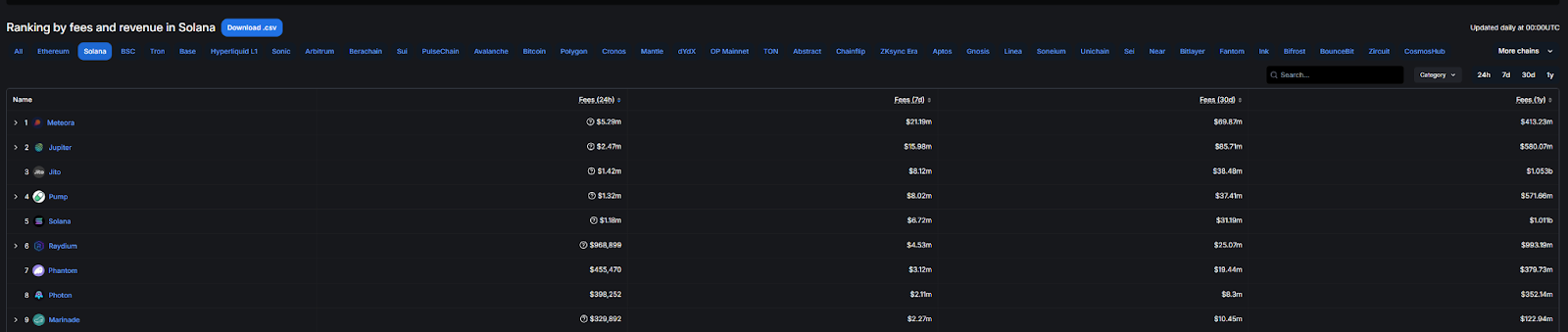
The launch of PumpSwap poses a direct threat to Raydium in three key ways: First, zero migration fees (compared to Raydium’s 6 SOL) drastically reduce user switching costs; second, instant migration simplifies the process from token launch to trading; third, improved liquidity mechanisms and creator revenue-sharing models offer better incentives for token creators. These advantages could drive massive user migration from Raydium to PumpSwap, further accelerating Raydium’s revenue decline.
Raydium’s Counterattack: Can LaunchLab Turn the Tide?
Facing the threat from PumpSwap, Raydium is not standing idle. In mid-March, Raydium announced it is developing LaunchLab, a new token launch platform designed to directly compete with Pump.fun. Interestingly, Raydium had actually been working on LaunchLab for months but previously paused development—likely to avoid appearing as if it were directly challenging Pump.fun. Clearly, the launch of PumpSwap erased such concerns. On March 26, Raydium stated it would officially roll out LaunchLab within a week.
According to reports, LaunchLab plans to introduce several innovative features, including linear, exponential, and logarithmic bonding curves to dynamically adjust token prices based on demand; allowing third-party UIs to set their own fees; supporting multiple quote tokens beyond SOL; and integrating with Raydium’s liquidity provider locker. These features aim to provide greater flexibility and control for token creators, positioning LaunchLab as a competitive alternative to Pump.fun.
However, whether LaunchLab can offset Raydium’s significant revenue losses remains uncertain. First, Pump.fun has already established strong brand recognition and a vast user base in the meme token launch space; second, PumpSwap’s zero-fee and instant migration features offer clear cost and convenience advantages; finally, Raydium faces the daunting challenge of rapidly completing and promoting LaunchLab within a tight timeframe.
Strategically, Raydium emphasizes that LaunchLab is not intended to replace Pump.fun, but rather to serve teams that don’t want to build their own launch infrastructure from scratch. This messaging may aim to soften direct confrontation with Pump.fun, but in reality, LaunchLab is undoubtedly a strategic response to the threat posed by PumpSwap.
Meme Market Cooling: Is the ‘Civil War’ Just Pointless Infighting?
Behind the Pump.fun–Raydium "civil war" lies a broader trend: the overall cooling of the meme market. At the beginning of 2025, the meme coin landscape has shifted from Solana’s dominance to a multi-chain competitive environment—but market enthusiasm has clearly waned.
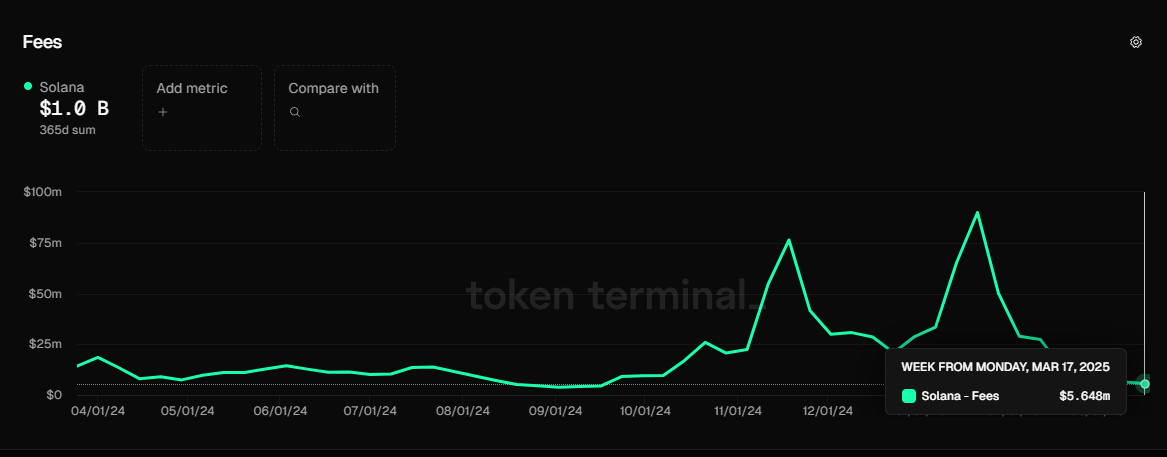
Solana’s on-chain fees dropped from a weekly high of $89.91 million in January 2025 to $5.64 million on March 17, a decline of about 93.7%.
Additionally, DEX trading volumes have plummeted. On March 27, Solana’s DEX trading volume was approximately $1.38 billion, down to just 3.8% of its January peak of $35.8 billion. From a macro-cycle perspective, current volumes resemble levels seen in the same period of 2024.
Other competing blockchains are experiencing similar downturns. Base chain’s daily trading volume has now fallen to $369 million, an 86% drop from January. BSC maintained daily volume above $1 billion recently due to endorsements from top influencers like CZ, yet it still lags significantly behind its January peak of $8.4 billion.
BSC’s popular meme coin Four.meme also saw a sharp decline after a brief surge. On March 27, Four.meme’s trading volume was only $20 million, down 75% from its peak of $80 million on March 21.

According to PANews observations, multiple professional rug-pull bots operating on Pump.fun have recently gone inactive. When even the scammers find no profit, the market truly appears to have entered a winter phase.
In this context, the "civil war" between Pump.fun and Raydium may well be a pointless internal struggle. Both parties are fighting over a shrinking market, not a growing blue ocean. Without genuine innovation or utility, this competition may only accelerate market cooling and fragment the Solana ecosystem.
The shift from cooperation to rivalry between Pump.fun and Raydium reveals deep-seated tensions within the Solana ecosystem. While data suggests PumpSwap’s launch could cause Raydium to lose nearly half of its new token market share, it's important to note that data reflects history—not necessarily the future. As the market contracts, Pump.fun may simply lack the capacity to continue fueling Raydium’s growth. Launching PumpSwap may thus be less of an aggressive move and more a desperate act of self-preservation.
For investors, while tracking the battle between Pump.fun, Raydium, or Four.meme, greater attention should be paid to the overarching trend of meme market cooling—lest they become the “last bagholders” in this “civil war.” The path forward remains unclear, but patience continues to be the most crucial skill for navigating market cycles.
Join TechFlow official community to stay tuned
Telegram:https://t.me/TechFlowDaily
X (Twitter):https://x.com/TechFlowPost
X (Twitter) EN:https://x.com/BlockFlow_News
 PANews