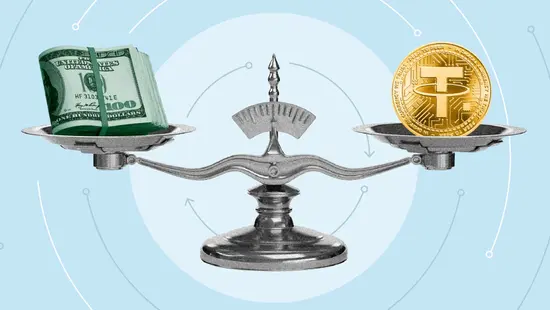
From a financial perspective, can stablecoins become mainstream?
TechFlow Selected TechFlow Selected
From a financial perspective, can stablecoins become mainstream?
Stablecoins have become a variable within the U.S. dollar economic system.
 Navigating Web3 tides with focused insights
Author: Bridget, Addison
Translation: Luffy, Foresight News
Addison and I have recently been discussing the convergence trends and core use cases between traditional finance and cryptocurrency. In this article, we will engage in a series of dialogues centered on the U.S. financial system, exploring how cryptocurrencies can integrate into it from first principles.
There's a prevailing belief today that tokenization will solve many problems in finance—this may be true, or it may not.
Stablecoins, like banks, involve the issuance of new money. The current development path of stablecoins raises significant questions about how they interact with the traditional fractional reserve banking system—in which banks hold only a small fraction of deposits as reserves and lend out the rest, effectively creating new money.
1. The Tokenization Hype
The mainstream narrative is "tokenize everything"—from publicly traded stocks and private equity to U.S. Treasuries. This is generally beneficial for both the crypto space and the world at large. Thinking from first principles about tokenized market dynamics, the following points are critical:
-
How asset ownership systems currently operate;
-
How tokenization would change these systems;
-
Why initial tokenization use cases are necessary;
-
What constitutes “real dollars” and how new money is created.
In the United States today, large asset issuers (such as publicly listed stocks) entrust custody of securities to the Depository Trust & Clearing Corporation (DTCC). DTCC then tracks ownership across approximately 6,000 interacting accounts, each maintaining its own ledger to track end-user ownership. For private companies, the model differs slightly: firms like Carta simply manage ledgers on behalf of businesses.
Both models represent highly centralized bookkeeping. The DTCC model resembles a "nested doll" structure—individual investors may need to pass through 1–4 different entities before reaching the actual DTCC ledger record. These could include the investor’s brokerage or bank, the broker’s custodian or clearing firm, and DTCC itself. While retail investors typically don’t feel the impact of this hierarchy, it imposes substantial due diligence burdens and legal risks on financial institutions. If DTCC were to tokenize assets directly, reliance on these intermediaries would decrease, enabling investors to interface more directly with the clearinghouse—but this is not the model being proposed in current discussions.
The prevailing tokenization model involves one entity holding the underlying asset as an entry in a general ledger (e.g., as a subset within DTCC or Carta records), then creating a new, tokenized form of that asset for on-chain use. This approach is inherently inefficient because it introduces another entity capable of extracting value, introducing counterparty risk, and causing settlement or unwinding delays. Adding such intermediaries breaks composability, requiring extra steps to “wrap and unwrap” securities when interacting with either traditional finance or decentralized finance, leading to friction and latency.
A potentially superior alternative would be to move DTCC or Carta’s ledgers directly onto the blockchain, making all assets natively “tokenized” so that all holders benefit from programmability.
A major argument in favor of securities tokenization is global market access along with 24/7 trading and settlement. If tokenization serves as a mechanism to deliver stocks to investors in emerging markets, it would undoubtedly represent a step-function improvement over the current system, opening U.S. capital markets to billions. However, it remains unclear whether blockchain-based tokenization is strictly necessary—this is ultimately a regulatory issue. Long-term, it's debatable whether tokenized assets will become effective tools for regulatory arbitrage, much like stablecoins. Similarly, a common bullish case for on-chain stocks is perpetual contracts; yet, the barriers to perps are entirely regulatory, not technical.
Structurally, stablecoins resemble tokenized stocks, but the market structure for stocks is far more complex and heavily regulated, involving multiple clearinghouses, exchanges, and brokers. Tokenized stocks are fundamentally different from “native” crypto assets, which aren't backed by any real-world asset and instead exist as native, composable tokens.
To build efficient on-chain markets, the entire traditional financial infrastructure would need to be replicated—a daunting task given the concentration of liquidity and existing network effects. Simply putting tokenized stocks on-chain isn’t a panacea; ensuring they’re liquid and interoperable with the rest of finance requires deep thinking and robust supporting infrastructure. That said, if Congress passed a law allowing companies to issue digital securities directly on-chain, many traditional financial intermediaries might become obsolete. Tokenized equities would also reduce compliance costs associated with going public.
Currently, governments in emerging markets lack incentives to legitimize access to U.S. capital markets, as they prefer capital to remain within their domestic economies. Meanwhile, expanded access from the U.S. side raises anti-money laundering concerns.
2. Real Dollars and the Federal Reserve
Real dollars are entries on the Federal Reserve’s ledger. Currently, around 4,500 entities (banks, credit unions, certain government agencies, etc.) have access to these “real dollars” via Federal Reserve master accounts. None of these entities are native crypto firms, unless you count Lead Bank and Column Bank, which do serve crypto clients like Bridge. Entities with master accounts can access Fedwire, an extremely low-cost and near-instant payment network available 23 hours a day for wire transfers with essentially immediate settlement. Real dollars fall under M0—the sum of all balances on the Fed’s master ledger. “Faux” dollars (created privately by banks through lending) belong to M1, which is roughly six times larger than M0.
The user experience of transacting with real dollars is actually quite good: transfers cost about 50 cents and settle instantly. Whenever you wire money from your bank account, your bank interacts with Fedwire—an infrastructure with near-perfect uptime, instant settlement, and minimal delay-related costs. However, tail-end regulatory risks, AML requirements, and fraud detection lead banks to impose numerous restrictions on large payments.
Given this structure, a disadvantage for stablecoins is expanding access to these “real dollars” through an intermediary-free, instant system, where intermediaries: 1) capture base yields (as the two largest stablecoins do); and 2) restrict redemption rights. Currently, stablecoin issuers partner with banks, which in turn hold master accounts at the Federal Reserve.
So why don’t stablecoin issuers simply apply for their own master accounts—if gaining one would be like obtaining a cheat code, granting 100% risk-free Treasury yields, with: 1) no liquidity issues; and 2) faster settlement?
Applications from stablecoin issuers for master accounts would likely be rejected just as The Narrow Bank’s application was—and crypto-native banks like Custodia have similarly failed to secure access. That said, Circle’s relationship with its partner banks may already be tight enough that a master account wouldn’t significantly improve its cash flow.
The Fed resists granting master accounts to stablecoin issuers because the dollar system is designed to work only with fractional reserve banking: the entire economy relies on banks holding just a few percentage points in reserves.
Much of the money supply is created through debt and loans. But if anyone could earn 100% or 90% of risk-free interest without lending funds for mortgages, business loans, etc., who would use regular banks? And if no one uses traditional banks, there are no deposits to fund loans or create additional money—leading to economic stagnation.
The two core principles the Fed cites when evaluating master account eligibility are: 1) granting an account must not introduce undue systemic risk; and 2) it must not interfere with the implementation of monetary policy. For these reasons, at least in the current environment, stablecoin issuers are unlikely to gain master account access.
Stablecoin issuers could only realistically gain master account access if they became banks themselves. The GENIUS Act proposes bank-like regulations for issuers with over $10 billion in market cap. The underlying logic is that since they're regulated like banks anyway, they might as well operate more like banks over time. However, under the GENIUS Act, the 1:1 reserve requirement means stablecoin issuers still couldn’t engage in fractional reserve activities.
So far, stablecoins haven’t been shut down by regulators, largely because most (like Tether) are issued offshore. The Fed welcomes the global dominance of the dollar in this form, as it reinforces the dollar’s role as the world’s reserve currency. But if a U.S.-based entity like Circle—or even The Narrow Bank—grew substantially and began functioning widely as a deposit-taking institution, the Fed and Treasury might grow concerned. Such growth could pull funds away from fractional reserve banks—the very institutions through which the Fed conducts monetary policy.
This is also the fundamental dilemma facing stablecoin banks: to make loans, you need a banking license. But if a stablecoin isn’t fully backed by real dollars, it ceases to be a true stablecoin, undermining its original purpose. This is where the fractional reserve model “breaks.” That said, in theory, a chartered bank with a master account could create and issue stablecoins while operating under a fractional reserve framework.
3. Banks, Private Credit, and Stablecoins
The sole advantage of becoming a bank is access to a Federal Reserve master account and FDIC insurance. These two features allow banks to assure depositors that their funds are safe “real dollars”—backed by the U.S. government—even though those dollars have often already been lent out.
You don’t need to be a bank to make loans—private credit firms do this all the time. But the key difference between banks and private credit is that banks issue receipts treated as actual dollars, interchangeable with receipts from other banks. The underlying assets backing these receipts are completely illiquid, yet the receipts themselves are fully liquid. This transformation of deposits into illiquid assets (loans) while maintaining the perception of stable value is precisely how money is created.
In private credit, the value of your receipt is tied directly to the performance of the underlying loan. No new money is created—you cannot spend your private credit receipt like cash.
Take Aave as an example to illustrate bank-like and private credit-like concepts in crypto. In the real world, when you deposit USDC into Aave, you receive aUSDC. aUSDC isn’t always fully backed by USDC at any given moment, since some deposits are used as collateral for loans. Just as merchants won’t accept private credit notes, you can’t spend aUSDC like regular money.
However, if economic participants were willing to accept aUSDC exactly as they accept USDC, then Aave would functionally be a bank—with aUSDC serving as the “receipt” telling depositors what dollars they own, even while all the backing assets (USDC) are already lent out.
4. Do Stablecoins Create New Money?
If we apply the above reasoning to stablecoins, then yes, stablecoins do functionally create “new money.” To further illustrate:
Suppose you buy a $100 Treasury bond from the U.S. government. You now hold a bond that can’t be used directly as money, though you can sell it at fluctuating market prices. Behind the scenes, the government is using that $100—the bond is essentially a loan.
Now suppose you send $100 to Circle, and Circle uses that money to buy a Treasury bond. The government uses the $100—and so do you. You receive 100 USDC, which you can spend anywhere.
In the first case, you hold a non-spendable bond. In the second, Circle creates a representation of that bond that functions identically to dollars.
On a per-dollar basis, stablecoins generate relatively little “money creation,” since most are backed by short-term Treasuries with low yield volatility. Traditional banks create far more money per dollar, due to longer liability durations and higher-risk lending. When you redeem a Treasury, the money you get back comes from the government selling another bond—perpetuating the cycle.
Ironically, within the cypherpunk values espoused by cryptocurrency, every stablecoin issuance merely makes it cheaper for the government to borrow and inflate: increased demand for Treasuries—which are, after all, instruments of government spending.
If stablecoins grow large enough (e.g., if Circle reaches ~30% of M2—currently stablecoins make up about 1% of M2), they could pose a threat to the U.S. economy. Every dollar shifted from the banking system to stablecoins reduces net money supply (since banks create more money per dollar than stablecoin issuers), encroaching on monetary territory long reserved for the Fed. Stablecoins would also weaken the Fed’s ability to conduct monetary policy through the fractional reserve system. That said, the global benefits of stablecoins are undeniable: they expand dollar dominance, reinforce the dollar’s status as a reserve currency, make cross-border payments more efficient, and greatly assist populations outside the U.S. who need stable money.
When stablecoin supply reaches several trillion dollars, issuers like Circle may become deeply embedded in the U.S. economy, prompting regulators to reconcile monetary policy needs with the demand for programmable money. That brings us into the realm of central bank digital currencies (CBDCs)—a topic for another discussion.
Join TechFlow official community to stay tuned
Telegram:https://t.me/TechFlowDaily
X (Twitter):https://x.com/TechFlowPost
X (Twitter) EN:https://x.com/BlockFlow_News
 @bridge__harris