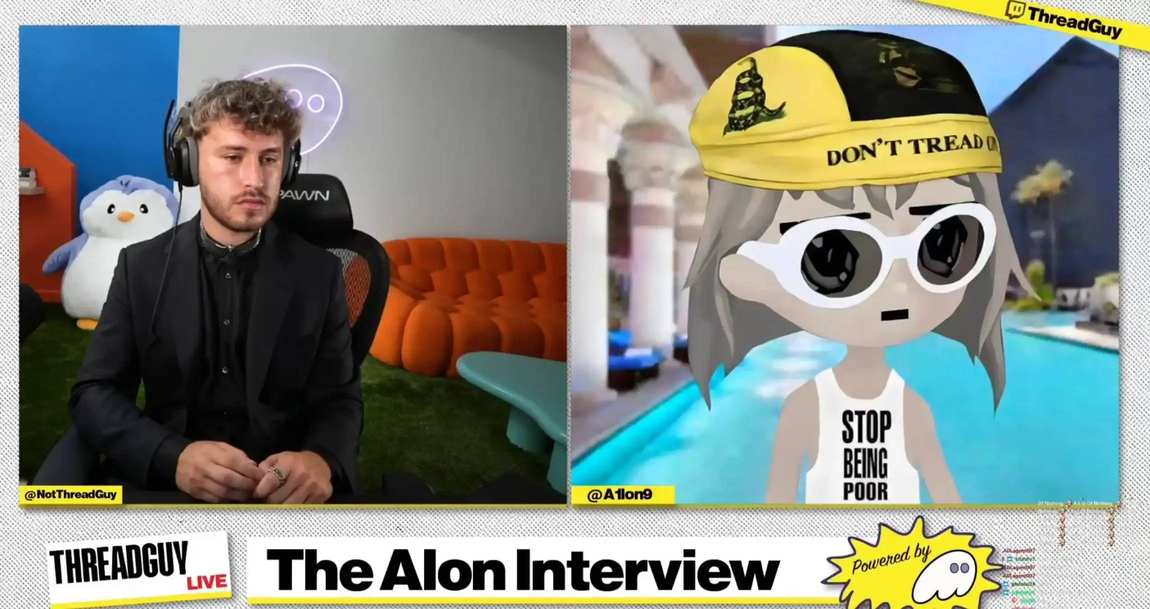
Interview with Pump.Fun Co-Founder: I Don't Think My Product Killed Market Cycles, Meme Coins Are Here to Stay
TechFlow Selected TechFlow Selected
Interview with Pump.Fun Co-Founder: I Don't Think My Product Killed Market Cycles, Meme Coins Are Here to Stay
Even tokens that initially appear in pure form may eventually spiral out of control as people continuously test the limits.
 Navigating Web3 tides with focused insights
Compiled & Translated: TechFlow
Guest: Alon, Co-Founder of Pump.Fun
Host: David Hoffman
Podcast Source: Bankless
Original Title: The Next Chapter for Pump.Fun with Co-Founder Alon
Air Date: March 25, 2025
Key Takeaways
Alon, co-founder of Pump.Fun, joins us to discuss the rapid growth of their token launch platform, the controversy and impact of Memecoins in crypto, and the vision behind their latest product, PumpSwap.
This episode offers Alon a fair opportunity to explain his views on Memecoins—while also acknowledging that Pump.Fun has been at the heart of one of the most controversial capital dynamics in the industry. What began as seemingly harmless speculation gradually evolved into a structured, systematic extraction of wealth, concentrating gains among a few while causing significant financial losses for many.
Memecoins may be inherently negative in their societal effects, similar to how tobacco impacts public health. I believe the Pump.Fun team might disagree with this view, given their vested interests. But we are still in the early stages of both the crypto space and the evolution of Memecoins. The future is not yet written. Perhaps Memecoins can have a more positive trajectory. Ultimately, Memecoins are simply a natural consequence of what crypto enables: the permissionless creation of financial assets. Whether we like them or not, whether they represent a threat to public good or a step toward a fairer future, the outcome will be shaped by the leaders within the Memecoin ecosystem.
Highlights & Key Insights
-
Memecoins are essentially "tradeable units of attention," where value correlates directly with the attention users give them.
-
I strongly disagree with the claim that "Pump.Fun killed market cycles."
-
I believe Memecoins will persist in some form because they genuinely offer users certain value—and that will become clearer over time.
-
I hope the narrative around Memecoins shifts so people no longer see trading these tokens on-chain as meaningless or nihilistic. I’ve never bought into “financial nihilism”—that’s just an excuse used on Crypto Twitter to justify the status quo.
-
Twitter isn’t an ideal platform because its mechanics tend to inflame emotions and conflict between users. As a result, many people's perceptions of other ecosystems often differ greatly from reality.
-
Crypto is fundamentally social in nature, and this trait permeates the entire ecosystem.
-
I don’t want Pump.Fun to be a short-lived product that only lasts one or two years.
-
Pump.Fun succeeded primarily due to our product strengths. We’ve consistently listened to user feedback, iterated quickly, and built features that truly meet user needs.
-
Every day I wake up thinking about one thing: how to make this product more sustainable, and how users can feel real value when interacting with the protocol or app. That’s our constant pursuit.
-
Directly talking to users was a great way to gather feedback on their market views, helping us build deep insights into the prevailing market conditions.
-
Many people spend too much time and energy building infrastructure. But if no one uses it, that infrastructure is meaningless.
-
I believe anything culturally significant, especially controversial content, always explores the boundaries between acceptance and rejection. But we’ll ensure there’s a clear line that no one crosses.
The Origin of Pump.Fun
David:
Maybe you could briefly introduce your background, your journey before Pump.Fun, and then walk us through the idea and founding of Pump.Fun.
Alon:
About myself and my two co-founders—we’ve been in this space for a while. We all entered as retail traders, buying BTC, ETH, Doge, etc.
Over time, our interest in the industry deepened, and we participated in various projects. Personally, I was deeply involved in a project called NFT perp, a futures exchange focused on NFTs.
Back then, we were very active in DeFi and saw real potential in the market. With NFT perp, for example, we observed strong product-market fit in collectibles trading. But after the Terra Luna and FTX collapses, we realized the market was declining, and the NFT outlook might not be as long-lasting as we thought.
So we wanted to try something new. I left that role and started experimenting with different ideas in the space alongside my two co-founders. Actually, we were mainly building on Ethereum and its L2s—something many might not know. We came from the Ethereum ecosystem, initially starting with NFTs, then building things in SocialFi, almost from scratch, going through a tough process.
I’d say we spent at least a year “eating glass.” One of my co-founders would even say it was longer—over two years—just iterating, shipping MVPs (minimum viable products), working on things we believed people would need. Honestly, when we started, we weren’t good at this. We built things we thought were cool or trends we assumed would emerge, but we weren’t actually building for today’s users. We didn’t engage deeply with users or build solutions to their current problems.
As we kept iterating and trying more things, our skills improved. But the issue was, we were building in problem spaces we didn’t fully understand. At one point, we tried building a creator fundraising marketplace—but we weren’t creators ourselves. We got into crypto because of on-chain trading, NFT trading, buying NFTs, etc. Eventually, when we saw people starting to trade Memecoins on Solana, it caught our attention. Honestly, we hesitated a bit about moving to Solana because we’d never used it before, and we’d been developing smoothly on Ethereum. I think our last project before switching was painful to build on Solana—we weren’t excited about it. But at that moment, we were desperate to attract users, and users were clearly on Solana. So we decided to go there.
From my perspective—or my co-founders’ perspectives—they’d definitely say, if users were on Cardano, we’d build on Cardano too. We’d do whatever it takes to get users. We saw users on Solana, so we started experimenting with products there. There was a lot of excitement in the market, and we felt like we were at the beginning of a new wave. The trading experience was smooth and fast. We enjoyed using Phantom wallet, trading on-chain, like on Jupiter, etc. But we noticed major structural issues—how people discovered coins, created coins, and ultimately what they traded. Back then, presales for Memecoins were super popular. People would post wallet addresses on Twitter or elsewhere, and others would send funds there. We saw so many people sending their SOL into these presales, and half the time, the coin never launched—it was pure chaos. There was zero standardization. No one knew what to expect. Even when everything went well, creators would take 50% of raised funds for marketing, which was absurd. You don’t need millions to market your Memecoin—it made no sense. Meanwhile, trading on AMMs or DEXs was brutal—pulling liquidity, buying honeypots, tokens that drained your entire wallet. It was a harsh experience.
In the Ethereum ecosystem, I think there’s more to unpack about the project behind it—its final performance, governance issues, etc. But I really admired the idea of being able to create a small token community without upfront capital. Using a bonding curve, you could bootstrap liquidity based purely on an idea.
So the model we eventually landed on was: You don’t need to pre-fund to create a coin. When enough people participate or market success is indicated, a liquidity pool is created and then burned. All permissions and related rights of the created coin are revoked from the creator. Once live, it becomes truly permissionless and immutable. When we released this model to the market, we quickly noticed it worked. It took us a while to get it running smoothly, but we were very optimistic about the product’s potential.
Pump.Fun’s Post-Launch Performance
David:
This reminds me of the era before Pump.Fun. Maybe the most iconic example is Slurf—a Solana developer who publicly announced a presale for his Memecoin, but there was no Pump.Fun back then. So people just sent money to this trusted individual to manage, launch the coin, add SOL to the liquidity pool—that’s how Memecoins were launched. Then in the Slurf incident, he accidentally burned the liquidity tokens because he didn’t know what he was doing. And then there was that famous tweet: “Guys, I think I accidentally burned the LP tokens. Sorry.”
I think this illustrates the chaotic state of the Memecoin market before Pump.Fun. Pump.Fun provided a commoditized platform where users could launch Memecoins in a less regulated but more standardized environment. Instead of trusting an influencer or individual, users could now launch tokens directly via the pump.fun platform.
In January 2024, how long did it take you to gain traction? Was it immediate? When did you realize, “Oh, we’ve just created something incredible”? How long did that realization take within the Pump.Fun ecosystem?
Alon:
I think we were confident in the idea from the very beginning, even before launch. Unlike other products we’d built, this time we were truly immersed in the ecosystem. We understood how important lowering barriers to entry was. Previously, a token needed thousands of dollars in liquidity to be considered valuable. Sure, you’d see pools with $50, but no one would buy them, right? So we had strong conviction in the idea and quickly shipped an MVP.
Honestly, the initial product was very rough and clunky. We just wanted to quickly validate whether the idea was worth pursuing. After launch, even though user numbers were low, the response was extremely positive. That told us the project had potential, and we also received a lot of feedback highlighting areas for improvement. So we began rapidly iterating.
At the same time, we faced the cold-start problem—Pump.Fun is a marketplace connecting token creators and buyers. Initially focused on Memecoins, but open to other token types. The challenge was attracting early users, since most people were already trading on other markets or exchanges. Getting them to switch to our platform was a huge hurdle. We needed to attract both creators and buyers simultaneously. Buyers wanted to see volume and activity—otherwise the platform wasn’t attractive.
In fact, we never paid any influencers, nor did we have the budget for it. Our initial funding was only around $100K—nowhere near enough for promotion. So we took a different approach—direct conversations with users. I personally messaged over 3,000 people to share our idea. This wasn’t copy-paste spam, but genuine conversations—greeting them, understanding their thoughts. We kept it simple. We talked to them directly, asked what they were trading and why—this was a great way to gather feedback on market sentiment and helped us build deep insight into the market at the time.
Eventually, after building rapport, I could say, “Hey, I’m building this thing.” At first, I only had 200 followers, and people thought I was a bot. But over time, people started listening. After two months of iteration, we even launched a version of Pump.Fun on an Ethereum L2—but it didn’t work.
We experimented with many product directions, but ultimately what mattered was optimizing the product to be good enough and showing it to enough people.
About a year ago, we truly realized product-market fit. Two micro-influencers independently launched their own tokens on our platform. We didn’t pay them, nor did we expect it—they just found the product interesting and used it organically. From there, more and more people started experiencing our platform.
It felt amazing—probably one of the most exciting moments I’ve had in recent years. Waking up every day to see trading volume hitting new highs—the feeling of effort paying off was unparalleled. Even after Pump.Fun achieved massive success later, that initial joy of finding product-market fit remains one of my most cherished memories.
Pump.Fun’s Impact on Memecoins
David:
Pump.Fun’s growth trajectory is still impressive. By March 2025, Memecoins have had a significant impact on the broader crypto industry. Overall, Memecoins have become a widespread phenomenon, similar to the Monkey craze of 2021. However, due to the launch of several high-profile Memecoins, crypto’s reputation in mainstream society may have hit its lowest point since the FTX collapse. These structured, systemic profit-extraction behaviors have severely damaged the industry’s image and weakened trust in crypto’s seriousness.
While Pump.Fun didn’t invent Memecoins—Memecoins existed long before—such as Dogecoin, the first Memecoin. Yet Pump.Fun played a crucial role in expanding the Memecoin space, transforming it from a niche crypto subculture into a mainstream use case. Can you reflect on Pump.Fun’s role and impact during this chapter of crypto history?
Alon:
As you mentioned, the Memecoin market has existed for a long time. I’d trace Memecoin history back over a decade, evolving in various forms. Many ICOs were essentially Memecoins; even many DeFi “food coins” had Memecoin-like traits. NFTs themselves can be seen as Memecoins, representing cultural value exchange and community formation around ideas. This phenomenon exists across Ethereum, Binance Smart Chain, Solana, and others.
I agree Pump.Fun played a key role in scaling the Memecoin ecosystem—lowering entry barriers and providing essential security. But I don’t believe Memecoins are why crypto has lasted over 15 years. Many find the market unappealing not because people enjoy trading “meaningless” Memecoins, but because existing use cases lack sufficient real value. It reflects demand for more engaging applications.
I strongly disagree with the notion that “Pump.Fun killed market cycles.” If a few years ago you launched an L2 or L1 with no users or product-market fit, yet your token reached a $5B or $2B valuation, attending conferences promising to build the future of finance—of course people feel let down when they lose money.
We should expect such reactions. Crypto has been around for 15 years—it’s time to see tangible results. Projects that succeed deserve praise. Take Hyperliquid, for example—a great product, strong user base, fair token distribution. People rallied behind it, and the token rose 10x or even 15x post-launch. This shows strong market demand for projects with real utility, whether speculative or not. But such projects remain rare.
I think the root issue is: many people spend too much time and energy building infrastructure. But if no one uses it, that infrastructure is meaningless. We need 10x more application builders than infrastructure builders. I know this is a point many thought leaders have emphasized for years, but Pump.Fun exemplifies it—showing how building a user-attracting product allows users to test your infrastructure in practice. Just like Solana’s significant improvements over the past year, this drives ecosystem-wide progress.
Making Memecoins More Sustainable
David:
I think there’s a recurring pattern in crypto’s evolution, going back to 2017. Why did the 2017 ICO boom happen? Because Ethereum’s ICO was highly successful, followed by Augur’s—both legitimate projects with real value. But as ICOs multiplied, absurd, valueless virtual currency ICOs emerged—even just memes. It’s like the classic “euthanasia coaster”: a valuable project starts a cycle—like DeFi Summer launching Compound governance tokens—sparking a chain reaction that ends with 10,000% APY yield farming. NFTs followed a similar path. I think Memecoins are the same: originally launching original, fair Memecoins, later devolving into hyper-speculative, profit-extraction models.
I believe the Memecoin wave is one of the most fascinating phenomena in crypto history. If you could go back to Pump.Fun’s early days, would you consider changing the design or architecture to encourage more sustainable development? Or is this phenomenon completely beyond your control?
Alon:
There are a few points here. I do believe the market is a powerful force. Ultimately, if crypto is inherently this way, there’s very little you can do when market mania kicks in. These patterns tend to repeat over time in similar ways. But I do agree mechanisms can improve. For example, we just launched PumpSwap yesterday—to optimize existing mechanisms.
I think a major improvement is better aligning incentives between token creators and holders/traders. Today on PumpSwap, creator revenue sharing isn’t live yet, but when it is, creators will earn fees from PumpSwap trading volume. So when their token succeeds, they’re strongly incentivized to maintain its value—not just dump and run, but keep their token relevant and active as long as possible. I believe this is a more sustainable model.
During the NFT boom, I worried about royalty fees. They were so high that users tried to bypass them. But that swung to the opposite extreme—an excessive extraction mechanism. I think we need balance, which is partly why we built PumpSwap. We aim to solve these issues with better mechanisms.
Again, though, crypto’s nature means it’s often tied to speculation. Even tokens born in pure form can spiral out of control as people push boundaries. Libra is a classic example. Facebook’s crypto project wasn’t a true Memecoin, but its failure revealed a truth: requiring intermediaries for token issuance is absurd. If you just want to create a token around a simple idea, you shouldn’t need middlemen.
That was part of our motivation for creating Pump.Fun. If Memecoins can enter a new chapter, and mechanisms evolve for greater sustainability, we fully support that shift. Because I don’t want Pump.Fun to be a short-lived product lasting only a year or two, then failing or disappearing. Despite our success, if Pump.Fun doesn’t survive the next market cycle or exist meaningfully in a few years, that would be a failure. Every day I wake up thinking about how to make this product more sustainable, and how users can feel real value when interacting with the protocol or app. That’s our constant goal.
Pump.Fun’s 4Chan Aesthetic
David:
My initial attitude toward Memecoins was resistance, mainly due to their detached, cynical character. They seemed to say: “We’re not here to create value. We’re just trading cartoon images, not contributing to GDP, not building anything real. We’re offering meaningless, nihilistic speculative assets.”
But my view has shifted. While I don’t fully embrace nihilistic asset trading, I think adding extra incentives to Memecoins could make them more sustainable. I want to discuss this—especially your recently announced PumpSwap feature. I think this could make Memecoins more productive and meaningful long-term.
One huge advantage of crypto is giving ordinary people access to financial assets. Before Bitcoin, individuals couldn’t possibly create financial assets. Bitcoin was the first asset created outside the nation-state system. Since then, crypto’s trend has been lowering barriers to asset creation. I see Pump.Fun as the logical extension of this—especially when you consider it created 9 million tokens in a year, meaning 9 million financial assets.
My next question: how do we turn these seemingly detached financial assets into sustainable business models? How do we integrate them into economic growth? What’s Pump.Fun’s cultural trajectory? Going back to design—Pump.Fun seems to have a 4Chan-style aesthetic and vibe. Why did you choose this design language?
Alon:
When we first built the MVP, we chose this style out of practicality—it was easier to implement. We just wanted to ship fast. But as we improved, we decided to keep it because we found it resonated with user behavior. Many early successful Memecoins originated on forums like 4Chan, and many users deeply connect with those platforms. So we’ve maintained that style ever since. While we still need UX improvements, we believe preserving this culture and honoring its roots is a key difference between Pump.Fun and soulless projects lacking cultural depth. Even if our goal is reaching 10 million daily active users, we want to preserve this culture. Without it, Pump.Fun becomes another lifeless Web2 product—and that’s not what we want.
David:
Still, some might question whether 4Chan culture truly counts as “rich culture.” I’m no 4Chan expert, but from what I understand, it’s the internet’s “sewer,” full of racism and toxic behavior. Of course, I don’t want to generalize, but it does resemble a “wild west” lawless zone. In 2025, crypto culture is largely shaped by core leadership within each ecosystem—Ethereum by its leaders, Solana similarly, and Pump.Fun is no exception. So I think some of Pump.Fun’s behaviors are determined by its design choices and cultural positioning.
If we want Memecoins to enter a more sustainable, fairer chapter, I think the 4Chan brand image could be a barrier. Do you agree?
Alon:
Overall, I agree. But I don’t think the design style hinders our efforts to improve culture. I believe content moderation is extremely important. In the past, especially in the Ethereum ecosystem, many found Pump.Fun’s environment off-putting—partly due to events in November 2024. I want to clarify: we’ve implemented content moderation from day one. For example, we launched live streaming in June 2024. Many users started live-streaming their tokens—harmless at first—and we thought supporting it internally would be interesting.
But six months later, users questioned why we built this feature since usage was so low. Then in October and November, as the market heated up, live streaming suddenly exploded. I remember daily streams jumping from 10 to thousands in just days. Before that, Andrew Tate streamed while trading tokens, and the whole market was volatile. When everything collided, crypto’s craziness was unbelievable. I regret we weren’t transparent enough about moderation, leading many to assume we had no standards. In reality, we’ve enforced rules all along—we just didn’t communicate it well.
As for the 4Chan aesthetic, I don’t think it blocks healthy development. I believe anything culturally significant, especially controversial content, always explores the boundary between acceptance and rejection. But we’ll ensure a clear line is drawn, so no one crosses it.
Pump.Fun’s Content Moderation
David:
Previously, I had no idea Pump.Fun had any content moderation. I assumed with 60,000 tokens launched daily, the scale was too massive to moderate. Could you briefly explain how this moderation system works? How do you manage moderation at such scale? I know not all 60,000 tokens have live streaming, so could you walk us through the moderation workflow?
Alon:
Yes, the number of daily launches might now exceed 60,000—closer to 80,000—which is indeed crazy. But a few points here.
First, once a token is launched on-chain, its metadata is immutable. Most interaction happens through frontends like Pump.Fun or similar sites. I don’t know if other sites moderate, but Pump.Fun attracts massive traffic from users wanting to interact with these tokens.
Content moderation challenges resemble those of social media platforms. Managing such high volume is tough but not impossible. Social platforms generate massive content every second. While different from text-heavy platforms like Twitter, we use a similar approach: combining automated systems, user reporting, and human review. A unique challenge for Pump.Fun is that in the Memecoin space, users are eager to join new tokens early. So many love browsing freshly launched tokens, meaning we have almost no time to moderate. With tens of thousands of users viewing new tokens in real-time, we must react within milliseconds. So we rely heavily on automated systems, backed by significant human moderation resources. Together, they form Pump.Fun’s frontend moderation. Of course, it’s imperfect—users can access tokens through other frontends. If those don’t moderate, problems arise.
David:
I find the Memecoin mechanism fascinating because it incentivizes user behavior—both good and bad. Removing the live streaming feature, for example, was a great move. When it launched, some absurd but funny things happened. Later, it escalated—like a dev livestreaming fentanyl use and faking death. That was probably the worst-case scenario. Eventually, you removed the feature, effectively curbing these wild behaviors. To me, this shows Pump.Fun can guide user behavior through mechanism design—a power derived from your traffic, users, and brand influence.
Do you have other mechanisms or methods to steer users toward more sustainable behavior?
Alon:
In permissionless systems, it’s hard to fully suppress bad behavior. On-chain actions are open and immutable—anyone can access and exploit them. But social layers can promote positive behavior. I believe we can guide attention toward positive content and reward such behavior. Ultimately, Memecoins are “tradeable units of attention,” and their value closely ties to the attention users give them. If we can direct attention toward positive things, we incentivize more constructive behavior instead of destructive ones. Of course, eliminating bad behavior entirely in permissionless systems is nearly impossible, but we can design mechanisms to focus attention more positively.
For example, many view AI-related tokens negatively, seeing them as hype-chasing. But some projects are actually building real products. Griffain, for instance, is fascinating—they’re building a ChatGPT-like app interacting with the Solana blockchain. Talking to the founder, I learned his goal wasn’t hype—he wanted to use the token to draw attention and drive real product development. If such tokens successfully capture attention, people start using the product, and progress follows naturally.
Of course, most projects fail—they don’t find product-market fit. But being able to quickly validate an idea via a token is a huge opportunity. We want to see more of this and will actively reward projects that build real products to gain attention. My co-founders and I have tried launching MVPs before—I deeply understand this need. If you can quickly test an idea’s viability with a token, it dramatically improves efficiency.
Still, many hesitate due to reputational risks. I completely understand—they don’t want to be seen as profiting from token sales. That’s why we need to explore alternative monetization paths—designing platforms or protocols so teams can profit without selling tokens. I think that’s critical. So this brings us back to incentivizing good behavior at the social layer and optimizing incentive structures at the protocol layer.
The Success of Pump.Fun
David:
After Pump.Fun’s success, several similar token launch platforms emerged, but none matched Pump.Fun’s level of success or viral spread. Why do you think that is? What key advantages does Pump.Fun have that others can’t replicate?
Alon:
I think the answer lies in the extremely low switching cost of open systems. Compared to Web2 or traditional finance, moving between platforms is far easier. So I believe Pump.Fun’s success stems mainly from product strength. We constantly listen to user feedback, iterate rapidly, and deliver features that genuinely meet user needs. We welcome competition—it benefits users. We also closely monitor market trends. There are some solid competitors out there—though they may not be as attractive yet—with innovative ideas and exciting developments emerging. Ultimately, users choose the best product. We believe that as long as we keep improving, market feedback will favor us. Last year’s performance already proved that. So honestly, I think the answer is quite simple.
David:
How each team uses their funds is their own decision, but I think many listeners expect me to ask this. It’s estimated that Pump.Fun has generated around $600 million in revenue for the team, investors, or a combination. $600M in profitability ranks among the top in crypto projects—especially for one launched in 2024. How has this money been primarily used?
Alon:
We reinvest all funds to build a better product. For example, we use it to grow the team. Currently, we have about 45 to 50 people—up from under 20 just six months ago. Previously mostly engineers, we’ve now added data scientists, machine learning engineers, and security experts. We’re still expanding—to deliver the best user experience possible.
David:
Do you distribute funds to investors? I recall you had a seed round, right?
Alon:
Pump.Fun did accept some early investment, but we’re now essentially self-funded. In a way, I also believe those who work hard should enjoy the fruits of their labor. But as I said earlier, our goal is always forward-looking—to build a product that withstands multiple market cycles. If years from now we look back and it was just a flash in the pan, that would be deeply disappointing. It would mean we didn’t truly create lasting value.
PumpSwap
David:
Next, let’s talk about one of your new products—PumpSwap. It’s Pump.Fun’s native DEX, your second major product. Previously, Pump.Fun operated under a model where any Memecoin reaching a certain market cap would migrate to Raydium. Raydium is Solana’s automated market maker (AMM), essentially Solana’s “Uniswap.” Once migrated, tokens became part of the Raydium ecosystem, and Raydium collected substantial fees. Thanks to Pump.Fun’s success, Raydium’s trading volume surged, and its token performed well. So Pump.Fun’s rise significantly boosted Raydium, increased overall Solana ecosystem activity, and even benefited Solana itself. For example, why did figures like Donald Trump launch Memecoins on Solana? Because Pump.Fun led the Memecoin wave.
Now, you’ve launched PumpSwap as Pump.Fun’s native decentralized exchange. This replaces Raydium with your own AMM, vertically integrating the Pump ecosystem. That’s my understanding. Can you discuss the strategy and vision behind PumpSwap?
Alon:
Your understanding is spot-on. PumpSwap is Pump.Fun’s native decentralized exchange. We launched it for two main reasons—both delivering significant value to users.
First, the current trading flow is still too complex. We aim to deliver a simple on-chain trading experience accessible to hundreds of thousands, even millions of users. Users shouldn’t need to understand migration processes, bonding curves, or how AMMs work. We want users to focus only on the core question: Is this fun? Does it create value for me or others?
To reduce friction, we made changes. Previously, during migration, Pump.Fun extracted about 6 SOL from the bonding curve—for liquidity pools, tips, etc.—with the rest going to protocol revenue. Now, that fee is completely gone—zero. This makes the trading flow smoother and better aligns with user interests. By lowering fees, we earn steady revenue when tokens succeed, without hurting user experience.
So we aim to eliminate the need for these complex concepts. Previously, Pump.Fun took ~6 SOL during migration—for liquidity, tips, etc.—and kept the rest as revenue. Now, that’s eliminated. This adjustment streamlines the process and aligns incentives with users. Lower fees mean stable revenue on success, without compromising UX.
Another aspect of PumpSwap is aligning token creators and holders. Simply put, we aim to incentivize higher-quality tokens and content, creating something truly enduring. To achieve this, you need sustained growth—by attracting content creators from other parts of the internet. Their participation must be simple and rewarding. They shouldn’t need capital or worry about reputation. Creator fees and revenue sharing play a vital role here.
Another goal is market experimentation—we want users to trade other asset types beyond Memecoins. We’re partnering with 15–20 teams, 10 of whom are bridging their tokens from other blockchains to Solana for the first time, creating liquidity pools here.
We hope these experiments let users explore more asset types, not just Memecoins. It may not bring revolutionary change soon, but it’s a promising experiment.
We stay close to users. People genuinely want to explore more, but many aren’t tracking every update daily. Core Crypto Twitter members might spend 16 hours a day in this bubble, but many Pump.Fun users don’t even know what CT is, lack centralized exchange accounts, and thus can’t access these new projects. So we want to bring these assets to them simply and conveniently.
I don’t expect disruptive change short-term, but it’s a worthwhile experiment. I believe many users will be interested in exploring these assets, gaining deeper exposure to crypto beyond Memecoins. That’s PumpSwap’s core direction.
David:
My current understanding is that PumpSwap uses a fixed x*y=k AMM model, similar to Uniswap V2. Uniswap V3 introduced innovation with concentrated liquidity, but you chose the simpler fixed-curve model, avoiding concentrated liquidity. Can you explain this design choice? After all, there are many cutting-edge AMM designs today—you seem to favor a more traditional approach. Please also share your thinking on AMM design and future directions.
Alon:
My view: if something’s proven to work, don’t fix it. Clearly, Uniswap V2’s bonding curve model is nearly optimal for long-tail assets like Memecoins.
Of course, future innovations are possible. When tokens succeed, liquidity grows, and people might adopt concentrated liquidity AMMs or even trade on orderbook exchanges (mostly off-chain, sometimes on-chain). So those are future possibilities.
But right now, we’ve seen Memecoins thrive under the Uniswap V2 model. I don’t think we need to over-experiment with AMM design. Instead, we’d rather innovate on incentive mechanisms—better aligning creators and users—rather than drastically altering the AMM model.
Creator Revenue Sharing
David:
I’d like to revisit creator revenue sharing, which we’ve touched on. I think it’s so important it deserves deeper discussion. If Memecoins are entering a new chapter, I hope it centers on this mechanism.
What I see here is that creator revenue sharing lets token creators earn from trading volume, not from selling tokens. In the past, Memecoin creators typically profited by dumping tokens. But this misaligns with later buyers’ interests. Early holders have strong incentives to dump, often leading irresponsible creators to rug pull—dumping all tokens at peak prices or scamming investors. This crashes the price, kills the project, and leaves investors searching for the next opportunity.
With creator revenue sharing, creators theoretically don’t need to hold any tokens. Their main income comes from trading fees, not token appreciation. When creators earn from volume, their incentives align with holders’. As token value rises, trading volume increases, boosting creator income. This helps transform Memecoins from pure financial assets into projects with long-term growth potential.
For example, a creator could build a business entity, even as an individual online creator. This closely matches the “creator economy” concept we heard about in 2021. Though theoretical then, now it has a chance to become real. This mechanism could become a new commercial tool for creators. No similar model has been proven yet, but I’m optimistic. Do you agree? If not, how would you adjust it?
Alon:
I completely agree—you summarized it perfectly. I think we’re still in experimental phase—figuring out how to truly attract creators, of any kind, into crypto and retain them sustainably. This benefits creators, token holders, traders, and the entire ecosystem.
Though unproven, I’m excited. It’s a novel attempt, a thrilling experiment. Let’s see if it delivers win-win outcomes for creators and investors.
Pump.Fun vs. Raydium
David:
I’d like to quote a tweet from a Raydium contributor, who said Pump.Fun plans to build its own AMM to replace Raydium and create a fully vertical ecosystem. He tweeted in February: “While the Pump platform itself is impressive, whether a brand-new, untested AMM can generate significant network effects remains to be seen. Raydium will continue enabling teams to build protocols that otherwise wouldn’t exist. I believe Pump.Fun replacing Raydium entirely with its own AMM is a strategic misstep, underestimating the critical role Raydium’s AMM plays in liquidity bootstrapping.” What’s your response as a core contributor to Raydium?
Alon:
I disagree with that view. If Pump.Fun wants to build its own token launch platform or other features, we fully welcome it. We want more people experimenting with new models and functions. Ultimately, I believe vertical integration is a key piece. What does verticalization enable? It lets us experiment internally without relying on third parties.
I’m genuinely happy every day—I believe our team is among the best in this space. We ship fast and iterate quickly based on user feedback. I notice many other teams lack the same focus and efficiency in UX and product delivery. We don’t want to depend on third parties—we’d be constrained in product delivery. With PumpSwap, we fully control our ecosystem and take responsibility. Of course, if we fail, users will leave—that would be fatal. But I believe we’re willing to take that risk.
David:
Recently, Raydium announced they’re launching a token launch platform similar to Pump.Fun—I think they call it Launch Lab.
Alon:
I’ve heard. I’m excited to see what ideas they bring. Let’s wait and see. Either way, we’re not afraid of any competition.
David:
Does this mean competition between Pump.Fun and Raydium will escalate into a “conflict”? Or could you potentially find ways to collaborate?
Alon:
I don’t see it as a conflict. I see it as companies striving to deliver the best products to end users. It’s not just Raydium—many platforms, under various names. In fact, many innovative platforms in Ethereum and elsewhere have borrowed ideas from Pump.Fun and iterated on them.
Ultimately, I believe Pump.Fun designed a very clever token launch mechanism. But we acknowledge many ideas originated from existing protocols and projects. If Memecoins can enter a new chapter, I believe the potential of on-chain token generation will become richer.
There’s still much to do. I believe multiple distinct niches will inevitably emerge, each needing tailored mechanisms. That’s the natural evolution of the industry. As a protocol, Pump.Fun aims to be as general-purpose as possible, covering as many niches as we can. But we know we can’t cover all. So I’m excited to see new mechanisms from other teams. If any achieves massive success, we’d happily explore collaboration.
The Social Element of Pump.Fun
David:
Crypto is inherently social—the entire ecosystem reflects this. We exist in “tribes,” gathering on Crypto Twitter, chatting, discussing, even creating drama. Almost everything crypto-related has a social component. I noticed Pump.Fun’s live streaming feature already demonstrates this well—social components
Join TechFlow official community to stay tuned
Telegram:https://t.me/TechFlowDaily
X (Twitter):https://x.com/TechFlowPost
X (Twitter) EN:https://x.com/BlockFlow_News
 深潮TechFlow