








Unconventional Bull Market: The New Bitcoin Era and the Mini Altcoin Season
TechFlow Selected TechFlow Selected
Unconventional Bull Market: The New Bitcoin Era and the Mini Altcoin Season
As long as the market exists, as long as liquidity remains, opportunities will be there. We should ride the trend, yet also act against it when necessary.
 Navigating Web3 tides with focused insights
Author: Talk Beyond the Hype
In our previous article (March 12), we briefly discussed potential future directions of the crypto market. Different people may have different thoughts or perspectives—no one can truly predict the market's future—but one thing is certain: while market cycles follow certain patterns, the market itself continues to evolve.
Looking back at some of our earlier articles (e.g., from 2022 and 2023), views that once seemed reasonable or correct might not fully apply today.
In this cycle, we've witnessed numerous changes and unprecedented developments, such as:
1) MemeCoin Season appears to have replaced the previous Altcoin Season.
2) Bitcoin has reached the milestone of $100,000 and repeatedly broken all-time highs, yet Ethereum—the so-called "king of altcoins"—hasn't surpassed its previous all-time high in this bull run, and ETH’s current price is nearly identical to what it was four years ago.
3) The number of projects (tokens) has increased exponentially.
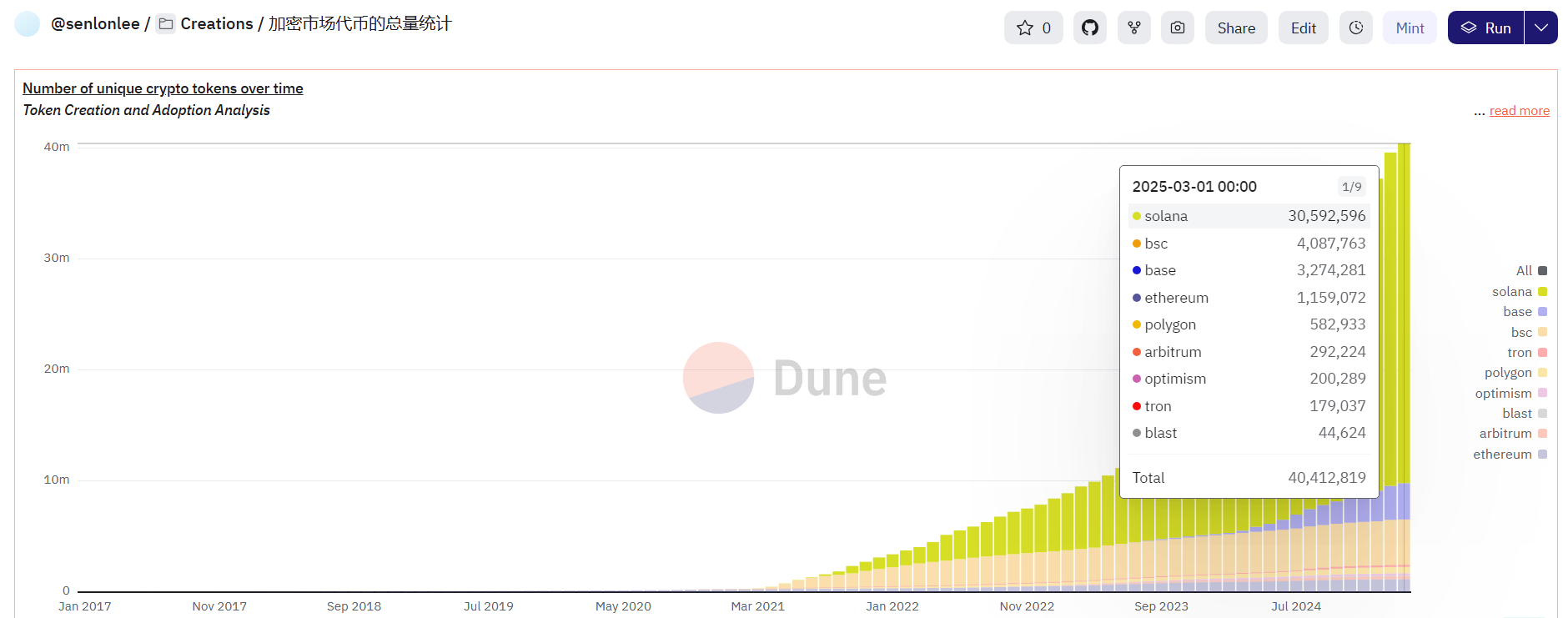
For example, there were about 350,000 tokens in the crypto market in March 2021; by March 2022, that number had grown to 4 million; and by March 2025, total token count exceeded 40 million. At this rate, we could see over 100 million tokens in the market by 2026. See chart below.
4) In 2024, BTC ETFs were officially approved, followed by ETH ETFs. Applications for additional ETFs—including DOGE, XRP, LTC, SOL, ADA—are currently under review (though the SEC has postponed decisions on these altcoin ETFs). Given overall market conditions, approval odds may increase in the second half of this year.
5) In 2025, the U.S. added Bitcoin to its strategic reserve via executive order.
6) Institutions are actively accumulating Bitcoin and certain altcoins.
While major institutions like Grayscale already existed in the last cycle—and we saw entries from companies like Tesla, with Elon Musk consistently vocalizing support—institutional participation in this cycle runs deeper and broader, including well-known players such as MicroStrategy and BlackRock.
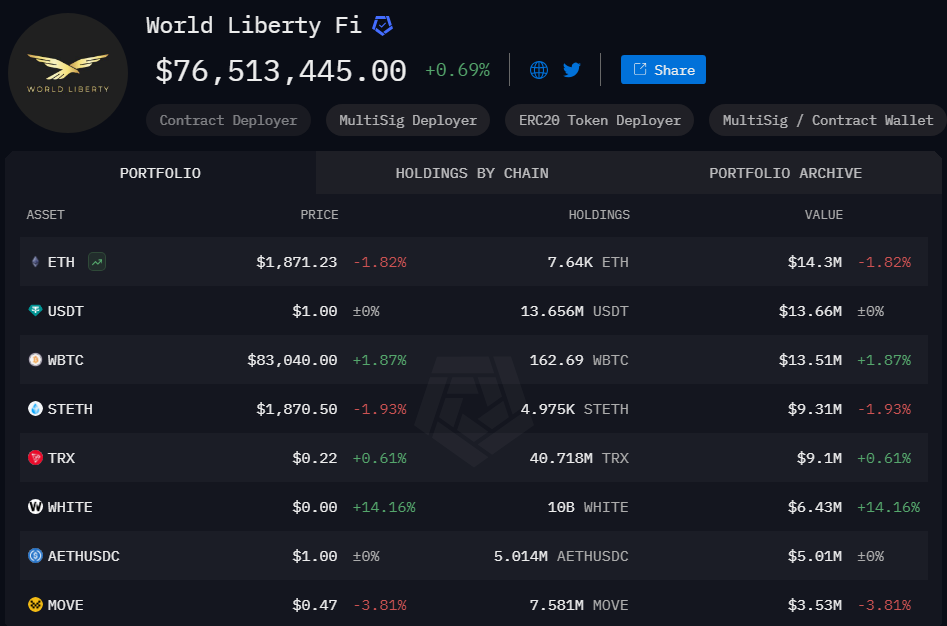
Beyond Bitcoin, some altcoins are also gaining institutional interest and investment. For instance, WLFI (World Liberty Financial—a DeFi project backed by the Trump family) has been steadily purchasing (and possibly receiving sponsorships of) ETH, ONDO, MOVE, ENA, LINK, AAVE, and other tokens since early this year. See chart below.
In short, we appear to be simultaneously following historical cyclical patterns while continuously witnessing new differences—or making new history.
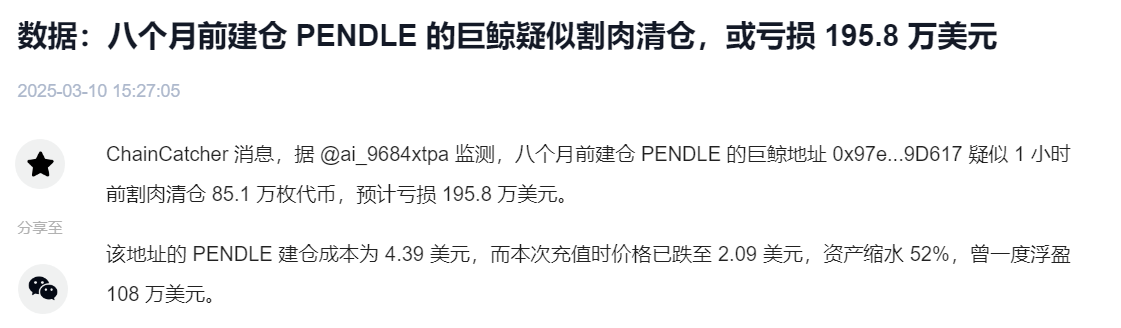
From an investment standpoint, in this cycle, many seasoned investors adhering strictly to traditional strategies have suffered losses—especially those who doubled down entirely on long-term value investing in altcoins. Recently, a representative case emerged: a whale bought PENDLE eight months ago but seemingly gave up holding it this month and may have already sold off completely. See chart below.
Compared to this decisive move, many other experienced investors are still stubbornly holding onto their altcoins despite price drops exceeding 80%, now trapped in a dilemma: selling feels unacceptable, but switching into Bitcoin means accepting they may never recoup costs... Facing such outcomes, anyone would struggle to make a decision. We’ve already shared our thoughts and suggestions on this topic from both long-term and short-term angles in our March 11 article—interested readers can refer back to that piece; we won’t repeat it here.
Setting macro factors aside for now, within the crypto market itself, given the current environment, heightened attention toward Bitcoin (in this cycle, whether hurt or unscathed, most investors now seem to plan long-term focus on Bitcoin again) makes another explosive “upward” surge unlikely. Excessive attention can create pressure—an accumulation of pressure that reinforces Bitcoin’s dominance (which may even continue rising), drives more investors toward Bitcoin (increasingly seen as superior to altcoin investments), and ensures strong buying support whenever Bitcoin pulls back...
Under these new dynamics and operational models, we’re unlikely to witness the traditional altseason—where Bitcoin reaches a peak, its dominance declines, and thousands of altcoins surge together. Starting this cycle, what we call “altseason” seems increasingly replaced by rapid-rise-and-fall sector-specific mini-altseasons: MemeCoin Season, Trump Season, AI Season, etc.—what we might term “mini alt seasons.”
Can we still expect a broad-based, “thousands of coins flying together” alt season? I believe such comprehensive alt seasons are now highly improbable. How could you possibly expect 10 million tokens to collectively rise several or even tenfold at once?
Unless there’s a fundamental shift in liquidity—that is, unless massive new capital floods back into crypto, enabling widespread altcoin surges.
However, mini alt seasons will still occur—it’s only a matter of time. If you remain interested in altcoins but don’t want to spend much time researching projects or engaging in PvP games, simply focus on fundamentally strong projects: those generating consistent revenue, with sound tokenomics, and committed to ongoing development with clear visions. The easiest method is to pick directly from the top 100 by market cap.
It’s foreseeable that liquidity will continue concentrating in BTC and a small number of select altcoins over the coming period. Most altcoins will likely face insufficient or dwindling liquidity. The vast number of altcoins (alongside countless VC-backed projects continuously unlocking tokens) will further fragment liquidity. This fundamental issue can only be alleviated through internal innovation (i.e., structural reforms within the crypto ecosystem—which I currently don’t see emerging) or shifts in macro conditions (such as the expected rate cuts in June or new U.S. policies targeting the crypto industry), which could help ease liquidity constraints in the crypto market.
As the saying goes: “History doesn’t repeat itself, but it often rhymes.”
We must interpret this wisely. Rhyming doesn’t mean rigidly applying past patterns. As stated at the beginning of this article, while market cycles exhibit certain regularities, the market keeps evolving. Scenarios from prior cycles may no longer fully apply today. We need to keep pace with the times and continuously adapt to and study the new realities of the current cycle.
Currently, opinions are divided: some believe the market has already entered a full bear phase; others see only a technical correction (with the biggest rally still ahead); some think the bull market has just begun. My personal view has been shared across previous articles—I believe there may still be new opportunities this year (though not widespread ones). As for longer-term predictions, I can’t see that far ahead. For now, let’s focus on what might unfold between May and June.
Moreover, everyone defines bull and bear markets differently. Some consider it a bear market once BTC falls below the 200-day MA; others only see it as bearish if Bitcoin drops below $50,000… As we’ve said before, perhaps it’s better to forget about labeling bull or bear altogether. Instead, focus on identifying key phases (accumulation → rise → decline → despair → rise → decline → despair → re-accumulation). Bear markets don’t necessarily mean losses, nor do bull markets guarantee profits. Regardless of labels, as long as the market exists and liquidity remains, opportunities exist. We should act with momentum when possible, and against it when necessary.
That’s all for today. Sources for images/data mentioned in the article have been added to the Talk Beyond the Hype Notion page. The above content reflects personal viewpoints and analysis only, intended solely for learning, documentation, and discussion purposes—not as investment advice.
Join TechFlow official community to stay tuned
Telegram:https://t.me/TechFlowDaily
X (Twitter):https://x.com/TechFlowPost
X (Twitter) EN:https://x.com/BlockFlow_News






