








Quai Network: How to Unlock the PayFi Highway with Technology and Application in Tandem?
TechFlow Selected TechFlow Selected
Quai Network: How to Unlock the PayFi Highway with Technology and Application in Tandem?
Challenging the "impossible trinity," building a technological highway for PayFi.
 Navigating Web3 tides with focused insights
Author: Nancy, PANews
Crypto assets are accelerating their integration into the real world. As a new financial paradigm merging traditional payments with DeFi, PayFi liberates payment flows from lengthy institutional pathways and reshapes financial interactions in the physical world. In response to this market trend, Quai Network—a Layer 1 blockchain whose mainnet recently launched—has built dual-engine crypto infrastructure driven by both technology and application innovation, unlocking greater potential for PayFi. Its novel design overcomes efficiency bottlenecks of traditional payments and blockchain scalability challenges, paving the way for seamless connectivity between the crypto economy and the real world.
Challenging the "Impossible Triangle": Building a High-Speed Tech Highway for PayFi
Bitcoin’s evolution from a niche geek consensus to a global mainstream asset marks the maturation of cryptographic technology and its growing integration into traditional finance. PayFi, as an emerging crypto narrative, challenges conventional financial frameworks with its innovative “Buy Now, Pay Never” model. Traditional payment systems suffer from high fees, long settlement cycles, and geographic limitations. Meanwhile, existing crypto payment solutions face issues such as cost volatility, insufficient throughput, and narrow use cases—making them ill-suited for large-scale commercial adoption.
PayFi aims to solve these pain points by enabling instant settlements, low-cost cross-border transactions, and seamless integration with real-world assets (RWA) via blockchain, thereby endowing crypto assets with practical utility. However, widespread adoption demands a delicate balance among transaction speed, cost control, and ecosystem compatibility—placing extraordinary demands on underlying infrastructure. Quai Network, a scalable and programmable Layer 1 blockchain, meets these requirements through technological superiority, offering robust support for PayFi applications.
PoEM and Dynamic Sharding: By combining its innovative Proof-of-Effort Mining (PoEM) consensus mechanism with a dynamic sharding architecture, Quai Network delivers a highly efficient, scalable, and secure blockchain solution.
Specifically, Quai Network employs a dynamic sharding algorithm that enables parallel transaction processing based on demand, boosting throughput without compromising security. Unlike traditional blockchains like Bitcoin or Ethereum, which rely on single-chain sequential recording, Quai Network uses multiple independent execution shards to process transactions concurrently, achieving superior performance. However, as the number of shards increases, inter-shard coordination and consensus speed can become scalability bottlenecks. PoEM optimizes traditional Proof-of-Work (PoW) by introducing entropy—the randomness generated through block removal—to assign block weight. Nodes prioritize blocks with the highest entropy removal as chain headers, eliminating fork disputes and accelerating consensus, thus mitigating the impact of network latency.
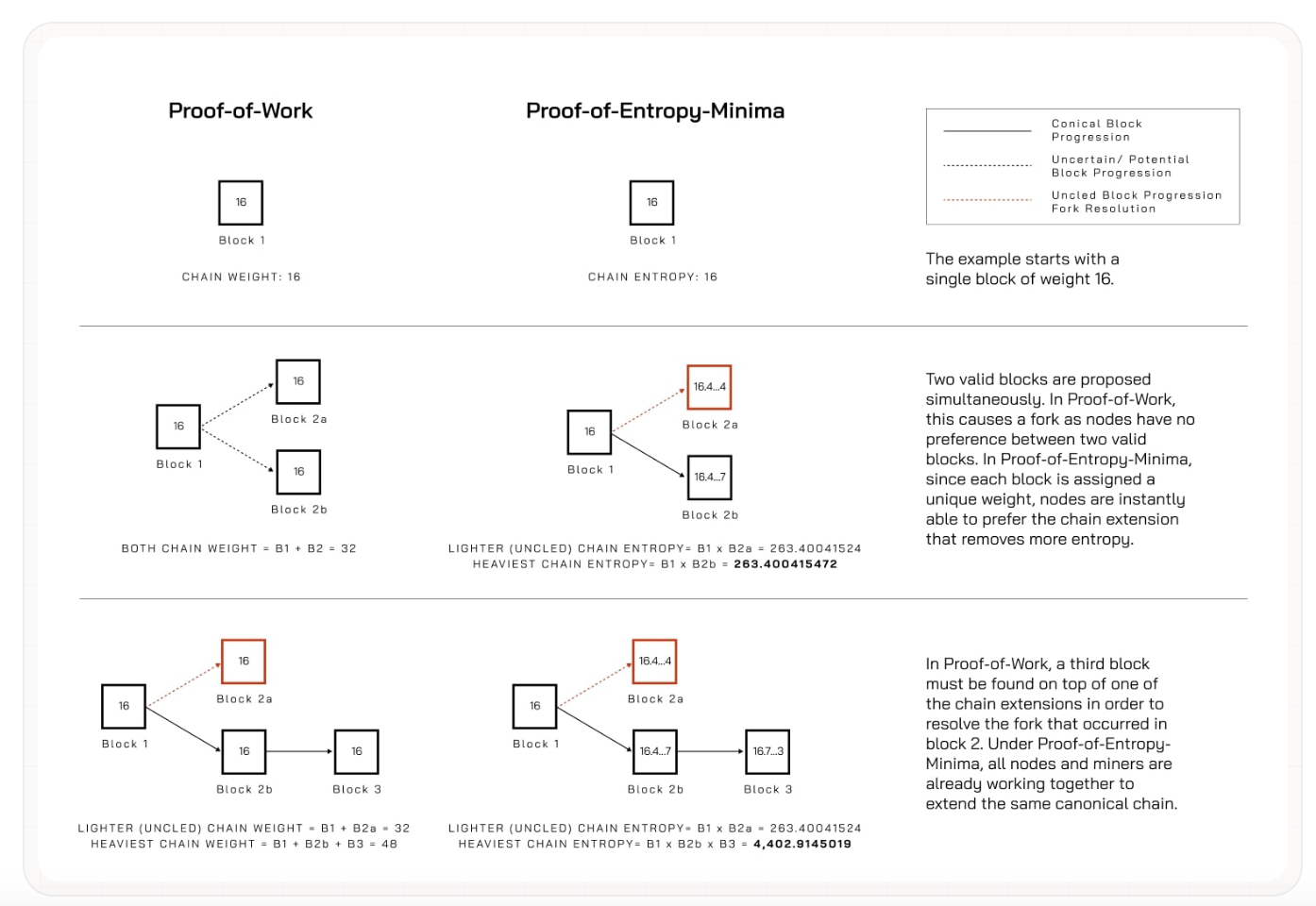
To put it simply, dynamic sharding is like a multi-lane highway that dynamically adjusts lanes according to traffic volume, allowing parallel processing to avoid congestion. PoEM acts as an intelligent navigation system, prioritizing the “least problematic” routes—ensuring smooth and conflict-free cross-shard transactions. Together, they enable Quai Network to maintain high throughput and security even under heavy load, forming a superhighway engineered for the future of payments.
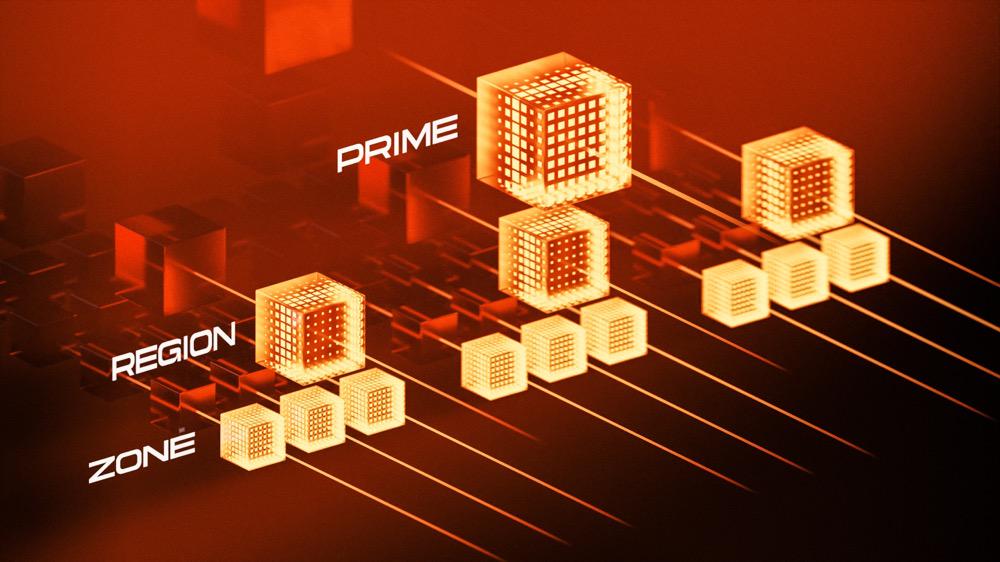
· Cross-Chain Interoperability: Quai Network adopts a hierarchical multi-chain architecture, dividing the network into multiple interoperable blockchains (execution shards): the Prime Chain, Region Chains, and Zone Chains. This structure supports throughput of up to 50,000 TPS. To enhance cross-shard transaction efficiency, Quai integrates Seamless Cross-Chain Transactions (ETXs), multi-chain contracts, atomicity guarantees, and dynamic sharding, ensuring fast and secure interoperability.
Imagine sending money via Quai Network like swiping a globally accepted credit card—whether transferring funds from the U.S. to a friend in Europe or buying a coffee on the corner, the transaction settles in seconds with fees under one cent, securely and tamper-proof. In this process, the Prime Chain coordinates, Region Chains handle clearing, and Zone Chains act like cash registers completing instant settlements—making cross-border payments as swift and efficient as local ones.
More importantly, Quai Network is compatible with the Ethereum Virtual Machine (EVM), allowing developers to directly use Ethereum tools to build and deploy smart contracts without learning a new tech stack—greatly lowering the entry barrier. It also seamlessly integrates with the broader Ethereum ecosystem—including DApps, wallets, and infrastructure. Additionally, Quai implements an MEV-resistant (Maximal Extractable Value) transaction ordering mechanism, ensuring fairer and more efficient execution in DeFi markets.
Merged Mining: Through merged mining, Quai Network significantly enhances blockchain scalability, security, and energy efficiency. Miners perform a single hash computation to simultaneously secure multiple blockchains—a concept originally proposed by Satoshi Nakamoto. Quai Network advances this idea into a multi-chain shared protocol network, where multiple chains run in parallel, share computational power, and generate overlapping blocks to ensure network security and efficient collaboration. Within the Quai Network, miners can simultaneously mine three chains, maximizing hash rate utilization and increasing overall network throughput. Overlapping blocks—created when a miner finds a nonce meeting the difficulty thresholds of multiple chains—enable cross-chain state transfers via cryptographic hashing, reducing trust dependencies and enhancing system stability.
For example, consider Xiaopai buying coffee at a global chain. Traditional blockchains resemble each store using isolated cash registers—slow and error-prone. Quai’s merged mining is like an accountant using a smart device to process accounts across multiple stores simultaneously—making payments faster and safer. Overlapping blocks function like universal payment vouchers, instantly recognized and settled regardless of which chain they originate from.
Moreover, Quai Network uses the ASIC-resistant ProgPoW algorithm, promoting GPU mining, lowering hardware barriers, and strengthening decentralization. Any blockchain supporting ProgPoW can join Quai Network for merged mining, further expanding its ecological reach.
Given the growing global demand for high-performance blockchains, Quai Network leverages innovations such as PoEM consensus, dynamic sharding, cross-chain interoperability, and merged mining to challenge the so-called “impossible triangle” of scalability, security, and decentralization. The result is a highly efficient, secure, and scalable blockchain network capable of powering high-load applications like PayFi—laying a technological foundation for the broader adoption of crypto assets.
Dual-Engine Token Model Unveiled: Mainnet Now Live
Beyond providing strong technical support for diverse PayFi use cases, Quai Network’s dual-token economic model offers both stability and flexibility across varying market conditions—delivering a two-pronged engine of value storage and medium of exchange for PayFi applications.
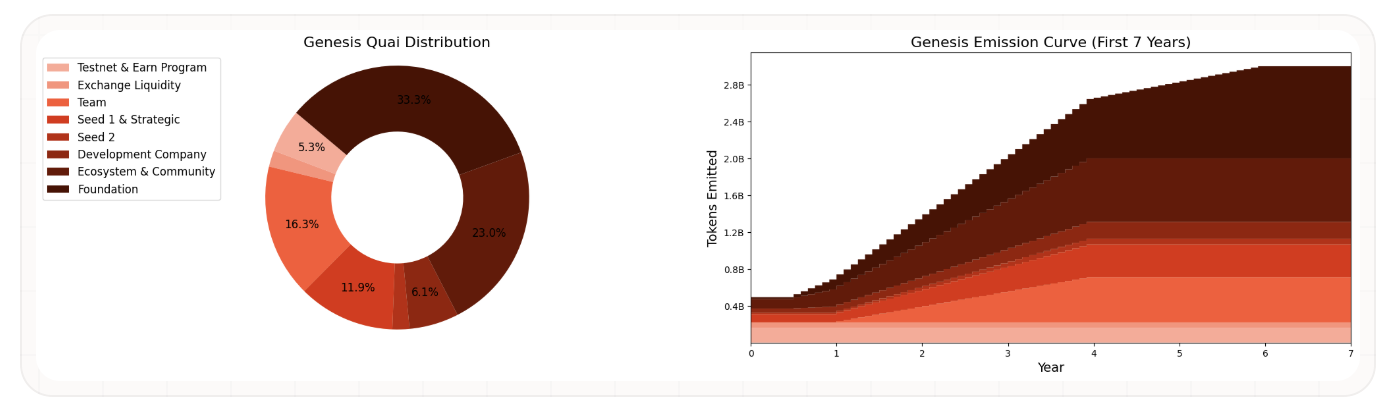
Quai is an EVM-compatible deflationary token designed for value storage. Its supply comes from two sources: genesis block allocation and miner rewards. Engineered with built-in scarcity and deflationary mechanics, the token issuance rate is designed to grow slower than network expansion. In other words, as the network scales and participation increases, the growth rate of Quai supply gradually declines. This mechanism avoids the boom-and-bust cycles typical of traditional economies, enabling Quai to meet decentralized finance's need for reliable value storage while maintaining long-term appreciation potential. In PayFi scenarios, Quai serves as a stable asset anchor for users and financial institutions—applicable in savings products, DeFi collateral, settlement assets, and cross-border wealth management.
Qi is the second core token within the Quai Network. As an energy-backed “flatcoin,” its value is directly tied to the energy cost of mining. This allows Qi’s supply to flexibly respond to changes in market demand and mining costs: when mining difficulty rises, Qi supply increases; when difficulty drops, supply decreases accordingly. Quai Network also features a two-way conversion mechanism between Qi and Quai, allowing users and miners to exchange tokens based on current block reward ratios.
Furthermore, Qi possesses cash-like privacy features and exhibits low volatility, making it suitable as a unit of account and medium of exchange for everyday payments and dynamic financial activities. Its efficiency and stability support daily PayFi operations such as instant payments and ecosystem incentives, enabling users to enjoy the benefits of blockchain in routine transactions while avoiding sharp price fluctuations.
In essence, Quai Network’s dual-token model provides dual assurance of stability and adaptability across different market environments. It satisfies diverse financial needs—from wealth preservation to efficient payments—and lays a solid foundation for a wide range of decentralized financial applications.
Quai Network’s innovation has already gained recognition from both capital and the market. To date, it has raised $15 million through multiple funding rounds, with participation from Polychain, Alumni Ventures, MH Ventures, Cogitent Ventures, and TPC Ventures. Simultaneously, Quai Network is actively building and expanding its partnership ecosystem across DeFi, AI, DAOs, infrastructure, wallets, and more—including Kaito AI, IO.NET, Entangle, Akash Network, MarginEx, IceCream Swap, Penomo, Portal DeFi, Butterfly Protocol, and UTXO Alliance.
Overall, Quai Network has constructed a high-speed dual-drive highway bridging the crypto economy with real-world business scenarios—particularly serving as ideal infrastructure for high-load, low-latency payment applications like PayFi. Through groundbreaking technologies that challenge the “impossible triangle” and a dual-token economic design, Quai Network not only resolves the tension between traditional payments and blockchain scalability but also accelerates the deep integration of crypto assets into the real world—unlocking vast new possibilities for decentralized economies.
Join TechFlow official community to stay tuned
Telegram:https://t.me/TechFlowDaily
X (Twitter):https://x.com/TechFlowPost
X (Twitter) EN:https://x.com/BlockFlow_News
 PANews






