Canada's New Prime Minister Mark Carney and His Cryptocurrency Anecdote
TechFlow Selected TechFlow Selected
Canada's New Prime Minister Mark Carney and His Cryptocurrency Anecdote
From Central Bank Governor to Canadian Prime Minister: How Is Mark Carney Navigating the Crypto Controversy with "Prudent Openness"?
 Navigating Web3 tides with focused insights
By Nicky, Foresight News
On March 9, 2025, Canada's ruling Liberal Party announced that Mark Carney had been overwhelmingly elected as its new leader. Carney will succeed current Prime Minister Trudeau as the party's leader and form a new cabinet, becoming the first prime minister in Canadian history to assume office without being directly elected by the public.
Mark Carney’s career has always been closely tied to the global financial system. From senior executive roles at Goldman Sachs, to leading central banks in both Canada and the United Kingdom, and later serving as the UN Special Envoy for Climate Action, each step of his journey has reflected deep thinking about the global economy and financial innovation.
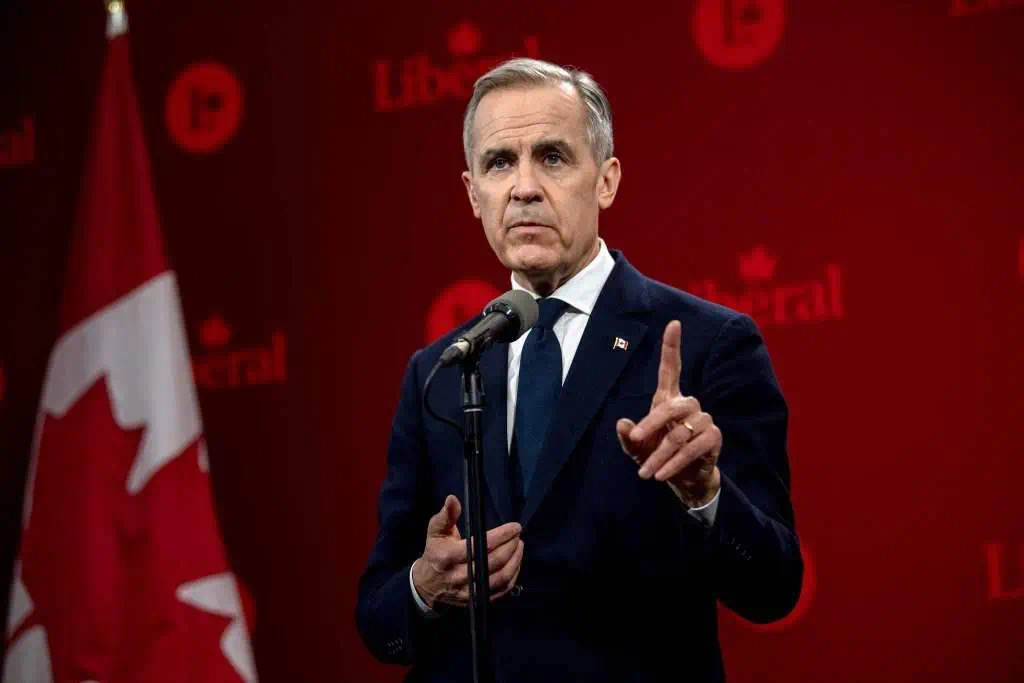
Photo: Mark Carney, Source: Visual China
Early Stance: Skeptical of Bitcoin, but Embracing Blockchain
Carney’s first public remarks on cryptocurrencies date back to December 2017, when Bitcoin prices surged to record highs, triggering a global speculative frenzy. While testifying on financial stability before the UK Parliament in London, Carney—then Governor of the Bank of England—clearly stated that "Bitcoin is not a threat to financial stability," noting its limited connection to the traditional financial system. However, he warned about the risks posed by ICOs (Initial Coin Offerings) circumventing regulatory oversight. This statement laid the foundation for his subsequent position: distinguishing between the speculative nature of cryptocurrencies and the transformative potential of their underlying technology.
In February 2018, speaking at Regent’s College in London, Carney bluntly declared that Bitcoin "has largely failed the traditional tests of money." He criticized Bitcoin’s fixed supply cap of 21 million coins as having a "serious flaw," calling its mechanical mimicry of the gold standard a "criminal act of monetary amnesia." While designed to resist inflation, this rigidity leads to extreme price volatility, rendering it a "poor short-term store of value." He issued a stark warning: "If an ordinary household borrows in Bitcoin to cover daily expenses, a sharp drop in its value could plunge them into debt." Nevertheless, he emphasized that blockchain technology represented a "revolutionary validation of decentralized financial transactions," revealing that the Bank of England was actively exploring the use of distributed ledger technology (DLT) in real-time settlement systems to enhance efficiency and security.
This dichotomy—rejecting speculation while endorsing technological potential—defined his early stance on cryptocurrencies.
Regulatory Philosophy: Combating Illicit Activity, Supporting Compliant Innovation
Carney’s approach to cryptocurrency regulation consistently revolves around two core principles: transparency and accountability. He has repeatedly pointed out that anonymous transactions create fertile ground for money laundering and illegal activities, advocating for crypto asset exchanges to be brought under the same regulatory framework as traditional financial institutions. In promoting central bank digital currencies (CBDCs), he has particularly emphasized their potential in counter-terrorism and combating economic crime—by enabling traceable transaction records that shrink the space for black-market operations. During the G20 summit in January 2018, he pushed for cryptocurrencies to be placed on the agenda, calling for international cooperation to regulate their exchange mechanisms with fiat currencies.
When it comes to private-sector digital currency initiatives, Carney has shown a rare openness. In June 2019, when Facebook launched its stablecoin Libra (later renamed Diem), he refrained from outright rejection, instead describing it as an innovative attempt that "could reduce the cost of global payments," while stressing that "the highest standards of regulation must be established upfront." He even proposed that a "synthetic hegemonic currency" (SHC)—backed by a basket of major central bank currencies—might one day replace the U.S. dollar as the dominant reserve currency, addressing imbalances in the global financial system caused by globalization. Though this idea was not widely adopted, it revealed his profound insight into how digital currencies could reshape international financial order.
Climate Lens: Energy Concerns and the Priority of CBDCs
In 2021, during an event at Stanford University, Carney—as the UN Special Envoy on Climate Change—shared his views on cryptocurrencies. He criticized Bitcoin mining for its high energy consumption and expressed support for China’s decision to ban crypto mining, stating plainly: "Climate change is already an existential challenge; we don’t need technologies that make the problem worse."
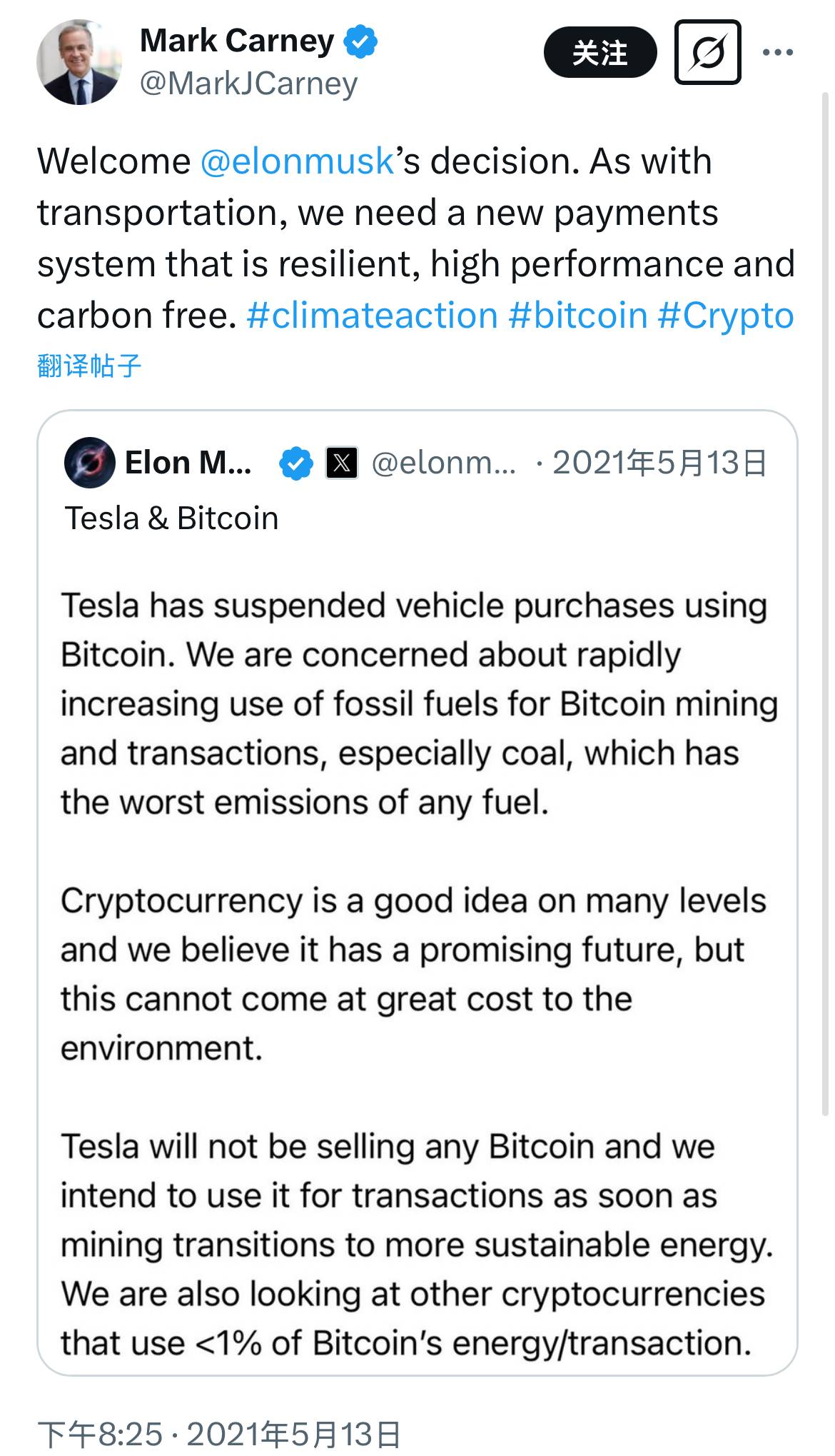
On May 13 of the same year, he retweeted Elon Musk’s post about suspending Bitcoin payments, calling for the development of a "resilient, high-performance, and carbon-free payment system." This seemingly contradictory move actually aligned with his policy priorities—he supports sustainable technological pathways, not specific crypto assets.
At the same time, he publicly highlighted the advantages of central bank digital currencies (CBDCs) in terms of security and sustainability. This position reflects his long-standing advocacy for CBDCs. As early as 2017, Carney led the Bank of England in testing prototypes of digital currencies, believing they could "restructure liquidity risks in banking," while cautioning against undermining financial stability. Just before stepping down as Governor of the Bank of England in 2020, he reiterated the need for a cautious approach to CBDC design to avoid destabilizing the existing monetary system.
This sustained exploration of "public digital currencies" stands in sharp contrast to his reserved attitude toward privately issued cryptocurrencies. In Carney’s vision, the future financial system should be anchored by sovereign-backed digital currencies—not decentralized crypto assets.
Driving Cryptocurrency Payments Forward
In 2021, Carney joined the board of directors at Stripe, the U.S. payments giant. Although Stripe had discontinued Bitcoin payments in 2018, during Carney’s tenure (2021–2025), the company rolled out a series of cryptocurrency payment solutions between 2022 and 2024, including support for stablecoin settlements and integration with Web3 wallets. In April 2024, Stripe resumed accepting cryptocurrency payments. Later that year, in October, it acquired Bridge, a stablecoin platform, for $1.1 billion—the largest publicly reported acquisition in the history of the cryptocurrency industry.
Stripe’s strategic shift aligns perfectly with Carney’s pursuit of an "efficient and compliant payment system"—one that embraces the efficiency of blockchain while avoiding regulatory uncertainty.
Join TechFlow official community to stay tuned
Telegram:https://t.me/TechFlowDaily
X (Twitter):https://x.com/TechFlowPost
X (Twitter) EN:https://x.com/BlockFlow_News
 Foresight News