Do XRP, SOL, or ADA have a place in America's cryptocurrency reserves?
TechFlow Selected TechFlow Selected
Do XRP, SOL, or ADA have a place in America's cryptocurrency reserves?
The inclusion of Ripple, Solana, and Cardano has instead caused divisions within the industry.
 Navigating Web3 tides with focused insights
Author: Yohan Yun
Translation: Block unicorn
On March 2, when U.S. President Donald Trump announced plans to establish a national cryptocurrency reserve, the American crypto industry finally got what it wanted. But instead of celebration, the move triggered backlash—not from traditional finance or regulators, but from within the crypto world itself.
The controversy stems from the selection of reserve assets. During his campaign, Trump promised to create a "national Bitcoin reserve," leading to expectations that Bitcoin—and to some extent Ethereum—would be included. However, the inclusion of Ripple, Solana, and Cardano has divided the industry.
All three assets come with their own issues, ranging from centralization concerns to questions about real-world utility. Supporters highlight their technological advancements and market potential, but skeptics argue they lack the stability, institutional trust, and global acceptance required for national reserves.
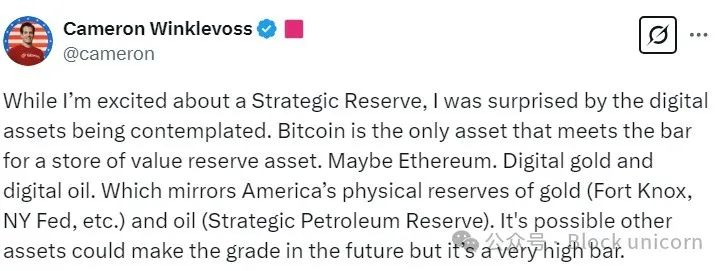
Cameron Winklevoss, co-founder of Gemini, was among those surprised by Trump's decision. Source: Cameron Winklevoss
The excitement surrounding the announcement was short-lived. All five cryptocurrencies initially saw price increases, but quickly fell back to pre-announcement levels, with slight rebounds as of this writing. XRP and ADA were exceptions—they didn’t fall below pre-announcement levels, though they still experienced significant volatility.
Each of the three selected altcoins brings different characteristics. Let’s examine why they were chosen and why their inclusion is controversial.
Solana offers speed and low fees—but is known for meme coins
Ethereum leads in total value locked (TVL) in decentralized finance (DeFi), capturing around 52% of the market share with $50.59 billion in TVL according to DefiLlama. This figure does not include its Layer-2 networks such as Base and Arbitrum, which serve as scaling solutions on Ethereum and remain part of its broader ecosystem.
Solana ranks second with $7.32 billion in DeFi TVL. Long dubbed an "Ethereum killer"—a term used for blockchains aiming to challenge Ethereum's dominance—Solana appeared to gain ground throughout 2024 and early 2025 due to its high throughput, capable of processing thousands of transactions per second.
In the meantime, developers have largely resolved its long-standing network outages, enabling the network to fully capitalize on the surge in traffic driven by the meme coin craze.
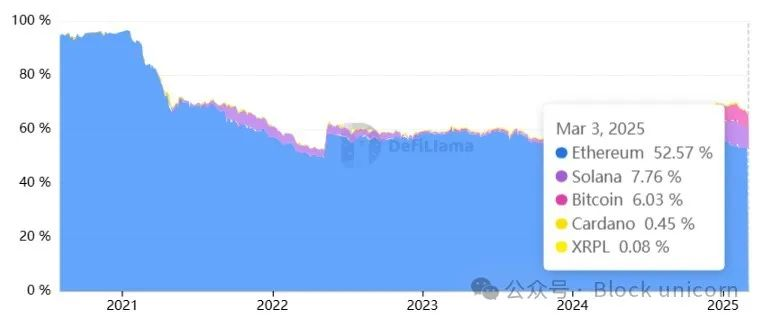
Solana ranks second in DeFi TVL but still lags far behind Ethereum. Source: DefiLlama
Fund managers have filed for SOL-based exchange-traded funds (ETFs), and the network has become a preferred platform for politicians launching or endorsing crypto projects—primarily through meme coins.
Recently, Solana’s meme coin frenzy turned chaotic. Sensational live streams designed to pump token prices, widespread scams, rug pulls, and bot-driven trading have raised concerns about the sector’s sustainability. As skepticism grows, the number of new tokens launched on Solana continues to decline.
Influential figures have voiced concerns over Solana’s venture capital influence. Edward Snowden, the NSA whistleblower, criticized Solana’s reliance on venture capital in November, suggesting it undermines the network’s decentralization. He described Solana as being “born in prison,” implying that its dependence on VC funding could limit its autonomy and alignment with core blockchain principles.
Georgii Verbitskii, founder of TYMIO, told us: "These assets, like any other tokens, cannot serve as genuine reserve assets. Including them in a U.S. cryptocurrency reserve is as arbitrary as including Nvidia stock in a strategic reserve."
He added: "While sovereign wealth funds, such as Norway’s, invest in equities for long-term returns, their purpose differs from national reserves, which should be built on universally recognized, decentralized assets. Bitcoin is the only rational choice for such a reserve."
Slow and steady: Cardano remains in the race
Cardano follows a slow-and-steady approach. The network is frequently criticized for rolling out features more slowly than other major blockchains, but its supporters argue that its peer-reviewed, research-driven strategy will ultimately succeed.
So far, however, this cautious approach has left Cardano lagging in a fast-moving industry. Users flock to chains where they feel their funds are secure or where they see the greatest profit potential—just as Solana’s meme coin boom attracted massive attention—leaving Cardano struggling to keep pace.
According to DefiLlama, as of March 5, Cardano’s DeFi ecosystem held only $412 million in TVL. The network is often mocked as a "ghost chain," implying minimal on-chain activity—a label strongly rejected by its supporters.
Artemis data shows that on March 4, Cardano recorded fewer than 40,000 daily active users, compared to over 5 million for Solana—though Solana also faces scrutiny for rampant bot activity.
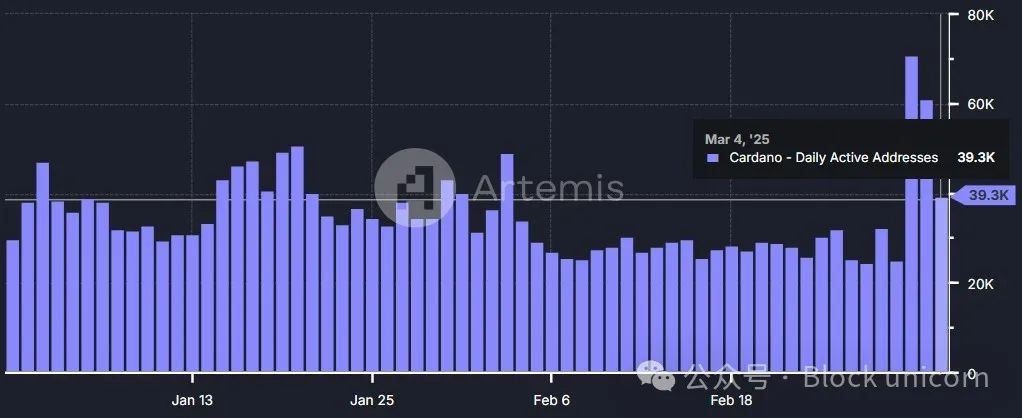
Cardano’s daily active addresses. Source: Artemis
A key advantage Cardano holds over networks like Solana is decentralization. Although the project initially relied heavily on IOHK, a private entity founded by Charles Hoskinson, it has transitioned to a community-driven model. January’s Pluton hard fork activated full decentralized governance for ADA holders, followed by the establishment of its on-chain constitution in February.
According to the University of Edinburgh’s Decentralization Index, Cardano was ranked the most decentralized blockchain in 2023. It leads in the Nakamoto coefficient—a metric measuring decentralization by determining the minimum number of entities needed to control 51% of the network.
Big companies use XRP, but centralization concerns persist
According to Vugar Usi Zade, COO of cryptocurrency exchange Bitget, there are strong reasons for including XRP in a national cryptocurrency reserve. He told us: "XRP is already the go-to for cross-border payments, with many major financial institutions using it to streamline transactions."
Compared to traditional financial systems, XRP offers faster and cheaper transactions for both institutions and individuals. Several major entities—including American Express, SBI, and Siam Commercial Bank—have tested or integrated XRP into their cross-border payment solutions.
The network has long been criticized as more centralized than cryptocurrencies like Bitcoin and Ethereum. A primary reason for this perception is that Ripple controls a large portion of the XRP supply. When the cryptocurrency was created, 100 billion tokens were pre-mined, and as of March 5, over 37 billion remain locked in escrow.
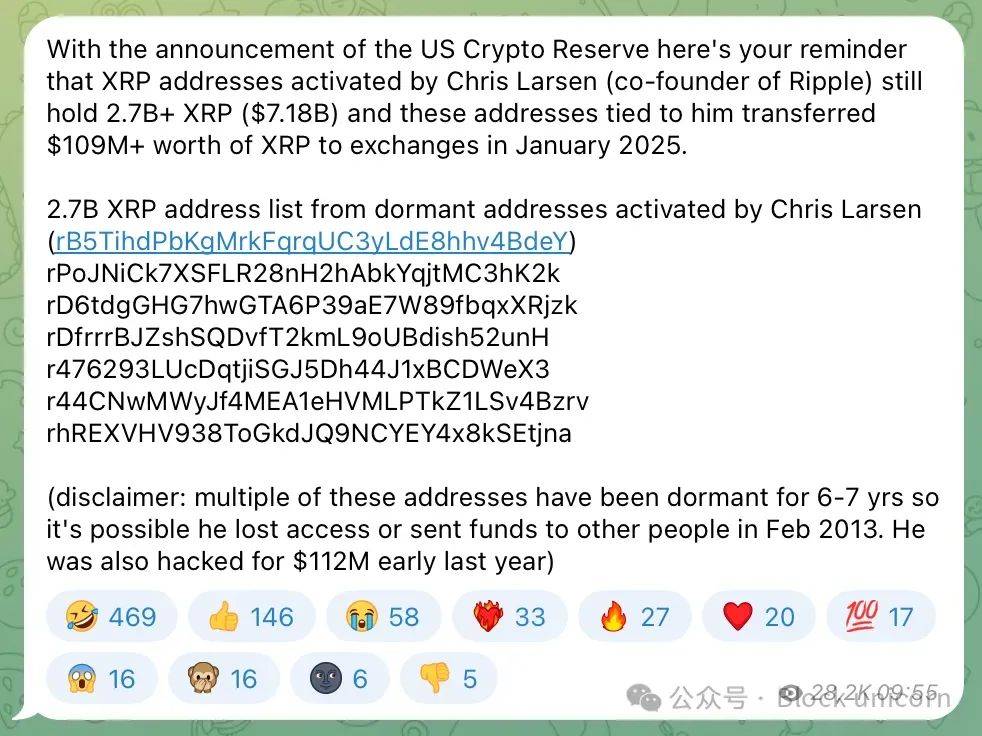
Source: ZachXBT
Nonetheless, arguments against the centralization narrative exist. Over time, Ripple has reduced the number of its own validator nodes, allowing third-party institutions to play a larger role in network validation.
Moreover, XRP transactions do not require Ripple’s approval, as the network operates independently and settles transactions within seconds. Ripple has also repeatedly emphasized its legal separation from the XRP Ledger, stating it does not control XRP.
Bitcoin is the clear frontrunner, but even it has skeptics
The three tokens—XRP, SOL, and ADA—each have their strengths and weaknesses, but they share one common trait: they are all U.S.-based projects.
As Bitget’s Zade put it:
"Let’s be honest: none of them have Bitcoin’s level of institutional trust or liquidity. This volatility could be a problem, especially for assets meant to form a stable part of a national reserve."
While Bitcoin is the obvious frontrunner for inclusion in a U.S. strategic cryptocurrency reserve, some argue that even Bitcoin carries significant risks. Joshua Chu, Joint Chair of the Hong Kong Web3 Association, believes Bitcoin’s value is purely speculative, and its role as a reserve asset could make it a prime target for adversarial nations.
He told us: "If quantum computing becomes a reality, it could break Bitcoin’s cryptographic security, rendering it worthless overnight. Given the pace of technological development, this is a real risk. What happens if an adversarial nation develops quantum computing capabilities and decides to target Bitcoin?"
Although Trump’s cryptocurrency reserve plan has been announced, it still requires congressional approval before becoming official policy. Meanwhile, speculation mounts that more details will emerge at the cryptocurrency summit scheduled for March 7 at the White House.
Key figures including Ripple CEO Brad Garlinghouse and Strategy Executive Chairman Michael Saylor have been invited, suggesting the event may further clarify the government’s digital asset strategy.
Join TechFlow official community to stay tuned
Telegram:https://t.me/TechFlowDaily
X (Twitter):https://x.com/TechFlowPost
X (Twitter) EN:https://x.com/BlockFlow_News
 @Cointelegraph