Did the new players attracted by TRUMP lose or gain?
TechFlow Selected TechFlow Selected
Did the new players attracted by TRUMP lose or gain?
On the 30th day of Trump Coin's launch, how are the new crypto investors who got deeply rekt doing?
 Navigating Web3 tides with focused insights
Author: Jaleel
Flash back to January 17, just two days before the inauguration of America's new pro-crypto president.
On that day, without any warning, Trump suddenly announced via his social platform Truth Social the launch of a meme cryptocurrency called $TRUMP.
In a matter of seconds, $TRUMP ignited the start of the 2025 crypto market and became the most successful celebrity coin in history. Within 24 hours of its launch, it rapidly gained access to top-tier exchanges like Coinbase and Binance, achieving over $10 billion in trading volume—more than three times Bitcoin’s 24-hour volume.
Besides conspiracy groups, the first to profit from $TRUMP were the ever-online traders on the front lines of the crypto scene. Even amid widespread skepticism such as "Trump's official account must have been hacked," a group of people represented by 0xsun leveraged their years of accumulated on-chain data monitoring skills to act quickly and buy early. Around the 10th minute after $TRUMP’s release, 0xSun began purchasing and bought $600,000 worth within half an hour at an average cost of just $0.60, earning over $27.5 million—a legendary trade.
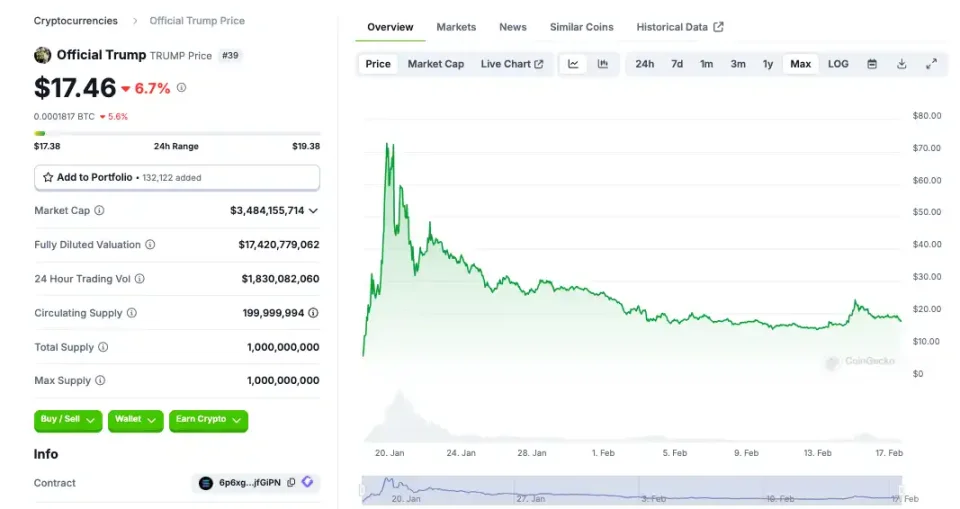
But here's the problem: the meme coin market is a classic zero-sum game, lacking technological innovation, fundamentals, or value creation—only differing by timing of entry. Not everyone could be as lucky as 0xsun. As hype faded and the launch of Melania Coin (Trump’s wife’s token) effectively increased the supply of $TRUMP, its price plummeted from a high of $72 down to around $17 today.
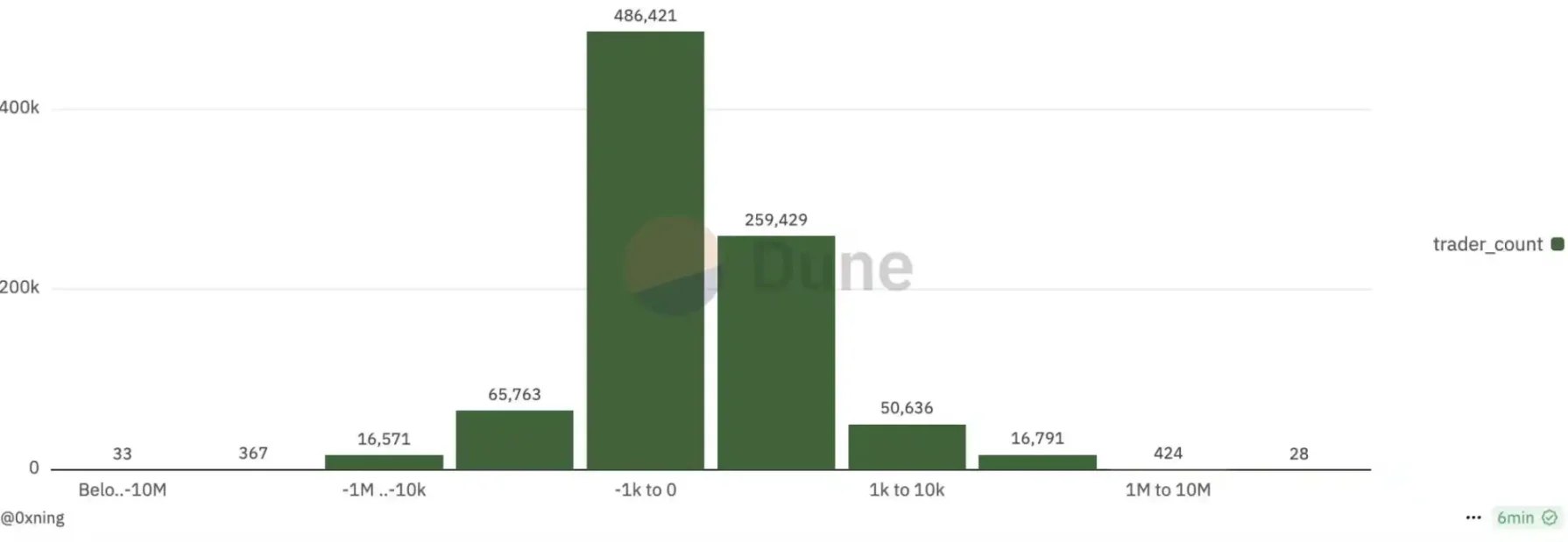
Early statistics show that profitable addresses follow a clear normal distribution, with still 560,000 addresses at a loss while only 300,000 realizing profits.
Data source: Dune
Even PhD students get rekt
The market isn't always kind to everyone. KOHA is one example—he’s among those 560,000 trapped holders.
KOHA is a Canadian-based STEM PhD student who occasionally dabbles in U.S. stock investments. In 2024, he bet on Trump winning the presidency and bought shares in Trump’s company DJT ahead of time, making a small profit. This success boosted his confidence in Trump’s business model and led him to mistakenly believe $TRUMP would hold long-term value similar to DJT stock.
However, the pace of the crypto market is far faster than that of traditional stocks.
When $TRUMP launched, it was Saturday morning in Beijing but late Friday night in North America. Like many locals resting at the time, KOHA didn’t catch the news immediately. By the time he learned about $TRUMP, it was already the next day for him.
Given Trump’s frequent unfriendly policies toward international students and Canada’s close ties with the U.S., KOHA happened to be in an environment highly attentive to Trump’s moves. The following day, during conversations in overseas student groups, KOHA heard about Trump launching his own coin—by then, $TRUMP had already surged from its initial price to $28.
He acted instantly, attempting to purchase $TRUMP through the Moonshot platform. However, delays due to identity verification, uploading driver’s license, KYC procedures, and learning how to buy slowed him down. By the time he finally succeeded, the price had risen to $30. Still, he hesitated little and decided to enter.
"His four-year term has just begun, and Trump holds extremely centralized power in this administration. A U.S. president can only serve two terms, so everyone agrees the second term is all about making money and doing business. People worldwide want to do business with him, and $TRUMP becomes the gateway and threshold," KOHA explained simply.
In KOHA’s view, the more people wanting to connect with Trump through this channel, the higher the price of Trump Coin would go. "This scheme is clearly much easier to manipulate than DJT—no need to file disclosures with the SEC when selling, total supply of 1 billion tokens with only 200 million circulating, and 80% still held by himself. I immediately sold all my DJT shares and bought $TRUMP."
KOHA wasn’t the only investor believing Trump’s business model could be replicated in the crypto space. In fact, many saw Trump’s $TRUMP launch as part of a broader financial strategy.
"Trump can't blend in, won't blend in, and never will. His estrangement from his daughter Ivanka actually reflects a deeper ideological rift between two financial factions—the capital divide so deep even blood ties cannot bridge it," KOHA analyzed. In his opinion, traditional finance is dominated by Wall Street and Democratic-aligned Jewish capital, which Trump has never been able to penetrate. His only path forward is taking an unconventional route—leveraging the decentralized nature of cryptocurrencies to build his own financial order.
KOHA sees the crypto industry as “an accidental beneficiary of conflict between two capitals.” And indeed, Trump showed friendly policy signals: easing crypto regulations to create a freer trading environment; Bitcoin breaking $75,000 and ushering in a bull market frenzy; Republican lawmakers pushing for a national Bitcoin strategic reserve, further boosting market confidence. All these factors gave KOHA a grand investment narrative, convincing him that $TRUMP was a long-term asset.
Seeing $TRUMP continuously rising, KOHA doubled down at $40. But by Monday—the next workday—$TRUMP had transitioned from the FOMO (fear of missing out) phase into profit-taking mode. Market liquidity dropped, buy orders dwindled, and KOHA’s holdings gradually turned into trapped liquidity, with an average cost of $36.
This cycle is an open gambling table
Like KOHA, Li Yi also got trapped.
But unlike KOHA—who had no experience in crypto and didn’t even know the major exchanges—Li Yi had spent some time navigating this market. Compared to complete newcomers unfamiliar with platforms, Li Yi at least knew where to trade and understood that logic doesn’t matter in crypto—only sentiment drives everything. He frequented multiple crypto trading groups, constantly monitored market movements, and closely followed trades made by self-proclaimed “crypto veterans.”
And yes, he did make a profit.
During the early stages of $TRUMP, he successfully entered at the low of $17 using the principle of “if you lack insight, then follow others,” then exited profitably during the surge. However, after profiting, he grew overly confident.
Instead of exiting, Li Yi stayed in the market searching for “the next $TRUMP.”
Sure enough, the Trump family didn’t disappoint. Two days after $TRUMP’s launch, Melania Coin ($MELANIA), dubbed “Trump’s wife coin,” was introduced. Meanwhile, in trading groups, the concept of “family coins” started trending.
Though unofficially supported, Trump’s younger son Barron’s name was used by the community under the banner of “Trump Family,” hyping up the idea of “the future presidential coin.” Rumors even spread that Trump’s housekeeper had launched her own token, quickly attracting capital inflows. Li Yi was one of them.
Naively, he believed these tokens shared the same momentum as $TRUMP and would skyrocket similarly. So, he poured most of his profits into wife and son coins.
But the market gave him no second chance.
The other family tokens quickly went to zero. Li Yi’s principal was trapped, and his profits vanished overnight. Now, he’s desperately asking around how to buy World Liberty Financial (WLFI), Trump’s decentralized finance project, hoping to recover losses through another speculative play. “One more bet—maybe WLFI can carry on the legacy of Trump Coin,” he said.
The biggest shift in this cycle is that everyone has laid their cards on the table.
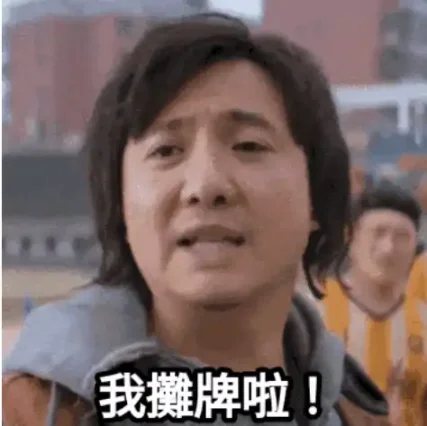
No need for packaging, no pretense of being a tech-innovative project, no need to spend $5,000 hiring someone to write an elaborate English whitepaper filled with obscure jargon.
The playbook in this bull run is brutally simple—ride sentiment, celebrity hype, trending topics, and information asymmetry. Use FOMO to create a series of new meme coins and harvest new retail investors’ fantasies.
In the past, new chain projects at least tried to disguise themselves as innovative ventures. Looking back at the early days of BSC, Aptos, and Arbitrum, we’ve seen the same pattern—waves of anonymous “project factories” rushed in, exploiting the novelty of new chains to capture TVL and users, then shutting down communities and websites once the heat died down, vanishing with the funds.
Behind these projects were often the same familiar faces—just wearing different masks, tweaking some code, and relaunching as hot new tokens. They emerged as the first viral projects on new public chains—anonymous, mysterious, without backing from known investors or audits from major firms—yet consistently hyped by KOLs and fueled by community FOMO into waves of wealth myths.
Now, however, the market seems to have reached a new consensus: this is simply a new gambling den, a wealth transfer game.
Nobody talks about “technological revolution” anymore, nor “changing the world.” Everyone tacitly understands—lose this round, wait for the next. You play, you pay. That’s what crypto is for. It’s said even nightclub staff in Hangzhou now know they should short meme coins.
And Li Yi is merely another participant in this wealth redistribution game.
Are the short sellers the real winners?
Among the newbies entering crypto through Trump Coin interviewed here, only Professor L walked away profitable.
While most were betting on rallies and rushing in blindly during the $TRUMP storm—only to get stuck at the peak—some chose the opposite path: shorting, and successfully profited against the market frenzy.
Professor L, a finance professor and seasoned futures trader, has long studied market structures. He deeply understands that crypto price swings are far more volatile than traditional markets. As a meme coin, $TRUMP lacks fundamental support and relies entirely on sentiment—meaning it’s highly likely to crash sharply after a short spike.
Yet his strategy wasn’t simply betting on a market drop, but rather employing a basic futures hedging technique:
He used $50,000 to buy spot, ensuring he wouldn’t miss upside gains. Simultaneously, he shorted $TRUMP contracts with $10,000 at 5x leverage as risk hedge. If $TRUMP kept rising, his spot gains would offset contract losses. If $TRUMP crashed, his shorts would cover losses and potentially generate excess returns.
Professor L disagrees with most retail gamblers’ leveraged trading: “The essence of futures is risk dispersion, not amplifying returns.” But most people fail to grasp this.
He also strongly agrees with Peter Lynch’s view: “Large short positions don’t initiate at the top—they wait until prices have halved, until retail traders think the fall has stopped and start buying again. That’s when big shorts love to step in.” This explains why Professor L didn’t rush to close his short position during $TRUMP’s rapid decline after the initial pump.
In trading groups, people constantly boast about their high-leverage wins: “Opened a 50x short today, made $2,000!” or “Lost long yesterday, but recovered today on shorts!” But in reality, such strategies remain pure gambling.
Professor L’s success stands in stark contrast to散户 blindly using high leverage and betting on luck. Extreme volatility combined with high leverage means a single reversal can wipe out an account instantly. Many retail traders went all-in with leveraged longs at $TRUMP’s peak, dreaming of endless gains, only to be crushed by the market and liquidated to zero.
In the end, as $TRUMP’s price retreated from its peak, Professor L’s hedging strategy delivered stable profits. Unlike 0xSun, who profited from speed, or Li Yi, who fell victim to FOMO, Professor L survived the extreme conditions of crypto through rational risk management—and earned consistent returns.
How many traps must newbies fall into when entering crypto?
During this $TRUMP craze, it wasn’t just clueless beginners joining—but also experienced players from traditional investing. They’d battled in A-shares, commodity futures, even tea speculation markets, witnessing every form of capital game.
Professor L was fortunate, but not all veterans could replicate their past success in crypto. In fact, they often had to stumble through numerous pitfalls before even starting real trading.
“A-shares have short bulls and long bears—survival lies in chasing small caps and low-quality stocks.” This is a shared belief among domestic investors including “Su Bing Ge.” Long accustomed to A-share speculation, he’s used to short-term swing trading, buying cheap, and playing sentiment.
When Su Bing Ge saw a coin like $TRUMP with strong hype potential, it felt instantly familiar—“Isn’t this just a tightly controlled small-cap stock?” So, he decided to “take a shot.”
Buying over 4,000 RMB worth of $TRUMP at the peak of $69, Su Bing Ge tried calculating break-even odds. As the price fell, during his interview with BlockBeats, $TRUMP traded at $26—meaning he’d need to add 50,000 RMB at a 5% gain just to lower his average cost. But deep down, he knew this was just “a韭菜-style fantasy.”
After getting trapped, Su Bing Ge realized crypto rules were far harsher than A-shares: “No price limits, no rules for fund flows—whales can dump anytime; no regulation, market makers can drain liquidity and manipulate freely; no time windows—24/7 trading leaves retail with zero breathing room.” Frustrated, he could complain for three days straight.
Many investors used to A-share tactics ended up losing principal—not making money—because they attempted swing trades, repeatedly entering and exiting.
But crypto is a place that eats people without spitting bones. After struggling with the cultural shock between traditional stocks and crypto trading, Su Bing Ge stumbled into yet another trap.
“When I lost hope and prepared to cut losses, I found out I’d bought a fake coin.” Before $TRUMP was listed on exchanges, Su Bing Ge followed seniors in a trading group and used a web3 wallet on a certain platform to buy his first batch of $TRUMP.
Having never used a web3 wallet before, he relied solely on quotes in the group chat and didn’t check again after buying. Only when preparing to sell did he realize his money never entered the real market—it had been swallowed by a hacker-deployed “fake coin contract.”
And this was just one of the simpler ways crypto farms retail investors. More traps awaited Su Bing Ge ahead.
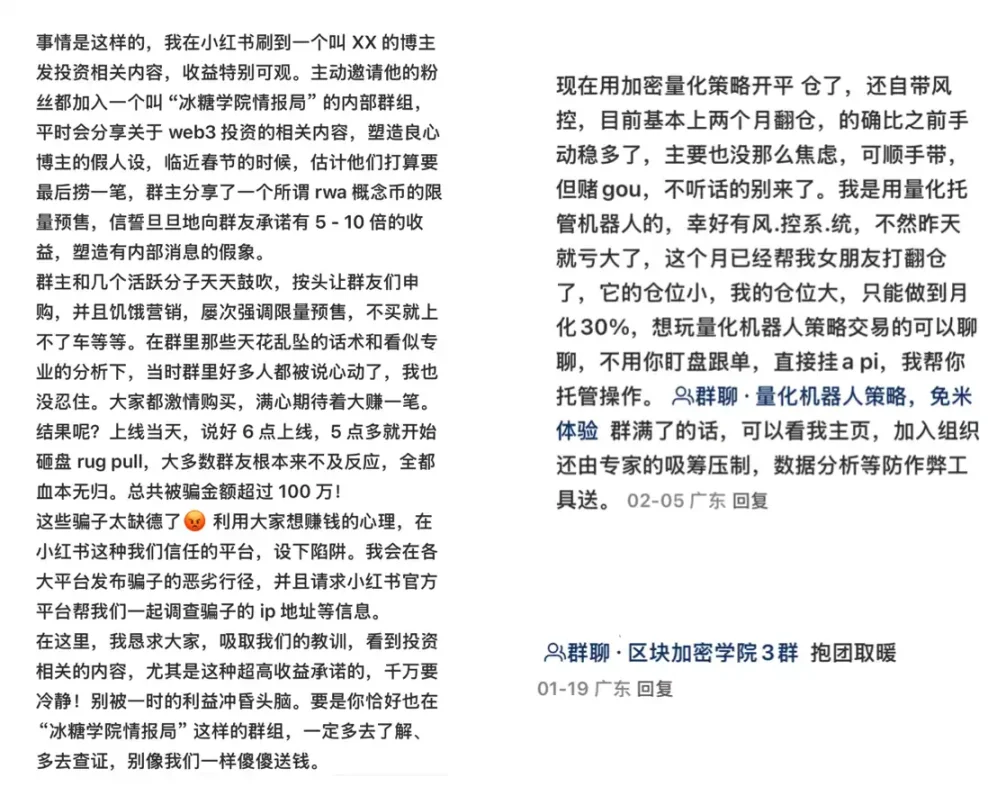
Paid trading groups of mixed quality operate like boiling frogs slowly. Initially free, they attract users with female influencers’ photos, profit screenshots, or luxury car/house purchase images. Senior members warmly teach newcomers how to open exchange accounts and trade—but in doing so, earn referral commissions from the exchange as tuition fees.
At best, they use retail funds to boost order volume and generate trading fees. At worst, they run direct pump-and-dump schemes, claiming “exclusive insider info” that’s actually pre-designed traps. The most common scam on Xiaohongshu now is so-called “quantitative robot trading strategies” promising 30% monthly returns.
Crypto is a completely different world. Here, battles are high-frequency confrontations measured in seconds—each missed second could mean massive losses. Worse, many veteran players with deep pockets often adopt “heavy bets with large capital” strategies, only to become targets at the top. The big whales controlling the market often prepare well in advance, waiting for these “big fish” to bite so they can swiftly absorb their capital.
In this invisible PvP battle, the flow of funds and market control remains firmly in the hands of a few. For players still thinking in traditional market terms, crypto rules often come as a shock. Here, risk and opportunity coexist—but more often, it’s just risk.
By the time these veterans regain awareness, they find not only did they fail to earn substantial wealth using their years of experience, but instead became textbook examples of “entering only to be harvested.” Their once-reliable rules of thumb prove useless in this new arena.
And all of this is the tuition fee they must pay to enter the industry.
Join TechFlow official community to stay tuned
Telegram:https://t.me/TechFlowDaily
X (Twitter):https://x.com/TechFlowPost
X (Twitter) EN:https://x.com/BlockFlow_News
 BlockBeats