








Key points from the U.S. "Crypto Czar"'s first digital asset briefing: advancing market structure and stablecoin legislation, assessing Bitcoin reserves
TechFlow Selected TechFlow Selected
Key points from the U.S. "Crypto Czar"'s first digital asset briefing: advancing market structure and stablecoin legislation, assessing Bitcoin reserves
David Sacks: Looking forward to the "golden age of creating digital assets," currently evaluating a proposal for Bitcoin reserves.
 Navigating Web3 tides with focused insights
Author: Weilin, PANews
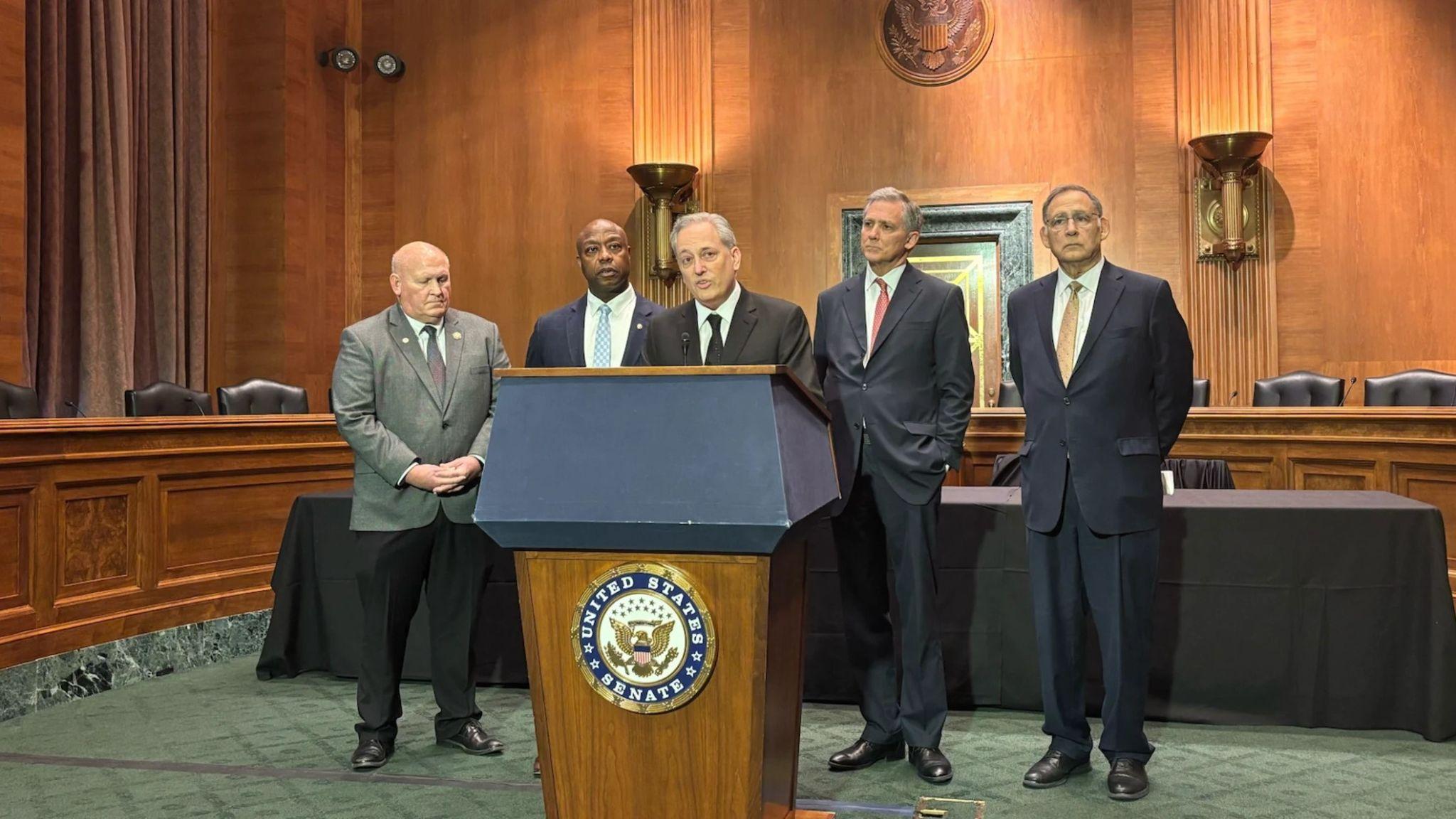
In the early hours of February 5, Beijing time, David Sacks, White House AI and cryptocurrency lead, held the first congressional press conference on digital assets with several U.S. lawmakers on Capitol Hill, detailing the latest plans by the White House and Congress to advance America's digital asset development.
Sacks stated at the event that he looks forward to collaborating with congressional lawmakers to "create a golden age for digital assets." He revealed that the administration is evaluating proposals for a Bitcoin reserve, although it remains in the early stages.
On the Securities and Exchange Commission (SEC) front, reports indicate the agency is downsizing its team previously dedicated to crypto enforcement actions and reassigning some attorneys—a move signaling a shift in SEC’s approach to crypto regulation. Meanwhile, the SEC has launched a website for its new Crypto Task Force. The task force leader, Hester Peirce, outlined ten priority items, focusing on reviewing the classification and regulation of crypto assets.
David Sacks: Aiming to “Create a Golden Age for Digital Assets,” Evaluating Bitcoin Reserve Proposal
At the press conference, Sacks emphasized his desire to work with Congress to jointly "create a golden age for digital assets." The event was also attended by Senate Banking Committee Chair Tim Scott, Senate Agriculture Committee Chair John Boozman, House Financial Services Committee Chair French Hill, and House Agriculture Committee Chair G.T. Thompson.
These committees are forming a bicameral working group to lead cryptocurrency regulatory efforts, aiming to build upon last year’s House Financial Services Committee-passed market structure legislation, FIT21, and incorporate Senator Bill Hagerty’s newly introduced stablecoin bill released on February 4, to drive a new wave of legislation. Senate Banking Committee Chair Tim Scott said he intends to push aggressively for these bills to pass the Senate within the first 100 days.
Sacks confirmed that the Presidential Working Group on Digital Assets—established under Trump’s executive order—will first assess the feasibility of a Bitcoin reserve. However, he noted the initiative remains in its early phase, as some members of the working group have yet to be confirmed.
Senator Bill Hagerty Introduces New Stablecoin Bill GENIUS
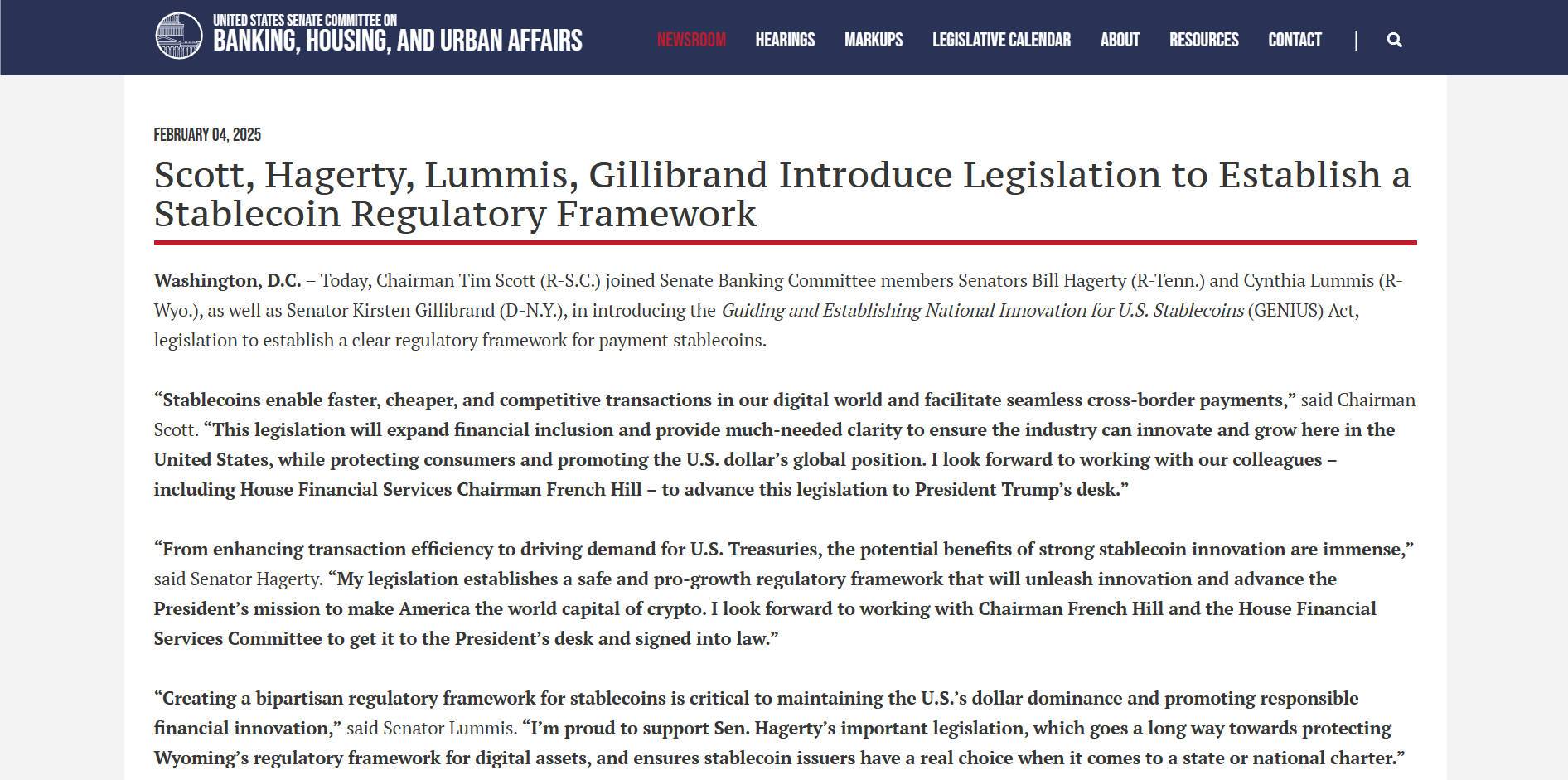
As mentioned above, on February 4, U.S. Senator Bill Hagerty introduced a bill aimed at establishing a regulatory framework for stablecoins, bringing tokens like Tether and USDC under Federal Reserve oversight rules.
The stablecoin bill aims to create “a safe and growth-friendly regulatory framework that unlocks innovation potential” and advances President Trump’s pledge to make the United States the “global capital of cryptocurrency.”
Hagerty’s “Guidance and Establishment of National Innovation Using Stablecoins (GENIUS)” Act is supported by Senators Tim Scott, Kirsten Gillibrand, and Cynthia Lummis.
Hagerty added on X that he looks forward to working with Representative French Hill and the House Financial Services Committee to “get this bill to the President’s desk for signing into law.”
Hagerty’s stablecoin bill builds on a discussion draft he submitted last October for former Representative Patrick McHenry’s Clarity for Payment Stablecoins Act.
Key components of the GENIUS Act include:
-
Defining payment stablecoins as digital assets used for payments or settlements, pegged to a fixed monetary value;
-
Establishing clear procedures for institutions seeking licenses to issue stablecoins;
-
Implementing reserve requirements for stablecoin issuers, along with streamlined, tailored regulatory standards;
-
Applying the Federal Reserve’s regulatory framework for depository institutions and the Office of the Comptroller of the Currency’s framework for non-bank issuers to those issuing over $10 billion in stablecoins;
-
Allowing state-level regulation for issuers with market caps below $10 billion, while providing an exemption process for those exceeding the threshold to remain under state oversight;
-
Establishing regulatory, examination, and enforcement mechanisms with clear limitations.
According to CoinGecko data, Tether (USDT) and Circle’s USD Coin (USDC) are currently the only two stablecoins with market capitalizations exceeding $10 billion.
Stablecoin issuers would also be required to submit monthly audited reserve reports, and submitting false information could result in criminal penalties.
SEC Launches Crypto Task Force Website, Adjusts Regulatory Strategy
On February 5, the New York Times reported, citing five知情人士, that the SEC has downsized a special unit of over 50 lawyers and staff previously focused exclusively on crypto enforcement actions. This move marks one of the first concrete steps taken by Trump and his administration to reduce regulation on cryptocurrencies and other digital assets. One of Trump’s initial executive orders aims to promote cryptocurrency development and “eliminate excessive regulation of digital assets.”
The sources said some lawyers from the crypto unit are being reassigned to other divisions within the SEC. A senior attorney from the unit has been moved out of the enforcement division.
Current SEC Acting Chair Mark T. Uyeda has made a series of appointments while reshaping other senior roles at the commission. One of Uyeda’s first actions upon taking office was establishing a working group to review how the SEC handles digital assets. The group is led by SEC Commissioner and outspoken crypto advocate Hester Peirce.
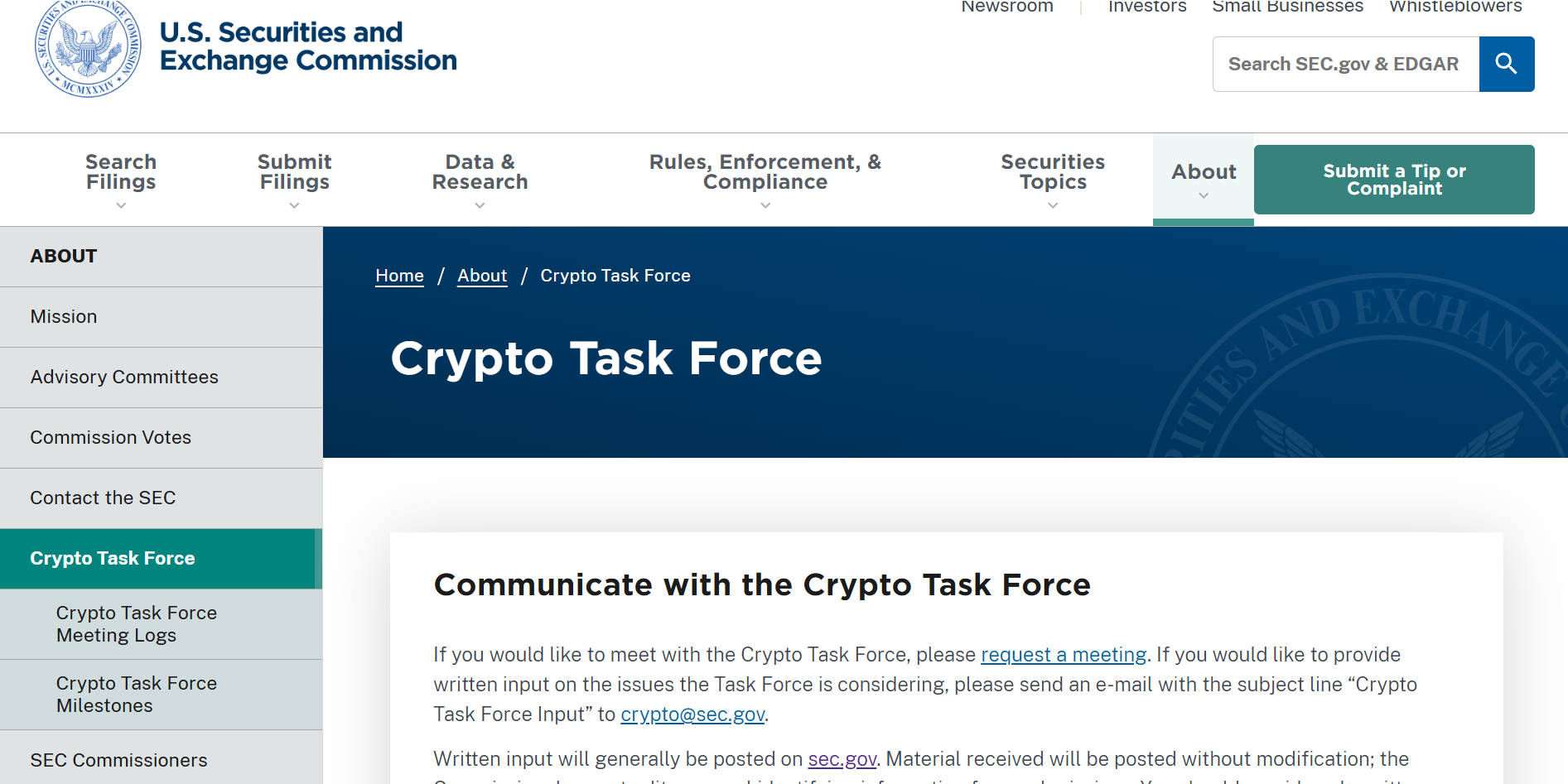
On February 4 local time, the U.S. Securities and Exchange Commission (SEC) launched a dedicated webpage for its Crypto Task Force, listing ten priority tasks, including resolving which cryptocurrencies should be classified as securities rather than commodities, and creating a more “workable” registration pathway by revising existing SEC registration processes.
Other priorities include “clarifying whether crypto lending and staking activities fall under securities laws” and determining which parts of the market lie outside the SEC’s jurisdiction.
For now, with close collaboration between the White House and Congress accelerating digital asset development, the U.S. legislative process around cryptocurrency and stablecoin regulation is gradually speeding up. Although many proposals remain in early stages, frameworks around Bitcoin reserves and stablecoins are beginning to take shape. As the SEC’s crypto task force continues its transition, it remains to be seen whether the U.S. can lead global crypto innovation.
Join TechFlow official community to stay tuned
Telegram:https://t.me/TechFlowDaily
X (Twitter):https://x.com/TechFlowPost
X (Twitter) EN:https://x.com/BlockFlow_News
 PANews






