








Core Members Depart to Found "Copycat EF" — How Long Can the Ethereum Foundation Last?
TechFlow Selected TechFlow Selected
Core Members Depart to Found "Copycat EF" — How Long Can the Ethereum Foundation Last?
Left or right, which direction is the way forward for EF?
 Navigating Web3 tides with focused insights
Authors: Kaori & Penny
On January 21, prominent Ethereum core developer Eric Conner announced his departure from the Ethereum Foundation (EF) via social media, citing issues such as lack of transparency, disconnection from the community, and resistance to change within the foundation.
Criticism toward the Ethereum Foundation has been ongoing for a long time. In recent months, Ethereum's weak market performance has further fueled community discontent. Numerous well-known investors and developers have voiced concerns about EF, but the exit of a veteran developer like Eric signals that internal divisions within EF have reached an irreconcilable point, placing the foundation squarely in the spotlight.
As public sentiment continues to escalate and community anger remains unresolved, a grassroots initiative quietly emerged—the creation of the "Second Foundation."
Ethereum now faces mounting internal and external challenges, making reform more urgent than ever.
Who Is Eric?
Eric Conner, a renowned core developer of Ethereum, has left the ecosystem after nearly 11 years of involvement, following Vitalik Buterin’s rejection of a leadership restructuring proposal.
Eric is the co-author of EIP-1559, a major network upgrade that transformed how transaction fees operate on Ethereum. Though never formally employed by the Ethereum Foundation, he has consistently provided advisory support, made investments, and played a key role in guiding the ecosystem since its early days.
On January 21, Ethereum core developer Eric Conner posted on social media: “I am no longer '.eth'. Maybe one day the people in leadership roles will realign with the community, but for now, I’m out. Deep down, I truly hope Ethereum succeeds. Good luck.”
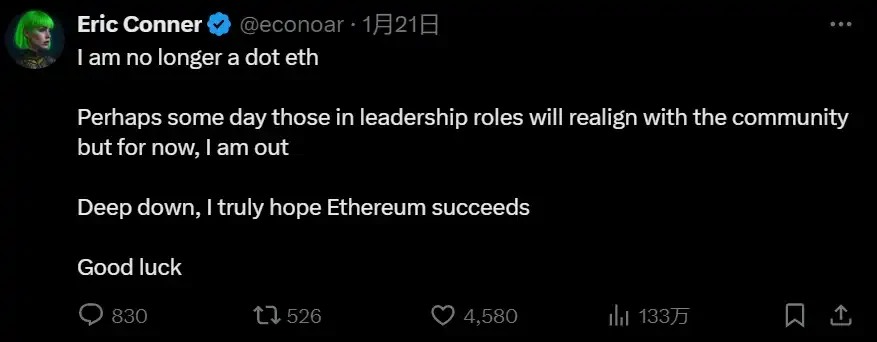
He later elaborated on why he joined Ethereum and why he ultimately chose to leave. Eric first encountered Bitcoin in 2012. After witnessing the Mt. Gox collapse, he saw many friends suffer heavy losses due to reliance on centralized exchanges. Together with several peers, Eric attempted to build the first decentralized exchange (DEX) on Ethereum—EtherEx. Although the project failed due to premature timing, it marked his entry into the Ethereum community.
Prior to his departure, Eric had expressed growing concerns over EF’s opacity and detachment from the community. He argued that the foundation could cut 80% of its budget and Ethereum would still function and grow normally. The core issue, he said, is that EF does not report to stakeholders, is sinking into inefficiency, and resists necessary changes. The foundation now exhibits an “anti-victory and competitive mindset,” leading many community members to question whether they should remain involved.
A Crisis Years in the Making
Dissatisfaction with the Ethereum Foundation began surfacing openly after last year’s EDCON in Montenegro. Layer 2 solutions, designed to scale Ethereum, have been shackled from day one by the requirement to stay “aligned with Ethereum,” meaning compliance with EF directives. Everyone vies for Ethereum’s approval, striving to be the most EVM-compatible L2. As a result, project teams often prioritize gaining EF endorsement over product or technological innovation, distorting the natural evolution of the Ethereum ecosystem under EF pressure.
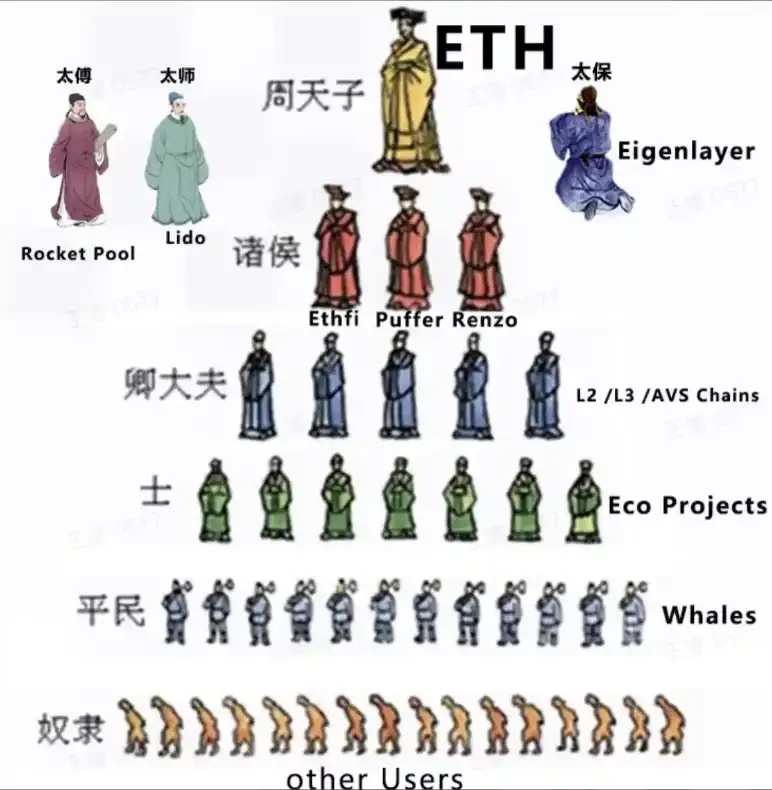
EF’s complex web of internal interests, ideological gatekeeping around “orthodoxy,” and the alienation of major protocols fleeing Ethereum—all suggest the organization is experiencing a midlife crisis, struggling structurally, operationally, and culturally. Meanwhile, Solana’s resurgence driven by meme trends, Ethereum’s underperformance during Bitcoin’s repeated all-time highs, and Trump’s recent token launch on Solana pushing SOL to new peaks have highlighted Ethereum’s weakening momentum. Community frustration has steadily intensified. Under mounting pressure, Vitalik responded directly on the 18th, acknowledging criticisms and outlining plans for sweeping reforms to EF’s leadership structure and specific reform goals.
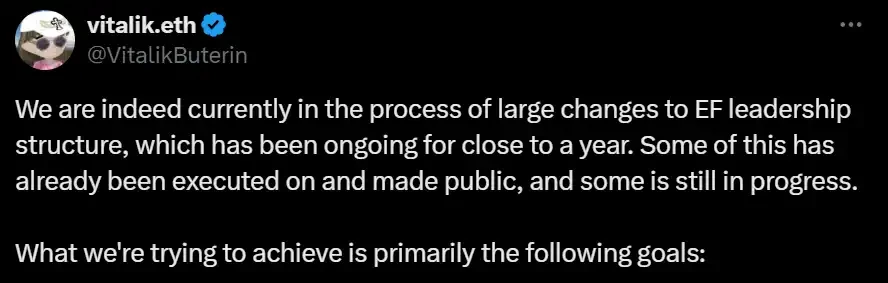
This sparked a firestorm—a full-scale backlash against EF erupted across the community.
On the 20th, Synthetix and Infinex founder Kain Warwick voiced his dissatisfaction with L2s: “If I were running EF, I’d pressure Layer 2s to use sequencer revenue to burn ETH. Ethereum holds a strong hand in this negotiation…”
At the same time, Aave founder Stani Kulechov stated that after reviewing EF’s 2024 budget report, he identified 12 areas for improvement to ensure EF’s sustainability—including slowing spending, reducing headcount, and building sustainable revenue models. However, on the 21st, Stani clarified: “I don’t advocate dissolving EF—I advocate for a better, faster, stronger, and broader EF path… We should spend less time on internal politics or neutrality and focus more on accelerating technical progress as quickly as possible.”
That evening, Evgeny Gaevoy, founder and CEO of top-tier market maker Wintermute, also shared his views on Ethereum, warning of a potential “death spiral”: “If there’s no casino, ETH’s only use case is sending stuff in Zuzalu, so the price stays low, and security stays low. As ETH price drops, fewer dapps consider it secure and flee to other chains, potentially creating a very (deadly) spiral that further lowers the price.”
Faced with this sudden wave of criticism, EF appeared unprepared to quell the backlash—and arguably made things worse by selling ETH in response to community suggestions around staking. The next day, Vitalik announced an EF treasury update: a new 3-of-5 multi-sig wallet had been established, which EF would use to engage with the DeFi ecosystem, having already conducted a test transaction on Aave.
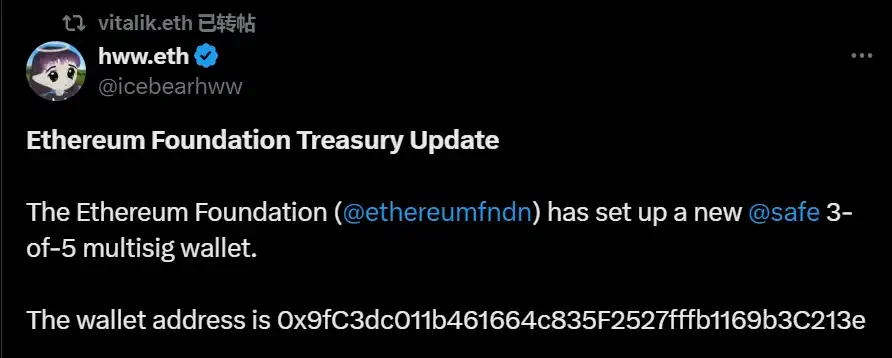
The community was unconvinced, mocking whether EF was “about to sell again.” The EF backlash continues, with tensions still high and no resolution in sight.
Now There’s a Second Foundation—Which Way Forward?
On January 22, rumors spread that Konstantin Lomashuk, founder of Lido, had launched the Ethereum Second Foundation (Second Foundation). The official Twitter account (@2nd_foundation_) went live, and Konstantin promptly retweeted its first post.
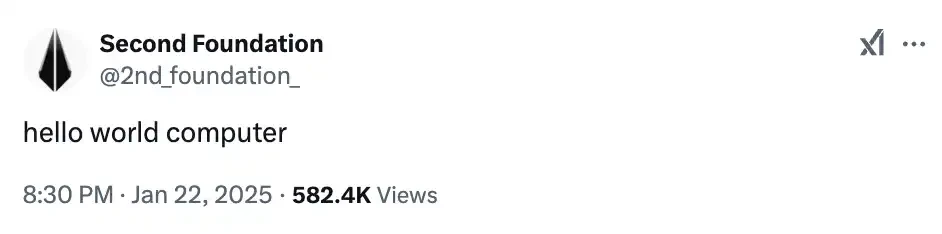
On January 23, however, Konstantin clarified that the tweet was merely a conceptual idea—no actual “Second Foundation” had been formed.
He emphasized that Ethereum is the ultimate world computer, and every member of the Ethereum community can contribute to its growth, development, and success. If a second foundation were ever established in the future, it must have a clear purpose that complements the existing efforts of current contributors. “Thank you all for your support. I also believe Ethereum needs more organizations working together to drive progress. I’ll share more thoughts after further discussions with those who’ve reached out.”
While this plan has not materialized, the combination of Eric Conner’s departure and growing debate over Ethereum’s internal and external struggles has ignited intense discussion.
Regardless of debates within global communities, one consensus is emerging: the Ethereum Foundation must make strategic choices. Left and right are inherently different—no one can simultaneously be both. During tough times, idealism (left) is needed; during growth phases, accelerationism (right) takes precedence. As one observer noted: “If Ethereum follows a ‘digital nation-building’ path, political diversity is inevitable. If multiple foundations can both compete and collaborate, it may lead Ethereum toward an even greater future.”
The Second Foundation currently appears to some as a disruptive provocateur. Yet others ask: why not welcome a decentralized ecosystem with multiple governing bodies sharing power? As Vitalik wrote on January 21, Ethereum’s blockchain future should be decentralized, and the Ethereum Foundation is just one part of that picture. He added: “EF shouldn’t ‘over-manage.’ It should confidently represent the parts of Ethereum it can effectively speak for, while consciously creating and nurturing open spaces for other organizations to represent other aspects of Ethereum—some of which might even work better in for-profit forms.”
Join TechFlow official community to stay tuned
Telegram:https://t.me/TechFlowDaily
X (Twitter):https://x.com/TechFlowPost
X (Twitter) EN:https://x.com/BlockFlow_News
 BlockBeats


