








Which cryptocurrencies face massive selling pressure during FTX's repayment process?
TechFlow Selected TechFlow Selected
Which cryptocurrencies face massive selling pressure during FTX's repayment process?
The industry is nearly healed from the last black swan event, yet no one has stepped in to continue FTX's once distinctive products.
 Navigating Web3 tides with focused insights
Author: jk, Odaily Planet Daily
After FTX's collapse in 2022, the exchange’s story shifted from glory to complex repayment and liquidation. Two years later, FTX's compensation plan is becoming clearer—but it has brought massive selling pressure on certain cryptocurrencies.
In this article, Odaily Planet Daily will review the progress of FTX’s debt repayment, examine which tokens are facing significant sell-offs, and explore how its once-market-leading products may still influence the future of the crypto industry.
FTX’s Repayment Plan and Timeline
In May 2024, the Associated Press reported that court filings submitted by FTX revealed clear figures regarding compensation. According to these documents, FTX owed creditors approximately $11.2 billion, while estimated recoverable assets available for distribution ranged between $14.5 billion and $16.3 billion.
The filing also stated that after fully satisfying claims, any remaining funds would be used to pay additional interest to creditors. Most creditors were entitled to a 9% interest rate.
However, all repayments would be settled in USD based on cryptocurrency prices at the time of FTX's collapse. Specifically, when FTX filed for bankruptcy protection in November 2022, Bitcoin was priced at $16,080. This situation presents both advantages and disadvantages—
The downside: investors originally held digital currencies but will now receive compensation calculated in USD. For example, if an investor held 1 BTC at the time, they would only be compensated $16,080 plus two years of interest—foregoing the roughly sixfold gains had they simply held the asset until today.
The upside: without the bull market over the past two years, FTX likely wouldn’t have had enough assets to compensate customers at all—so recovering even the nominal value at the time offers some consolation.
According to the plan filed with the U.S. Bankruptcy Court in Delaware, customers and creditors with claims of $50,000 or less would receive about 118% of their claim amount. This group makes up 98% of FTX’s customer base.
In August 2024, there was a minor update: as previously reported by Odaily, FTX reached a $12.7 billion settlement agreement with the U.S. Commodity Futures Trading Commission (CFTC). The CFTC agreed not to pursue claims against FTX as long as the company adheres to its restructuring plan. As a result, FTX will distribute up to $12.7 billion to creditors, depending on available funds. This effectively places a government seal of approval on the repayment plan, ensuring regulatory litigation won’t reduce funds available to customers. Based on current asset estimates, FTX remains capable of fulfilling full repayments—and may even have surplus assets.
Odaily previously reported that a judge approved FTX’s sale of $1 billion worth of shares in AI startup Anthropic, and that FTX plans to pay $200 million in priority taxes and $685 million in subordinated tax claims to the IRS. FTX argues it owes far less than the $24 billion claimed by the IRS. These actions are all part of FTX’s broader repayment strategy.
So where does FTX stand in its repayment process today? Since repayment requires selling crypto holdings, what kind of market impact can we expect? Will certain tokens face overwhelming downward pressure? Let’s take a closer look.
What Assets Does FTX Currently Hold?
FTX’s current wallet balances and token holdings are publicly accessible via Arkham. At the time of writing, FTX’s on-chain addresses hold total assets valued at $1.475 billion, with FTT being the largest holding at approximately $680 million.
In addition to FTT, here are the other 19 tokens currently held in amounts exceeding $1 million:
-
FTT: $680.79M
-
OXY: $356.56M
-
MAPS: $147.10M
-
MEDIA: $131.76M
-
FIDA: $55.31M
-
RAY: $21.69M
-
BOBA: $17.86M
-
BRZ: $14.58M
-
DRIFT: $10.15M
-
JUP: $6.66M
-
JTO: $6.25M
-
USDC: $3.31M
-
SOL: $3.14M
-
RENDER: $2.77M
-
ASD: $2.76M
-
SRM: $2.72M
-
KMNO: $2.67M
-
MPLX: $2.65M
-
AMPL: $1.67M
-
STG: $1.18M
Which tokens should we watch closely for potential selling pressure? Based on CoinGecko data, Odaily has compiled the following list:
-
FTT: Current fully diluted valuation (FDV) is only $870 million, with a 24-hour trading volume of $18 million, yet FTX holds $680 million worth. Even with market makers absorbing some pressure, it will be extremely difficult for buy-side demand to support the current price.
-
OXY: Current 24-hour trading volume is merely $3,000, with an FDV around $365 million. FTX holds $356 million—nearly the entire FDV. Unsurprisingly, due to anticipated sell-offs, trading activity has dried up. Additionally, apart from DEXs, OXY is only listed on Kraken, so most traders aren't exposed to it.
-
MAPS: FDV currently stands at $185 million, with FTX holding $147 million. 24-hour trading volume is similarly weak at just $130,000.
-
MEDIA: FDV listed on CoinGecko is $14.23 million, while FTX holds $131 million—nearly ten times higher than the entire FDV.
-
FIDA: FDV is currently $216 million, with FTX holding $55.31 million. If managed poorly, short sellers could exploit this. However, 24-hour trading volume is relatively healthy at $15.51 million.
-
BOBA: FDV is $94.67 million, market cap $81.05 million, with FTX holding $17.86 million. 24-hour trading volume is $1.62 million.
-
SRM: Market cap is $11.37 million, 24-hour volume $490,000, FTX holding $2.72 million.
-
MPLX: Market cap $185 million, 24-hour volume $1.36 million, FTX holding $2.65 million.
-
AMPL: Market cap $150 million, 24-hour volume $830,000, FTX holding $1.67 million.
Tokens with relatively lower impact:
-
RAY: Raydium currently has a $1.3 billion market cap and $94.83 million in 24-hour volume. FTX holds $21.69 million. With proper execution and stable selling via market makers, significant price drops are unlikely.
-
DRIFT: Market cap $310 million, 24-hour volume $29.01 million, FTX holding $10.15 million—easily absorbable by the market.
-
ASD: Market cap $32.02 million, 24-hour volume $1.24 million, FTX holding $2.76 million.
-
KMNO: Market cap $146 million, 24-hour volume $19.92 million, FTX holding $2.67 million.
-
Other tokens such as Solana (with $4 billion in daily trading volume and only $3.14 million held by FTX), Jupiter, Jito, Render, Stargate, and fully backed stablecoins like USDC and BRZ pose no real concern.
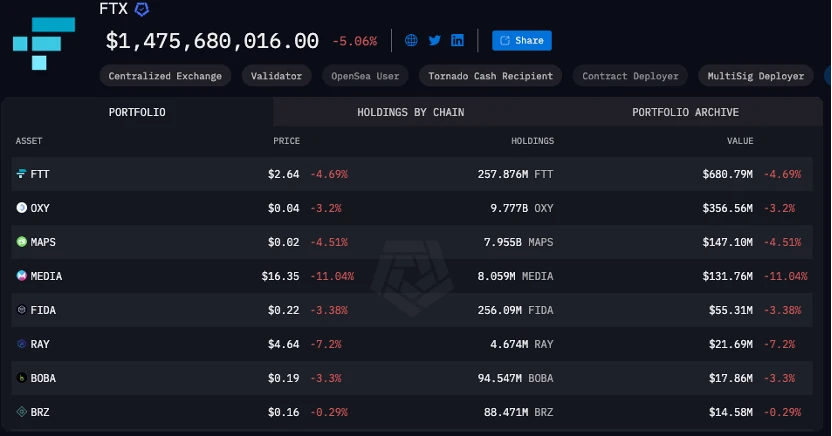
FTX-held tokens. Source: Arkham
At the time of publication, FTX continues to gradually sell off its crypto holdings. Data from Arkham shows that FTX’s liquidation addresses are transferring tokens to Binance and Gate.io multiple times per day, with individual transfers ranging from $50,000 to $5 million depending on the size of the position. It remains unclear whether market makers are involved behind the scenes, but unlike the German government’s approach, FTX is avoiding dumping large volumes all at once, thus preventing sharp price declines.
FTX’s Signature Products
Back in its prime, FTX was the preferred exchange for traders and institutions, particularly renowned for supporting high-frequency trading. This focus led to notable technological spillovers, and FTX also developed several unique products for retail users. After FTX’s collapse, some of these products were adopted by other exchanges, while others remain dormant.
One such product was FTX’s leveraged tokens, which were highly accessible to retail investors:
Leveraged tokens allowed investors to gain amplified exposure to assets without complex operations or the risk of liquidation associated with traditional margin trading. Conventional futures or margin trading requires users to post collateral and actively monitor positions to avoid forced liquidations during volatility. In contrast, FTX’s leveraged tokens—such as 3x Long Bitcoin or 3x Short Ethereum—greatly simplified the process. Users could trade these tokens just like regular spot assets, without needing a separate margin account or posting collateral. Moreover, through a daily rebalancing mechanism, leveraged tokens confined volatility risks within each trading day, helping users avoid catastrophic losses during extreme market swings.
For retail investors, leveraged tokens significantly lowered the barrier to leveraged trading. They enabled small-capital investors to achieve multiplied returns with minimal effort, making them highly popular on FTX at the time. Today, platforms like KuCoin have adopted this product and applied it to major assets like Bitcoin.
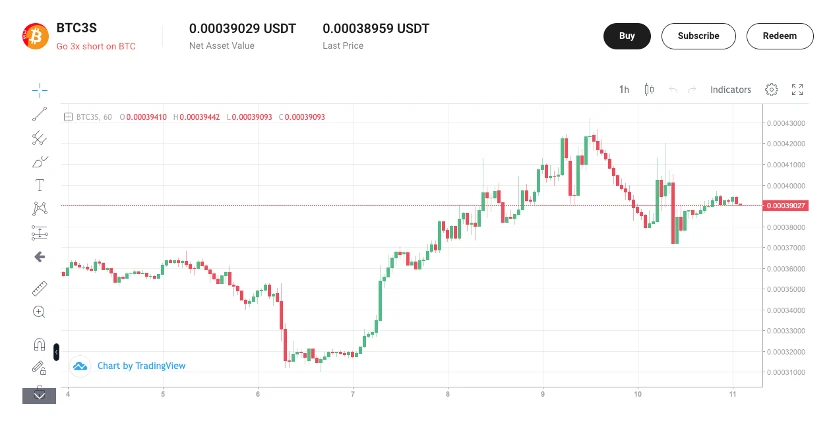
KuCoin's 3x Short Bitcoin product. Source: KuCoin
Another FTX innovation—tokenized U.S. equities—has yet to see a comparable large-scale replacement. FTX offered tokenized versions of stocks such as Alibaba and Coinbase, allowing global investors to participate in U.S. markets without opening a U.S. brokerage account. By partnering with regulated entities and custodians, FTX issued blockchain-based tokens pegged 1:1 to underlying stocks, enabling direct trading on its platform.
This product addressed several pain points in traditional stock markets. Investors were no longer restricted by geography or regulatory barriers, nor did they need to navigate cumbersome account-opening processes. Furthermore, tokenized equities enabled 24/7 trading, breaking free from the fixed hours of traditional stock exchanges.
To date, protocols like Backed offer non-U.S. users access to tokenized U.S. stocks, including recently popular ones like NVIDIA. However, U.S. residents still lack a compliant platform to purchase such tokenized equities.
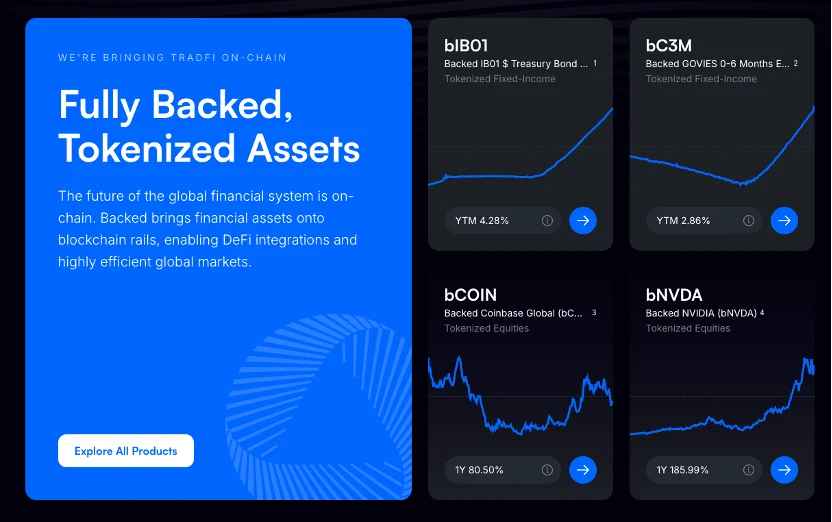
Tokenized U.S. equities offered by Backed. Source: Backed official website
As previously reported by Odaily, Jesse Pollak, a developer at Base, mentioned in a post on X that Coinbase is considering offering tokenized shares of its own stock to U.S. users on its Ethereum Layer 2 network, Base. Pollak noted that non-U.S. users can already obtain tokenized COIN shares via protocols like Backed (a tokenized RWA platform), and implementing COIN on Base is “something we’ll explore in the new year.” He added that ultimately, “every asset in the world will be implemented on Base.” However, he clarified that Coinbase currently has no concrete plans.
Join TechFlow official community to stay tuned
Telegram:https://t.me/TechFlowDaily
X (Twitter):https://x.com/TechFlowPost
X (Twitter) EN:https://x.com/BlockFlow_News
 Odaily






