









Reflections in Stagnation: The Dilemma of Centralized Exchanges "Web3-ified"
TechFlow Selected TechFlow Selected
Reflections in Stagnation: The Dilemma of Centralized Exchanges "Web3-ified"
When the old powers decay, new sword-bearers will inevitably emerge.
 Navigating Web3 tides with focused insights
On January 9, 2025, DEX trading volume reached a historic milestone—20% of CEX levels. Beneath the seemingly calm surface of the cryptocurrency industry, undercurrents began to stir.
History always moves in cycles. From Wall Street's "Occupy" movement to Bitcoin’s birth as a direct challenge against financial oligarchs, every era has its revolutionaries. They shatter chains and rebuild order, only too often to repeat past mistakes once victorious. Once champions of decentralization, today’s crypto space is replicating the very concentration of power it originally opposed: 80% of assets are again held by 20% of participants. Centralized exchanges (CEX), born from ideals of fairness, transparency, and openness, have gradually become even more centralized than traditional banks on Wall Street.
This is history’s allure: when old powers decay, new torchbearers inevitably emerge. Humanity’s yearning for fairness, transparency, and freedom remains unchanged.
A Glimpse at the Current State of the “Crypto Utopia” at a Crossroads
The CEX, once proudly claiming dominance over markets, now finds itself mired in unavoidable controversy. The wealth effect has faded. Exchanges have devolved into token distribution pools and the new destination for bagholders. Even Binance has been embroiled in repeated scandals involving listings and controversial Meme-related statements.
In the past, exchanges survived on bloated market share and inflated trading volumes. But time erodes all illusions. When DEX trading volume first broke through 20% of CEX levels, the market shattered like a glass orb—its fragments revealing hidden cracks for everyone to see.
-
Pump.fun empowers anyone to launch tokens at minimal cost;
-
Polymarket uses on-chain prediction data to unveil secrets within crypto’s “black box”;
-
Hyperliquid offers lower fees than CEXs and more attractive incentives; combined with rapid growth in token issuance and $HYPE’s price surge, it became a masterclass in marketing;
Change is inevitable. Markets constantly shift attention toward new narratives and innovations. It’s like building casinos on Mars—old orders face unprecedented disruption, while the true spirit of crypto evolves in better forms. Libertarians cherish the freedom and self-sovereignty of the crypto world; enthusiasts prefer permissionless value networks.
Breakthrough or Transformation? Exchange Strategies in Flux
Change has quietly arrived, and some alert CEXs are already moving.
Binance, the leading exchange, has long been constrained by traditional financial asset management approaches. Its frequent listing of low-circulating, high-FDV VC tokens triggered recurring trust crises. However, as market focus shifted in late 2024, Binance significantly increased its pace of Meme coin listings. Using the Alpha section of its Web3 wallet as a testing ground, it launched innovative tokens such as AIXBT, CGPT, and Cookie.
OKX focused heavily on compliance in 2024 while steadily strengthening its Web3 wallet business—a steady, methodical approach. Coinbase, highly sensitive and responsive to U.S. policy shifts, expanded into broader markets through high-frequency token listings.
Among other exchanges, LBank stands out as one of the earliest to sense change. As early as 2023, it began investing in the Meme sector, launching a dedicated $10 million Meme fund. In 2024, it aggressively pushed forward with Meme initiatives, listing popular coins like Moodeng, Goat, ACT, and Slerf—all delivering gains exceeding 50x. Compared to Gate and Bitget, LBank was bolder, leveraging information and timing advantages to achieve a breakthrough leap.
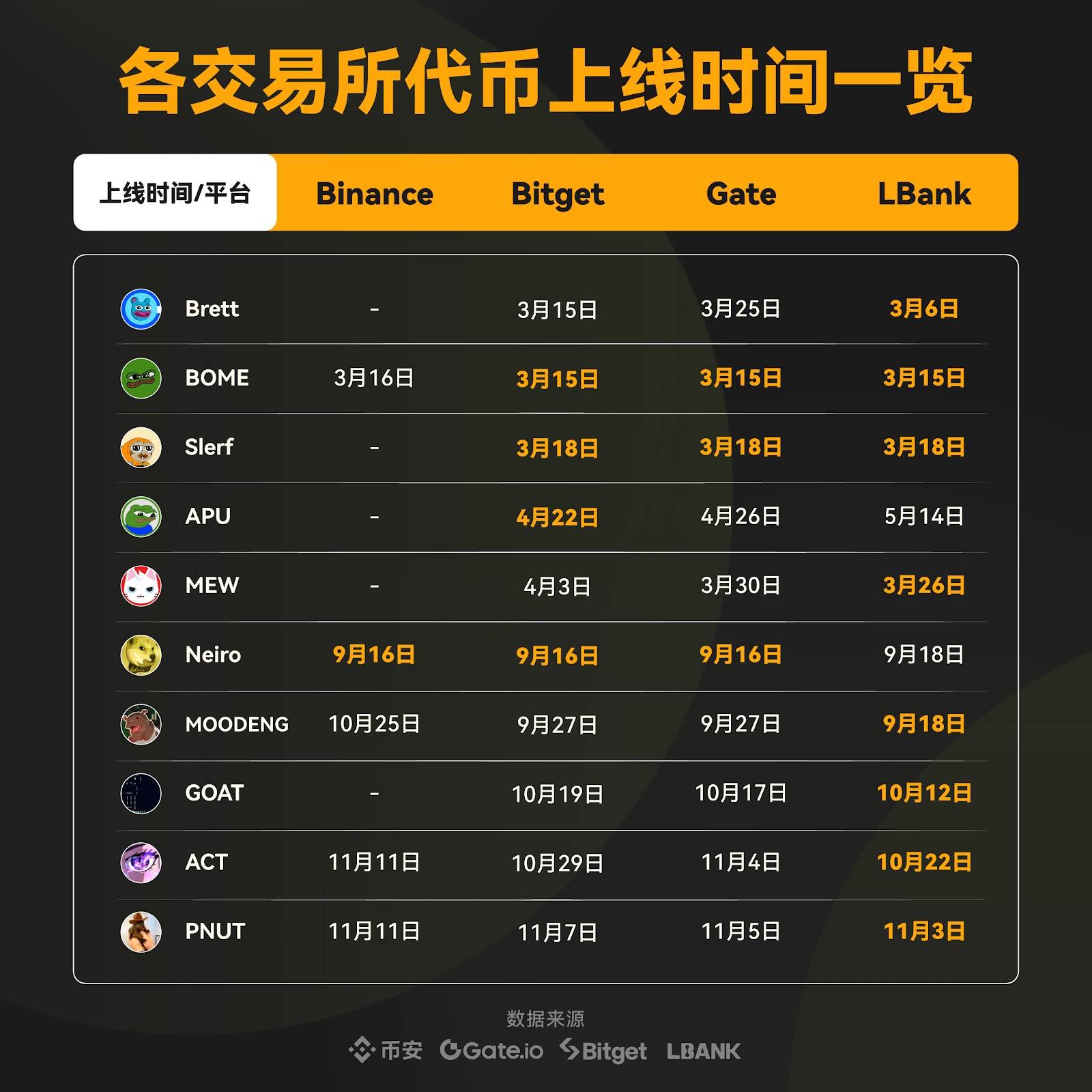
During this period, LBank conducted rigorous analysis of the 2024 Meme market—screening top ten Memecoins based on market cap, market share, performance across different ecosystems, infrastructure developments, and shifts in CEX attitudes toward Memes—demonstrating deep research and a disciplined mindset.
Crypto Revelation: Awakening from Bubble to Reality
With LBank’s brand upgrade at the start of 2025, it’s clear they’re not content with the status quo.
Recall Eric He, former CEO of LBank, who during multiple Spaces events in 2024 stated:
-
"So-called value investing is actually a step backward for the industry. High valuations represent arrogance and bias."
-
"Openness, transparency, and fairness will be the ultimate destiny of CEXs."
-
"If CEXs continue clinging to outdated traditions and refuse self-renewal, the crypto market will inevitably welcome the dawn of decentralization. The DEX era is unstoppable."
-
"Return to our original vision—let more users experience the 'get-rich-quick' effect and achieve wild growth amid the bubbles."
In his view, Memecoins break down traditional investment barriers, offering equal opportunities to all participants. Though high-risk, as he put it: "The next BTC or DOGE might just emerge here." Combined with LBank’s recent brand upgrade, one can’t help but wonder whether LBank will follow the Web3 wallet trend and enter the arena of product differentiation.
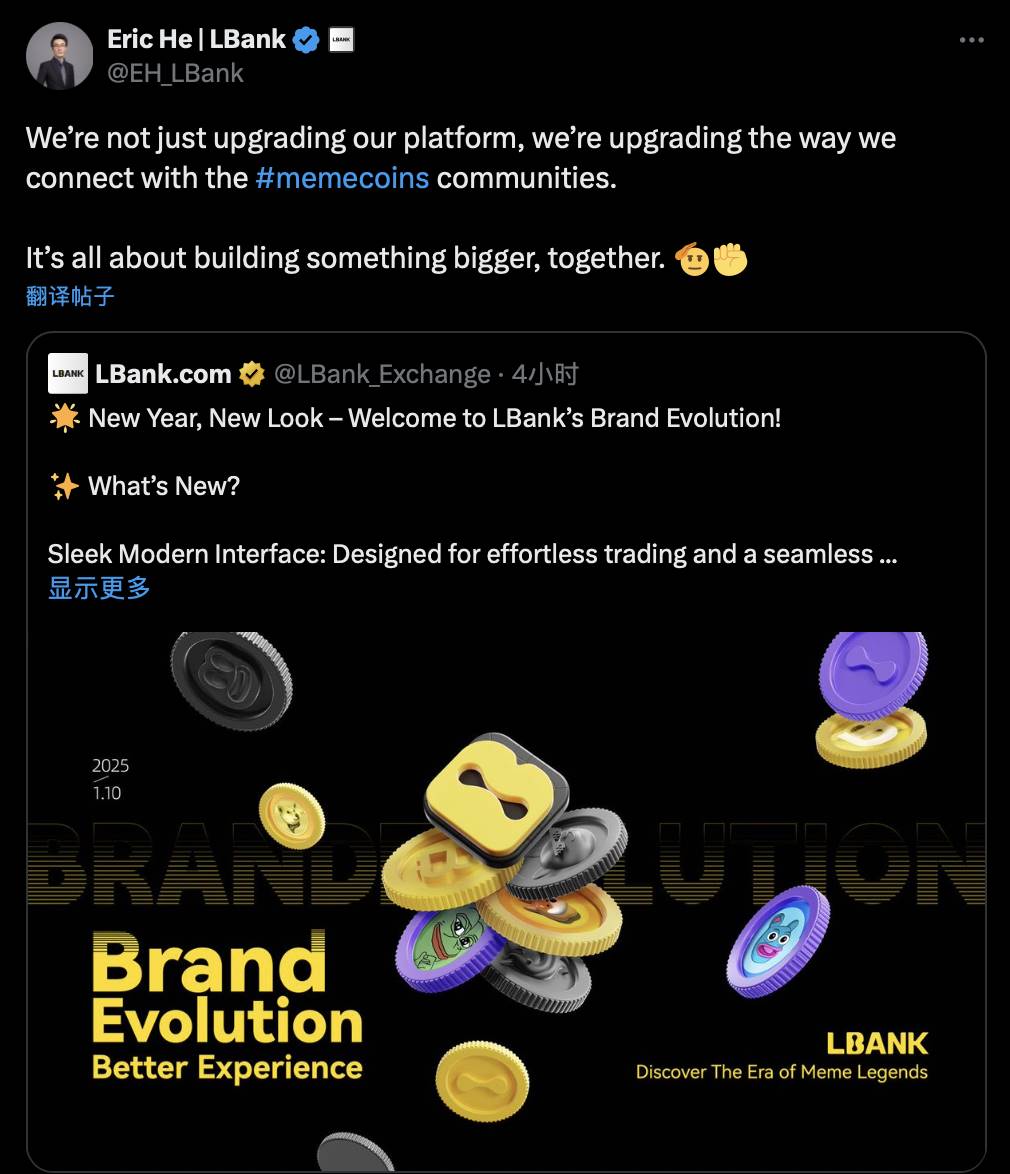
While many CEXs are now exploring Web3—launching services tightly integrated with wallet functions to secure a foothold in the decentralization wave—the so-called “exchange + wallet” model, though seemingly innovative, primarily aims to funnel CEX users into proprietary ecosystems rather than pursuing genuine decentralization. For LBank, despite signs that its rebrand may signal deeper engagement with the Web3 ecosystem, its historical actions suggest it likely won’t simply follow the crowd into “walletification.”
What Kind of CEX+DEX Do We Need?
The debate between CEX and DEX never ends—it remains one of the core controversies in the crypto market. Historically dominant, CEXs established supremacy through efficient trading systems, strong liquidity, and highly concentrated resources. Yet, as decentralization principles take root, DEXs have risen as formidable competitors. The greatest strength of DEXs lies in their decentralized nature: transactions are more transparent, users retain greater control, and transaction data and asset flows remain largely immune to external interference.
Perhaps, in the future, CEX and DEX won’t stand as opposing poles, but instead merge into an integrated ecosystem. True innovation will build upon the efficiency and liquidity strengths of CEXs while incorporating decentralized elements, forming a hybrid “CEX+DEX” trading model. This approach would preserve CEX advantages in speed, liquidity, and resource aggregation, while leveraging DEX transparency and user autonomy to ensure platform fairness and independence.
This doesn’t mean CEXs must abandon their traditional models, but rather evolve through incremental reform—gradually integrating decentralized technologies and governance into existing structures. Specifically, CEX platforms could introduce decentralized liquidity pools, smart contracts, and community governance to transcend limitations of traditional models, maintaining trading efficiency while granting users greater control and transparency.
The real winners will be platforms that deeply integrate decentralization with high-performance trading technology. LBank’s strategic positioning represents exactly such a critical step—using innovative thinking and technological convergence to forge a path between CEX and DEX that better meets market demands.
Be the Change, or Be Changed?
History has proven that in every major transformation, those who cling to the status quo are left behind. Every market participant now faces a choice: remain in the comfort zone of the old system, or courageously embrace the new paradigm? Defend existing interests, or proactively break through boundaries? The true victors will be pioneers bold enough to dismantle constraints and confront challenges of the new era.
For the so-called "perennial champions" of crypto—CEXs—controversy and security concerns persist. Today’s emerging token distribution models on-chain have long diverged from traditional institutional investment and conventional CEX listing practices. Crypto history has shifted from infrastructure-driven cycles to application-centric eras. Truth and deception intertwine. Will players remain complacent, or transform during this pivotal moment? It’s a monumental test.
Market evolution is never static. The true winners will be those daring enough to break conventions and seize new opportunities. In this age of transformation, transparency, decentralization, and innovation are the core values of the crypto market. Whether LBank or any other CEX platform, only by continuously reevaluating their core values and breaking free from rigid frameworks can they stand out in the future crypto landscape.
The call for change has sounded. The old order is crumbling. In this era brimming with opportunity and challenge, will you drive transformation—or passively accept it? Ultimately, history will write the answer.
Join TechFlow official community to stay tuned
Telegram:https://t.me/TechFlowDaily
X (Twitter):https://x.com/TechFlowPost
X (Twitter) EN:https://x.com/BlockFlow_News
 Odaily






