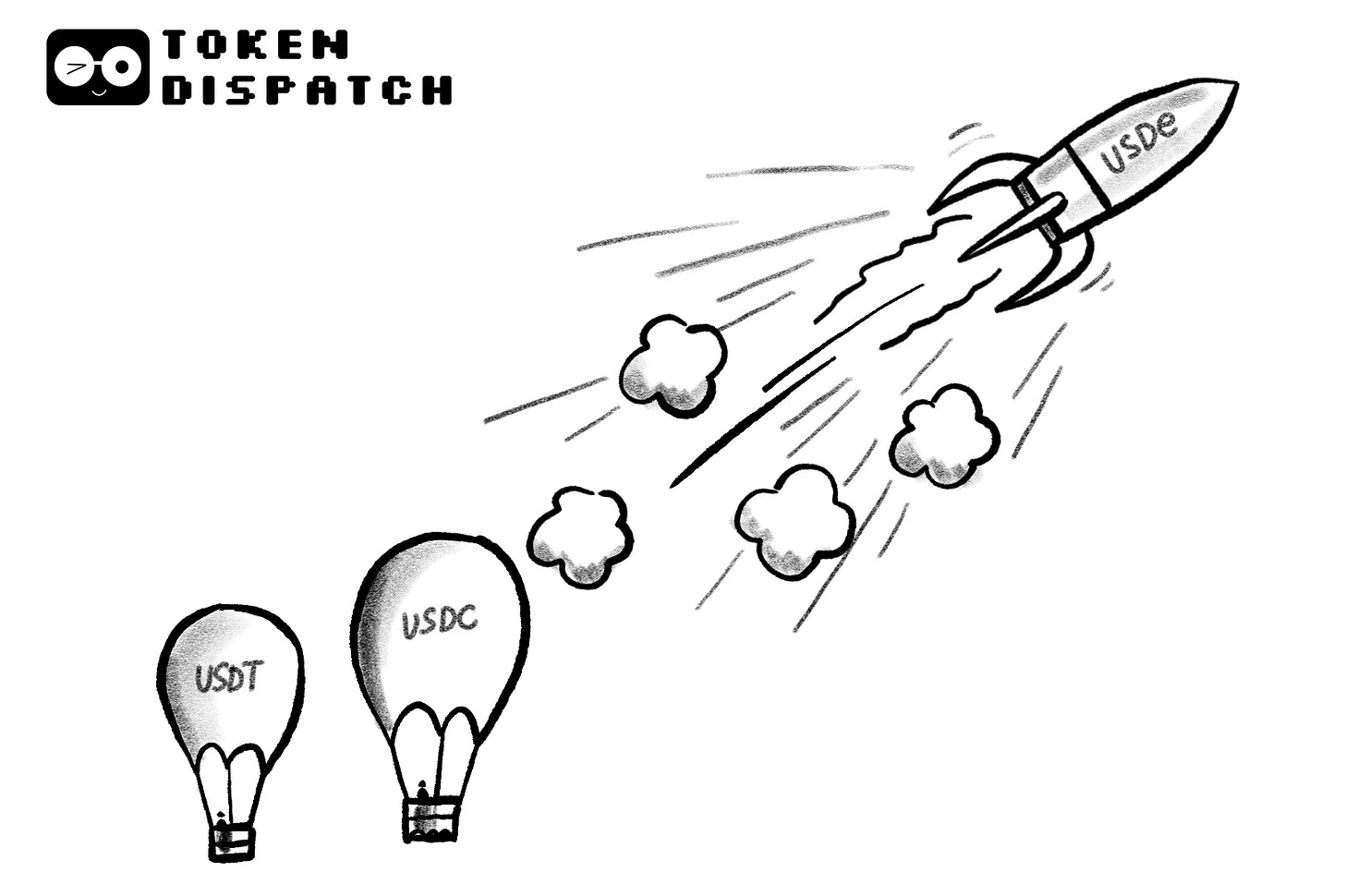
Ethena (ENA): Is USDe Synthetic Dollar the Future of DeFi?
TechFlow Selected TechFlow Selected
Ethena (ENA): Is USDe Synthetic Dollar the Future of DeFi?
USDe employs a sophisticated delta hedging strategy to reduce volatility, providing a reliable medium of exchange for the DeFi ecosystem.
 Navigating Web3 tides with focused insights
Text: Kucoin
Translation: Baihua Blockchain

Ethena (ENA), a rising star in the decentralized finance (DeFi) space, leverages blockchain technology to deliver innovative financial solutions. The platform aims to enhance the functionality and scalability of financial transactions without relying on traditional banking systems. One of Ethena’s core offerings is USDe, a synthetic dollar designed to provide stability and seamless integration within the digital financial ecosystem.
1. Features of USDe
USDe is pegged to the U.S. dollar at a 1:1 ratio, aiming to maintain stable value amid the high volatility characteristic of crypto markets. This pegging mechanism is crucial for users seeking a reliable medium of exchange or a stable store of value, effectively hedging against the price fluctuations commonly seen in cryptocurrency markets.
1) What is Ethena?
Ethena is a DeFi protocol built on the Ethereum blockchain, focused on creating a synthetic dollar called USDe. The platform aims to provide a stable, scalable, and censorship-resistant digital currency without reliance on traditional banking infrastructure. By employing a delta hedging strategy backed by Ethereum-based collateral, Ethena ensures the stability and security of USDe, making it an ideal choice for global transactions and savings.
2) Funding Support
Ethena has received strong backing from prominent figures and institutions in the cryptocurrency and financial sectors. The startup raised $6 million in a seed round led by Dragonfly, a well-known venture capital firm specializing in crypto investments. Additionally, Arthur Hayes, founder of BitMEX, along with his family office Maelstrom, participated in the funding. Other key supporters include major crypto derivatives exchanges such as Deribit, Bybit, OK, Gemini, and Huobi.
3) ENA—Ethena’s Native Token
ENA is the native utility token of the Ethena protocol and plays a vital role within the Ethena ecosystem. ENA holders can participate in protocol governance, voting on critical decisions such as risk management frameworks, the composition of assets backing USDe, and potential partnerships or integrations. Furthermore, ENA helps maintain the stability and functionality of USDe through various incentive mechanisms within the platform, serving as a key linchpin for the entire ecosystem.
4) What is Ethena’s Synthetic Dollar USDe?
USDe is a synthetic dollar issued by Ethena, designed to offer a stable and scalable digital currency pegged to the value of the U.S. dollar. USDe aims to become a decentralized, crypto-native dollar that operates independently of traditional financial infrastructure. Its stability is achieved through a combination of delta hedging and minting-redeeming arbitrage mechanisms. These features enable USDe to function as a reliable medium of exchange and store of value in the crypto market, supporting seamless and efficient transactions across the DeFi landscape.
2. How Does the Ethena Protocol Work?

How Ethena's Internet Bond Works | Source: Ethena Labs' Gitbook
1) Core Concept of Ethena
Ethena leverages the Ethereum blockchain framework to create a stable, scalable, and censorship-resistant digital currency known as the "internet bond." Through an innovative delta hedging strategy, the platform maintains monetary stability while also offering users yield opportunities.
2) Minting USDe
On the Ethena platform, users can mint USDe by using Ethereum or its staked derivatives as collateral. The system automatically establishes a delta-neutral position to stabilize the value of USDe and protect against fluctuations in the underlying collateral assets. This process involves opening short positions in derivative markets equivalent in value to the deposited Ethereum, ensuring that price movements in the underlying asset are offset by gains or losses in the derivative positions.
3) Stability via Delta-Neutral Mechanism
The core stability mechanism of USDe is the delta hedging strategy. This approach mitigates price volatility in crypto markets by establishing hedging positions in derivatives markets equal in value to the Ethereum collateral. This design aims to keep the synthetic dollar USDe firmly pegged to the U.S. dollar. Adjustments to hedging positions are fully automated, responding in real time to market changes to ensure continued stability.
4) Yield Generation
USDe is not only a stable currency but also offers earning opportunities for holders. Primary sources of yield include:
-
Rewards generated from staking the collateralized Ethereum;
-
Funding rates and basis spreads earned through delta hedging activities.
This dual-yield model makes USDe function similarly to traditional bonds—an investment that accumulates value over time—earning it the nickname "internet bond."
5) Risk Mitigation
While Ethena strives to build a stable and secure platform, it acknowledges inherent risks in DeFi protocols, including smart contract risks, liquidity risks, and risks associated with external platforms. To mitigate these, Ethena employs diversified hedging strategies, uses multi-custody solutions, and leverages blockchain technology to ensure all transactions and positions are transparent and verifiable.
3. Ethena’s Operational Mechanism
Below is a concrete example illustrating how users can obtain USDe (synthetic dollar) by staking Ethereum (stETH):
1) User Actions
-
Deposit stETH: The user deposits stETH worth $100 into the Ethena system (representing staked Ethereum that earns staking rewards).
-
Receive USDe: In return, the user receives approximately 100 USDe (after deducting any applicable fees), based on the 1:1 USD peg.
2) Actions by Ethena Labs
-
Open Short Position: After the user deposits stETH, Ethena Labs opens a short perpetual futures contract on a derivatives exchange with a value equivalent to the stETH. This is part of Ethena’s delta hedging strategy to stabilize the value of USDe.
-
Over-the-Counter (OTC) Settlement: The deposited stETH is managed through an “OTC settlement” system. This mechanism ensures that users’ stETH is securely stored outside of trading platforms, reducing counterparty risks arising from exchange hacks or insolvency.
4) Yield Distribution
Staking rewards generated by the user’s stETH are collected by Ethena, which converts these earnings into additional USDe and returns them to the user. This yield distribution model provides users with steady returns, enhancing USDe’s appeal as a yield-generating investment tool.
5) Key Summary Points
-
Stability: Through the delta hedging strategy (balancing stETH collateral positions in derivatives markets), Ethena effectively reduces volatility risk from collateral assets, ensuring USDe remains pegged to the U.S. dollar.
-
Security and Risk Management: Assets are managed via OTC settlement, minimizing the impact of external threats on user deposits and providing a safer environment for investors.
-
Yield Generation: Converting staking rewards into USDe delivers predictable and stable returns to users, positioning USDe as an ideal passive income instrument.
4. Use Cases of USDe
USDe is primarily used in trade, remittances, and as a stable medium of exchange, simplifying and securing cross-border transactions without reliance on traditional financial intermediaries. This makes it an ideal solution for businesses and individuals seeking efficient, low-cost options in international commerce.
1) USDe as a Medium of Exchange
Ethena’s USDe serves as a stable medium of exchange suitable for various financial transactions, avoiding the typical volatility associated with other cryptocurrencies. This stability makes USDe highly suitable for daily transactions, trading activities, and cross-border payments—especially in scenarios where exchange rate stability is critical.
2) Savings and Investment Tool
Referred to as the “internet bond,” USDe functions not only as a transactional medium but also as a savings vehicle. By generating yield through staking and hedging operations, USDe offers users investment opportunities akin to traditional bonds—but operating within the DeFi market. This feature attracts investors looking to earn passive income while maintaining liquidity in stable assets.
3) DeFi Application Scenarios
USDe plays a crucial role in DeFi applications such as borrowing, lending, and yield farming. Its stability and deep integration with the Ethereum blockchain allow it to serve as collateral for loans or as a liquidity asset in decentralized exchanges (DEXs). This versatility expands its utility across the DeFi ecosystem, enabling safer and more efficient financial services.
4) Hedging and Risk Management
USDe can also act as a hedging tool against volatility in cryptocurrency markets. During periods of market uncertainty or adverse conditions, traders and investors can convert volatile assets into USDe to protect their portfolios from sharp price swings, reduce potential losses, and retain the ability to quickly re-enter the market when favorable opportunities arise.
5) Promoting Cryptocurrency Adoption
By offering a stable, scalable, and censorship-resistant form of money, USDe supports broader adoption of cryptocurrencies. It addresses common barriers to crypto usage—such as volatility and complexity—enabling new users to enter the crypto market with greater confidence. The stability of USDe allows users to transition seamlessly into crypto-based financial systems without immediately facing the risks associated with more volatile cryptocurrencies.
6) Future Outlook
The potential applications of USDe are extensive. As the DeFi sector continues to evolve, USDe is expected to play a significant role in decentralized lending, yield farming, and more sophisticated financial instruments. This could have a profound impact on the entire cryptocurrency market, driving wider adoption of crypto-based financial solutions by enhancing stability and reliability.
7) Integration with Major DeFi Protocols
Ethena’s USDe has already been integrated into major DeFi protocols such as MakerDAO, Frax, Curve Finance, and Aave, highlighting its growing importance and transformative potential in reshaping global financial interactions.
5. Comparison Between USDe and Other Stablecoins

Exploring Comparisons Between Other Stablecoins and USDe | Source: Ethena Labs' Gitbook
USDe is one of hundreds of stablecoins in the crypto market, with its value tied to real-world assets (in this case, the U.S. dollar). As a crypto-based synthetic dollar protocol, USDe differs from other stablecoins in several ways:
1) Stability Mechanism
-
USDe: Maintains its dollar peg through a delta hedging mechanism using Ethereum derivatives to offset volatility in its collateral. This approach helps preserve USDe’s stability even during periods of extreme market turbulence.
-
Traditional Stablecoins (e.g., USDT, USDC): Typically rely on fiat reserves to maintain their peg, meaning their stability depends on the adequacy of those reserves and the financial health of the custodians managing them.
2) Decentralization
-
USDe: Operates on a decentralized platform with no single entity controlling its issuance or redemption processes. This structure enhances security and reduces the likelihood of censorship or interference.
-
Other DeFi Stablecoins (e.g., DAI): DAI also operates on a decentralized framework but relies on an over-collateralization model involving a basket of other cryptocurrencies, which may introduce different risks and dependencies.
3) Yield Generation
-
USDe: Offers intrinsic yield through its “internet bond” model, with returns derived from Ethereum staking rewards and spreads in derivatives markets. This unique feature enables USDe holders to earn yield directly.
-
Other Stablecoins: Most traditional stablecoins do not generate yield natively; users must seek returns through external channels such as lending platforms or DeFi yield farms.
4) Scalability and Efficiency
-
USDe: Built on the Ethereum network, leveraging existing DeFi protocols and infrastructure to achieve high scalability and efficiency, facilitating broader adoption and multi-platform integration.
-
Other Stablecoins: While also scalable to some extent, traditional stablecoins are often constrained by reserve management within traditional banking systems and may be slower to adapt to new blockchain technologies.
5) Risk and Transparency
-
USDe: Offers high transparency with on-chain records of transactions and positions. However, the complexity of its delta hedging strategy and potential risks stemming from derivatives market volatility require careful attention.
-
Other Stablecoins: Traditional stablecoins typically face risks such as counterparty exposure, lack of audit transparency regarding reserves, and potential regulatory challenges. That said, their simpler operational models may lead some users to perceive them as less risky.
6. Potential Risks and Challenges for Ethena and USDe
Before participating in the Ethena ecosystem, it is important to understand the following potential risks and challenges:
1) Regulatory Challenges
Ethena faces regulatory scrutiny similar to many DeFi projects, particularly concerning the issuance of synthetic stablecoins like USDe, which may vary across jurisdictions due to differing regulatory frameworks. The current regulatory environment is rapidly evolving, and new rules could affect stablecoins and their operations. Countermeasures: Ethena actively engages with regulators and seeks legal compliance across all operational regions. This includes implementing strict KYC and anti-money laundering (AML) checks for users, especially those involved in minting and redeeming USDe.
2) Market Acceptance
The widespread adoption of USDe depends on user acceptance and integration into mainstream DeFi platforms. Market uptake may be slow, especially if users remain cautious about new technologies or face competition from established stablecoins. Countermeasures: Ethena promotes USDe adoption through strategic partnerships with major DeFi protocols in the crypto ecosystem and incentives for early adopters. Additionally, educational outreach and transparent communication help build user confidence in the advantages and mechanics of USDe.
3) Technical Challenges
Ethena’s core technology—particularly the delta hedging mechanism used to stabilize USDe—is complex and may be susceptible to technical issues or vulnerabilities. Implementing such intricate mechanisms carries inherent risks, including smart contract bugs. Countermeasures: Ethena minimizes risks through extensive testing and third-party audits of its smart contracts conducted by reputable security firms. The protocol infrastructure is continuously monitored and updated to ensure robust defenses against potential vulnerabilities.
4) Liquidity and Volatility Risk
Like any financial instrument, liquidity constraints pose a risk—especially under market stress or rapid shifts in investor sentiment. Moreover, although USDe aims to remain stable, its underlying collateral (ETH and its derivatives) is highly volatile. Countermeasures: Ethena addresses liquidity concerns by maintaining reserve funds and establishing deep liquidity pools across multiple trading platforms. Regarding volatility, the protocol strictly enforces its neutral hedging strategy to ensure the synthetic dollar remains pegged despite fluctuations in underlying assets.
5) Dependence on Ethereum
As a protocol built on the Ethereum blockchain, Ethena’s performance is affected by Ethereum’s scalability and gas fees, which can impact transaction costs and speed. Countermeasures: Ethena plans to leverage Ethereum layer-2 solutions and may explore cross-chain integrations to reduce high transaction fees and improve scalability. This not only enhances efficiency but also broadens the protocol’s accessibility and user base.
6) Counterparty Risk
Maintaining USDe’s stability through derivatives and other financial instruments exposes the protocol to counterparty risk, particularly in decentralized environments where counterparties may lack full reliability or transparency. Countermeasures: Ethena selects reputable and trustworthy trading platforms and derivatives partners, ensures all positions are over-collateralized, and maintains transparency around hedging activities.
7. Conclusion
Ethena and its USDe stablecoin represent a significant innovation in the decentralized finance space. By leveraging Ethereum’s robust and secure infrastructure, Ethena offers a crypto-native, stable, and scalable digital dollar that operates independently of traditional banking systems while introducing a yield-generating asset in the form of an “internet bond.”
USDe’s use of advanced delta hedging to maintain stability sets it apart from traditional stablecoins, providing users with a reliable store of value that actively generates returns. This innovative approach addresses the volatility typically associated with cryptocurrencies, making USDe a viable solution for everyday transactions, savings, and financial planning in decentralized environments.
As the DeFi sector continues to grow, Ethena’s commitment to transparency, security, and user-centric innovation may play a pivotal role in shaping its trajectory. While its long-term success in the fast-evolving digital finance landscape remains to be seen, its potential to redefine perceptions and applications of stablecoins and synthetic assets within the DeFi ecosystem is undeniable. The ongoing development, adoption, and integration of Ethena and USDe could set new standards of stability and functionality in the cryptocurrency market.
Join TechFlow official community to stay tuned
Telegram:https://t.me/TechFlowDaily
X (Twitter):https://x.com/TechFlowPost
X (Twitter) EN:https://x.com/BlockFlow_News
 @kucoincom