
a16z: Stablecoins Will Restructure the Trillion-Dollar Payments Industry
TechFlow Selected TechFlow Selected
a16z: Stablecoins Will Restructure the Trillion-Dollar Payments Industry
Other advantages of stablecoins will attract more users, enterprises, and products onto the blockchain.
 Navigating Web3 tides with focused insights
Author: Sam Broner
Translation: TechFlow
The current payments market is dominated by a few gatekeepers that charge high fees, cutting into the margins of every business. They justify these fees with claims of ubiquity and convenience, while simultaneously suppressing competition and constraining innovators.
Stablecoins can offer a better solution.
Stablecoins provide lower fees, more competitive payment providers, and broader accessibility. By reducing transaction costs to nearly zero, stablecoins enable businesses to eliminate friction inherent in existing payment systems. Adoption will begin with those enterprises most affected by today’s payment inefficiencies—eventually disrupting the entire payments industry.
Stablecoins have already become the cheapest way to send U.S. dollars. Last month, over 28.5 million stablecoin users completed more than 600 million transactions globally. Stablecoin users span the globe, adopting them because they offer a secure, low-cost, and inflation-resistant method to store and spend value. Beyond cash and gold, stablecoins are the only widely adopted payment method that operates without intermediaries like banks, payment networks, or central banks. Additionally, stablecoins feature permissionless programmability, scalability, and integrability—anyone can build payment platforms atop stablecoin infrastructure.
This transformation may take time, but it will likely happen faster than many expect. Restaurants, retailers, enterprises, and payment processors will see the greatest benefits from stablecoin platforms, experiencing significant improvements in profit margins. This demand will drive adoption, and as usage grows, additional advantages of stablecoins—permissionless composability and enhanced programmability—will attract more users, businesses, and products on-chain. I’ll explain how and why below, starting with some context about the payments industry.
Payments Industry Participants
Payment rails: The technology, rules, and networks that process transactions
Payment processors: Operators that facilitate transactions on top of payment rails
Payment service providers (PSPs): Entities that grant access to payment systems for end-users or other systems
Payment solutions: Products offered by PSPs
Payment platforms: A suite of related payment solutions encompassing providers, processors, and rails
Background on the Payments Industry
The scale of the payments industry is hard to grasp. In 2023, the global payments industry processed 3.4 trillion transactions totaling $180 trillion, generating $2.4 trillion in revenue. In the U.S. alone, credit card payments reached $5.6 trillion, and debit card payments hit $4.4 trillion.
Despite its size and reach, payment solutions remain expensive and complex—even though consumer-facing apps often mask this complexity. For example, Venmo, a peer-to-peer payment app, appears simple on the surface, but behind the scenes involves intricate bank integrations, debit card loopholes, and countless compliance obligations. Compounding the complexity, payment solutions are often layered: people still use multiple methods—cash, debit cards, credit cards, P2P apps, ACH (Automated Clearing House), checks, etc.
The four main metrics for evaluating payment products are speed, cost, reliability, and convenience.
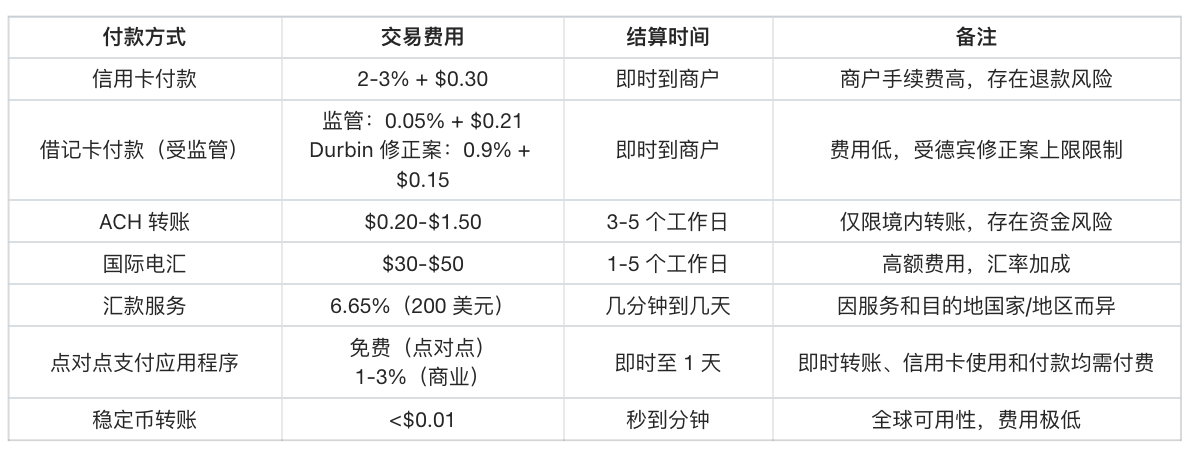
Consumers typically ask: How much will I pay? Merchants ask: Will I receive the funds? But in reality, all four criteria matter to both sides.
Since the days when businesses had to manually check physical ledgers for fraudulent credit cards, waves of innovation have improved the payment experience. Each wave brought faster, more reliable, convenient, and cheaper transactions—driving higher transaction volumes and spending.
Yet, many customers still lack access to modern payment products or are underserved. For merchants, credit cards are expensive, directly eroding profits. Despite growing adoption of real-time payments (RTP), U.S. bank transfers remain slow, often taking days. Peer-to-peer apps suffer from regional and network fragmentation, making cross-platform transfers slow, costly, and complicated.
While businesses and consumers increasingly expect payment platforms to deliver advanced functionality, existing solutions fail to meet everyone’s needs. In fact, most users pay too much.
Where Stablecoins Enter the Payments Landscape
Stablecoins find traction where traditional payment solutions fall short—high cost, low availability, or high friction—especially in cases where add-on features (identity, lending, compliance, fraud protection, banking integration) are less critical.
Take remittances, which often stem from urgent needs. Many remittance users are underbanked, relying on fragmented financial services. As such, they place little value on local integration between traditional payments and banking. Stablecoin payments offer immediate settlement, low cost, and no intermediaries—advantages beneficial to any user or developer. After all, sending $200 from the U.S. to Colombia via stablecoin costs less than $0.01, compared to $12.13 through traditional channels. (Remittance users must send money home regardless of fees, but lower costs bring meaningful relief.)
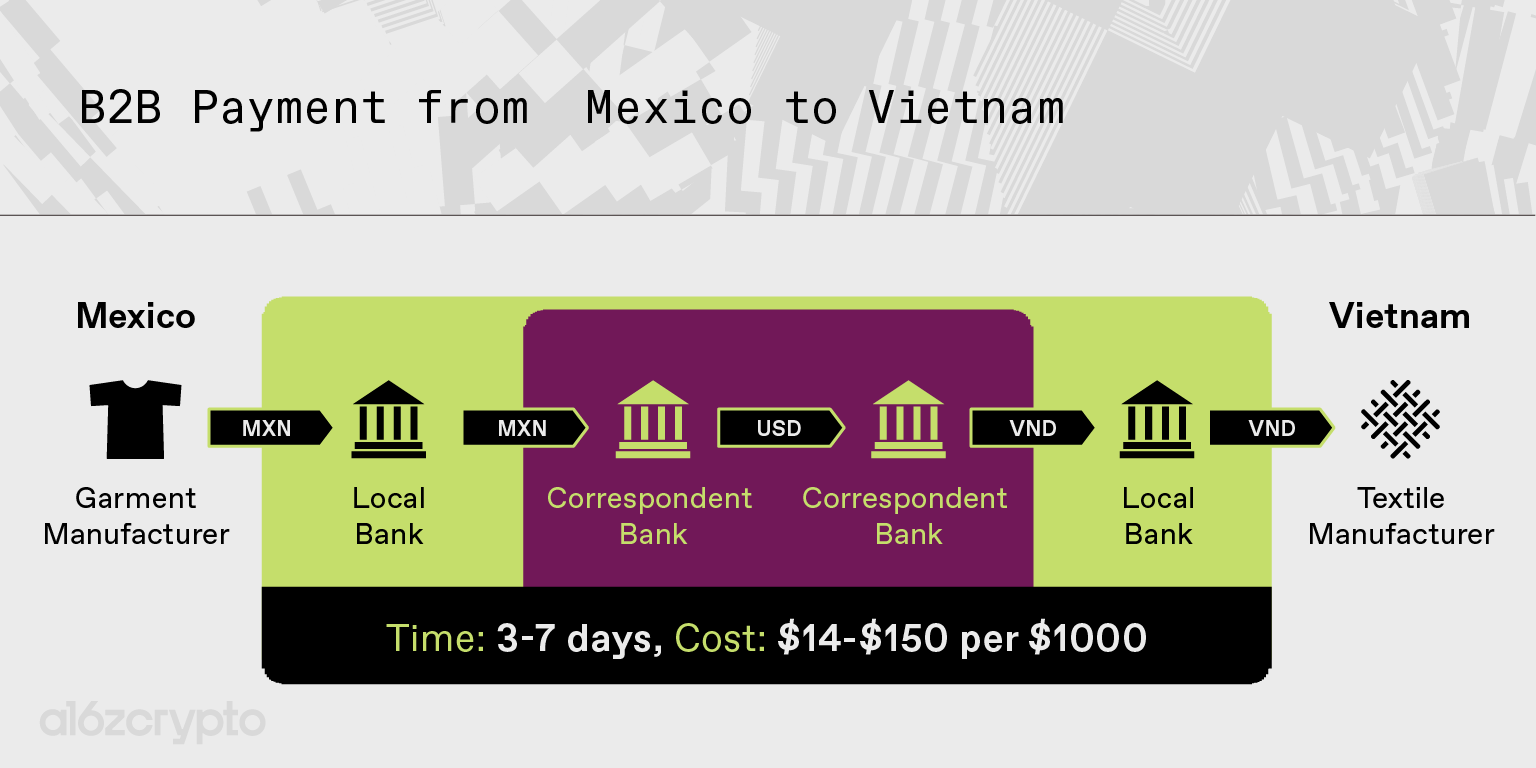
International business payments, particularly for small businesses in emerging markets, face similar issues: high fees, long processing times, and poor banking support. For instance, a clothing manufacturer in Mexico paying a textile supplier in Vietnam might go through four or more intermediaries—local bank, foreign exchange, correspondent bank, foreign exchange again, then local bank. Each intermediary takes a cut and increases the risk of failure.
Luckily, these transactions often occur between parties with long-standing relationships. Using stablecoins, the Mexican payer and Vietnamese recipient can bypass slow, bureaucratic, and costly intermediaries. They may need to develop local on/off ramps and workflows, but ultimately gain faster, cheaper transactions and greater control over the payment process.
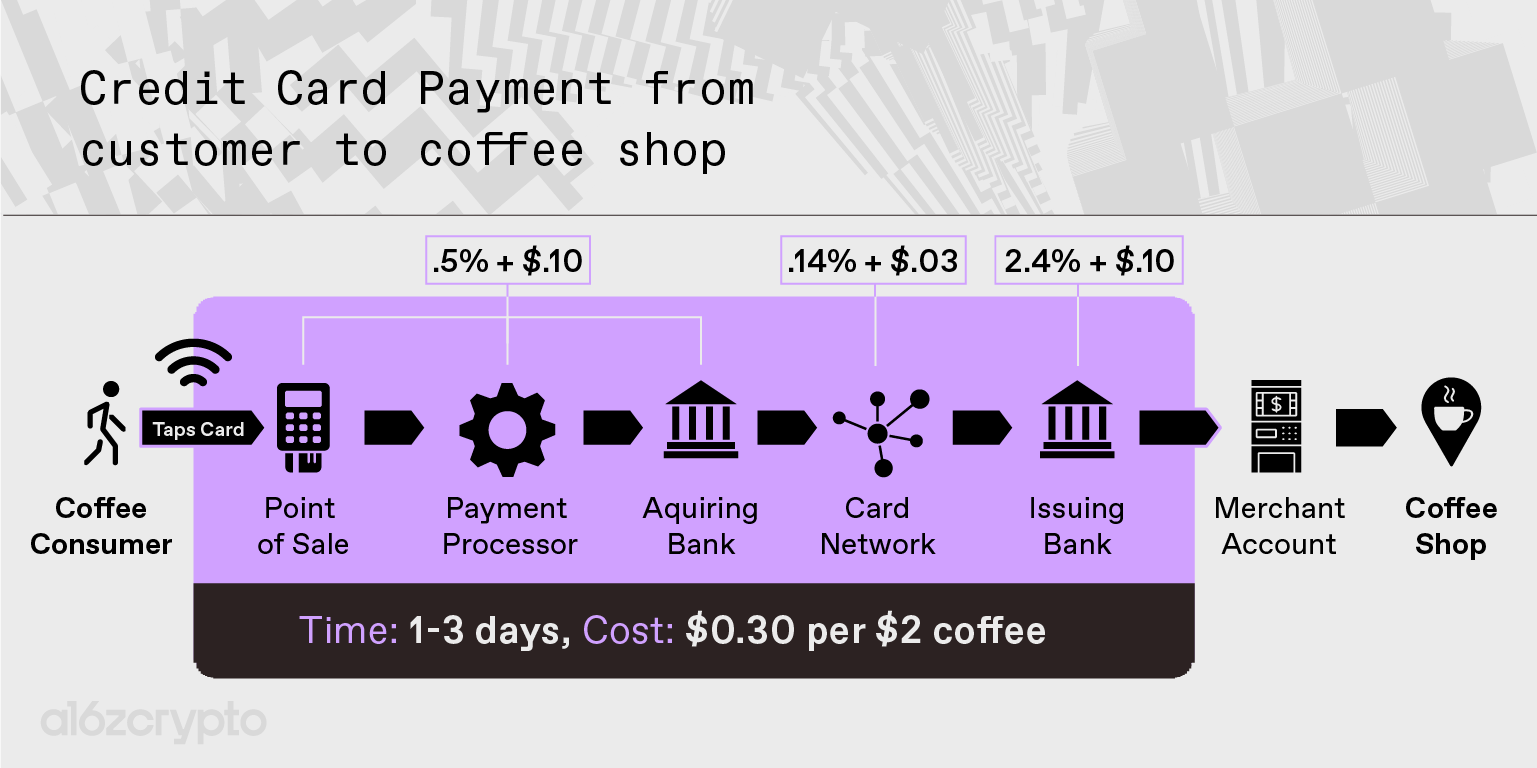
Low-value transactions—especially low-fraud, in-person purchases at restaurants, cafes, or corner stores—are another promising opportunity. These businesses operate on thin margins and are highly sensitive to costs, so even a $0.15 transaction fee significantly impacts profitability.
When a customer spends $2 on coffee, only $1.70–$1.80 reaches the café—the remaining ~15% goes to the credit card company just to facilitate the transaction. Yet here, the credit card adds little value: neither the consumer nor the shop needs the附加 features that justify the fee. The consumer doesn’t need fraud protection (it’s just a coffee) or lending (the coffee costs $2). The café has minimal need for compliance or banking integration (typically using integrated restaurant management software or none at all). So if a cheap, reliable alternative exists, we should expect such businesses to adopt it.
Cheaper Payments Boost Profitability
Transaction fees in today’s payment systems directly impact many businesses’ bottom lines. Reducing these fees unlocks substantial profit potential. Early signals are already visible: Stripe now charges 1.5% for stablecoin payments—30% lower than its standard card-processing rate. To support this, Stripe announced it would acquire Bridge.xyz for approximately $1 billion.
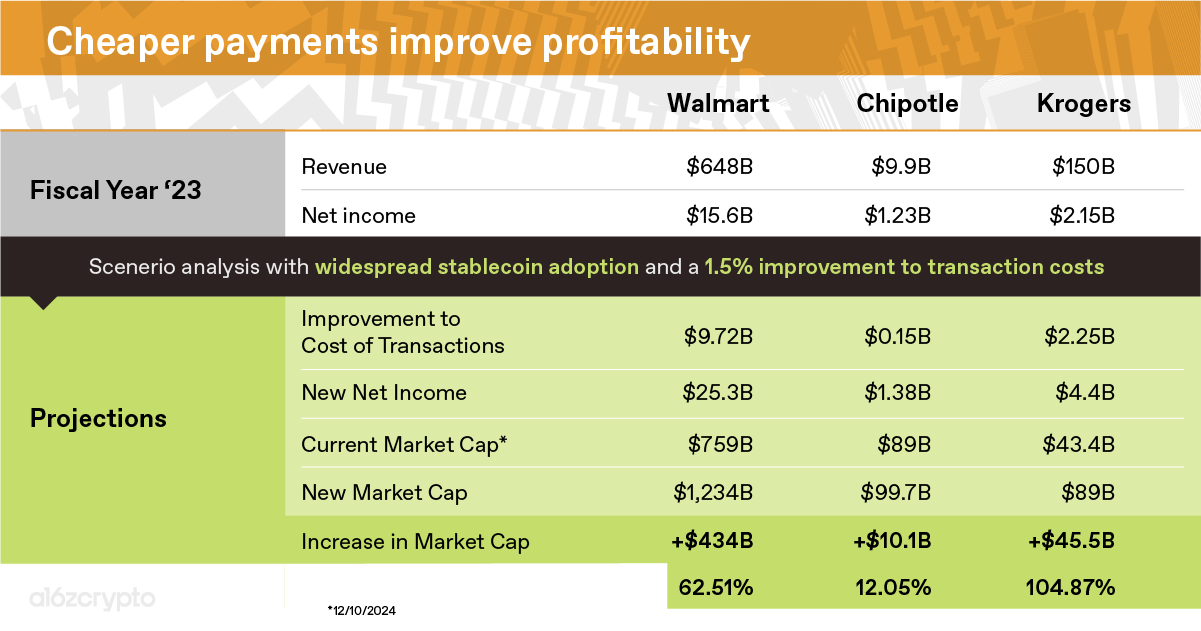
Wider stablecoin adoption could dramatically improve profitability—not just for small businesses like cafes or restaurants. Consider the 2024 financials of three public companies to estimate the impact of reducing payment processing fees to 0.1%. (For simplicity, this assumes a blended 1.6% payment processing cost and minimal on/off-ramp fees. More details below.)
Walmart generated $648 billion in annual revenue and likely paid $10 billion in credit card fees, with $15.5 billion in profit. Eliminating payment fees could increase Walmart’s profitability and valuation by over 60%, all else equal, through cheaper payment solutions.
Chipotle, a fast-growing fast-casual chain, reported $9.8 billion in annual revenue and $1.2 billion in profit, paying $148 million in credit card fees. Just by reducing fees, Chipotle’s profitability could rise by 12%—a significant boost not easily achieved through revenue growth.
Kroger, the national grocery chain, stands to benefit the most due to its razor-thin margins. Surprisingly, Kroger’s net income may be roughly equal to its payment processing costs. Like many grocers, its profit margin is under 2%—lower than typical credit card processing fees. Kroger could potentially double its profits by switching to stablecoin payments.
How could Walmart, Chipotle, and Kroger reduce transaction fees using stablecoins? First, this is an idealized scenario—widespread consumer adoption won’t happen overnight. Significant costs will remain until robust on/off-ramps are widely available. Second, retailers and payment processors alike resist high-fee models. Payment processors themselves operate on thin margins, with most profits captured by card networks and issuing banks. When Stripe processes an online checkout, it charges 2.9% + $0.30, but over 70% of that goes to Visa and the issuing bank. As more processors—like Block (formerly Square), Fiserv, Stripe, and Toast—adopt stablecoins to improve margins, it will become easier for more businesses to use them.
Because stablecoins eliminate intermediary fees, processors earn higher margins per transaction. These improved margins may incentivize processors to promote stablecoin adoption across more businesses and use cases. However, as adoption grows, competitive pressure will likely drive stablecoin fees down further—for example, Stripe’s current 1.5% rate may decline.
Next Step: Driving Broad Consumer Adoption of Stablecoins
Currently, stablecoins are gaining traction as a new, permissionless way to transfer and store funds. Entrepreneurs are building solutions that transform stablecoin infrastructure into full-fledged platforms. As with past innovations, adoption will progress gradually—starting with edge users and forward-thinking businesses—until platforms mature enough for mainstream users and conservative enterprises. Three trends will accelerate broad corporate adoption.
Enhanced back-end orchestration and integration
Stablecoin orchestration—the ability to monitor, manage, and integrate stablecoins—will soon be embedded within payment processors like Stripe.
These orchestration tools will let businesses process payments at far lower costs than current systems, without major changes to operations or engineering. Consumers may unknowingly enjoy cheaper goods and services as invoicing, payroll, and subscriptions automatically become less expensive. Many stablecoin orchestration startups already serve B2B and B2C clients seeking instant settlement, low cost, and wide availability. By integrating stablecoins behind the scenes, businesses can capture their benefits without compromising user expectations for payment quality—while simultaneously increasing adoption.
Better onboarding and shared incentives for enterprises
Stablecoin firms are maturing in their approaches to user onboarding and shared incentive models to attract end users on-chain. On/off-ramp costs continue to fall, becoming faster and more accessible. More consumer apps now support crypto, allowing users to benefit from the expanding stablecoin ecosystem without changing habits or switching apps. Popular platforms like Venmo, Apple Pay, PayPal, Cash App, Nubank, and Revolut now allow stablecoin usage.
Companies also have stronger incentives to integrate stablecoins and keep funds in stablecoin form. Fiat-backed stablecoin issuers like Circle, PayPal, and Tether share profits with mainstream businesses—similar to how Visa shares rewards with United Airlines and Chase to attract credit card users. These partnerships benefit issuers by growing asset pools, while enabling businesses that successfully shift users from credit cards to stablecoins to earn revenue from the capital flowing through their products—a model previously reserved for banks, fintechs, and gift card issuers who profit from float.
Greater regulatory clarity and accessible compliance solutions
Businesses are more likely to adopt stablecoins when confident in the regulatory environment. While comprehensive global regulation remains absent, many regions have introduced rules and guidance, enabling entrepreneurs to build compliant, user-friendly businesses.
For example, the EU’s Markets in Crypto-Assets Regulation (MiCA) establishes prudential and conduct requirements for stablecoin issuers. Since its stablecoin provisions took effect earlier this year, the regulation has significantly reshaped Europe’s stablecoin landscape.
Though the U.S. lacks a formal stablecoin framework, bipartisan policymakers are increasingly recognizing the need for effective legislation. Such regulation should ensure issuers fully back tokens with high-quality assets, undergo third-party reserve audits, and implement robust measures against illicit finance. At the same time, laws should preserve developers’ ability to create decentralized stablecoins that reduce user risk by eliminating intermediaries and leveraging the benefits of decentralization.
These policy efforts will empower companies across industries to consider shifting from traditional rails to stablecoin infrastructure. While compliance tools may seem unglamorous, each new adopter helps demonstrate to established businesses that stablecoins are reliable, secure, regulated, and a superior solution to legacy payment challenges.
As adoption grows, platform network effects will strengthen. It may take years before stablecoins are used at point-of-sale or replace bank accounts, but as user numbers rise, stablecoin-centric solutions will become more mainstream—increasingly attractive to consumers, businesses, and entrepreneurs.
Riding the Wave: Stablecoins Will Keep Improving
During adoption, the product itself will continue to evolve. The Web3 community has good reason to celebrate stablecoin adoption: after years of infrastructure and on-chain application investment, stablecoins are climbing the S-curve of value innovation S-curve. As infrastructure improves, applications proliferate, and networks grow, stablecoins will become increasingly compelling to users. This will happen in two ways.
First, technical advances in crypto infrastructure make sub-penny stablecoin payments possible. Ongoing investment will make transactions cheaper and faster. Meanwhile, better wallets, bridges, on/off ramps, developer tooling, and AMMs will enable improved orchestration and user onboarding.
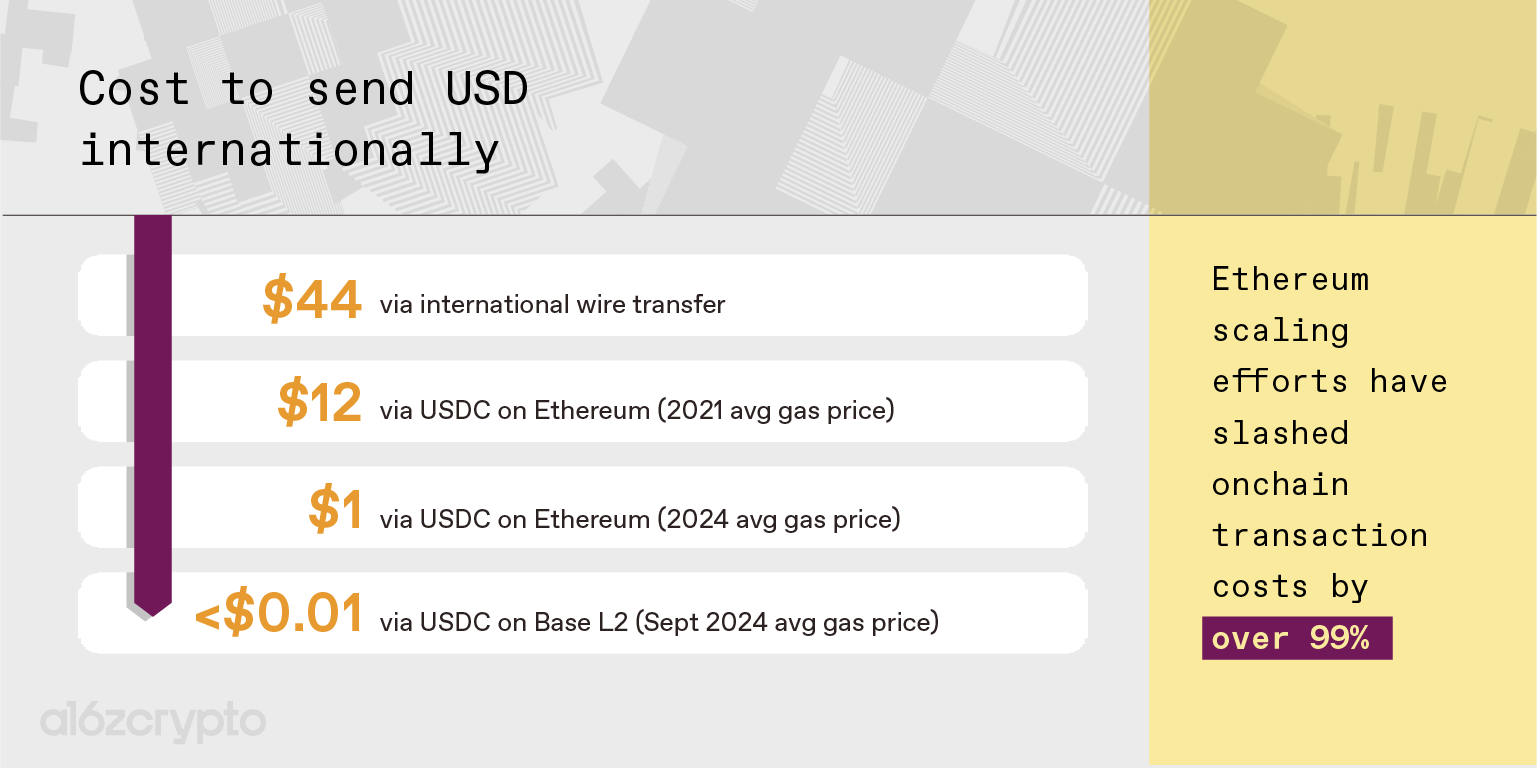
This technological foundation gives entrepreneurs stronger incentives to build on stablecoins—offering better developer experiences, richer ecosystems, widespread adoption, and permissionless composability of on-chain funds.
Second, stablecoins unlock new use cases through permissionless composability. Other payment platforms have gatekeepers, forcing entrepreneurs to work with extractive networks—like credit card schemes or costly intermediaries in international payments. But stablecoins are self-custodied and programmable, lowering the barrier to creating novel payment experiences and integrating value-added services. They are also composable, letting users benefit from increasingly powerful on-chain applications and growing competition.
Stablecoins promise to usher in a new era of free, scalable, and instant payments. As Stripe CEO Patrick Collison put it, stablecoins are like “room-temperature superconductors in financial services,” enabling businesses to explore commercial opportunities previously impractical under the weight of traditional payment systems.
In the near term, as payments become freer and more open, stablecoins will trigger structural shifts in financial products. Existing payment companies will need new monetization models—perhaps through revenue sharing or complementary services built atop this emerging platform. As traditional businesses recognize the shift, entrepreneurs will build new tools to help them leverage stablecoins effectively.
In the long run, as stablecoins become ubiquitous and technology advances, startups will seize opportunities inherent in a world of free, frictionless, and instant payments. These new ventures will emerge gradually, unlocking unexpected applications and further democratizing the global financial system—bringing its benefits to more people than ever before.
Acknowledgments: Special thanks to Tim Sullivan, Aiden Slavin, Eddy Lazzarin, Robert Hackett, Jay Drain, Liz Harkavy, Miles Jennings, and Scott Kominers for their invaluable feedback and suggestions that helped shape this article.
Sam Broner is a Partner on the investing team at a16z crypto. Prior to joining a16z, Sam was a software engineer at Microsoft and a founding member of the Fluid Framework and Microsoft Loop teams. While studying at MIT Sloan School of Management, Sam participated in the Federal Reserve Bank of Boston’s Project Hamilton, led the MIT Sloan Blockchain Club, curated the inaugural MIT Sloan AI Summit, and received the MIT Patrick J. McGovern Award for building entrepreneurial communities. Follow him on X at @SamBroner.
The views expressed herein are those of the individuals listed and do not necessarily reflect the opinions of AH Capital Management, L.L.C. (“a16z”) or its affiliates. Certain information in this article is derived from third-party sources, including portfolio companies of funds managed by a16z. While believed to be reliable, a16z has not independently verified the accuracy of such information and makes no representations or warranties regarding its current or future accuracy or applicability. This article may contain third-party advertisements; a16z has not reviewed such ads and does not endorse any content therein.
This article is for informational purposes only and should not be construed as legal, business, investment, or tax advice. You should consult your own advisors on these matters. References to any securities or digital assets are for illustrative purposes only and do not constitute investment advice or an offer to provide investment advisory services. Furthermore, this article is not directed to or intended for use by any investor or prospective investor and should not under any circumstances be relied upon in making an investment decision for any a16z-managed fund. (Offers to invest in a fund managed by a16z are made only through the fund’s private placement memorandum, subscription agreement, and related documents, which should be read in full.) Mentioned, cited, or described investments or portfolio companies do not represent all investments made by funds managed by a16z and cannot guarantee that such investments will be profitable or that future investments will have similar characteristics or outcomes. A list of investments made by funds managed by Andreessen Horowitz (excluding those not permitted for public disclosure by the issuer and undisclosed publicly traded digital assets) can be found here.
The content of this article is accurate only as of the date indicated. Any projections, estimates, forecasts, targets, prospects, and/or opinions contained herein are subject to change without notice and may differ or conflict with opinions expressed by others. See here for additional important disclosures.
Join TechFlow official community to stay tuned
Telegram:https://t.me/TechFlowDaily
X (Twitter):https://x.com/TechFlowPost
X (Twitter) EN:https://x.com/BlockFlow_News
 a16z
a16z