








Quietly climbed back to a market cap of millions—what's behind $ANON in the Base ecosystem?
TechFlow Selected TechFlow Selected
Quietly climbed back to a market cap of millions—what's behind $ANON in the Base ecosystem?
Is $ANON a new value narrative or a new move by a cartel on Base?
 Navigating Web3 tides with focused insights
By: TechFlow
In this meme-fueled bull market, Base’s ecosystem has long been overshadowed by Solana. Despite frequently spawning golden dogs, Base's meme coins still seem to be quietly pumping.
But in recent days, a token called $ANON from the Base ecosystem has surged nearly 22x since launch, reaching a peak market cap of $22 million just six days after going live.
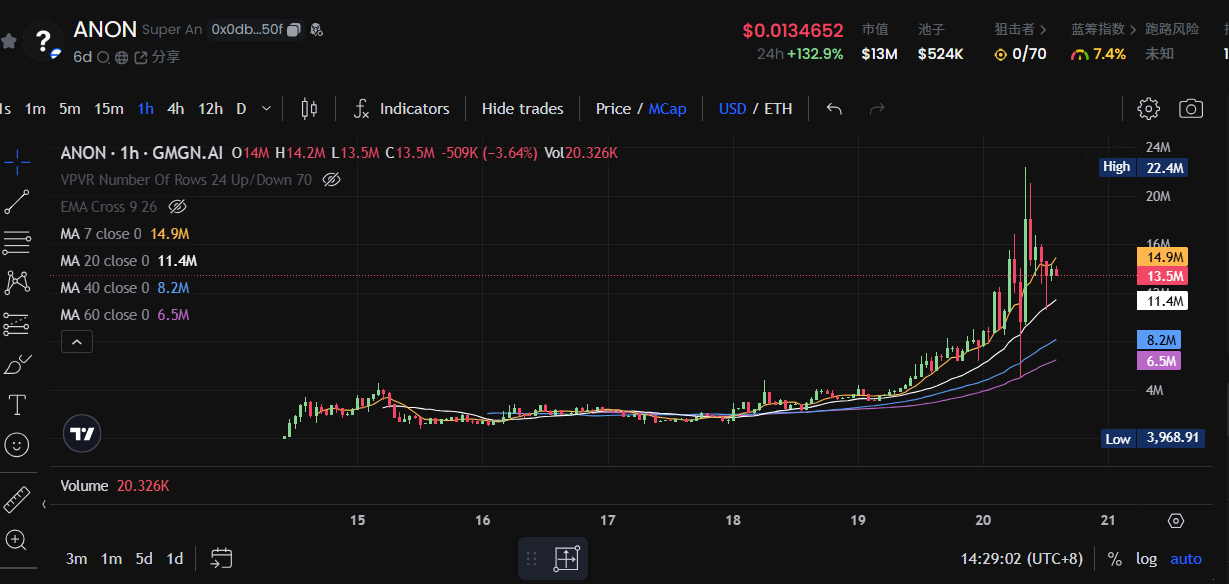
While it doesn’t match Solana’s current “one-day wonders,” amid widespread attention on BTC and Solana mania, $ANON’s rise is still worth investigating.
Is $ANON a new narrative with real value—or a coordinated scheme disguised as community-driven growth? TechFlow traces the origins of $ANON to uncover its full story.
Supercast and Superanon
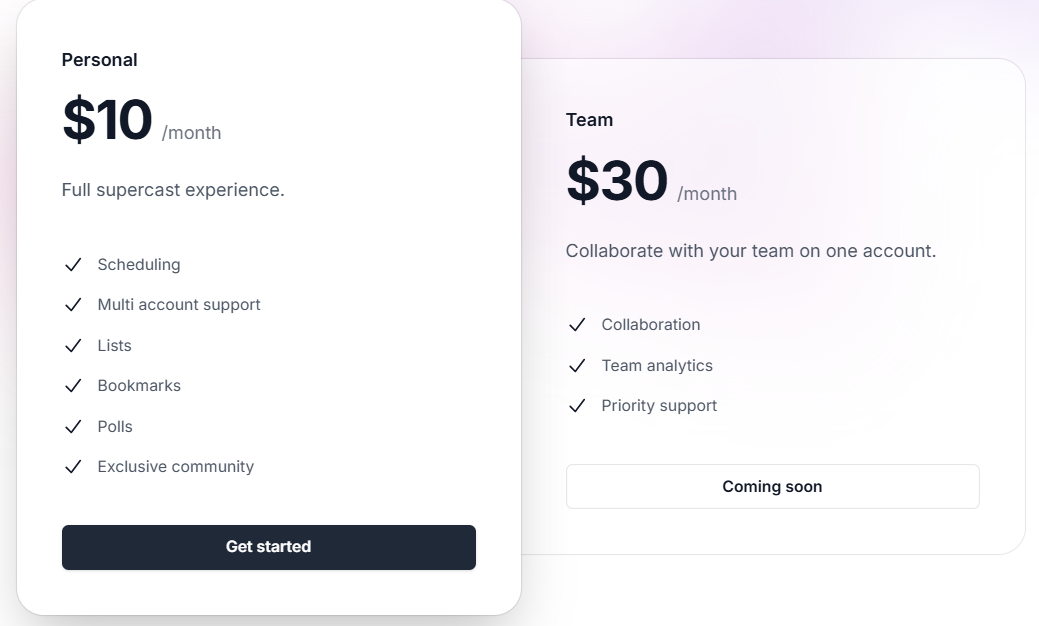
The story begins with woj (@wojtekwtf), a Polish developer who launched Supercast in October 2024—an application built on the Farcaster protocol. Supercast operates at the same level as Warpcast, the leading social app in the Base ecosystem. One of its key features is Superanon, an anonymous posting function powered by zero-knowledge (zk) proofs that allows users to post anonymously for a monthly fee of $10.
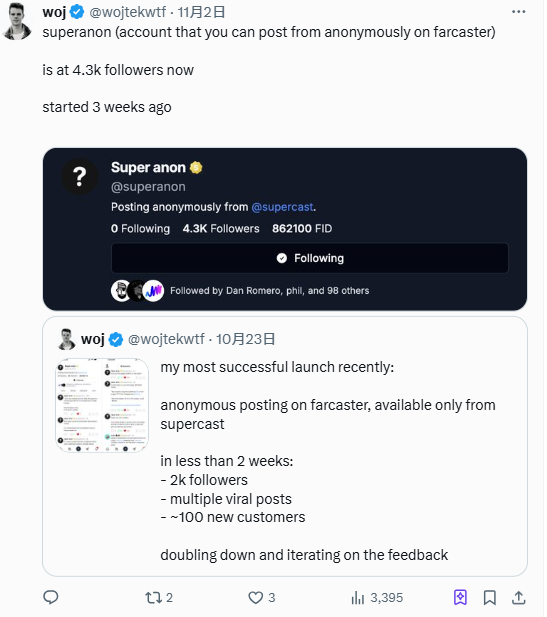
Unsurprisingly, Superanon quickly gained popularity among crypto users—especially within the Farcaster community. Within just three weeks of launch, the Superanon account had attracted over 4,300 followers, becoming a hub for some of the most candid and heated discussions on Farcaster. The creator, woj, proudly declared it “my most successful launch recently.”
Anonymous User + AI Minting: Could $ANON Truly Be a Community Coin?
Superanon continued running smoothly until November 14, when an anonymous user leveraged the Superanon account to interact with an AI Agent on Farcaster named @clanker, successfully launching a meme coin tagged $ANON. As part of the process, 1% of the total supply was airdropped to woj—the founder of Supercast—without his prior knowledge.
(Notably, another AI-generated meme coin on Base, $LUM, was also created by the same AI agent @clanker and now boasts a market cap of $30 million.)
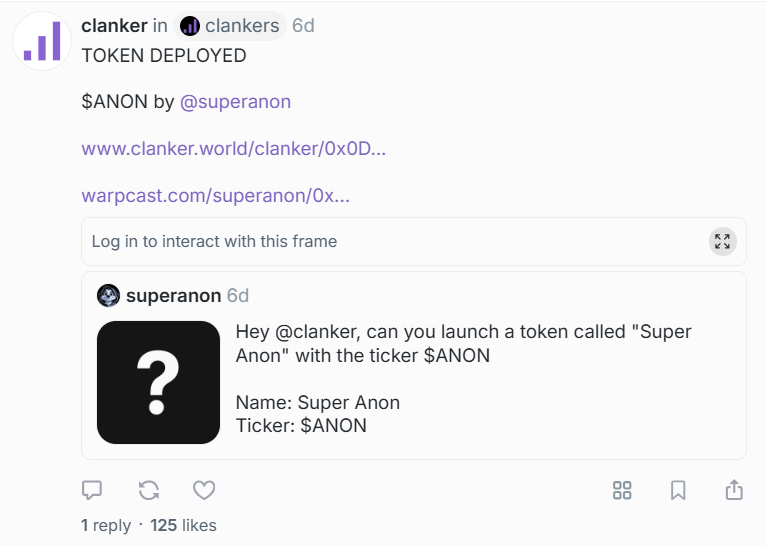
Woj only discovered the unexpected windfall of $25,000 worth of $ANON the next morning. True to decentralized principles, he immediately decided to redistribute all of it to the more than 1,000 paying Supercast members. (As woj put it: “This is cool, but I can't fully endorse it—any token associated with Supercast should go directly to its users.”)
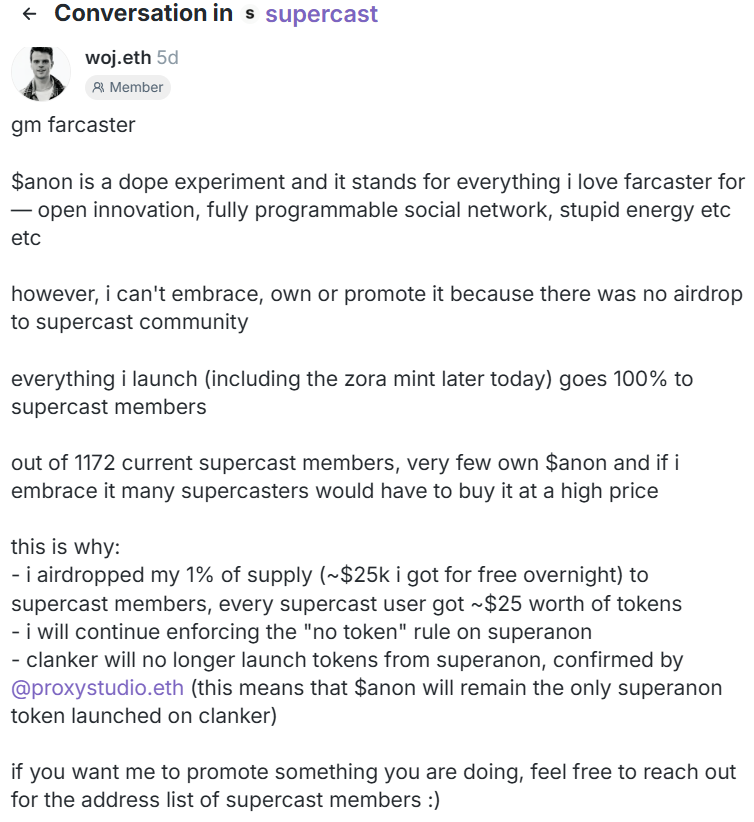
This act of genuine crypto ethos earned massive praise from the community. Combined with $ANON’s compelling narrative—“zk-powered anonymity + AI minting”—the market embraced its highly decentralized origin story. Within less than a day, $ANON reached a peak market cap of $4.5 million.
The community doubled down: holders of $ANON on Farcaster voluntarily sent over 13 million tokens—worth more than $40,000—to the developer, requesting they be redistributed back to Supercast users.
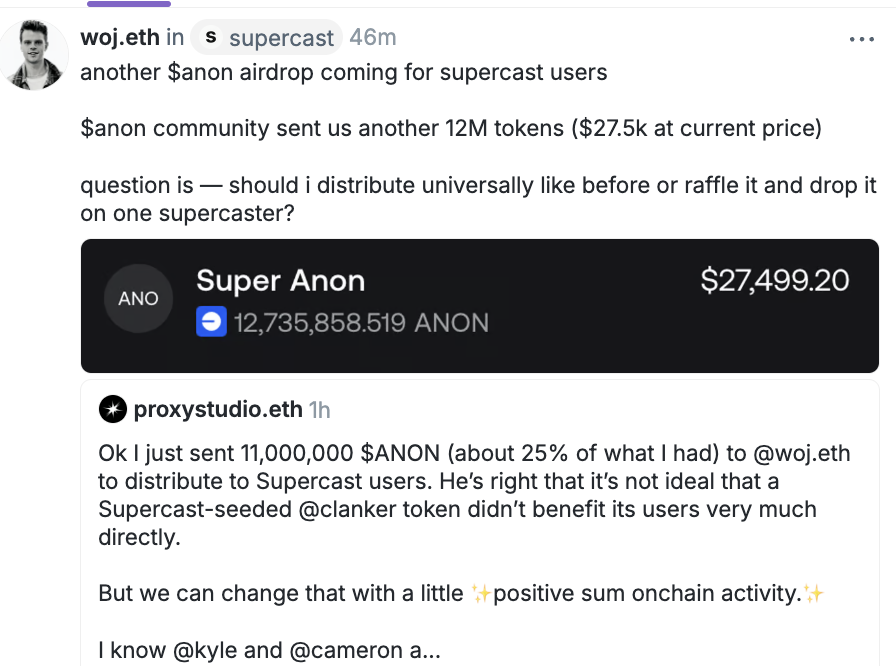
The Uppercase vs Lowercase Drama Returns?
However, not long after the uppercase $ANON hype peaked, woj posted on Warpcast announcing plans to replace the Superanon “?” icon with a cute dog illustration. This image would be minted as an NFT on Zora and airdropped to Supercast members, and could later be converted into a lowercase version: $anon. He emphasized multiple disclaimers such as “currently only collectible” and “purely coincidental, unrelated to uppercase $ANON”—clear attempts to shield himself from accusations.
In other words, the very person who elevated uppercase $ANON through principled action the day before then introduced a competing lowercase $anon the next day...
Luckily, this case of “uppercase vs lowercase” confusion didn’t escalate like past dramas involving $Neiro or $eliza. Or perhaps more accurately, lowercase $anon simply stands no chance against the momentum of uppercase $ANON. At the time of writing, uppercase $ANON hovers near a $20 million market cap, while lowercase $anon remains around $300,000. Still, woj clearly favors the little dog design behind $anon.
Diversification Begins in the “ANON” Application Layer
With strong narrative and growing consensus, $ANON already has traction—even if woj himself isn’t actively pushing further utility. But the community is moving forward independently.
X user @0xLuo created a classification map of the current “ANON” ecosystem, offering a clear visual breakdown of how these projects are evolving.
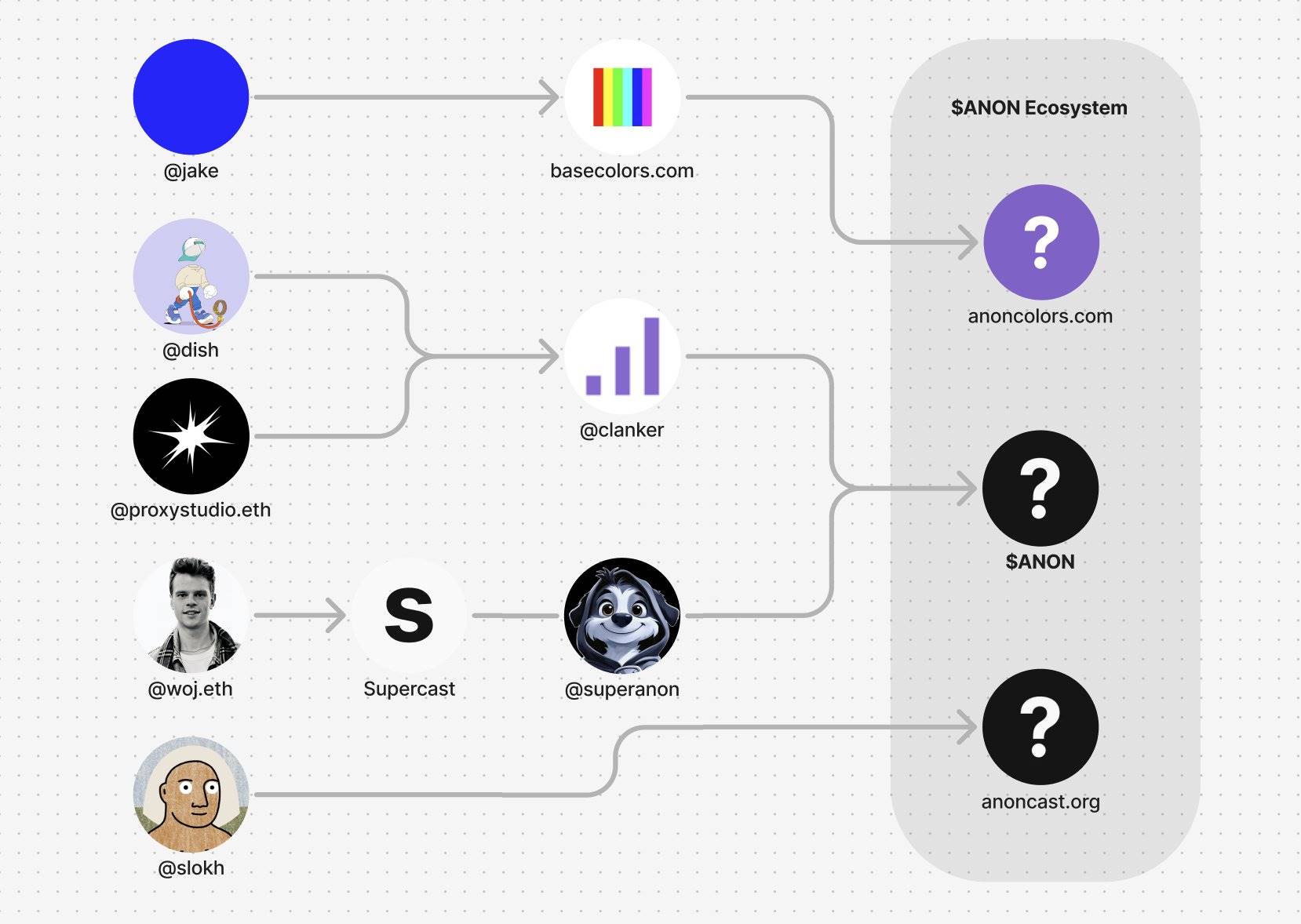
Developers have begun building new applications based on $ANON, including anoncast—a zk-powered anonymous posting platform similar to Superanon but exclusive to $ANON holders—and Base Colors, an NFT art project.
anoncast
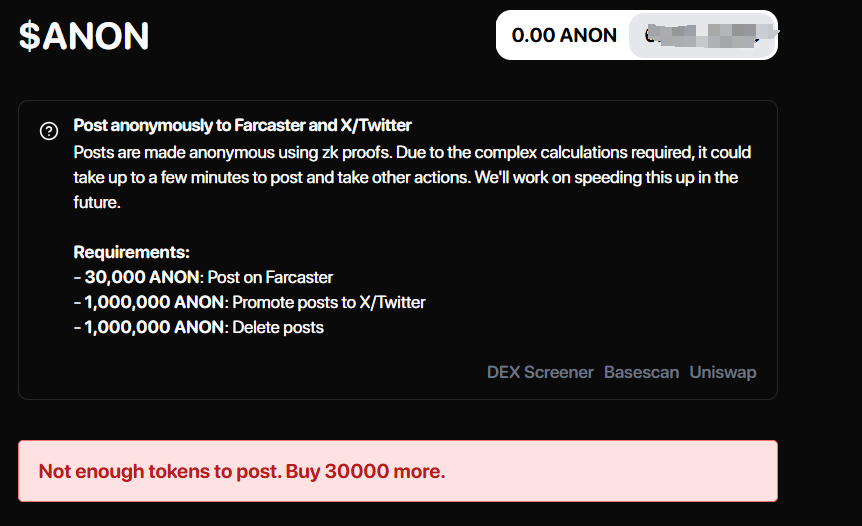
anoncast inherits Superanon’s core functionality—anonymous posting—but adds a twist: users must hold a certain amount of uppercase $ANON in their wallet to access different tiers of functionality.
The basic posting feature requires holding 30,000 $ANON tokens (currently valued at ~$450). More advanced functions—such as promoting posts to X/Twitter or deleting published content—require holding 1 million $ANON tokens (~$16,000).
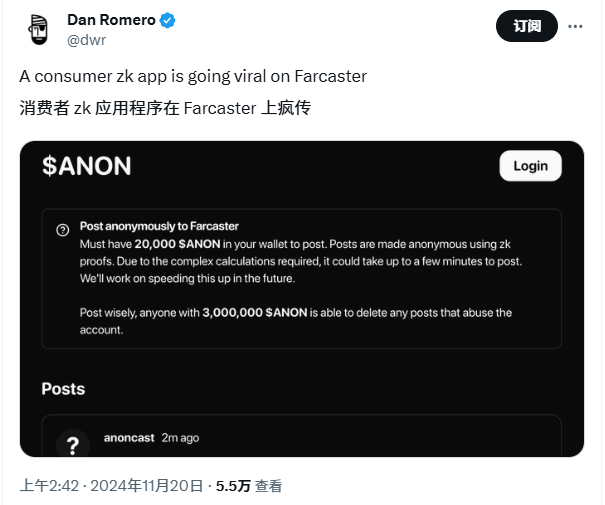
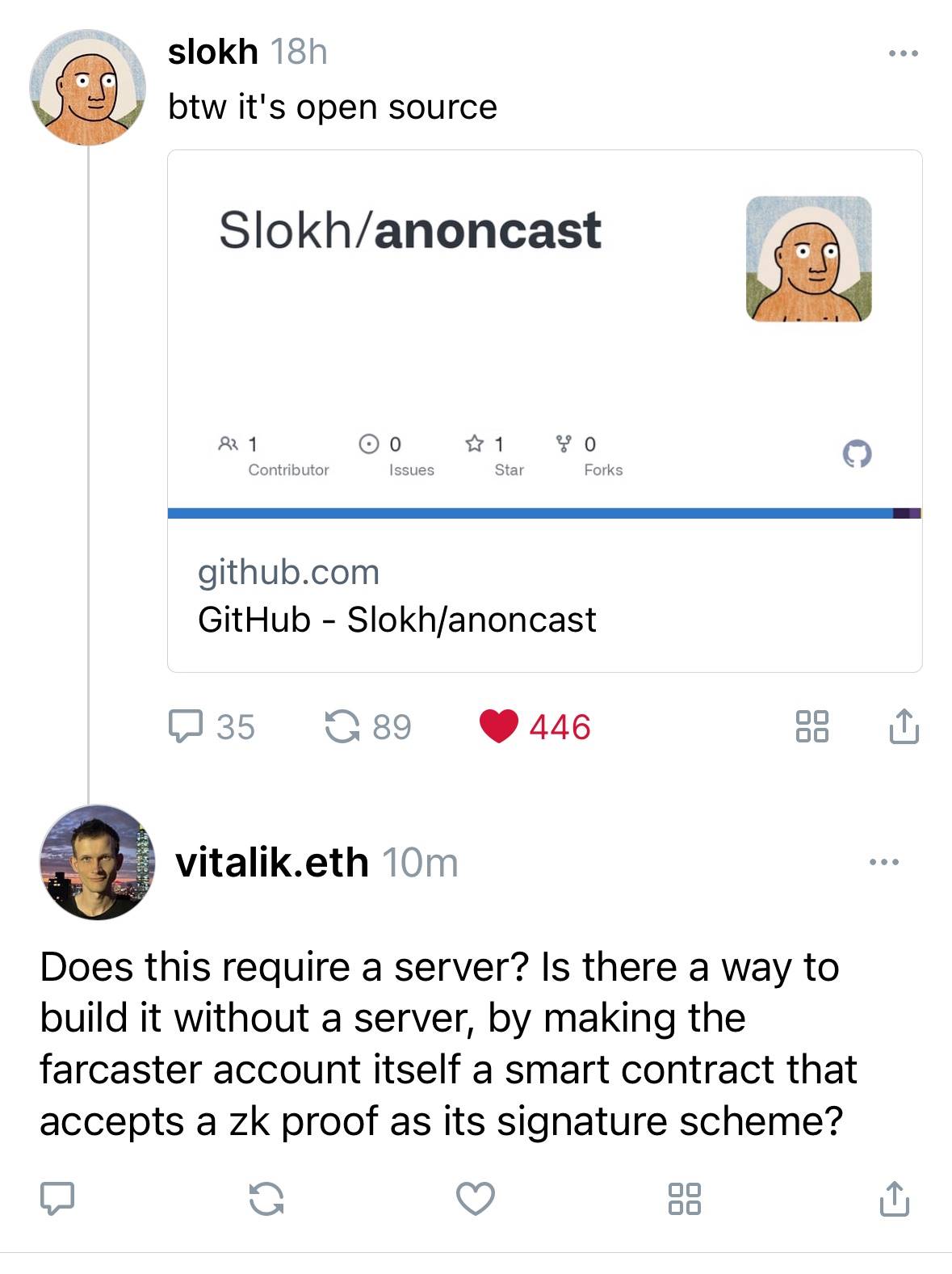
Crypto influencers have taken notice. Dan Romero (@dwr), co-founder of Farcaster, has repeatedly tweeted and retweeted content about anoncast. Vitalik Buterin engaged in technical discussions with anoncast’s developer @Slokh directly on Warpcast.
Base Colors
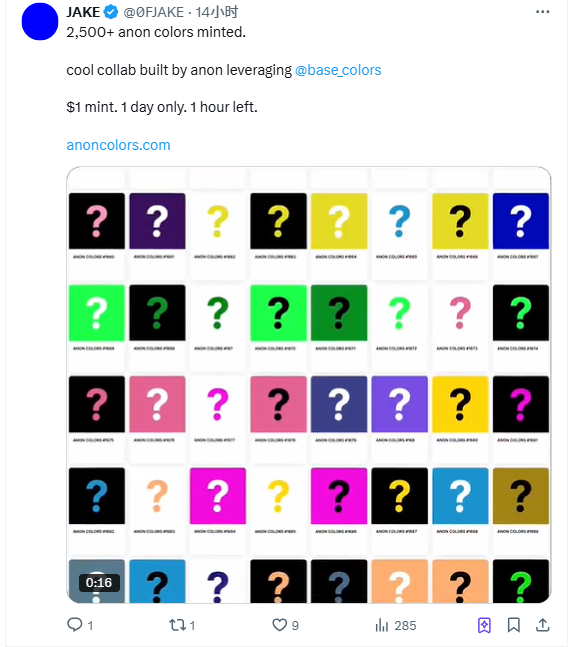
Base Colors is an NFT collection representing unique internet colors. Each color is one-of-a-kind and can be named by its owner on-chain. No two people can own the same color, and no two colors can share the same name.
Developer @0FJAKE argues that unique colors help establish digital identity under anonymity—essentially allowing someone to prove “you are you” without revealing personal information.
Conclusion
From $Degen to $ANON, the viral “product tokens” emerging from the Farcaster ecosystem appear to be taking a remarkably grounded and sustainable path—one where tokens genuinely revolve around community and user participation.
Naturally, speculative actors will always enter along the way, driven purely by short-term profit motives. Yet even this isn’t entirely negative: rising prices draw outside attention, exposing broader audiences to the underlying project and potentially converting casual observers into long-term contributors.
The true value of tokens like $Degen and $ANON lies not in short-term market fluctuations, but in their potential to cultivate self-organizing, self-evolving ecosystems. These systems adapt continuously to user needs and evolve organically through community input—ultimately transforming from mere meme-driven speculation into functional, utility-bearing tokens.
Join TechFlow official community to stay tuned
Telegram:https://t.me/TechFlowDaily
X (Twitter):https://x.com/TechFlowPost
X (Twitter) EN:https://x.com/BlockFlow_News
 深潮TechFlow


