Base's token launch expected soon, what does Zora's new live streaming feature signify?
TechFlow Selected TechFlow Selected
Base's token launch expected soon, what does Zora's new live streaming feature signify?
Zora provides users with easy-to-use and nearly barrier-free token issuance tools.
 Navigating Web3 tides with focused insights
By Umbrella, TechFlow
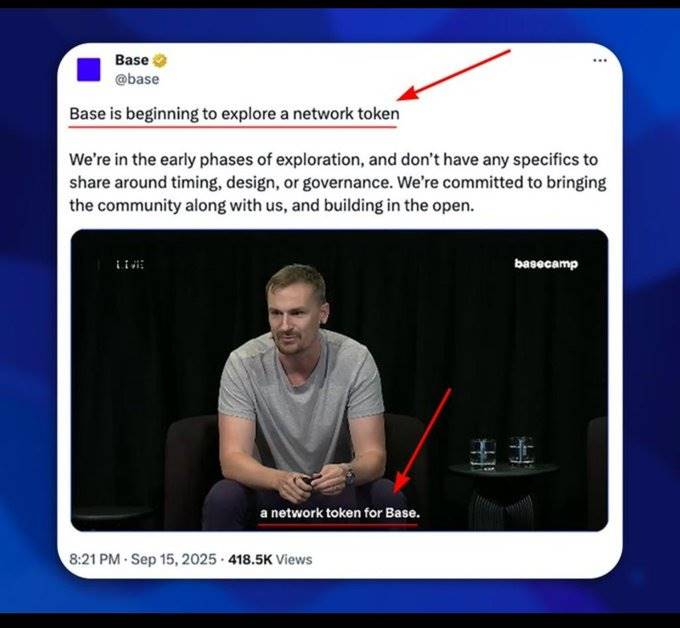
On September 15, 2025, Base founder Jesse Pollak announced that the team is exploring a native token for Base, sparking widespread attention and discussion in the crypto market.
As the flagship L2 of Coinbase, the largest cryptocurrency exchange in the United States, Base has a TVL of approximately $7.2 billion. Additionally, thanks to numerous SocialFi products within its ecosystem, Base leads all L2s with nearly 700,000 daily active addresses on-chain.
This series of metrics has led the market to hold high expectations for Base issuing a token. Moreover, the recent rebranding of Coinbase Wallet to Base App, along with major product updates introducing social and payment features, seems to foreshadow the imminent arrival of a native Base token.
Related reading: From Coinbase Wallet to Base App: Understanding the Opportunities and Transformation of a Web3 Super App
The current market believes Base will most likely complete its TGE in Q4 this year, potentially distributing airdrop allocations based on user interaction records with top projects within the Base ecosystem.
Such speculation has turned leading applications within the Base ecosystem into scarce assets, with many users now turning their attention to Zora.
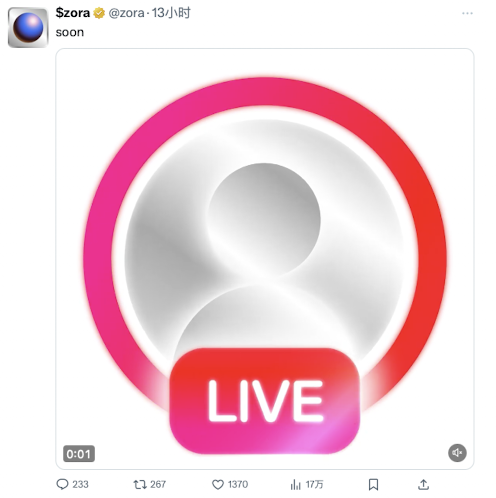
As a leading application within the Base ecosystem, Zora has performed exceptionally well over the past two weeks. On October 14, it announced plans to launch a live streaming feature on its platform, seemingly preparing thoroughly for what’s coming next—the “big thing.”
The traditional "content-as-token" narrative of crypto creator economy platforms is gradually losing its appeal to meme players. Compared to text and images, live streaming offers richer content and stronger FOMO across multiple dimensions. It's foreseeable that a large number of “talented” creators will launch even more narratively compelling memes through Zora’s live streaming feature.
Zora: From NFT Platform to Creator Economy Infrastructure
Zora was founded in 2020 and received early backing from Coinbase’s venture fund. Through three rounds of fundraising, it raised a total of $60 million.
Zora launched during the peak of the NFT narrative and quickly captured over 50% of the NFT market share on Base. This year, Zora completed a transformation—from an NFT platform to a leading content platform within the Base ecosystem—establishing a natural advantage in any potential Base token distribution.
In April 2025, the $Zora token launched with a total supply of 10 billion, 50% of which was allocated to the community. At that time, however, the market was heavily focused on various memes on Solana, leaving little attention for Zora.
The turning point came in July when Zora rolled out a major update, enabling mass issuance of creator tokens and meme coins via integration with Base. This move officially shifted Zora from an NFT marketplace to a leading meme launchpad, making it one of the hottest applications in the Base ecosystem overnight.
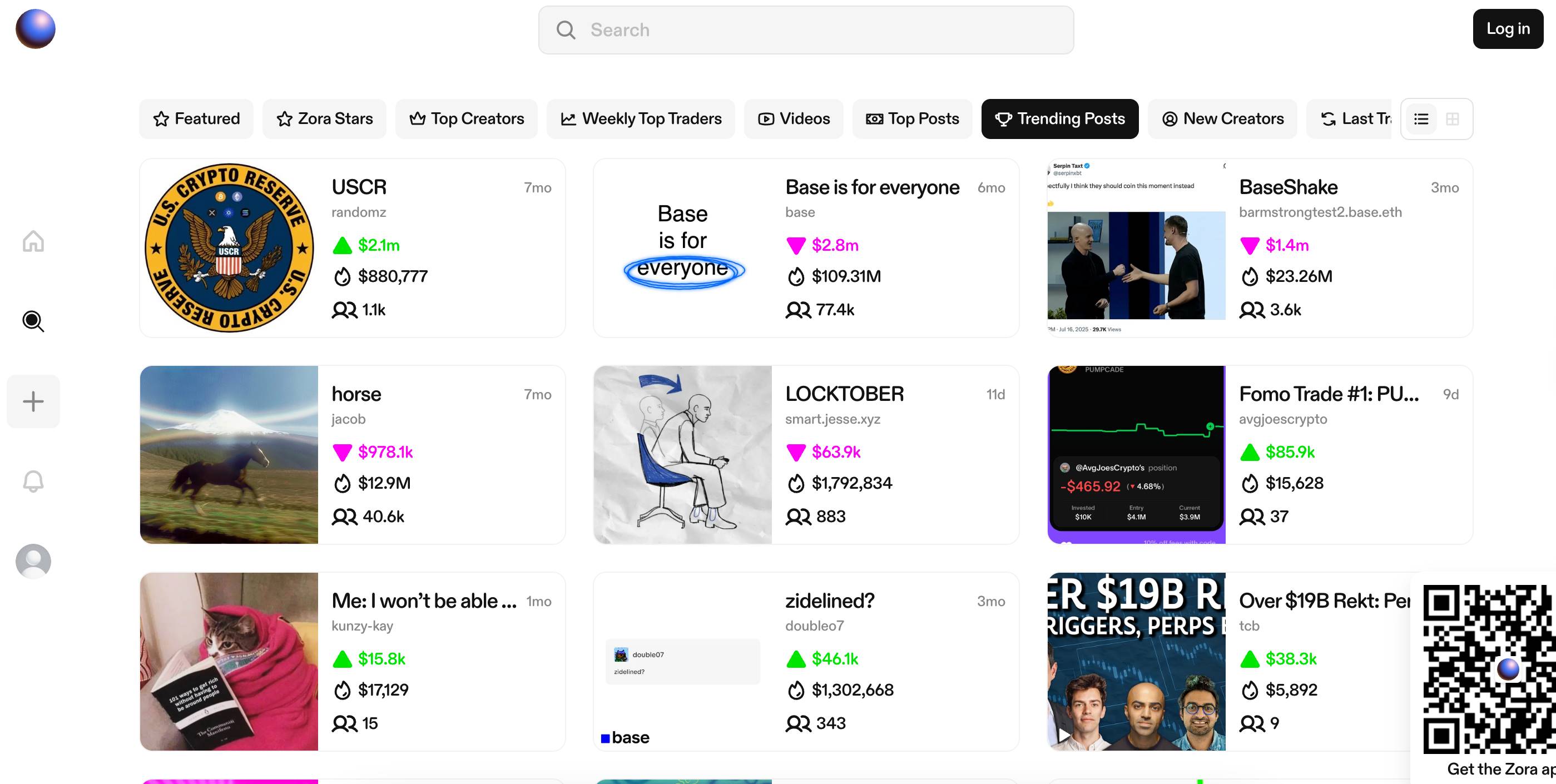
Compared to established platforms like Pump.Fun, Zora—a later entrant—learned extensively from its predecessors and introduced numerous innovative mechanisms.
In terms of token types, Zora not only supports content-specific tokens but also introduced “creator coins,” one per creator profile, allowing creators to earn additional rewards based on market recognition for producing high-quality content.
A more fundamental innovation lies in Zora’s revenue distribution model. Platform trading fees have been reduced from an initial 3% to 1%, with 50% distributed directly to creators, 20% permanently locked to increase pool depth, 20% rewarded to developers/platforms that refer creators, 4% allocated as incentives for specific transaction addresses, and 5% directed to the platform treasury.
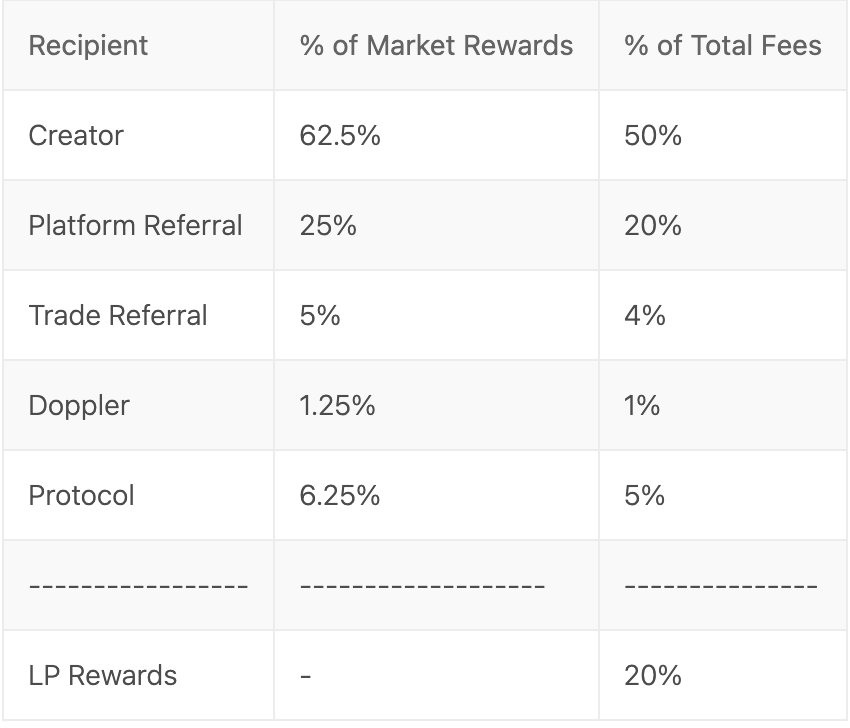
This distribution mechanism is tightly integrated with the $Zora token—all rewards are paid in $Zora, and all revenue flowing into the platform treasury will be used for market buybacks to support price stability.
Overall, Zora provides users with an easy-to-use, nearly barrier-free token issuance tool, allowing any content creator to deploy tokens with one click, while enabling creators to earn ongoing revenue from secondary market trading rather than relying solely on one-time sales.
Data shows that Zora generated over $460 million in trading volume in July alone—nearly ten times its historical NFT trading volume. It issued over 1.6 million creator tokens, surpassing competitors like Pump.fun during the same period and becoming one of the most active meme launchpads in the Base ecosystem.
The most direct reflection of this transformation was seen in the price of $Zora. According to Coingecko data, the token surged from around $0.012 to approximately $0.09 within just ten days—a nearly 800% increase.
Recent Performance and Analysis
Over the past month, Zora has demonstrated strong competitiveness in both price resilience and product iteration.
Following the bullish trends in July and August, $Zora’s price dropped back to around $0.05 in September as the creator economy narrative cooled and the broader crypto market declined.
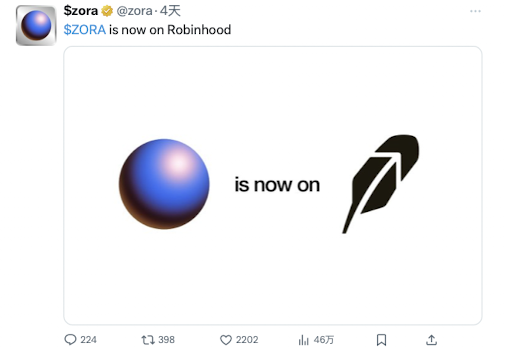
On October 10, Zora announced its listing on Robinhood—the first Base ecosystem token to do so. On the day of listing, $Zora’s price surged about 70% from $0.05 to $0.085, while its 24-hour trading volume skyrocketed by approximately 780% to $569 million. This brought massive liquidity improvements. Furthermore, the Robinhood listing marked mainstream recognition of Zora’s value and growing interest in the development of the Base ecosystem.
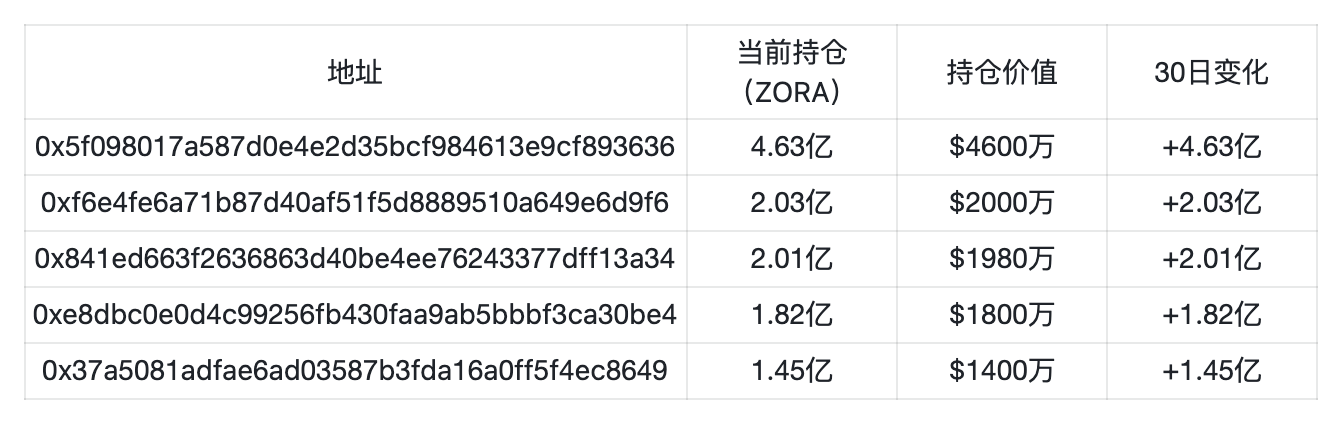
Meanwhile, between September and October, $Zora’s holder structure underwent significant changes. On-chain data reveals substantial whale accumulation or增持 of $Zora over the past 30 days, particularly during the broader market downturn in September when large holders continued buying against the trend. This shift in holdings suggests growing institutional-level recognition of Zora’s long-term value.
Shortly after the Robinhood listing came the black swan event on October 11—Trump’s announcement of increased tariffs on China—which triggered one of the largest market crashes in crypto history. $Zora’s performance during this event further drew market attention.
Data shows that on October 11, $Zora briefly dropped from a high of $0.12 to $0.05 but, unlike most other assets with weak rebounds, recovered back to around $0.10 within just one day—achieving nearly a 50% single-day gain and emerging as one of the few assets to complete a rapid “post-disaster recovery.”
During this black swan event, $Zora’s strong resilience prompted many investors to add it to their watchlists. On October 15, $Zora once again showed strength, rebounding from $0.08 back to around $0.10.
From an ecosystem perspective, Zora currently dominates the creator economy sector on Base, hosting over 90% of all meme coins on the network. These impressive figures strongly support market speculation that Zora could receive a significant weight in any future Base token distribution.
Also in October, Zora reduced its transaction fee from 3% to 1%, with 50% of the revenue directly returned to creators. While this profit sacrifice may impact protocol income in the short term, it benefits long-term user engagement and expansion. The strategic generosity has also improved Zora’s public perception.
Recently, Zora has shown clear signs of strategic acceleration. On October 14, Zora tweeted a preview of its upcoming live streaming feature—immediately drawing comparisons to Pump.Fun’s recent launch of live streaming, which generated numerous breakout events and meme coins in a short time.
While Zora has not yet released detailed information about the new feature, we can reasonably predict its potential impact based on the existing content token mechanics on the platform.
For example, users might spend $Zora to tip streamers instantly; streamers could use $Zora to mint NFTs for their fanbase as exclusive membership badges. Additionally, users might spend $Zora to unlock premium paid streams or gain special live-stream privileges.
All these possibilities would provide clear upward momentum for $Zora, showcasing a model more aligned with sustainable growth and long-term token value compared to Pump.Fun.
Potential Risks
Despite numerous positive developments, risks behind Zora’s growth cannot be ignored.
The primary issue is insufficient liquidity for most creator tokens on Zora. Currently, CoinGecko tracks only nine tokens with meaningful market caps, totaling just $18 million. Compared to popular meme launchpads on BSC and SOL, where individual meme tokens often reach tens of millions in market cap, Zora still has considerable catching up to do.
Furthermore, if recent market volatility leads to a broader decline in sentiment, widespread liquidity drying-up is highly possible.
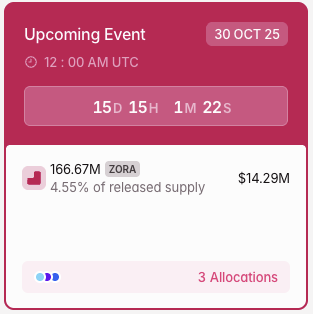
A more immediate investment risk comes from token unlocks: on October 30, 160 million Zora tokens will unlock, representing 4.55% of the total supply, which could create significant selling pressure in the short term.
Additionally, the upcoming live streaming feature may prove to be a double-edged sword. Pump.Fun serves as a prime example—while its live streaming initially attracted massive attention and popular tokens like $BUN and $BackWork, poor content moderation later sparked controversy, and the eventual collapse of trending tokens caused heavy losses for many investors.
However, unlike Pump.Fun’s historically “wild” development path and inexperienced young team, Zora benefits from the more mature and “stable” Base ecosystem. Its demonstrated operational capability has somewhat alleviated similar concerns. With over 2.9 million users, Zora has ample resources for promoting its live streaming feature and may deliver a fresh take on the fusion of crypto and live streaming.
Capturing the Window of Base Token Expectations
Zora offers a clear pathway for participating in Base token airdrop expectations. Its central role in the Base ecosystem, robust growth metrics, and proven price resilience indicate it is a noteworthy asset.
With a current FDV of $850 million, Zora still has reasonable room for appreciation relative to its ecosystem standing and growth potential. Especially under the catalytic effect of Base token expectations, its value as a top-tier ecosystem app could be further amplified.
However, near-term market uncertainty and the upcoming large token unlock pose headwinds. Investors should monitor recent market dynamics and post-unlock price action before deciding whether to include $Zora in their portfolios.
Expectations around a Base token launch are drawing closer. Amid intensifying L2 competition, launching a native token is almost inevitable for Base. In this context, Zora’s position makes it a critical project for anyone aiming to capture potential Base airdrops.
The opportunity is right in front of us—it all comes down to accurately timing and navigating the rhythm.
Join TechFlow official community to stay tuned
Telegram:https://t.me/TechFlowDaily
X (Twitter):https://x.com/TechFlowPost
X (Twitter) EN:https://x.com/BlockFlow_News
 深潮TechFlow