The Power Behind Holdings: A Look into Bitcoin's Institutionalization
TechFlow Selected TechFlow Selected
The Power Behind Holdings: A Look into Bitcoin's Institutionalization
ETFs become the dominant force in the market.
 Navigating Web3 tides with focused insights
By Chandler, Foresight News
As Bitcoin's price continues to rise, its appeal is gradually shifting from retail investors to large institutions with substantial capital and resources. Unlike the previous bull market, where ecosystem prosperity and institutional entry served as core drivers of price surges, in this cycle, deep institutional positioning has become a key variable shaping market development. From the successful approval of spot ETFs to frequent accumulation by traditional financial giants and professional asset managers, institutionalization is reshaping the Bitcoin market landscape.
During this process, the investment rationale for Bitcoin is quietly evolving—from being viewed purely as a speculative asset chasing price volatility, it is increasingly becoming a long-term portfolio tool valued for diversification and inflation hedging. Meanwhile, changes in institutional holdings and profitability have drawn significant market attention: Who is consistently increasing their Bitcoin positions? Which institutions have already realized substantial returns from this rally? And have shifts in holding sizes significantly impacted market prices? This article focuses on several leading institutional holders.
Institutional Bitcoin Holdings Overview: ETFs Emerge as Market Leaders
According to data from BitcoinTreasuries.com, as of November 18, 2024, 92 entities—including companies and nations—publicly hold nearly 2.718 million Bitcoins, accounting for 12.94% of Bitcoin’s total supply. As Bitcoin becomes increasingly recognized as “digital gold,” institutional investments reflect not just reactions to price movements but also long-term strategies for asset diversification and inflation hedging.
Overview of Institutional Bitcoin Holdings:
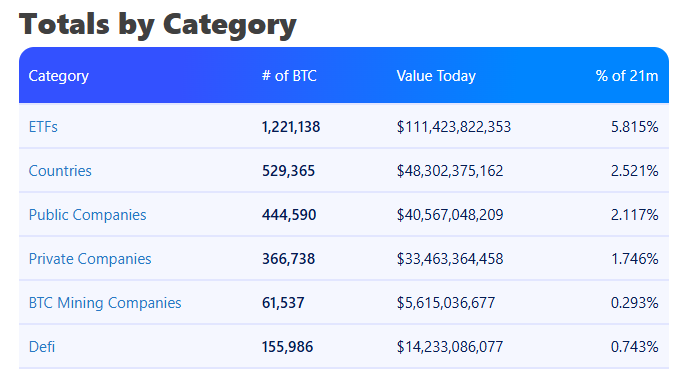
Notably, Bitcoin ETFs now account for 5.82% of Bitcoin’s total supply. Since the launch of U.S. Bitcoin spot ETFs in January 2024, traditional institutions have accelerated their acquisition of Bitcoin market share.
The ETF Race: BlackRock Leads While Grayscale Shifts Toward Diversification
Bitcoin ETFs offer investors convenient exposure to Bitcoin, particularly U.S. spot Bitcoin ETFs, which have attracted widespread attention as new market instruments. Since its launch in 2021, ProShares’ Bitcoin futures ETF saw some inflows but exhibited significant divergence from spot Bitcoin prices due to futures market volatility. In January 2024, the official approval of the first U.S. spot Bitcoin ETF marked a new phase in Bitcoin investing.
With the introduction of spot Bitcoin ETFs, institutional participation has intensified, especially among top-tier players whose holdings stand out.
Top 10 Bitcoin ETF Holders:
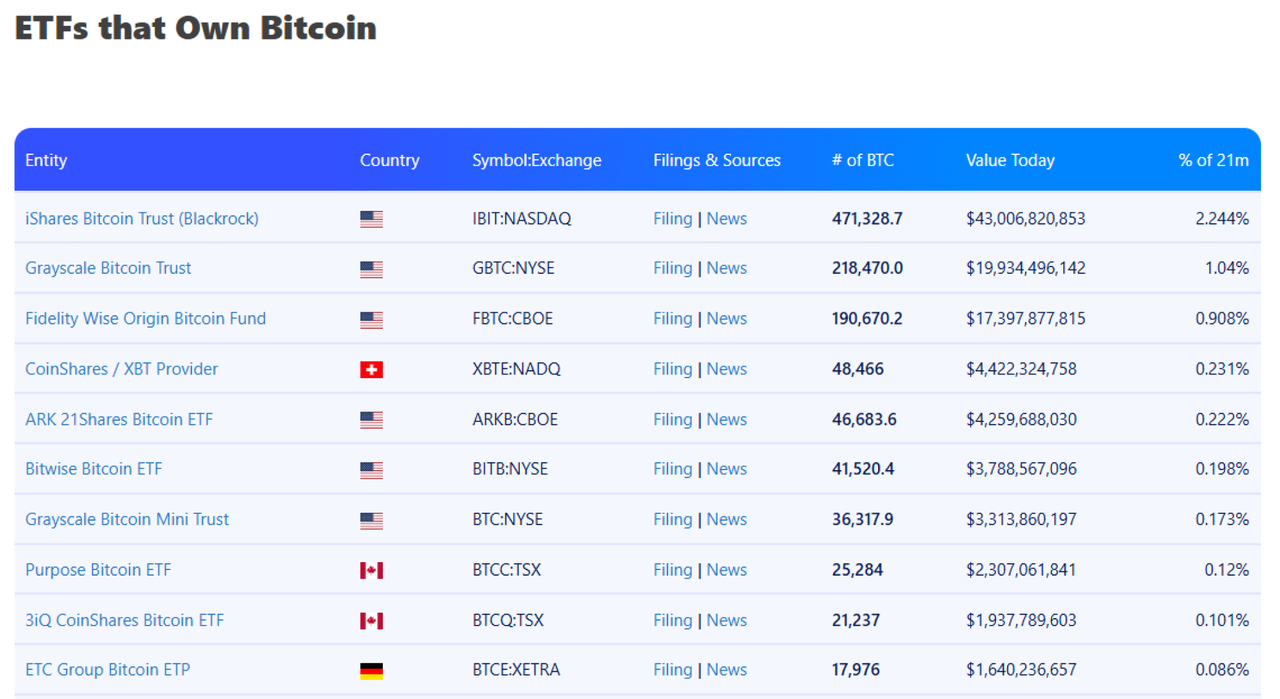
BlackRock’s iShares Bitcoin Trust (IBIT: NASDAQ) leads the Bitcoin ETF rankings. Since beginning Bitcoin purchases on January 11, 2024, the trust has continuously increased its holdings. By November 2024, it held 471,000 Bitcoins, with a market value exceeding $4.3 billion, representing 2.24% of Bitcoin’s total supply.
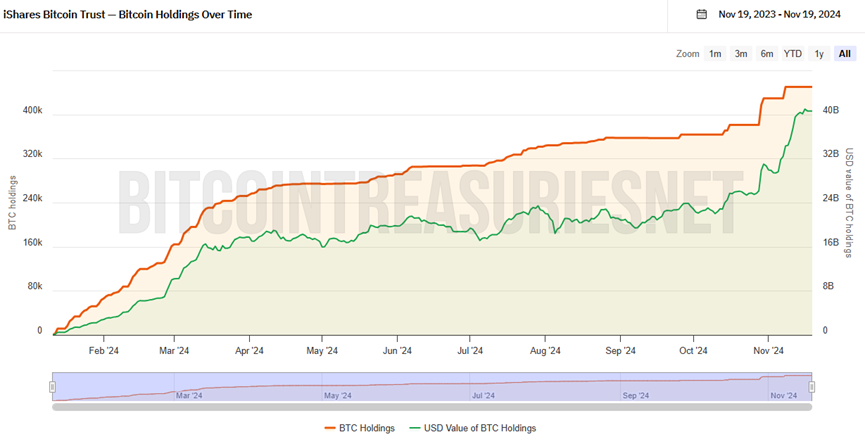
Based on iShares' purchase history, BlackRock added over 1,400 BTC in October 2024 and more than 2,500 BTC in November alone, accumulating nearly 15,000 BTC within months. With Bitcoin priced around $30,000 at the start of 2024, BlackRock’s average acquisition cost was approximately $30,000 per BTC. At current prices nearing $91,000, BlackRock’s holdings have nearly doubled in value, generating cumulative gains of about $2.1 billion.
Beyond Bitcoin, BlackRock continues expanding its digital asset footprint. In March 2024, it partnered with Securitize to launch BUIDL, a tokenized fund, enhancing its influence in Web3. Additionally, BlackRock is actively pushing for an Ethereum ETF, further solidifying its strategic position in digital asset investing.
Grayscale, a veteran player in crypto asset management, has taken a different approach compared to BlackRock’s aggressive accumulation. Over the past year, Grayscale has steadily reduced its Bitcoin holdings from a peak of 654,600 BTC down to 218,400 BTC.
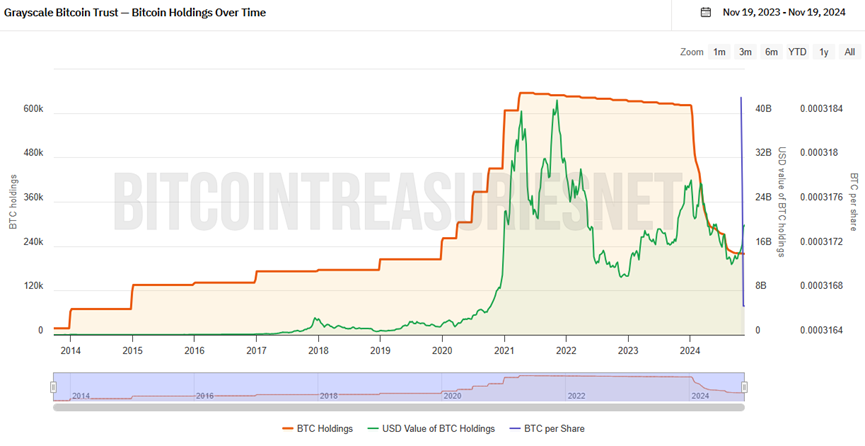
For Grayscale, deeply experienced in digital assets, diversified crypto portfolios may offer greater profit potential. Over the past year, Grayscale has notably adjusted its strategy, accelerating diversification across various crypto assets. It currently manages 14 crypto asset trusts including Bitcoin, covering Ethereum (ETH), Litecoin (LTC), Bitcoin Cash (BCH), and other cryptocurrencies. Furthermore, Grayscale has launched three thematic funds focusing on DeFi (decentralized finance), smart contract platforms, and emerging crypto assets.
While institutional activity remains largely concentrated overseas, Asia is also gaining traction. According to SoSoValue, Hong Kong had launched six spot Bitcoin ETFs by November 2024—including Bosera and CSOP Bitcoin ETFs—with total assets under management reaching $428 million.
Public Company Holdings: MicroStrategy Takes Clear Lead
Although public companies hold far less Bitcoin than dedicated asset managers, analyzing them reveals diverse applications and strategic values of Bitcoin within corporate frameworks.
MicroStrategy leads by a wide margin with 331,200 BTC, accounting for 1.58% of the global total, setting a benchmark for corporate Bitcoin reserves. North American Bitcoin miners Marathon Digital, Riot Platforms, Hut 8, and CleanSpark focus on efficient and environmentally friendly mining operations, with Marathon holding 25,945 BTC—the largest among mining firms. Crypto trading and service providers such as Coinbase and Galaxy Digital hold 9,000 and 8,100 BTC respectively. Germany’s Bitcoin Group, holding 3,830 BTC, stands as a key European participant.
Top 10 Public Company Holders:
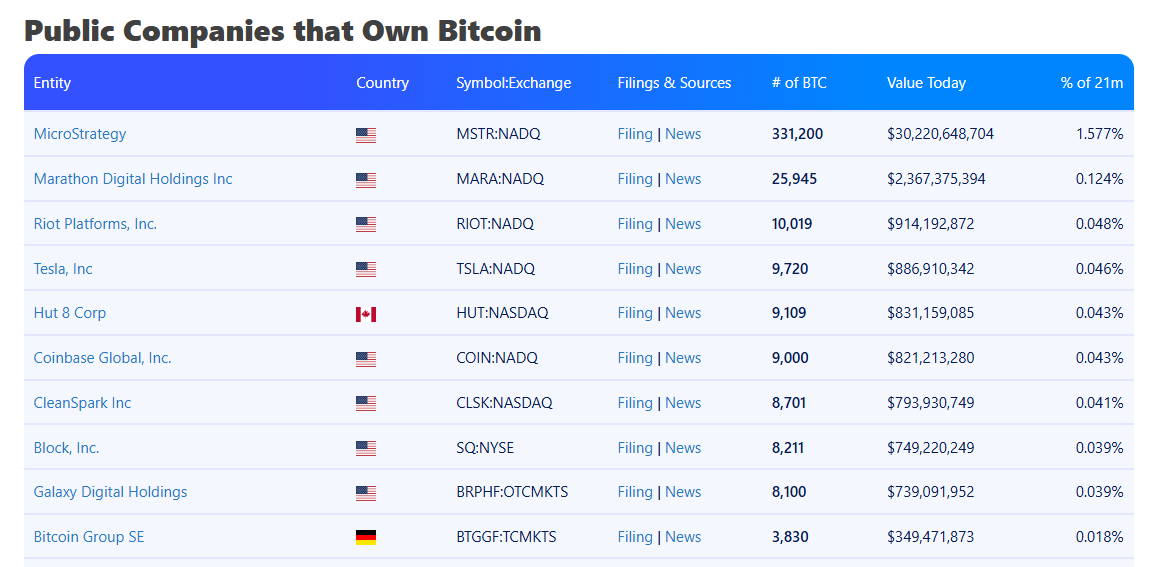
MicroStrategy (MSTR), originally a global business intelligence (BI) software company, now resembles a "Bitcoin pi xiu"—a mythical creature said to only take in but never release wealth. In August 2020, MicroStrategy announced the purchase of 21,454 BTC for $250 million, becoming the first publicly traded company to adopt a Bitcoin treasury strategy.
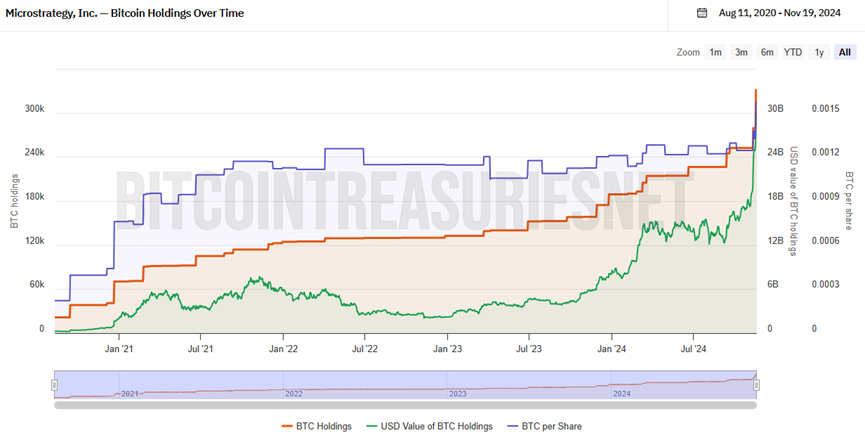
On November 19, MicroStrategy announced plans to issue $1.75 billion in 0% convertible notes, with initial purchasers granted an option to buy up to an additional $250 million within three days of issuance. The company stated it intends to use net proceeds to acquire more Bitcoin and for general corporate purposes.
According to disclosures, MicroStrategy used proceeds from stock sales to purchase another 51,780 BTC for $4.6 billion between November 11 and 17, 2024, at an average price of $88,627 per BTC. As of November 18, 2024, MicroStrategy’s total Bitcoin holdings reached 331,200 BTC, with an average acquisition cost of $49,874. Based on current market prices, the company’s Bitcoin investment has yielded a profit of 82.85%.
Besides standout holders like MicroStrategy and mining firms that accumulate Bitcoin through operations, most other public companies remain cautious, treating Bitcoin primarily as part of a diversified asset allocation.
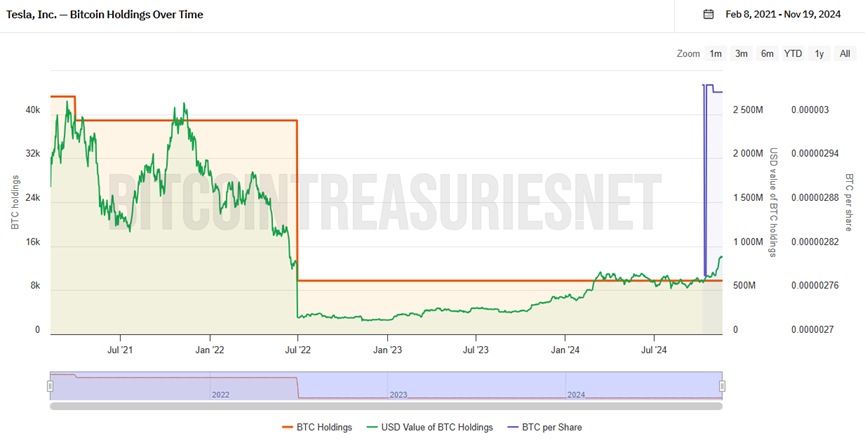
Elon Musk, founder and CEO of Tesla, has long been a focal figure in the crypto space. In February 2021, Tesla made headlines by announcing a $1.5 billion investment in Bitcoin and plans to accept Bitcoin payments. However, due to environmental concerns, Tesla suspended Bitcoin payments in May of that year. Still, the company did not fully divest—selling only 4,320 BTC in March 2021 and another 29,160 BTC in June 2022—after which holdings remained unchanged.
As of November 18, 2024, Tesla still holds 9,720 BTC, with a current market value of approximately $914 million.
Institutionalization Reinforces Long-Term Recognition of Bitcoin’s Value
Overall, institutional confidence in Bitcoin as a long-term asset is becoming increasingly evident. As major players like BlackRock and Grayscale continue accumulating Bitcoin and broadening their digital asset strategies—including expansions into Web3 and Ethereum—Bitcoin is poised to secure a stronger role in global asset allocation.
While the concentration of Bitcoin holdings may pose certain challenges to its decentralization, this trend is not necessarily negative. On the contrary, the growing involvement of large institutions and enterprises could enhance recognition and support for Bitcoin, reinforcing its significance within the global financial system.
On one hand, participation from major financial institutions brings greater trust and stability to the Bitcoin market. Their deep engagement signals strong belief in Bitcoin’s long-term value, boosting global acceptance and adoption. This trend provides robust support for Bitcoin’s price, increases market liquidity, and attracts more investors. On the other hand, despite rising concentration in holdings, Bitcoin’s decentralized network structure remains resilient. Countless distributed nodes worldwide ensure the independence and risk resistance of the Bitcoin network. Institutional participation can drive technological advancement and improve network security, further cementing Bitcoin’s status as digital gold.
Moreover, from an industry development perspective, deeper institutional involvement helps establish Bitcoin as a legitimate investment vehicle, promoting market maturity and stability. This shift may encourage more constructive regulatory approaches, creating favorable conditions for compliance and legitimacy in the digital asset sector, steering the entire industry toward more sustainable growth.
Join TechFlow official community to stay tuned
Telegram:https://t.me/TechFlowDaily
X (Twitter):https://x.com/TechFlowPost
X (Twitter) EN:https://x.com/BlockFlow_News
 Foresight News