Interview with Solana Co-founder: Execution is the Only Moat, Commercialization is the Key to Success
TechFlow Selected TechFlow Selected
Interview with Solana Co-founder: Execution is the Only Moat, Commercialization is the Key to Success
Solana's advantage lies in its multiple validators that can simultaneously submit transactions globally.
 Navigating Web3 tides with focused insights
Compiled & Translated: TechFlow
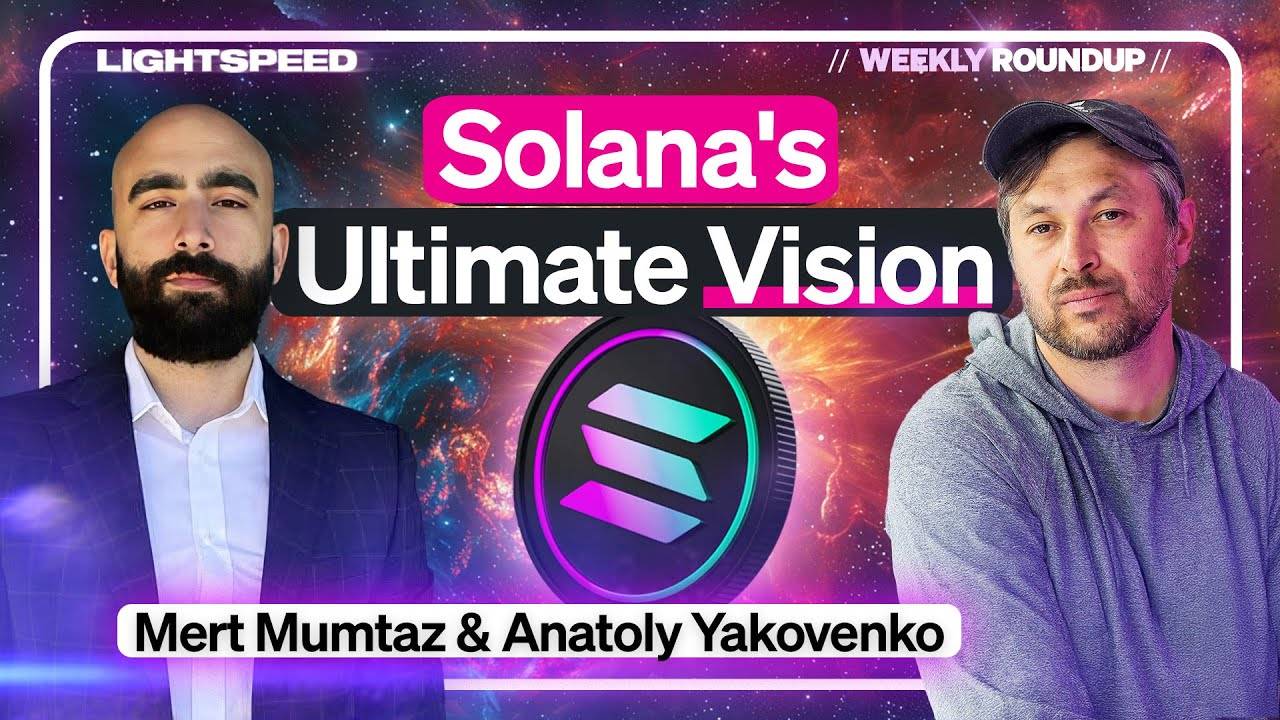
Guest: Anatoly Yakovenko, Co-founder of Solana
Host: Mert Mumtaz, CEO of Helius
Podcast Source: Lightspeed
Original Title: What's Next For Solana | Anatoly Yakovenko
Release Date: November 9, 2024
Background
This week, we welcome Anatoly Yakovenko, co-founder of Solana Labs. We dive deep into topics including Solana’s transaction fees, how to stay competitive in crypto, SOL inflation, competition with Apple and Google, and whether Solana has a moat. Enjoy!
Front-Running on Solana
-
Mert engages in an in-depth conversation with Anatoly Yakovenko, co-founder of Solana Labs, discussing challenges in transaction processing on the Solana network, particularly front-running. Anatoly explains the original vision behind Solana and the current realities.
Solana’s Vision and Current Challenges
-
Anatoly mentions that one reason he founded Solana was due to frequent front-running in traditional markets. He aimed to achieve global information synchronization via Solana—maximizing competition and minimizing arbitrage. However, in reality, front-running remains widespread, and often users pay priority fees exceeding even Solana’s own priority fee structure.
Solutions and Future Outlook
-
Anatoly believes users can set up their own validators and submit transactions—a capability impossible in traditional markets. While this functionality exists, he notes that the difficulty of setting up validators and market immaturity prevent most from leveraging this advantage. The future solution lies in increasing bandwidth, reducing latency, and optimizing the network to eliminate unfair bottlenecks.
Market Dynamics and Competition
-
He further explains that current market dynamics favor users with more stake, creating a "rich-get-richer" phenomenon in transaction prioritization. Anatoly argues that improving performance and lowering entry barriers for honest participants will shift market dynamics toward fairer competition, ultimately achieving ideal market equilibrium.
-
Anatoly emphasizes that the key difference between Solana and Ethereum is that solving these issues is primarily an engineering challenge. He firmly believes that through continuous optimization—increasing the number of leaders per second and block sizes—Solana will realize its original vision of a fair and efficient transaction environment.
Solana’s Fee Market
Status Quo of the Fee Market
-
In this section, Mert raises questions about Solana’s fee market, especially why Jito tips exceed priority fees.
-
Anatoly explains this is mainly due to suboptimal implementation of transaction processing, especially under high load, where the fee market performs far below expectations.
Transaction Processing and Performance Bottlenecks
-
Anatoly points out that during low-load periods, Solana processes transactions smoothly, with confirmation times under one second. But when transaction volume increases, queues congest, preventing effective prioritization and disrupting local fee market operations. These are engineering challenges requiring pipeline optimization.
Comparison with Other Solutions
-
Mert notes that certain Layer 2 solutions seem to avoid similar issues,
-
Anatoly counters that even L2s with centralized sequencers face similar priority problems. While they may iterate faster, fundamental issues remain. Even in L2 environments, competition among multiple applications leads to fee market congestion.
Future Solutions
-
Anatoly believes solving these issues isn’t just about architectural differences but requires continuous optimization of existing systems. Though L2s may perform well in some cases, when multiple markets coexist, they face similar challenges. Therefore, Solana must continue investing in engineering to improve transaction processing.
Massive Composability
-
Mert asks how Solana competes with purpose-built chains like Atlas, which optimizes performance for DeFi without worrying about consensus or shared blockspace overhead.
Challenges in Simplified Optimization
-
Anatoly notes that chains like Atlas can optimize more easily due to fewer validators and concentrated workloads. However, he stresses the importance of whether “synchronous composability” remains valuable at scale. Atlas might serve a niche, but information still needs global propagation.
Complexity of Global Information Propagation
-
Anatoly further explains that Solana’s strength lies in having many validators capable of submitting transactions globally simultaneously within a permissionless open network. The real challenge is enabling fast global dissemination and agreement on information. While Atlas may excel in local optimization, it still faces the same consensus and consistency issues as Solana in broader use cases.
Competition and User Experience
-
He compares such single-purpose chains to large apps (like ByteDance), emphasizing user experience. Ultimately, users choose platforms offering better experiences. Thus, Solana must become the best version of a decentralized exchange to stand out. Anatoly believes only a decentralized multi-proposer architecture can achieve this.
Competition with L2s
Solana’s Challenges vs. L2 Advantages
-
Mert mentions that Solana must solve multiple problems, while L2s can resolve certain issues faster.
-
Anatoly responds that single-purpose chains have local optimization advantages but don’t automatically overcome all engineering hurdles. Deploying a single chain doesn’t magically solve complex engineering challenges.
Similarity of Engineering Challenges
-
Anatoly adds that even if L2s move faster in some areas, they face the same engineering challenges as Solana—especially in transaction submission pipelines. Even a single-chain like Jito could hit bottlenecks under heavy load, limiting data transmission rates.
The Tragedy of Shared Blockspace
-
Mert raises concerns about shared blockspace, suggesting Solana may face a “tragedy of the commons,” especially when multiple apps share the same chain. Anatoly emphasizes that sharing works only in permissioned settings. Once permissionless validators enter, inter-application competition causes interference and degrades overall performance.
The Importance of Isolation
-
Anatoly stresses that even in permissioned environments, isolation must be solved to ensure one market or app doesn’t affect others’ performance. This isolation problem is technically similar to what Solana faces. Without solving it, we may see more specialized payment chains or single-market L2s emerge.
Diversity of Use Cases
-
Mert asks if this market analogy applies to other application types.
-
Anatoly responds that some apps (like P2P payments) may not face congestion, making scheduling simpler. But if a single market risks causing global gridlock, companies like Visa might launch their own dedicated payment L2s.
-
Anatoly believes that without proper isolation, the concept of a massive composable state machine becomes meaningless. He thinks that if these engineering problems are solved, composability within a single environment offers huge advantages by reducing friction when moving capital across states and liquidity pools. He concludes that Solana survived the bear market partly due to higher composability and capital efficiency.
Synchronous Composability
-
Mert cites Vitalik’s view that synchronous composability is overrated, noting lack of empirical evidence. He expresses skepticism and asks Anatoly’s opinion.
Anatoly’s Rebuttal
-
Anatoly disagrees with Vitalik, pointing to Jupiter as a prime example of synchronous composability. He emphasizes Jupiter’s dominant market share in the Solana ecosystem, proving the practical importance of synchronous composability. He argues Jupiter’s success couldn’t exist without it.
Example from Ethereum
-
Anatoly further notes that competitor 1inch performs poorly on Ethereum partly because cross-L2 transactions are expensive and slow. This shows that lack of effective synchronous composability limits DeFi scalability.
Asynchronous vs. Synchronous
-
Anatoly acknowledges asynchronous finance exists—most financial systems operate asynchronously—and doesn’t imply those systems will vanish. But he firmly believes that if Solana continues solving current issues and iterating, synchronous composability will ultimately prevail.
Future Outlook
-
Anatoly is optimistic about Solana’s future. As the ecosystem evolves and problems are resolved, synchronous composability will gain greater advantage in crypto. Long-term, systems enabling faster, more efficient transactions will lead the market.
Validators
Mert’s Question on Validators
-
Mert asks: assuming other chains overcome engineering issues and achieve synchronous composability, how would validator count and role impact network success? If engineering isn’t the moat, then what is?
Anatoly’s View on Validator Count
-
Anatoly says Solana has no specific validator target. He wants as many validators as possible to prepare for the network’s future. More validators increase opportunities for block production and allow more people to participate permissionlessly in various parts of the network.
Network Scalability
-
Anatoly emphasizes that solving these issues costs relatively little, so Solana doesn’t need to reduce validator count for performance. If Solana attracts more users, more will want to run their own nodes, enhancing security and decentralization.
Changes in Validator Count
-
Mert notes that despite the goal of increasing validator numbers, data shows a decline over time. He asks if this relates to lack of product-market fit (PMF), leaving insufficient incentive for users to run nodes.
Self-Sustaining Validators
-
Anatoly agrees and says he cares about self-sustaining validators. While total validator count may be large, the number truly self-sustaining may be small. The network must scale to support all users who wish to run nodes.
Delegation and Stress Testing
-
Anatoly explains delegation aims to involve as many people as possible in stress-testing the network. Though testnets can’t fully replicate mainnet behavior, growth in self-sustaining validators is a positive trend.
Validator Theory vs. Practice
-
Mert points out delegation helps stress-test, but Anatoly stresses that self-sustaining validators matter most. Even theoretically, a single validator surviving a catastrophic failure helps, but fundamentally, network growth and success are what count.
Solana Inflation
Mert’s Critique on Inflation
-
Mert raises criticism of Solana’s inflation model, arguing it may subsidize validators via higher rewards but harm pure investors. He asks Anatoly’s view on potentially excessive inflation.
Anatoly’s Response
-
Anatoly suggests reading John Carbono’s article, calling inflation debates somewhat pointless. Moving numbers doesn’t create or destroy value—it only affects accounting. Inflation exists because it was copied from Cosmos; early validators largely came from Cosmos.
Impact of Inflation
-
Anatoly further explains inflation’s personal impact depends on individual tax regimes. But from a network-wide perspective, inflation costs non-stakers but benefits stakers—an offset summing to zero. Thus, from an accounting standpoint, inflation doesn’t matter for the network’s overall performance.
Views on Reducing Inflation
-
Mert mentions some argue if inflation is arbitrary, why not lower it. Anatoly responds anyone can try changing the rate, but must convince validators to adopt it. When choosing these numbers, the main constraint is avoiding catastrophic outcomes—Cosmos’ model has proven effective here.
How Does Solana Compete?
Mert’s Question on Competition
-
Mert asks: in a world where everyone can run systems quickly, cheaply, and permissionlessly, why should people choose Solana?
Anatoly’s View on Competition
-
Anatoly believes the winner will either be Solana—due to strong execution giving it an edge—or a project very similar to Solana but executing faster. The only reason it wouldn’t be Solana is if another project executes faster, overcoming Solana’s potential network effects.
The Importance of Execution
-
Anatoly stresses execution is the only moat. Without executional advantage, other projects could surpass Solana. He highlights behavioral shifts (i.e., product-market fit, PMF) as critical. For example, if fees were ten times cheaper, would users switch? But if fees are already very low (e.g., half a cent), even slightly lower fees elsewhere may not trigger switching.
User Behavior Shifts
-
Anatoly illustrates that the difference between Solana and Ethereum—users seeing $30 fees on Ethereum—is enough to drive behavioral change. Confirmation time also matters: Ethereum may take two minutes, while Solana confirms in ~2 seconds, sometimes up to 8 seconds.
Potential for Performance Optimization
-
He notes whether improvement from 8 seconds to 400 milliseconds is enough to drive user switching remains unknown. However, Solana’s engineering design doesn’t prevent optimization to improve latency and throughput.
Competitive Challenge
-
Anatoly concludes that although Solana may grow faster than Ethereum, marginal differences among competitors make significant user behavior shifts difficult. This is Solana’s main challenge.
Execution Is the Moat
Mert on Execution and Organizational Challenges
-
Mert notes that if execution is the key moat, it becomes an organizational and coordination challenge. Using Solana and modular design (though the term isn't perfectly accurate) as examples, he points out that developers building apps on Solana (e.g., Drip) must wait for L1 changes—like handling congestion or fixing bugs. On app-specific chains (ML2s), developers can make these changes themselves, potentially enabling faster execution elsewhere.
Anatoly’s View on Execution Speed
-
Anatoly believes the execution speed gap will narrow over time. He cites Ethereum: if fees rise to $50, developers might ask Vitalik when it’ll be fixed—he might reply there’s a six-year roadmap. On Solana, teams respond rapidly, aiming to fix issues in the next release.
Cultural and Responsiveness Differences
-
Anatoly emphasizes that in Solana’s ecosystem, the entire transaction infrastructure understands that slowdowns or global congestion are zero-priority emergencies requiring immediate resolution. As network usage grows, major design changes (e.g., fee market redesigns) become increasingly unlikely.
Possibility of Design Changes
-
He notes no major design changes are imminent, meaning the network won’t face six-month to year-long design overhauls. While unexpected release bugs may require overtime fixes, this is normal operation.
Advantages and Costs of App-Specific L2s
-
Anatoly further notes that owning an app-specific L2 instead of shared infrastructure may enable faster movement—but at high cost. For most use cases, using shared, composable infrastructure layers is likely cheaper and faster. As software improves and bugs are fixed, this gap will shrink.
Firedancer
Mert’s View on Firedancer Hype
-
Mert mentions recent excitement around Firedancer, citing Jerry’s view that it may be overhyped, noting initial progress could slow as ANSA engineers and others align and develop. He asks Anatoly: once specs and interfaces are clear, can iteration accelerate?
Anatoly on Design, Implementation, and Validation
-
Anatoly outlines three stages: design, implementation, and test validation. Design may take longer, but implementation can proceed in parallel. Testing and auditing should be faster since two independent teams are less likely to make the same errors. Ethereum tends to bundle all goals into major releases, whereas Solana sets release dates and drops incomplete features—enabling faster release cycles.
Accelerating Iteration Cycles
-
Anatoly believes theoretically, two teams can iterate faster if core engineers are committed to rapid releases. Culture matters—both teams operate under high pressure, enabling quick response and execution.
Coordination and Execution Challenges
-
Mert raises a third point on coordination and execution: assuming development lacks execution capability, is that correct?
-
Anatoly says one major change he led was moving the account database index out of RAM. He could design and propose the solution, but successful implementation required a full-time engineer dedicated to the task.
Personal Role and Influence
-
Anatoly wants to focus as an individual contributor (IC) on Firedancer, but his time is split across many projects. He finds his greatest impact lies in defining problem states—such as multi-concurrent leader issues or MEV competition—and proposing solutions, discussing with teams, and building consensus.
Design Cohesion and Implementation
-
Anatoly emphasizes that once design gains acceptance, deeper discussion leads to convergence and solidification. When urgency rises, the team already has a design foundation—then it’s about implementation and testing. His role resembles a chief engineer in a large company, coordinating teams, helping solve problems, and aligning efforts.
Solana Phone
-
Mert asks Anatoly: does this mean he believes figures like Jack Dorsey and Elon Musk can coordinate and execute while launching phones simultaneously?
Anatoly’s Trust in the Team
-
Anatoly says he doesn’t carry all responsibility alone—he has an excellent engineer and a strong general manager leading phone execution. His role is setting the vision: building a trustworthy phone platform is possible. He notes Android and iOS firmware are cryptographically signed, establishing trust in the entire platform.
Importance of Cryptographic Signing
-
Anatoly further explains that firmware updates validate signatures—a cornerstone of security. He envisions that if a company like Apple allowed DAOs (decentralized autonomous organizations) to control cryptographic signing certificates, it would disrupt existing software platforms.
Vision Setting and Team Execution
-
Anatoly notes his job is setting the vision and motivating the team to sell more phones, giving the project meaning and eventually enabling the ecosystem to control its own firmware. He doesn’t handle day-to-day execution. He observes Elon Musk sets big goals and finds engineers capable of delivering end-to-end. With sufficient funding and time, such engineers can complete the project.
Mert on Business vs. Idealism
-
Mert further explores: if this phone project succeeds and disrupts the market, will Apple lower its fees? Anatoly believes this change would stop mid-sized and small software firms from feeling like they’re paying ransom with 30% fees to Apple, boosting productivity and software innovation.
Combining Idealism and Business
-
Anatoly stresses the ideal can only be achieved through commercial success. Apple must feel competitive pressure from a growing, commercially viable ecosystem to change its fee structure. Thus, the project must find product-market fit and remain self-sustaining. He believes this doesn’t diminish its world-changing potential—lower fees will shift market economics and benefit consumers.
Competition with Apple and Google
-
Mert asks Anatoly: does he believe they can compete with the world’s largest companies—Apple and Google—and what gives him confidence?
Anatoly’s View on Market Status
-
Anatoly says the 30% fee is clearly too high, drawing attention from many—including Tim Sweeney’s lawsuits against Apple and Google. He notes Apple and Google’s “rent-seeking” behavior burdens businesses relying on their distribution platforms. Consumers don’t see these hidden costs—they pay app prices knowing 30% goes straight to Apple.
Challenges in Solutions
-
Anatoly emphasizes the key is breaking existing fee models—a network creation problem. Blockchain has advantages in monetizing digital assets and scarcity, unlike traditional Web2 models. He admits this idea has potential but could also fail.
Reasons for Failure
-
Anatoly notes failure wouldn’t be because app developers don’t want lower fees, but because no effective method yet exists to leverage crypto incentives to grow the network. It’s not a product or business model issue—it’s about truly shifting user behavior and getting them to switch networks.
L1 Business Model
-
Mert starts discussing ZK (zero-knowledge) technology, asking Anatoly about Solana’s vision in this area. He suggests future blockchains may rely entirely on ZK proofs, verifying without executing everything on full nodes. He questions whether Solana has related plans.
Anatoly on Asynchronous Execution
-
Anatoly responds that reading his earlier writings on asynchronous execution clarifies his view on validators. Multiple validators can share a common prover to verify state. This allows different trust models (like Te or ZK1). Once an app packages asynchronous execution and computes a snapshot hash, it becomes feasible.
ZK Compatibility with Solana
-
Anatoly stresses fully verifiable ZK packing isn’t something Solana lacks. Asynchronous execution enables computing snapshot hashes regardless of trust model. If users run their own full nodes, the underlying environment doesn’t affect their node.
Solana’s Business Model
-
Anatoly further elaborates on Solana’s path to survival: it must be commercially viable. He believes the only L1 business model is priority fees—equivalent to Maximum Extractable Value (MEV). This means building rollups that generate their own math, externally ordered on L1—essentially parasitic on L1.
Value of Competitive Environments
-
Anatoly believes such competitive environments are beneficial, pushing each other to improve. Like LeBron James, top athletes want to compete against the best, not in high school leagues. While other technologies (like SVMs) accelerate development, they differ from Solana’s core philosophy.
Differences Between ZK and Solana
-
Anatoly concludes that ZK and other technologies differ fundamentally in how they apply to Solana versus Ethereum. He notes Solana’s light protocol excels because ordering happens on the Solana mainnet by Solana validators. This mechanism gives Solana unique advantages in transaction processing and smart contract execution.
Bandwidth
Mert’s Theoretical Example on Bandwidth
-
Mert presents a theoretical case: suppose bandwidth is maximized, latency minimized, Moore’s Law fully leveraged, and extra hardware added when channels saturate. If crypto adoption increases, what happens?
Anatoly on Network Saturation
-
Anatoly says even with increased bandwidth, you can’t launch another network—Solana’s full nodes already saturate every ISP’s bandwidth; there’s no capacity left. Solana has already “eaten up” all available bandwidth.
Relationship Between Bandwidth and TPS
-
Anatoly further explains nearly every smartphone today supports 1 Gbps bandwidth, meaning Solana’s Turbine mechanism could handle 250,000 TPS under current inefficient conditions. He calls this astronomical—bandwidth must saturate first before discussing anything else. Solana currently lags 250x in load; it needs 250x improvement before other issues matter.
Current Technical Level
-
Anatoly emphasizes 1 Gbps standards have existed for 25 years, yet Solana hasn’t reached saturation. While the Fire Dancer team demonstrated this capability in labs, many other issues remain in real-world commercial environments to effectively utilize such tech.
Mert’s Final Question on Competitive Landscape
-
Mert finally asks: given Ethereum’s existing security effect attracts higher-quality assets, how can Solana compete on transaction volume—especially if asset or stablecoin quality is insufficient? What should change?
Anatoly’s View on Assets
-
Anatoly responds that we can start calling Ethereum’s assets “legacy assets” and emphasize the need for new assets to flood the market. He believes we must reframe the narrative—Ethereum is the platform for “legacy assets”—to attract new attention and usage.
Join TechFlow official community to stay tuned
Telegram:https://t.me/TechFlowDaily
X (Twitter):https://x.com/TechFlowPost
X (Twitter) EN:https://x.com/BlockFlow_News
 深潮TechFlow