Why are DeFi and AI driving this bull market?
TechFlow Selected TechFlow Selected
Why are DeFi and AI driving this bull market?
Smart people do on weekends what others will do on weekdays ten years later.
 Navigating Web3 tides with focused insights
Author: Rich Beeman
Translation: zhouzhou, BlockBeats
Editor's Note: This article reveals the dawn of a new financial era—the convergence of cryptocurrency, DeFi, AI, and social media is sweeping through traditional finance, driving transformative change. As assets migrate on-chain, wealth shifts, and a new generation of investors emerges, the global financial order is gradually being disrupted. Though the path to reform is fraught with challenges, the opportunities are unprecedented—those brave enough to explore will stand at the forefront of this wealth explosion and lead the future.
Below is the original content (slightly edited for readability):
The hottest topic in corporate finance today could be described as a "slow-cooked legend," a story that began in 2020 when Michael Saylor made an extremely bold decision to pivot his publicly traded company, MicroStrategy, in an entirely new direction. At the time, his so-called "Bitcoin Strategy" was widely dismissed by peers as absurd.
Years later, this same strategy—essentially leveraging debt to buy and hold the dominant cryptocurrency—has delivered remarkable results. With Bitcoin approaching new highs, MicroStrategy has outperformed every stock in the S&P 500 since adopting this strategy, including even Nvidia, the market darling of 2024.
There's no denying it: Bitcoin is steadily evolving beyond being seen merely as a high-risk asset, while the broader crypto industry continues to expand.
Top-tier crypto venture firm a16z shared some striking data in its latest *State of Crypto Report*. They estimate that active blockchain addresses reached 220 million in September 2024—triple the number at the end of 2023. Global crypto activity and usage have hit record highs, with approximately 617 million people holding crypto, representing over 12% of the global population aged 18 and above. The report also details why cryptocurrency has become a pivotal political issue in the upcoming U.S. election.
An increasing number of countries—including Bhutan, Argentina, and El Salvador—are taking bold steps to adopt Bitcoin as a reserve currency and investing national resources into mining. Multiple nations are now exploring their own Bitcoin strategies and proposing frameworks to support digital asset innovation. Even in the United States, bipartisan calls for establishing a strategic Bitcoin reserve are growing louder.
Meanwhile, while the "Bitcoin Strategy" gains traction in traditional finance, another development recently ignited frenzy across the crypto space: a new Solana-based meme coin called Goatseus Maximus surged to a $900 million market cap within just one week. Behind this success lies AI agents leveraging meme-driven virality and social influence on X to fuel speculative trading.
This seemingly bizarre case actually demonstrates how AI-powered narratives, DeFi liquidity, and social influence can shape speculative markets—and more impressively, offers a glimpse into a new frontier where finance, technology, and culture seamlessly converge, enabling unique "superpowers" through digital assets.
From these figures and headlines, we can clearly see a larger transformation unfolding—an unprecedented revolution reshaping the global financial system.
Saylor stated in an interview: "The world will be remade. Finance is undergoing a digital transformation." While Saylor and many others remain focused on Bitcoin, the "remaking of the world" he refers to encompasses numerous profound changes happening alongside the traditional financial system.
In short, the digitization of finance extends far beyond Bitcoin, encompassing various forms of money and assets, along with diverse operations powered by advanced programming. This is precisely why the crypto industry has spent the past decade building massive infrastructure, with ambitious developers creating decentralized protocol networks capable of supporting complex applications and rapid iteration.
Recently, growing interest and investment from major institutions have pushed this innovation into new territory. Almost daily, leading global financial institutions take concrete steps toward integrating digital assets and cryptocurrencies. These changes are occurring so rapidly and broadly that it’s difficult to fully grasp their scope—especially as the pace accelerates. Keeping up with every major development becomes nearly impossible, and identifying key signals amid the noise grows increasingly challenging.
Yet from this cacophony, one thing should be clear: we are at a tipping point. Cryptocurrency is rapidly entering its mass deployment phase and approaching critical mass that will impact the entire global financial system. The industry is maturing, pushing a decade-long financial digital transformation into the mainstream. However, remaking the financial system is immensely complex—that’s why this revolution has taken so long to gain momentum.
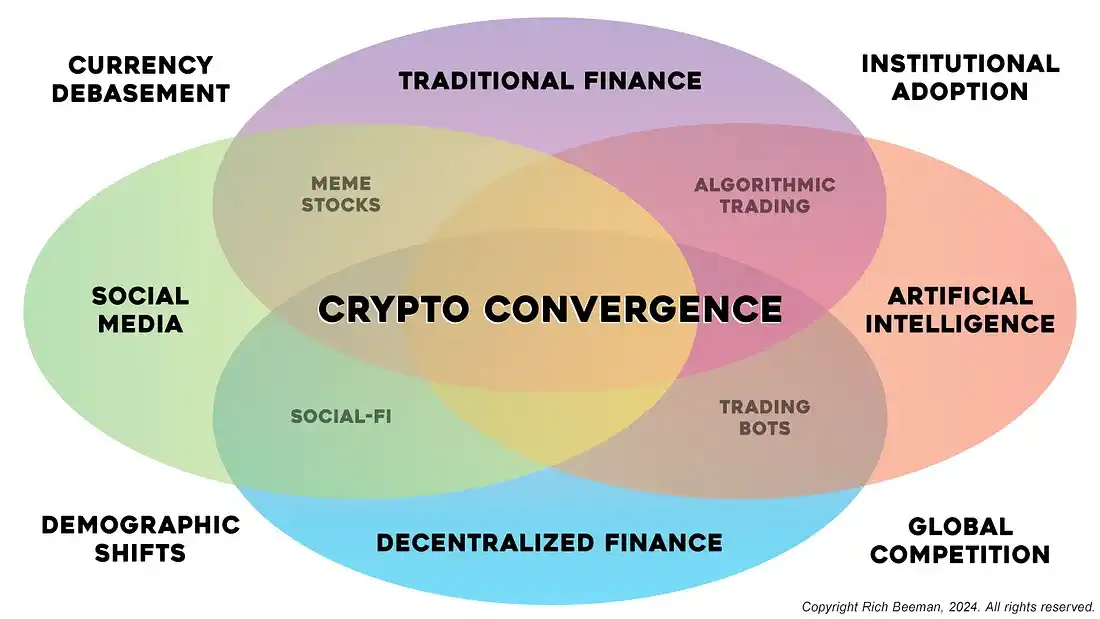
Now, multiple forces are converging to drive this turning point. What comes next is a super-convergence that will truly change the world—at least three exponential technologies are colliding head-on with traditional finance: DeFi, AI, and SocialFi. These emerging technologies are called "exponential" because they rely on the widespread adoption of foundational digital networks, generating compounding acceleration effects.
At a macro level, improved productivity reduces costs through cumulative learning (Wright’s Law), computing power grows exponentially (Moore’s Law), and increased network participation delivers greater value to all users (Metcalfe’s Law). As these networks evolve, new subgroups form, unlocking additional utility layers (Reed’s Law). These compounding effects interact, forming feedback loops of continuous innovation that accelerate progress along exponential curves—ultimately realizing what Ray Kurzweil calls the "Law of Accelerating Returns."
In simple terms, this illustrates two key points:
1. Modernizing outdated financial systems requires the alignment of many factors;
2. The pace of future change will only accelerate.
Luckily, the convergence and innovation aren’t driven solely by technology. Strong cultural and macro trends—such as demographic shifts, institutional adoption, currency devaluation, and global competition—are also powerful drivers. This explains why the modernization of traditional financial systems is almost inevitable.
At the heart of this massive transformation lies what I call the "exponential gap in finance"—borrowing the concept from Azeem Azhar’s 2021 book *The Exponential Age*. This gap refers to the complex and widening chasm between traditional financial institutions and these emerging technologies. Understanding this gap is the simplest way to grasp why today’s financial system urgently needs upgrading.
As a Web3 entrepreneur, my experience with cryptocurrency over the past few years has been both exhilarating and confusing. Re-examining the current financial landscape and trying to understand why recent years have felt so chaotic, I’ve gradually clarified the deeper logic behind it all. For those engaged in and invested in crypto, these years have been marked by confusing regulations, contradictory media narratives, and skepticism from traditional institutions—not to mention the extreme volatility of emerging digital assets.
This is exactly the hallmark of an "exponential gap"—the difficulty traditional systems face in adapting to rapid technological change. In such cases, entrenched interests within legacy industries often actively resist the transition. Still, it remains hard to clearly foresee where things are headed. This transformation is especially difficult because it must occur without halting global markets, making a complete overhaul of the financial system impossible.
But like any major technological revolution, the exponential gap will close quickly and globally. This process will accelerate in the coming years, driven by technological advances and cultural trends, and fueled by the immense incentives to reshape the financial world. Though messy, this process is unstoppable—it is the "Crypto Convergence": a transformative fusion of disruptive technologies redefining how wealth is built, managed, and created.
This trend is forcing traditional finance to evolve using these powerful digital tools to stay relevant. Legacy systems can no longer ignore this shift, as their infrastructure appears weak and incompatible in the face of these new financial realities. History repeatedly shows that institutions failing to cross the exponential divide will be left behind.
Global Turning Point
From the perspective of millennial investors, there has been little meaningful innovation in how financial markets operate during our lifetimes.
Beyond mobile banking and commission-free trading via platforms like Robinhood, there has been little progress in native digital finance. Traditional finance (TradFi) has largely succeeded in resisting or absorbing any major disruption from new technologies.
The result? Wealth inequality and dollar depreciation have reached unprecedented levels. By most measures, the majority of millennials are economically worse off than previous generations, while Baby Boomers remain the wealthiest generation in history. As of June 2023, despite making up only 20% of the U.S. population, they controlled 52% of the nation’s net worth (source: Yahoo Finance).
For cryptocurrency, this meant spending nearly a decade under cold shoulders from TradFi institutions. Particularly over the past four years, the Biden administration has placed the U.S. crypto market in a hostile regulatory environment, employing strategies like “Operation Choke Point 2.0” to suppress crypto adoption and liquidity. China has also been adversarial, banning crypto ownership and mining outright in 2021.
Yet crypto continues to prove its value proposition. Despite efforts by traditional institutions, emerging technologies persist and expand. Core believers in the movement continue doubling down, testing new use cases and pushing functional boundaries.
All this top-level conflict and market indifference means most ordinary people remain unprepared. Most haven’t realized we’re standing on the edge of this technological convergence, nor do they understand the significance of building a faster, transparent, globally accessible financial ecosystem.
In the next decade, personal and professional finance will look dramatically different from the past 50 years. The tide has turned toward crypto, and what happens next will be determined by the speed of this convergence.
Narrowing the exponential gap in finance requires not just technology, but powerful cultural forces. This transformation is being driven by deep cultural currents: institutional participation, generational demographic shifts, and unprecedented scale in global competition.
· Generational Shift: Millennials and Gen Z retail investors are more digitally native, skeptical of traditional institutions, and already embracing emerging fintech. They have higher risk tolerance and view speculative assets differently. Data shows that four out of five millennial millionaires hold crypto, while only 1 in 200 traditional portfolios include Bitcoin. Nearly 60% of new investors report owning crypto.
· Institutional Adoption: Banks, asset managers, and governments are integrating blockchain and crypto-native solutions to stay competitive. As Wall Street and TradFi scramble to get ahead of crypto’s disruptive impact, the competition intensifies. Stablecoins, nearly all USD-denominated, processed $8.5 trillion in transaction volume in Q2 2024—more than double Visa’s $3.9 trillion. Companies like Microsoft and Tesla are also testing their own Bitcoin strategies.
· Global Competition: Nations and corporations recognize crypto’s global nature and the immense economic potential of leading this transformation. Despite banning crypto years ago, China now appears poised to lift restrictions. BRICS nations are developing plans around digital currencies. Dubai just announced acceptance of crypto for real estate investments, and many countries—including the U.S.—are advancing pro-crypto policies. Sovereign Bitcoin mining is gaining popularity.
· Currency Devaluation: The U.S. has entered an era of fiscal dominance, increasingly relying on government spending to drive the economy. The top 10% of households control 67% of total wealth, while the bottom half owns just 2.5%. Dollar devaluation exacerbates inequality. Global debt is nearing $100 trillion, and currency devaluation pressures grow as central banks struggle with persistent inflation caused by expanded money supply.
These macro trends are compelling TradFi institutions to adjust strategic allocations and future investments, giving rise to stronger use cases and exciting new ventures. Beyond obvious developments like Bitcoin and Ethereum ETFs, consider the Texas Stock Exchange (TXSE), expected to launch in 2026 with ambitions to directly compete with NYSE and Nasdaq.
TXSE has already raised $120 million from crypto-supportive firms like BlackRock and Citadel, aiming to build a new exchange from scratch using cutting-edge digital technology. Though details remain scarce, this Dallas-based exchange will likely integrate crypto-native features—such as blockchain rails, tokenized assets, and automated market makers—and position itself as a leader in the new financial landscape.
Robbie Mitchnick, Head of Digital Assets at BlackRock, stated: "Blockchain has the potential to transform financial infrastructure. Especially when combined with DeFi applications built around tokenized assets... If this vision is realized, we’ll have a more efficient, accessible, low-cost, and flexible financial system instead of traditional financial rails."
Imagine the advantages of a new U.S. stock exchange with crypto-native capabilities—how many small and mid-sized companies could benefit from improved funding mechanisms and faster capital flows in a 24/7 blockchain-based market.
Whether or not this vision materializes at TXSE, the line between DeFi and institutional finance grows blurrier each day, and the foundation for deep collaboration is already set.
The Three Exponential Forces Driving Finance Forward
As the crypto industry matures into a significant part of the global economy, discussions about it remain surprisingly rudimentary. Society needs updated mental models to better understand the complexity of the financial digital transformation underway.
"Crypto Convergence" provides such a framework, simply explaining how traditional finance is irreversibly colliding with at least three key exponential technologies—DeFi, AI, and social media—which will collectively reshape the financial landscape over the next decade.
Crypto Convergence is driving a profound upgrade in the financial world, improving how financial services operate while expanding opportunities for individuals and institutions. Combined with the aforementioned cultural forces, these technologies are creating a new paradigm that disrupts finance and accelerates the evolution toward a more open, efficient, and decentralized system.
From this vantage point, Crypto Convergence can be seen as the "manifest destiny" moment of the financial reforms initiated in 2008. This grassroots movement, primarily driven by Occupy Wall Street and the birth of Satoshi Nakamoto, is now reaching a turning point where the big picture begins to emerge.
In fact, U.S. Senator Cynthia Lummis described her proposed legislation—establishing a U.S. Bitcoin Strategic Reserve—as "our Louisiana Purchase moment," a pivotal event in fulfilling this manifest destiny.
With this analogy, we can begin to collectively envision Oregon Territory, seeing the West Coast as a logical extension. The grander vision grows clearer—a dream of a fairer financial system becoming increasingly hopeful over time.
This movement, born from a historic financial collapse and the daunting task of fixing systemic banking issues, holding banks accountable, and protecting ordinary people’s funds, has evolved into a powerful force.
Just as the Forty-Niners and bold entrepreneurs once opened the Wild West, it is crypto’s "frontline pioneers" who are blazing new trails in the financial frontier. These risk-tolerant rebels are using unproven, cutting-edge technologies to pave the way for mainstream adoption in the high-stakes realm of decentralized finance.
DeFi is leading financial innovation by eliminating barriers and offering direct access to services like lending, trading, and yield through parallel systems. Layer 2 solutions on Ethereum—like Optimism and Base—have significantly improved scalability and reduced transaction costs, making DeFi more accessible. Scalable L1 platforms like Solana and Sui are also enhancing accessibility and creating strong use cases for retail investors.
Meanwhile, projects like MakerDAO and Ondo Finance are bringing real-world assets (RWA)—such as real estate and government securities—onto blockchains, integrating billions of dollars in traditional assets. BlackRock has already tokenized Treasury yields via its Ethereum-based BUIDL fund and publicly stated plans to bring trillions of dollars in assets on-chain in the coming years.
At the same time, AI is transforming financial markets through automation and personalization. Robo-advisors and AI agents are rapidly advancing, capable of tailoring investment portfolios to individual financial goals. We’re even beginning to see AI agents deployed within DAOs or trusted execution environments (TEE) as experimental decentralized venture capital entities.
AI-driven trading algorithms are already reshaping most markets, executing trades at speeds beyond human capability by analyzing vast datasets—including sentiment trends on social media. Additionally, AI-powered fraud detection systems help financial institutions monitor transactions in real time, identifying fraudulent activity more effectively than ever before. The iterative speed of large language models (LLMs) and other AI advancements cannot be underestimated.
Yet among all these converging forces, attention is just as crucial as computing power, regulation, or platform capabilities. Social media is evolving into a ubiquitous, powerful "Swiss Army knife" for savvy investors and traders.
Platforms like Reddit, Discord, and X sit at the forefront of SocialFi, where communities organize around shared investment opportunities, spawning meme stocks and now meme coins. Viral memes like PEPE and BONK drive network liquidity—they’re not just financial instruments but cultural assets fueling ecosystem growth. Though slower than I expected, traditional finance is also moving toward digital management strategies to engage retail investors.
Social media channels are also democratizing financial literacy, promoting community-driven investment strategies, and enabling user participation in decentralized governance via tokens on platforms like Uniswap. Decentralized social platforms like WarpCast and Nostr are also gaining traction.
Clearly, these examples represent only high-level illustrations. More importantly, these three exponential technologies are increasingly overlapping, and their convergence creates a powerful flywheel effect.
As Sam Altman described in 2021, crypto provides a mechanism of deterministic scarcity that balances AI’s infinite abundance, thereby setting constructive boundaries for generative processes. The decentralizing power of crypto, combined with the democratizing force of social networks, will counteract AI’s centralizing tendencies. Today’s new trend on Crypto Twitter—AI agents launching meme coins—is based on intuitive understanding of these synergies.
In this cycle, many will realize that combining AI with blockchain is creating new opportunities for automated and decentralized markets. SocialFi will empower communities to rally around these opportunities, giving rise to novel investment methods. AI will further simplify DeFi processes and continue expanding community engagement on social platforms.
Each domain reinforces the others, accelerating adoption and innovation, unleashing the massive effects of the Law of Accelerating Returns. The synergy of these technologies unlocks a superset of tools and capabilities, forming the interface into Web3.
This new paradigm empowers internet users to harness network effects more effectively in an attention-driven digital economy. It aims to reclaim the internet from Web2 monopolies, advancing toward decentralized, open platforms—fulfilling the original vision of the internet. Web3 achieves this by distributing value at the protocol layer to builders and core users, rather than concentrating wealth and control in the hands of a few corporations.
While existing power structures will continue resisting these changes, the combination of technological and cultural forces is driving the financial industry toward greater inclusivity, efficiency, and innovation. As the boundary between traditional finance and crypto blurs, we are witnessing the birth of a new financial infrastructure that will define the future of money and wealth.
Why Cryptocurrency Is the Unifying Engine of Change
Although each of these exponential technologies is a core component of this transformation, cryptocurrency is the engine that makes the fusion with traditional finance possible.
This is because blockchain provides the decentralized infrastructure necessary for trustless transactions, data integrity, digital identity, and secure asset ownership across all these domains. As Cathie Wood, CEO of ARK Invest, put it, blockchain is adding a "financial layer" to the internet—one that should have existed all along.
The foundational principles of cryptocurrency—open-source, permissionless, immutable, global, transparent, democratic, and censorship-resistant—ensure that new ideas can develop and scale without the friction of slow, centralized control dependent on outdated legacy systems. The integration of blockchain networks built on these principles, and the underlying mechanisms that make them possible, is precisely how a viable new financial layer for the internet is being constructed.
Crucially, blockchain’s cryptographic properties also provide key mechanisms to control AI’s malicious activities. As early as 2017, Coinbase co-founder Fred Ehrsam stated: "Blockchain is the lifeblood of AI." This is because AI entities, being code-based, can exist on-chain within smart contracts. "On the blockchain, there is no difference between AI and humans," was Fred’s profound observation.
In general, this seems correct. A Cambrian explosion of synthetic lifeforms is already here, rapidly acting in the real world by controlling resources through cryptocurrency tokens. Blockchain infrastructure now supports not only interoperability between AI and crypto but also broader collaboration among social networks and digital finance.
This blockchain-based financial layer unlocks the potential of Web3, where the interoperability and connectivity of these emerging technologies converge into rapidly evolving financial innovation. Of course, inertia from existing market players, legacy systems, and policymakers remains a challenge. Bad actors haven’t disappeared either. Although we’re at a tipping point in financial transformation and many rough edges of crypto can now be abstracted away, these issues still severely hinder the full potential of crypto convergence.
Mainstream narratives continue to frame crypto’s speculative nature as reckless and unstable, sometimes even calling it a scam. It wouldn’t be hard to fill a book with negative statements about crypto from leaders across industries over the past five-plus years—terms like "rat poison" abound.
Ironically, many of these once-vocal critics have completely reversed course and are now staunch crypto advocates. Yet, as Federal Reserve official Kashkari recently stated: "Unless it’s drugs or illegal activity, almost no transactions happen on crypto."
In reality, the truth has never been as simple or binary as Kashkari and others suggest. The facts emerging from the crypto frontlines are far more complex than sensational headlines, financial nihilism, and tales of over-leveraged gambling would have us believe. Many innovations driving financial digitization actually depend heavily on crypto’s speculative nature.
This disruptive, countercultural force in society pushes boundaries and catalyzes accelerated technological innovation—a pattern well-documented in other industries. Notably, adult content played a key role in the rapid development and adoption of many innovations now foundational to media and entertainment—such as streaming video, online privacy systems, mobile devices, and broadband internet.
Just as early Silicon Valley startup culture achieved breakthroughs through risk-taking, today’s crypto "casino culture" serves as a high-risk testing ground for new financial tools, liquidity mechanisms, and governance models. Perhaps the most prominent example is Polymarket, a crypto-based prediction market platform updating standards for real-time sentiment analysis and mainstream political reporting.
Regardless of the stigma attached to crypto speculation and its potential negative side effects, the surprising truth is that speculation drives progress across many industries.
Contrary to popular belief that NFTs and memecoins are mere bets on worthless trinkets, high-risk experiments in DeFi and SocialFi have actually spurred technological advancement. The speculative energy harnessed by breakout platforms like Pump.Fun has acted as both stress test and catalyst, accelerating the development of the Solana ecosystem.
Don’t believe it? These speculative behaviors are precisely the forces accelerating technological progress that will eventually enter mainstream finance.
In his widely discussed speech *Token 2049 Memecoin Super Cycle*, Murad Mahmudov shared similar insights, stating that the crypto industry operates on "speculation first, technology second," and that tokens are the most important product. This principle explains why memecoins, NFTs, and other speculative assets not only onboard retail users into the crypto ecosystem but also push the boundaries of technological innovation.
Smart money understands this, whether or not they admit it publicly. Why does nearly every blockchain race to have a top-tier cultural token? Because these speculative activities create vibrant cultural zones at crypto’s frontier—spaces where financial innovation occurs. Like early Boston or Paris’s Montmartre, these virtual frontiers attract pioneers, builders, and innovators who thrive in high-risk environments.
In fact, although traditional institutions initially dismissed crypto as a pile of speculative "toys," they are now rapidly integrating these technologies into their own systems. Venture capitalists and institutional investors are actively leveraging speculation to generate liquidity and drive growth and adoption of their projects.
Today, it’s hard to deny that the rise of tokenized assets and blockchain-based financial products demonstrates how speculative markets are shaping the evolution of global finance.
While blockchain infrastructure enables digital asset ownership and unlocks financial potential, speculative assets and trading also play a catalytic role in advancing and reforming finance. This is how crypto forces institutions like BlackRock and Fidelity to adopt technologies once deemed impractical or irrelevant, and drives bipartisan legislative progress.
Some fringe industries, often ignored or demonized by mainstream society, are actually key drivers of technological progress. Just as the porn industry pushed forward the media and entertainment forms we use today, blockchain innovation and speculative crypto markets are laying the foundation for the future financial system. Just as Bitcoin and Ethereum were once dismissed as worthless nonsense, many technological advances will continue to emerge from crypto’s frontier.
A Once-in-a-Lifetime Opportunity
The future of crypto convergence cannot be predicted, but we can assume it lies somewhere along a spectrum. At one end is a totalitarian nightmare—a world where governments and financial institutions hijack crypto technology to expand centralized control.
In this scenario, the U.S. government and regulators impose strict measures on altcoins and decentralized platforms, allowing only approved networks like Bitcoin and Ethereum to exist under heavy regulation. Central bank digital currencies (CBDCs) become tools to monitor every transaction, effectively dismantling financial privacy.
This vision echoes the worst elements of China’s surveillance state, where innovation is tightly controlled and individual sovereignty becomes a distant memory.
At the other end of the spectrum lies the libertarian dream—a decentralized future where the U.S. embraces crypto innovation, creating an open financial environment built on self-custody and digital sovereignty. Here, the government actively supports progressive policies, bans CBDCs, and fosters a business environment akin to the early internet.
In this version of the future, crypto fulfills its promise of financial freedom, empowering individuals and small businesses while shifting power away from traditional institutions. American ideals—privacy, autonomy, and liberty—are renewed and reinforced through on-chain governance and protocol-level decision-making.
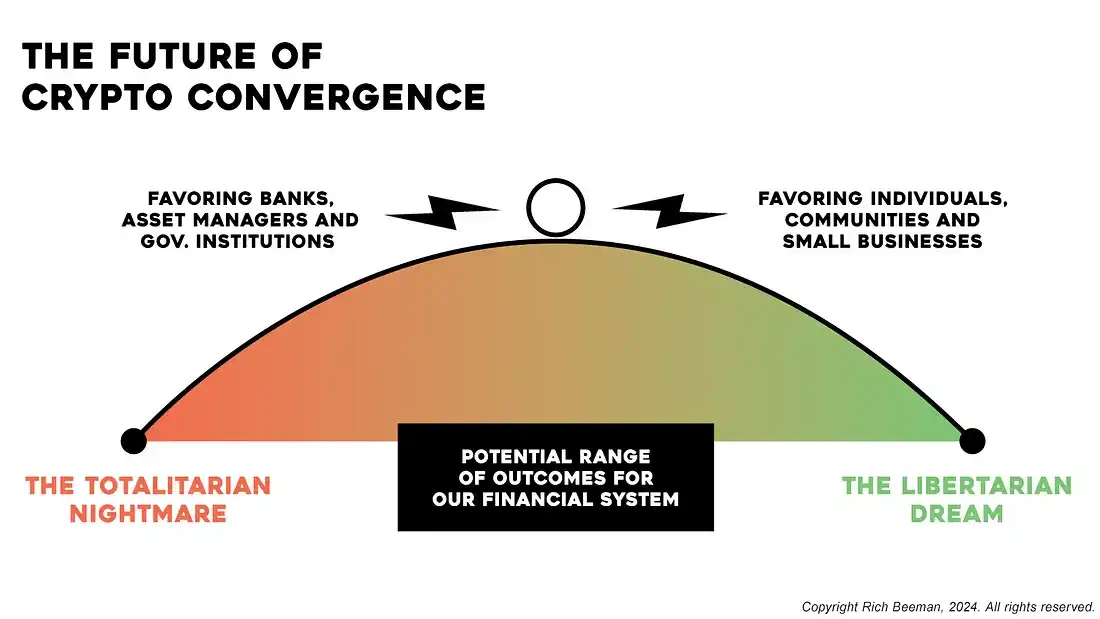
However, the most likely outcome probably lies between these extremes. In reality, most regulators and policymakers won’t continue full-scale crackdowns to eliminate crypto. The game theory of Bitcoin adoption has already begun—nations, corporations, and financial institutions are gradually realizing they can no longer stay idle and are starting to accumulate crypto assets.
The U.S. will struggle to balance innovation and control—on one hand, recognizing the need to stay competitive in the global digital economy; on the other, powerful financial giants like banks, asset managers, and government agencies naturally want to retain control over critical financial infrastructure.
This hybrid middle scenario may remain chaotic until a new equilibrium forms—a process that could take time. Murad recently made a similar prediction, suggesting things will get worse before they get better. He likened this turbulent transition period to Germany’s ill-fated Weimar Republic.
During this time, we may see certain decentralized elements—like Bitcoin ETFs and blockchain-based clearing systems—gradually incorporated into mainstream finance. But these advances will likely coexist with regulatory demands aimed at limiting the disruptive potential of DeFi and altcoins, resulting in an uneasy coexistence.
This gradual middle ground presents many challenges—but also new opportunities. Even under regulation, crypto projects will continue innovating, finding niches within the broader ecosystem where decentralization can thrive. Technologies like zero-knowledge proofs, governance tokens, and dApps will help preserve the dream of financial sovereignty, even as institutions attempt to apply them to more traditional uses.
Ultimately, the outcome of crypto convergence depends on how policymakers, entrepreneurs, investors, and voters shape this transformation. In this complex environment, those willing to balance caution with creativity will have the chance to influence the trajectory of the next-generation financial paradigm. In this future, crypto is neither fully controlled nor completely free—it becomes a battleground for progress.
Right now, a revolution driven by exponential technologies is dismantling old structures and potentially building more inclusive, efficient, and community-driven systems. As traditional finance increasingly integrates DeFi protocols, AI automation, and SocialFi ecosystems, we are entering a new era of democratized financial power.
This age of crypto convergence offers a rare opportunity to build an alternative financial system that serves not just the powerful, but individuals—leading toward a fairer future. But it requires forward-thinking strategy, courageous leadership, and broad community participation.
Replacing the financial engine mid-flight isn’t just a metaphor—it reflects the reality that global markets must keep operating while undergoing major upgrades. This highlights the sheer scale of unfinished work and the extremely high risks involved. Even as many traditional financial firms, policymakers, and legacy service providers adopt more positive stances toward crypto, shutting down the system for "repairs" is impossible. Therefore, many complex parts of our financial system must seamlessly absorb these innovations within the constraints of ongoing business cycles and practices.
This is precisely why the current state of crypto as an emerging industry is filled with pain points and awkwardness—why this phase could be called its "adolescence." Though crypto is going through growing pains, this is also when critical leadership motivations begin to take hold.
The core question is: Can we collaborate to steer the future toward self-sovereignty, or will we slide further into surveillance and control?
As crypto regulation takes shape, recent events show both possibilities. Efforts like the *Anti-Surveillance State CBDC Act* signal resistance to centralized digital currencies, reflecting concerns about financial privacy and government overreach. The bill is gaining increasing support in Congress, indicating a desire to curb state-controlled financial surveillance.
Just this week, Pennsylvania became the latest state to pass a regulatory clarity bill for digital assets, dubbed the "Bitcoin Bill of Rights." Passed with strong bipartisan support—76 Democrats and 100 Republicans voting unanimously—this progress suggests that, with sustained pressure, there is political will in the U.S. to resist a fully surveillance-oriented financial system.
Yet it’s a delicate balance. Traditional financial stakeholders—including large institutions and governments—continue exploring ways to control or regulate decentralized assets. As the U.S. and other major nations stand at the crossroads of crypto convergence, the challenge is whether we can harness these forces to empower individuals—or be pulled into the gravitational field of surveillance infrastructure that defines the future of money and finance.
Only time will tell whether we can redirect history toward personal freedom and self-sovereignty, or again fall into the old path where security and convenience take precedence over ownership. Personally, I choose optimism. The stakes in the race to reform the financial system are enormous, and early movers stand to dominate the creation of next-generation wealth.
I agree with Murad: we will eventually reach another "Belle Époque"—an era defined by social stability, economic prosperity, and cultural flourishing, all driven by massive technological progress—even if it means enduring some difficult times first.
Within the next decade, the "exponential gap" in finance will largely be closed, and waves of cultural and technological innovation will relentlessly erode our outdated financial conventions. I believe that by 2034, most major opportunities will have emerged, and the era of crypto convergence will draw to a close.
We will witness wealth transfer from Baby Boomers to Millennials and Gen Z, and see trillions in existing assets tokenized. A growing share of global money supply will flow into top cryptocurrencies as people seek to escape fiat systems that undermine their economic power. I foresee the crypto industry gradually expanding to eventually integrate the entire economy and financial sector.
This means that, just as digital news source X has made mainstream media its downstream, traditional financial institutions that fail to evolve will ultimately become downstream to crypto platforms. Likewise, innovations happening at crypto’s frontier today will ultimately determine the future direction of mainstream finance.
As renowned VC and writer Chris Dixon said, "What smart people do on weekends, everyone else will do during the workweek ten years later." Today, countless geniuses spend their nights and weekends deeply immersed in crypto.
While frontier exploration isn’t for everyone, there are now many more passive, lower-risk ways to participate in crypto. Regardless of your role, those who recognize crypto’s potential and are willing to explore this intersection of disruption, creativity, and commerce will stand at the forefront of the global financial revolution.
Keeping up with this trend isn’t easy—but it could change your life.
We are only beginning to witness how the convergence of AI, DeFi, and social media creates viral financial phenomena, accompanied by a "Cambrian explosion" of new wealth creation. For those involved, the confluence of these forces and the digital transformation of traditional finance represents one of the most profitable opportunities of our time.
DeFi is already replacing traditional gatekeepers, enabling anyone with internet access to lend, borrow, and trade without intermediaries. AI is enabling higher levels of personalization and automation, streamlining financial processes and risk detection, while opening countless new use cases for digital assets.
Social media networks and SocialFi platforms will continue redefining investment behavior, community-driven strategies, rallying around the most compelling cultural units, and embracing decentralized governance models.
Yes, the economic incentives are huge—but viewing "crypto convergence" as merely profit-driven is too narrow. At its core, this is a fundamental transformation rooted in the 2008 global financial crisis. The crypto movement born from that crisis is leading us toward a financial paradigm prioritizing transparency and inclusivity, secured by mathematical proof against centralized manipulation.
The very institutions that caused that crisis are now gradually recognizing the movement’s power, acknowledging that these disruptive technologies are inevitable, not fleeting fads. Moreover, the rapid pace of exponential innovation means the gap between traditional finance and the Web3 frontier will close faster than many expect.
Unlike traditional finance, many of crypto’s best opportunities are open to anyone willing to participate.
We can all position ourselves in future markets by seizing these opportunities and leveraging new fintech tools. Crypto convergence provides a theoretical framework to identify emerging financial innovations and uncover emerging risks to avoid.
Those who act now—whether developers, investors, or entrepreneurs—will gain agency in this new paradigm and may even help shape emerging systems at the foundational level.
Crypto convergence is not just an economic trend—it is a multilateral movement dedicated to reforming and reshaping global financial mechanisms. By decisively adapting to this change and embracing convergence rather than resisting it, we can all benefit from one of the most significant opportunities of this era.
Join TechFlow official community to stay tuned
Telegram:https://t.me/TechFlowDaily
X (Twitter):https://x.com/TechFlowPost
X (Twitter) EN:https://x.com/BlockFlow_News
 @gifdead