From Speculation to Utility: Why AI and Stablecoins Are Unfazed by Bear Markets
TechFlow Selected TechFlow Selected
From Speculation to Utility: Why AI and Stablecoins Are Unfazed by Bear Markets
AI tokens rise against the trend; stablecoin trading volume hits record $1.8 trillion.
 Navigating Web3 tides with focused insights
By: Cointelegraph
Translated by: AididiaoJP, Foresight News
Despite the broader cryptocurrency market’s decline in 2026, the artificial intelligence (AI) and stablecoin sectors outperformed the overall market. Data shows that usage in both sectors continued to grow even as prices of other assets fell steadily.
Key Takeaways
- The AI sector recorded the smallest decline in Q1 2026—just 14%.
- Total stablecoin market capitalization hit an all-time high of $320 billion, while monthly trading volume reached $1.8 trillion—the highest level on record.
AI and Stablecoins Defy Market Headwinds
In 2026, Bitcoin’s price fell 18.5%, and total cryptocurrency market capitalization dropped to $2.42 trillion, with most altcoins underperforming. Market sentiment remained cautious amid concerns and uncertainties tied to U.S. and Israel–Iran tensions, alongside the Federal Reserve’s hawkish stance.
In contrast, AI- and stablecoin-related businesses continued to expand against the trend, demonstrating strong fundamentals and notable growth—reflecting a broader shift in market focus from speculation toward infrastructure development.
For example, USDC, issued by Circle, had a supply of $7.8 billion as of the latest data from Token Terminal—a 220% increase since November 2023.
Meanwhile, ChatGPT’s weekly active users surged from 85 million in November 2023 to 900 million in March 2026—an approximately tenfold increase over the same period.
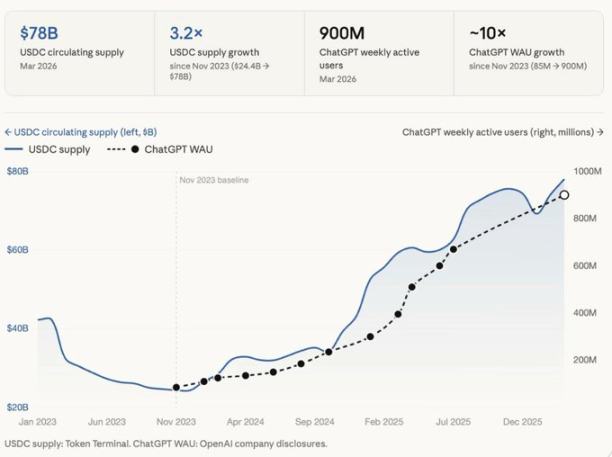
(Chart: USDC supply and ChatGPT weekly active users; Source: Token Terminal)
Grayscale’s Q1 2026 report further confirms this trend. It notes that the AI sector posted the smallest decline in Q1—at 14%—while consumer & culture fell 31%, smart contract platforms dropped 21%, and currency tokens declined 21%.
The digital asset management firm states this reflects “a shift in investor preference away from momentum-driven, more speculative sectors.” The report adds:
“Although overall market sentiment remains subdued, capital is beginning to flow toward projects with stronger fundamentals aligned with key themes such as AI and tokenization.”
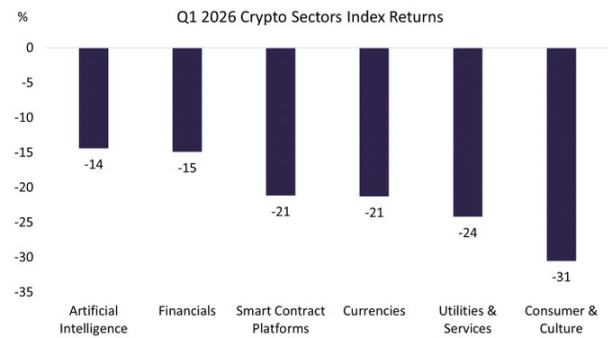
(Chart: All sector returns were negative in Q1 2026; Source: Grayscale)
Currently, the total market capitalization of AI tokens stands at approximately $17.4 billion, rising 30% over the past 30 days. Bittensor and NEAR Protocol (NEAR) led gains, with prices up 75% and 30%, respectively, over the same period.
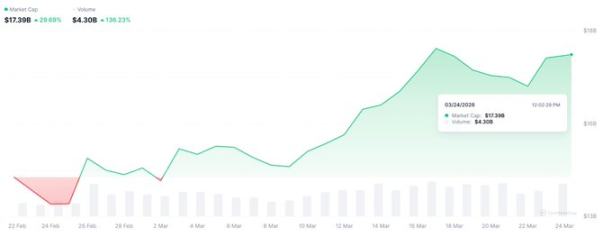
(Chart: Market caps of major AI and big-data tokens; Source: CoinMarketCap)
On the stablecoin front, market scale continues to expand. As of March 23, total stablecoin market capitalization reached a record $320 billion. USDt, issued by Tether, retained its dominant position with a market cap of roughly $184 billion—57% of total stablecoin supply.
In February 2026, stablecoin monthly trading volume hit an all-time high of $1.8 trillion—rivaling traditional payment systems. USDC stood out in supply growth, rising 80% month-on-month, while its trading volume last month reached a record $1.26 trillion.
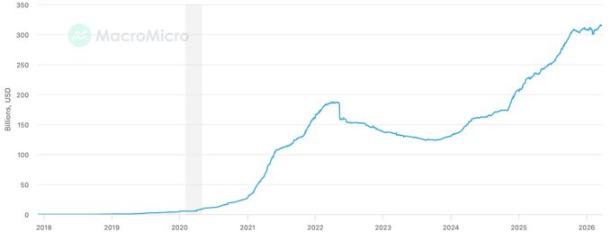
(Chart: Total stablecoin market capitalization; Source: MacroMicro.me)
Stablecoins are cryptocurrencies designed to maintain price stability, typically pegged to fiat currencies like the U.S. dollar, and operate across multiple blockchains.
In bear markets, stablecoins serve as stores of purchasing power and settlement rails—widely used in trading pairs, tokenized real-world assets, and yield-generating products. Stablecoin transfer volumes on Ethereum and other blockchains remain consistently high, while institutional-grade products launched by banks and fintech firms increasingly integrate stablecoins for yield management and treasury operations. Even amid weak performance of speculative assets, stablecoins’ role as financial infrastructure remains solid.
“Structural Tailwinds” Drive Convergence of Two Sectors
The robust growth of both AI and stablecoins stems from their ability to deliver tangible value—even after speculative fervor subsides.
Token Terminal notes: “AI labs and stablecoin issuers are among the businesses with the strongest structural tailwinds of the 2020s.”
The crypto data service adds that these two domains sit at the “confluence of three independent forces—technology, finance, and geopolitics”—each driving demand for both sectors. The report continues:
“AI drives productivity and national defense capabilities, while stablecoins provide the financial infrastructure for global U.S. dollar distribution.”
Cryptocurrency trader Mando CT stated on X on March 24 that AI and stablecoins are two of the four dominant sectors in 2026.
Explaining the convergence trend, he noted that AI requires instant, low-fee payment systems to function—and stablecoins are the “internet money” enabling precisely that.
Mando CT said: “These trends are interconnected,” adding:
“2026 isn’t just another cycle rotation—it’s a transformational year shifting from speculation to infrastructure.”
According to Cointelegraph, stablecoins stand to benefit from AI-driven payment use cases, further fueling long-term growth in both fields through seamless, automated, rule-based transactions between entities.
Join TechFlow official community to stay tuned
Telegram:https://t.me/TechFlowDaily
X (Twitter):https://x.com/TechFlowPost
X (Twitter) EN:https://x.com/BlockFlow_News
 @Cointelegraph