








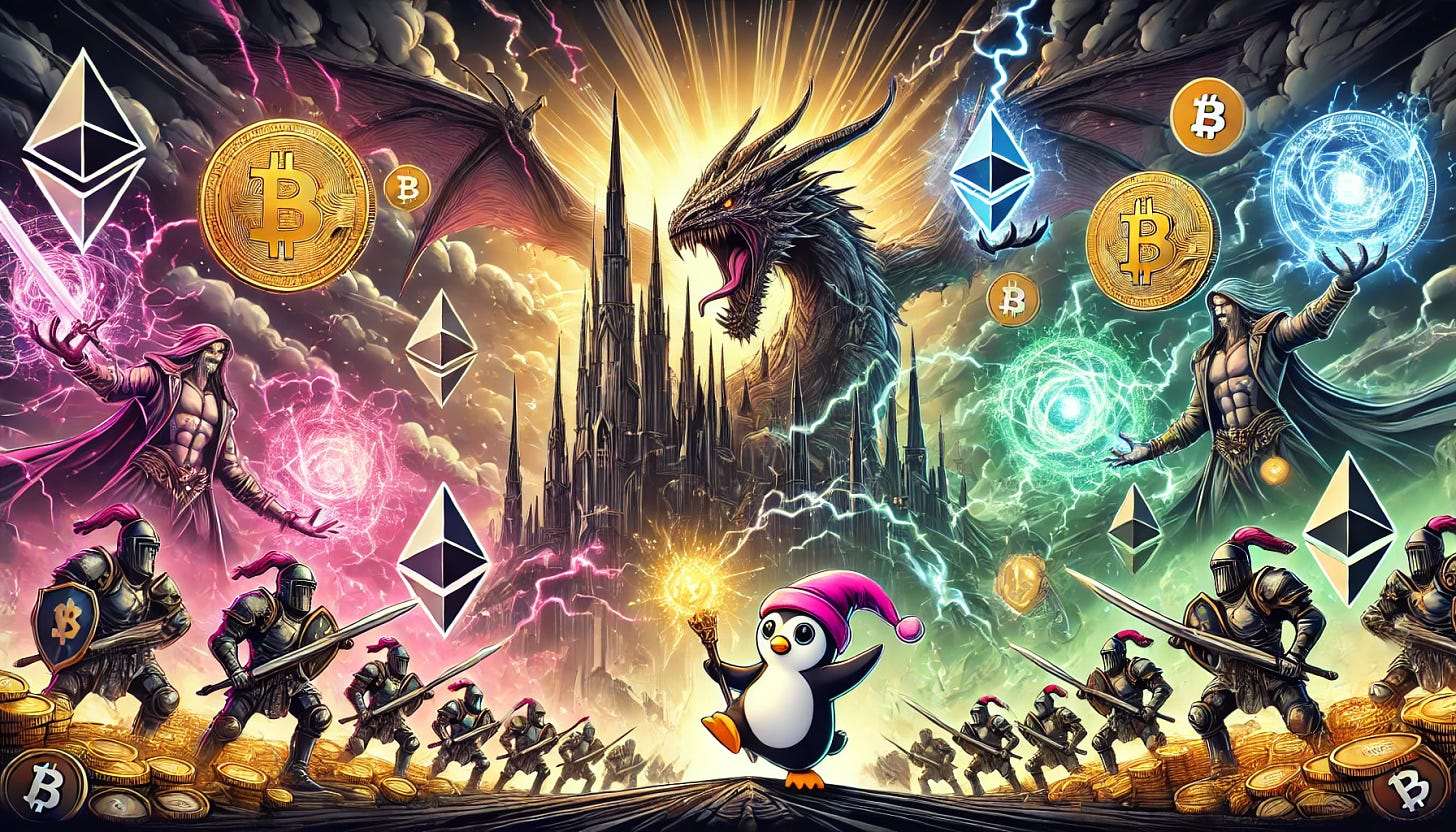
Invest in crypto like playing a game, and find your niche
TechFlow Selected TechFlow Selected
Invest in crypto like playing a game, and find your niche
Small enough to fly under the radar of big players, but large enough for you to win—this could be your gold mine in crypto gaming.
 Navigating Web3 tides with focused insights
Author: Ignas | DeFi Research
Translation: TechFlow
Cryptocurrency feels like a game: you trade tokens, earn (or lose) money, and grow your following on X. Don’t you feel the same way? But unlike real games, failure in crypto can have serious consequences. After the Terra collapse, a South Korean family of three—including a 10-year-old daughter—was suspected of suicide due to financial losses, based on their father’s online search history, according to reports.
This makes me feel guilty, knowing so many people have been deceived and lost their life savings.
Yet, viewing crypto as a game helps me stay sane and motivates me to keep going. The sheer madness we experience in this industry is unprecedented. And the massive rewards make it worth playing: financial freedom.
As DegenSpartan once said in a now-deleted tweet: "After graduation, you have a short window to make ultra-high-risk investments to reach elite status; otherwise, you'll be a wage slave for life."
In this blog post, I want to share how to play the crypto game, my mental framework, and tips on choosing and winning your version of the game.
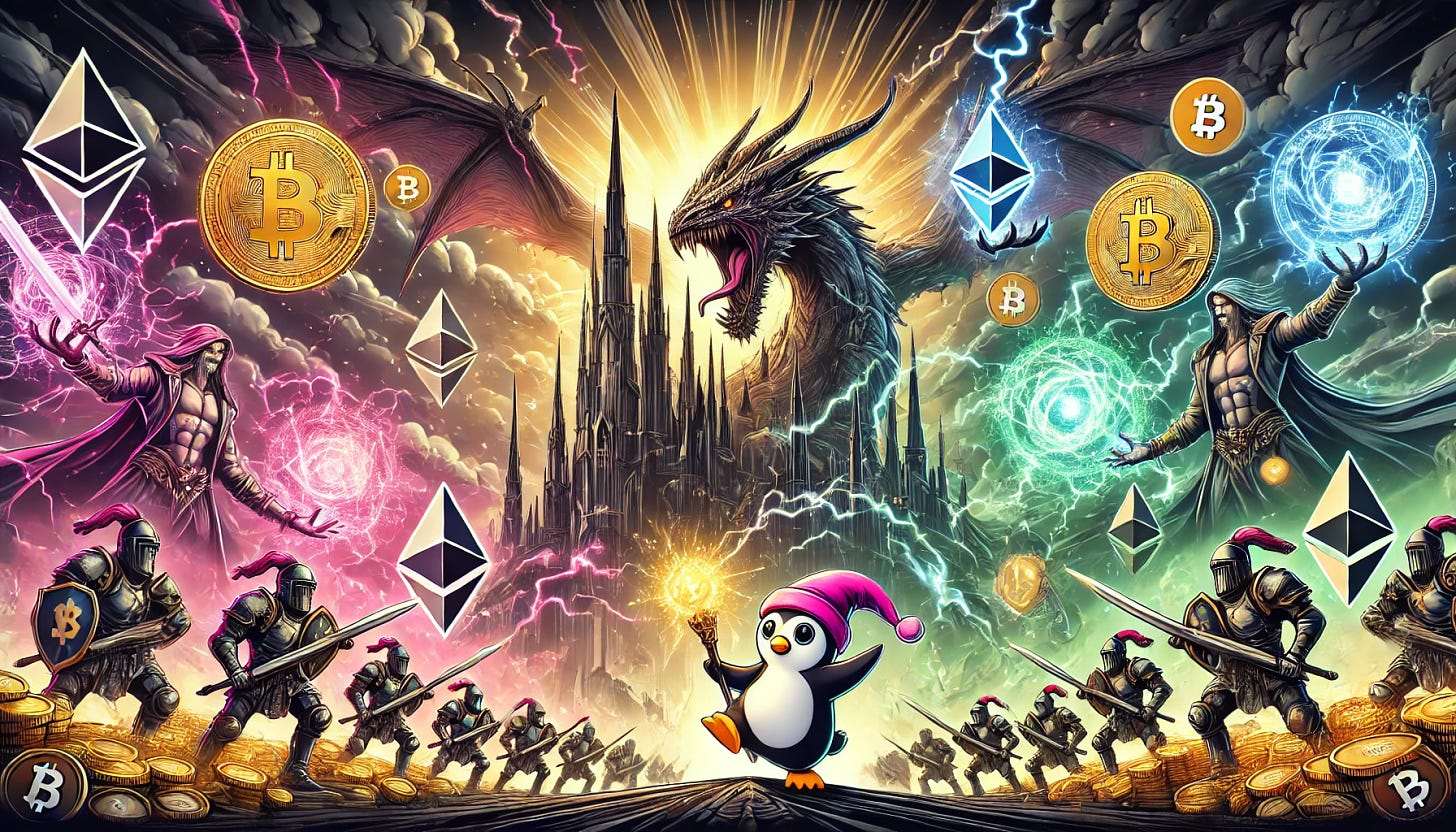
The Rules of the Crypto Game
Once you see the analogy between cryptocurrency and games—especially MMORPGs—you’ll never unsee it.
In tough times, when no new capital flows in, we play in “PvP – player versus player” mode.
But during bull markets, with fresh retail money pouring in, we shift into “PvE – player versus environment” mode.
When we're upset about influencers dumping their bags, we often justify it with phrases like “Don’t hate the player, hate the game.” We even design tokenomics using various game theories to discourage selling.
Just like every game update, the crypto game constantly evolves, with new storylines emerging and fading away.
For example, once-top NFT player Pranksy is now completely disconnected from the meme coin wave. While gameplay has changed, he's still playing a version few care about anymore.
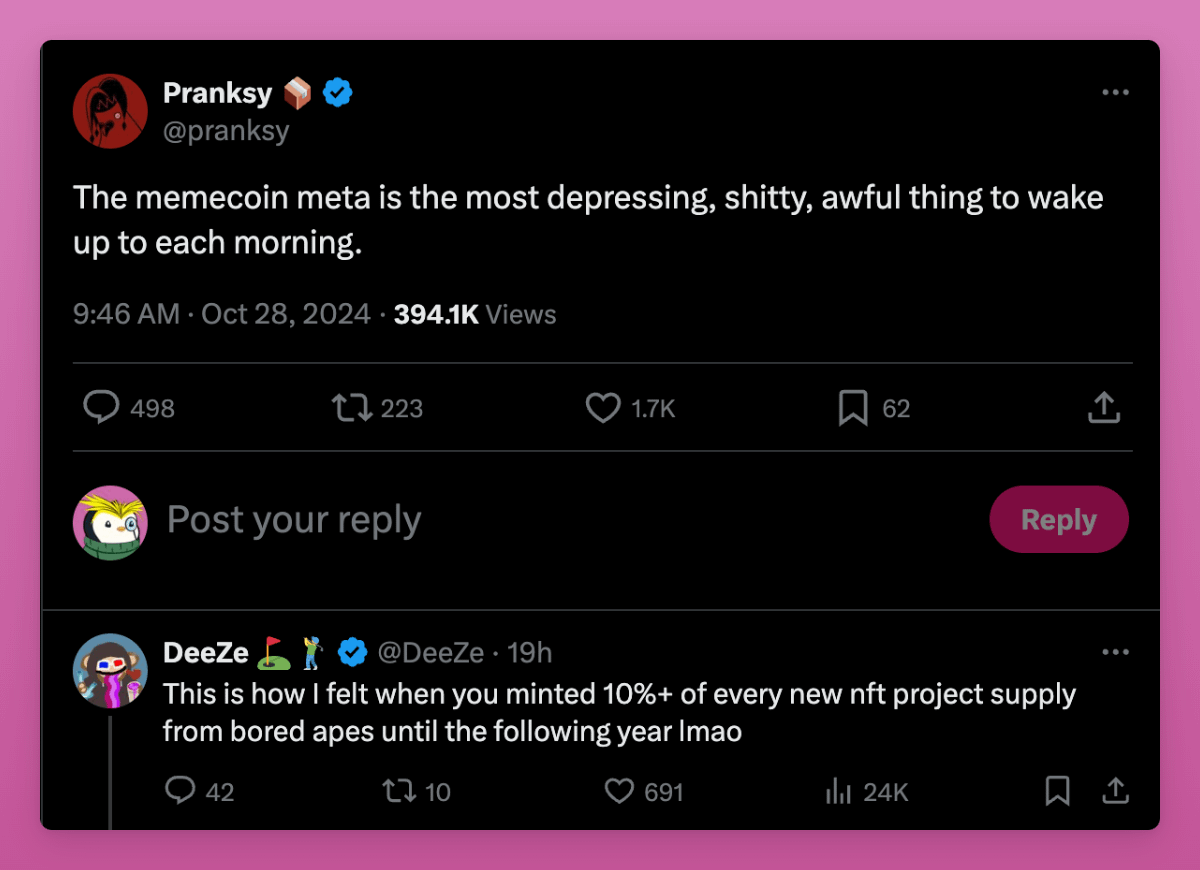
In this game, you have two choices: adapt and play, or sit out and wait for the gameplay to change.
There's an even harder choice: change the rules of the game itself.
For instance, Cobie launched Echo, enabling regular investors to participate in venture-like opportunities and buy tokens just like in the ICO era. Gradually, players who choose to reshape the game push meme coin narratives to the sidelines.
Still, meme coins deserve credit—they’ve successfully rewritten the rules.
Over the past year, we’ve played a “points” game: deposit $$$ into a protocol, accumulate points, then pray for a generous airdrop. I know you enjoyed this game because my article “The DeFi Degens’ Playbook to the Bull Run” remains my most popular post.
Yet, it turned out many were actually played instead.
With higher TVL justifying sky-high valuations, tokens launched at absurd FDVs—benefiting only early VCs, teams, and farmers who dumped their airdrops.
Fed up, many shifted to meme coins—the very thing VC-backed tokens lacked.
While Pranksy lost (or chose not to play), key meme coin figures like Ansem, Murad, and anyone joining them are winning.
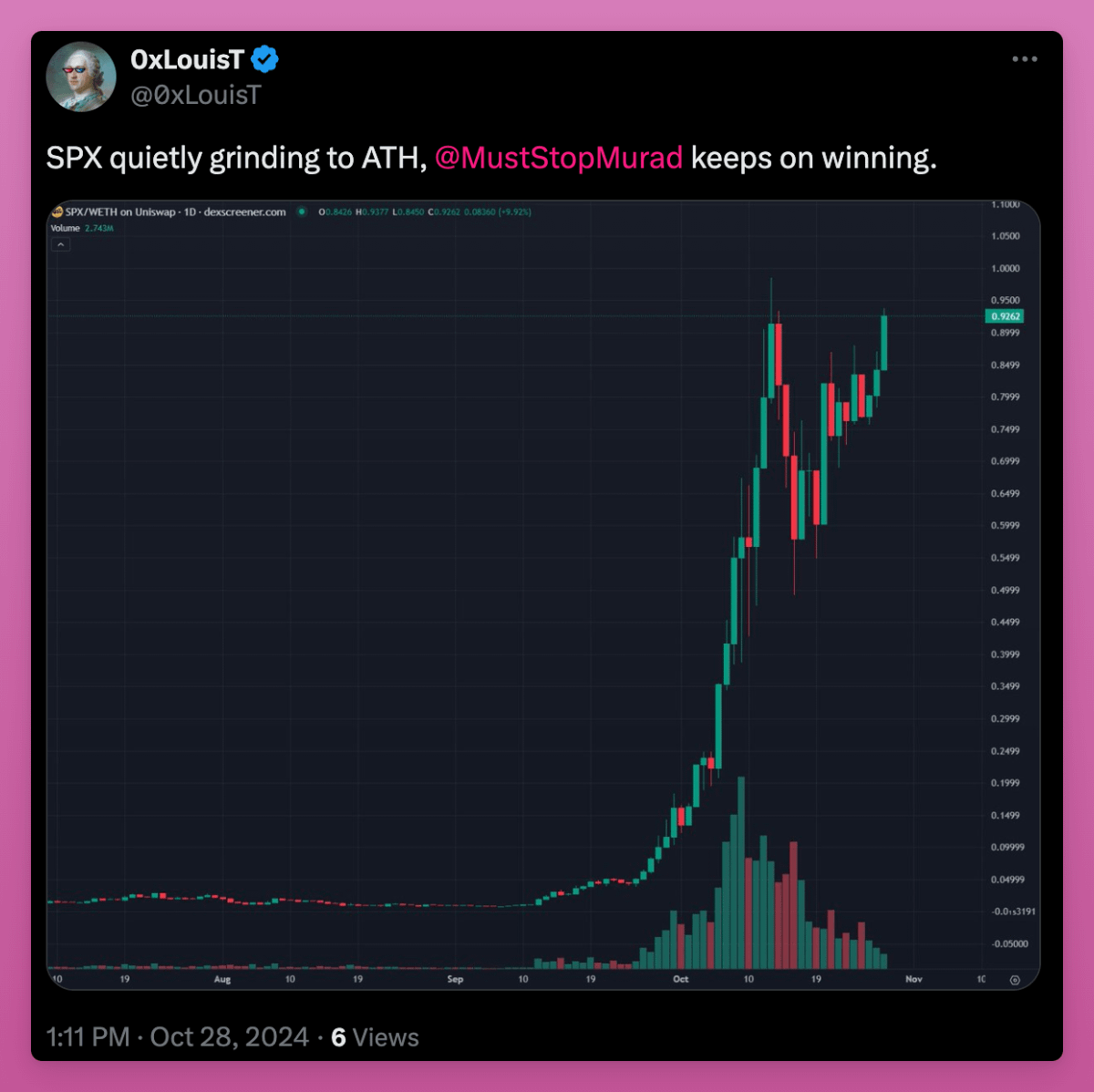
“Don’t hate the player, hate the game.”
Across the meta-game, we continuously introduce new mini-games. You must decide whether to participate.
If you do, understand the rules—because there will always be opponents.
Take DAOS FUN, which allows trading tokenized funds. Confusingly, the top “fund” ai16z trades at 52x its net asset value (NAV), making it look more like a meme coin.
All players struggle to make sense of this. Squiggly compared these funds to “Grayscale structures” or Friendtech’s Ponzi-like trading fee model, while BREAD disagreed with parts of that take on Friendtech.
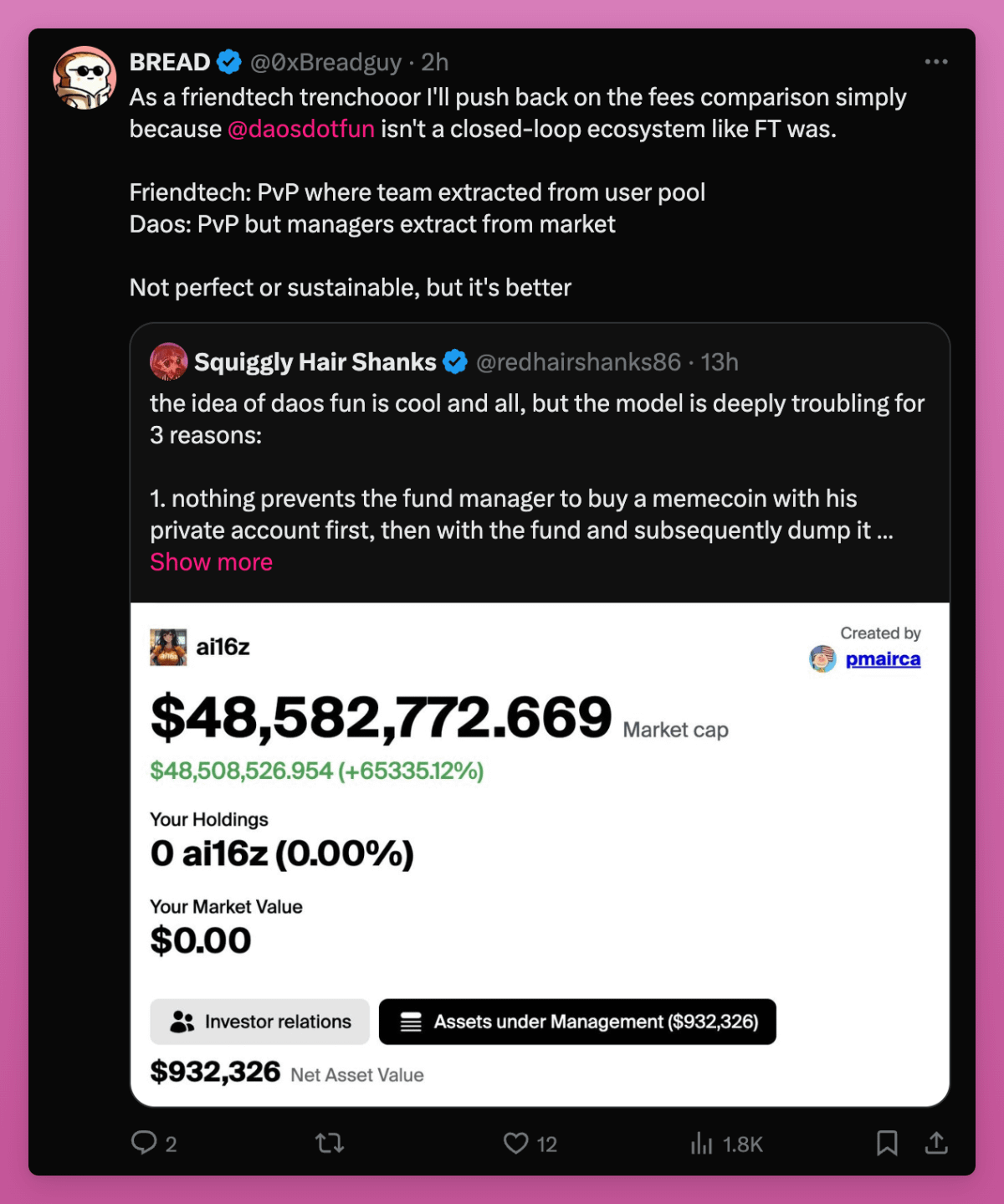
Who’s right?
It’s the same product, but interpretations vary widely among players.
Find your edge in the game to profit—and sometimes it’s simple. After the team announced they’d whitelist a new “fund” on their site, I anticipated speculators holding existing “fund tokens” would sell some old ones to invest in the new fund, causing prices to drop. Sure enough, once the new fund was added, all previous fund tokens fell by about 50%.
Generally, the messier the gameplay, the clearer the information asymmetry—and the greater your profit potential.
The beauty of crypto is that there are always speculators blindly chasing trends without doing homework. With even basic research, you can spot profitable opportunities.
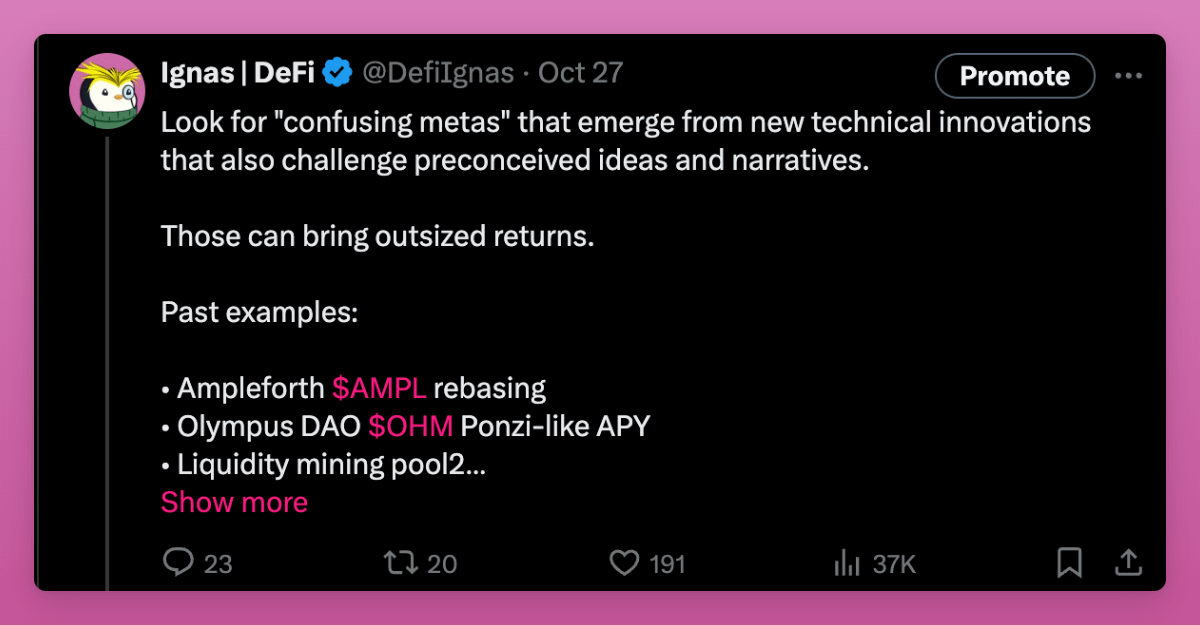
That said, I often allocate a small amount to hot new projects before fully understanding how they work—learning by doing. Once I figure out if I can win, I deploy more capital.
Ton’s tap-to-earn meta-game thrived because it was the opposite of complex DeFi games—you literally earn money by tapping a button on your screen.
However, due to its simplicity, rewards are relatively low unless you’re gaming the system with hundreds of phones and robotic fingers.
This is why crypto becomes ten times more interesting and complex: you can choose multiple layers, roles, and strategies—like side quests.
Let me give an example. Recently, I’ve been actively engaging as a representative across several DAOs, particularly Lido, Arbitrum, and Uniswap.
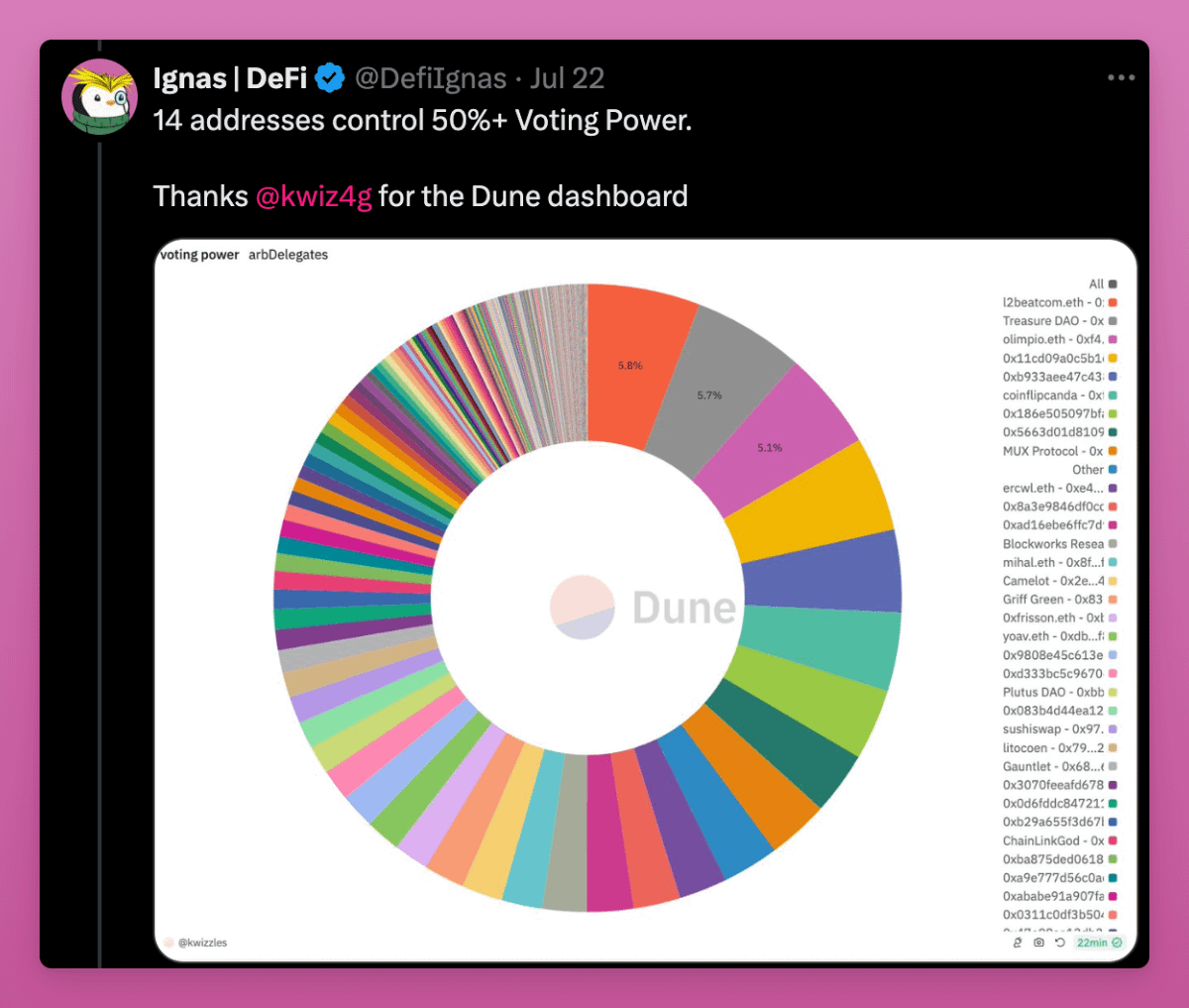
While DAOs promote visions of decentralized governance, it’s now widely known that most aren’t truly decentralized. For instance, in the Arbitrum DAO, just 14 addresses control over 50% of voting power—similar centralization exists across other DAOs.
The Uniswap DAO wasn’t informed about the upcoming $UNI staking feature on Unichain. That explains why Uniswap’s fee switch remained off for months—insiders knew that once $UNI staking launched, the fee switch would become redundant, while the DAO remained unaware.
DAOs recognize vote concentration as a major issue. To address this, they launched delegate incentive programs to attract new participants. By becoming an active delegate, you can earn rewards ranging from $3,000 to $10,000 per DAO.
But it’s not easy.
You need to actively engage in forum discussions, write comments, and vote on proposals. The hardest part is securing token delegations—where politics come into play.
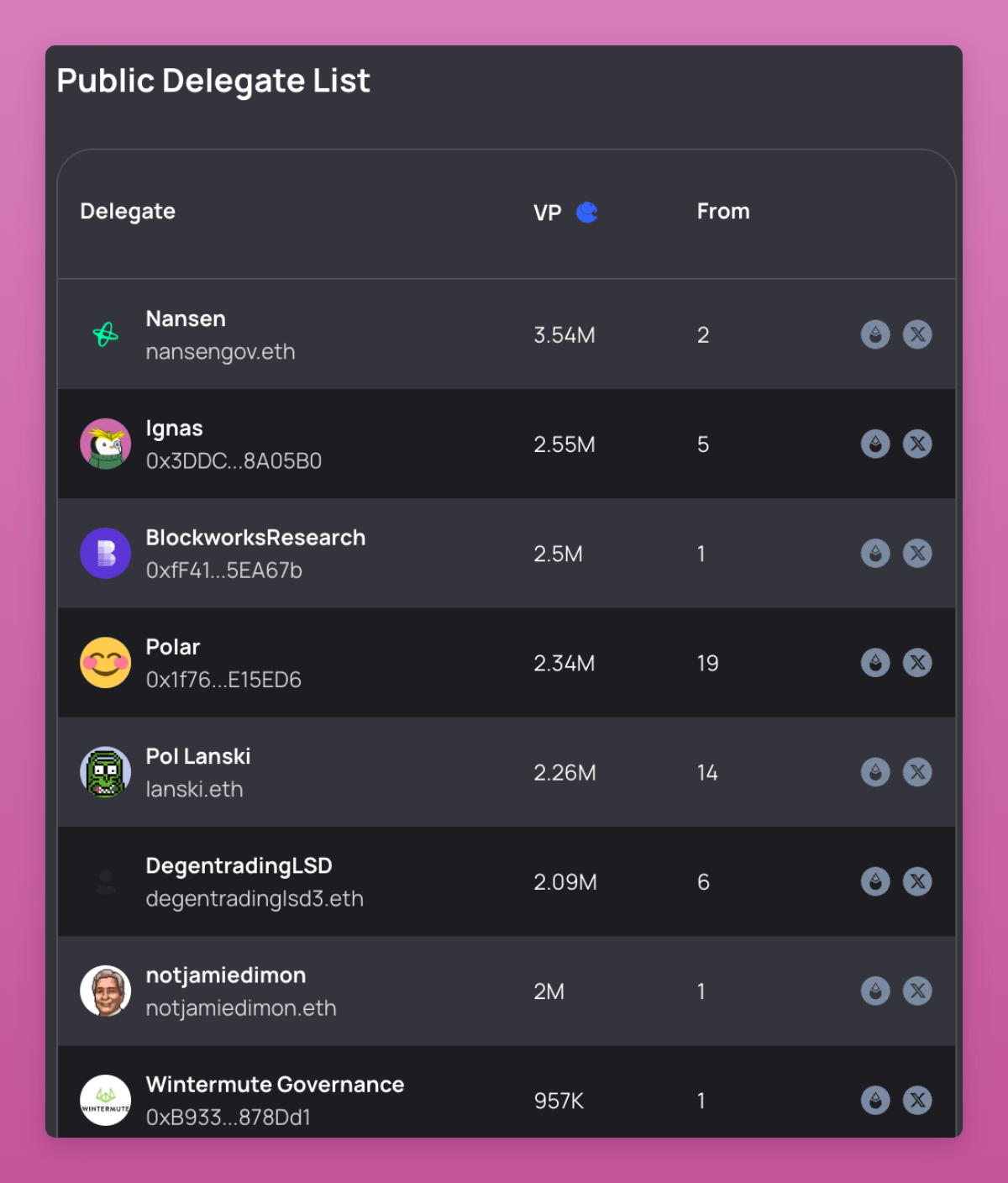
After discussing token holder and protocol incentive alignment on Twitter, an anonymous whale delegated 2.5 million LDO to me. Honestly, I earned that delegation because I’m well-known from my posts on X. Playing the popularity game on X has opened many doors in crypto that few realize exist.
Now, multiple protocols reach out thanking me for voting on their proposals or requesting support for future ones. There’s significant relationship-building within each DAO that isn’t visible in public X threads or DAO forums.
Mindset of a Player
Did you know Vitalik Buterin started working on Ethereum shortly after Blizzard removed the damage component from the beloved Warlock spell "Life Tap"?
-
“I cried myself to sleep, realizing that day how terrible centralized services could be. I quickly decided to quit.” — Vitalik (this quote from his personal page has since been deleted).
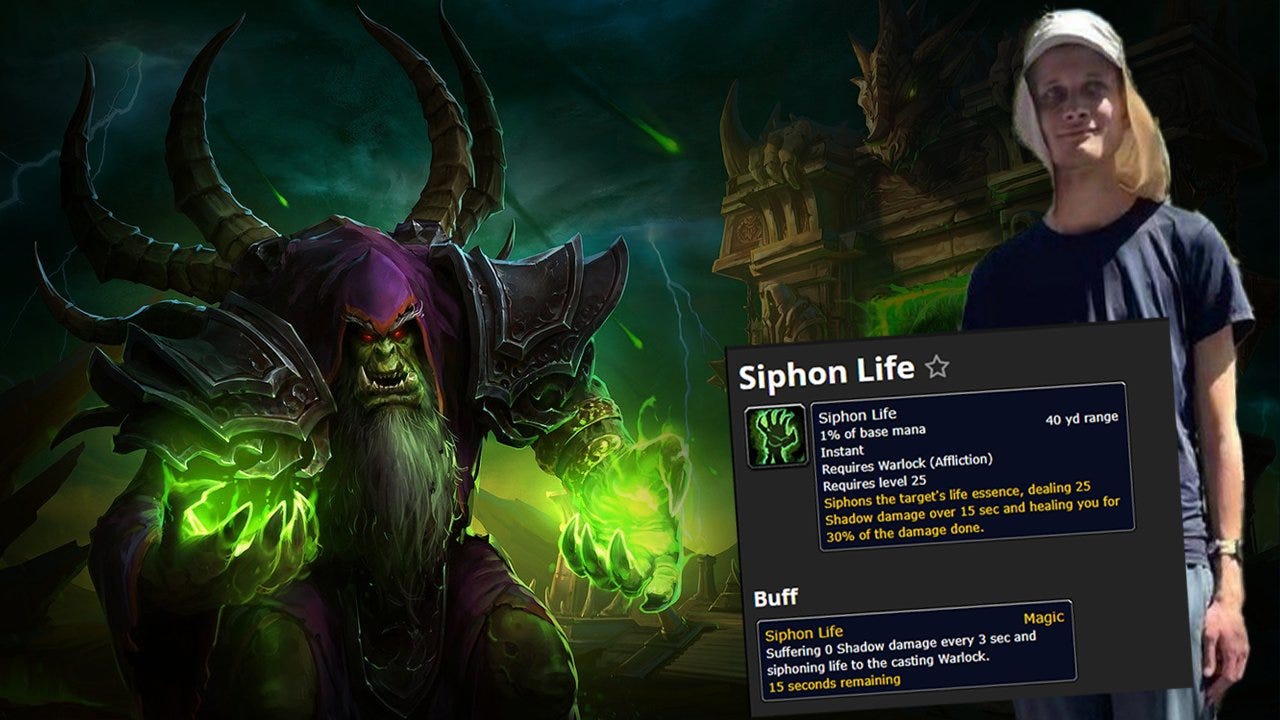
Vitalik quit World of Warcraft because he felt powerless over the game’s rules.
The appeal of crypto is that each of us can participate and influence the rules.
Like blockchains themselves, the gameplay in crypto is decentralized. VCs, retail investors, developers, and KOLs—we all play different roles, some with more influence than others.
Ansem, Murad, and other meme coin influencers drive the meme cycle, but you can choose not to play their game simply by not talking about or buying meme coins.
Slight tangent, but I’m surprised by how little influence VCs seem to have in shaping narratives. Crypto VCs should advocate for their investments, yet they have minimal presence on X.
Do they even care? Or are they playing a different game altogether?
A notable exception is Kyle from Multicoin, who actively promotes his portfolio. More VCs should share their vision for the industry, support their invested protocols, and publish deep research to clarify current dynamics.
Based on interviews I’ve conducted with crypto VCs, one possible explanation is that they’re essentially ordinary speculators—just with more capital.
In a strange coincidence, while Vitalik was playing World of Warcraft (2007–2010), I was immersed in another MMORPG—Lineage 2.
In Lineage 2, you choose a race (e.g., human, elf, orc) and a class (e.g., warrior, mystic).
You level up by completing quests and defeating enemies, gaining XP. Leveling unlocks new skills, better gear, and access to harder content.
I spent two years grinding obsessively, sleeping only a few hours a day. These memories are deeply ingrained and continue to shape how I approach crypto trading.
Just like earning XP in a game, in crypto you gain experience by learning blockchain, understanding DeFi, studying tokenomics, etc. The harder you work, the more knowledge you accumulate.
While grinding, you also need to monitor your HP (health points) and MP (mana points).
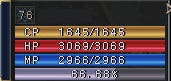
HP and MP represent your health, financial stability, and emotional resilience. Both gaming and crypto demand relentless effort, which can lead to burnout. In crypto, the pressure to stay ahead, constant market monitoring, and fear of missing out create a high-stress environment—like being trapped in an endless game with no exit.
During the last bull cycle, I burned out badly, so now I take a break every three months to manage my “HP.”
Does it sound strange how I view crypto?
The similarities extend to demographics: the majority of crypto participants are male, much like MMORPGs, where only about 35% of players are female.
South Koreans' passion for crypto mirrors their obsession with esports (like League of Legends), even surpassing traditional sports. No wonder GameFi resonates so strongly in the crypto space.
My point is, a gamer’s mindset can help you stand out in crypto. Just pick the right game and understand your role within it.
In his famous thread “How to Get Rich (Without Getting Lucky)”, Naval mentions “game” and “play” a total of 15 times! His advice includes:
-
“Ignore people playing identity games. They build identity by attacking wealth creators.”
-
“Choose an industry where you can play long-term games with long-term people.”
-
“Play iterated games. All returns in life—wealth, relationships, knowledge—are compound interest.”
And my favorite:
-
“Specific knowledge will seem like play to you, but like work to others.”
So, what game are you playing in crypto?
What’s Your Role in Crypto?
Crypto has grown increasingly complex in recent years. Before 2020, success often meant simply investing in ICOs or trading on centralized exchanges (CEX). Since then, the landscape has exploded: DeFi, Layer 2s, NFTs, RWAs, Runes, Meme Coins, and more.
So, how do you keep up?
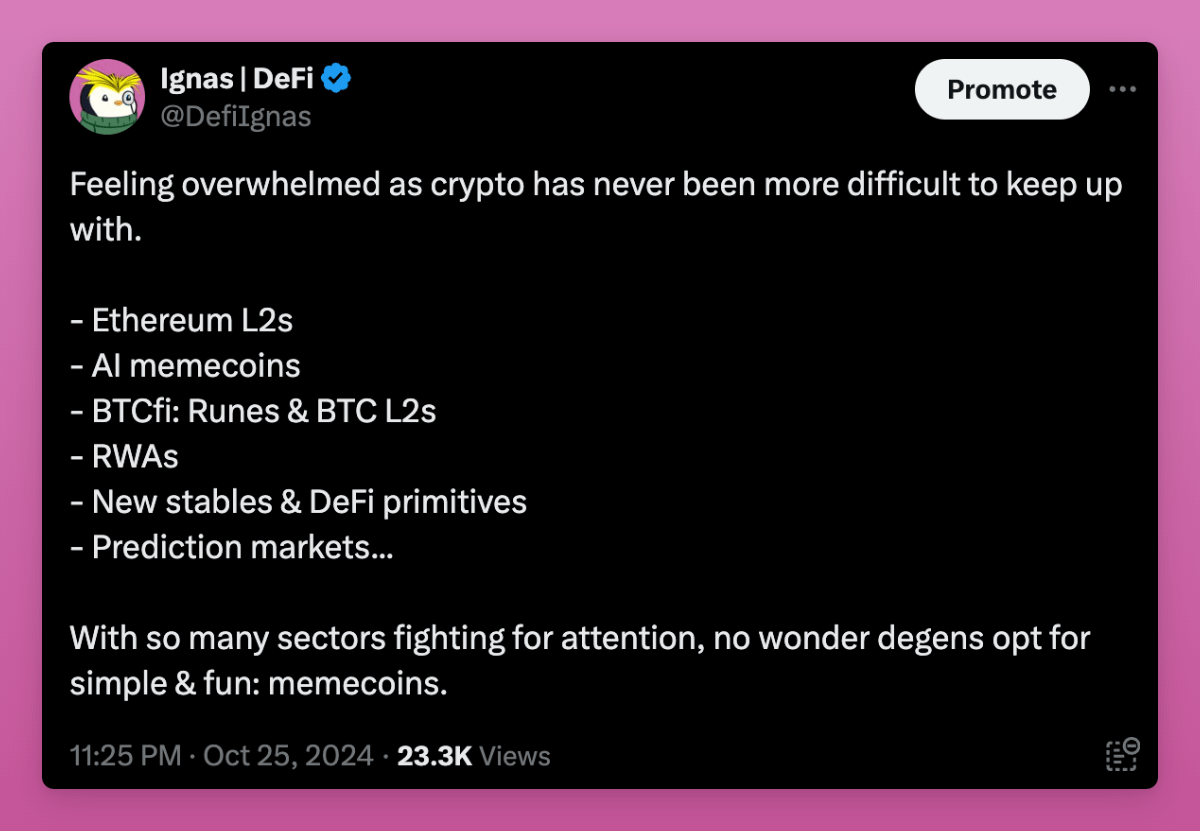
Do you specialize in one area, or try to “collect them all”?
In MMORPGs, you first choose a race, then a class. In Lineage 2, I picked the least popular options because I wanted to stand out and increase my chances of becoming a “hero.”
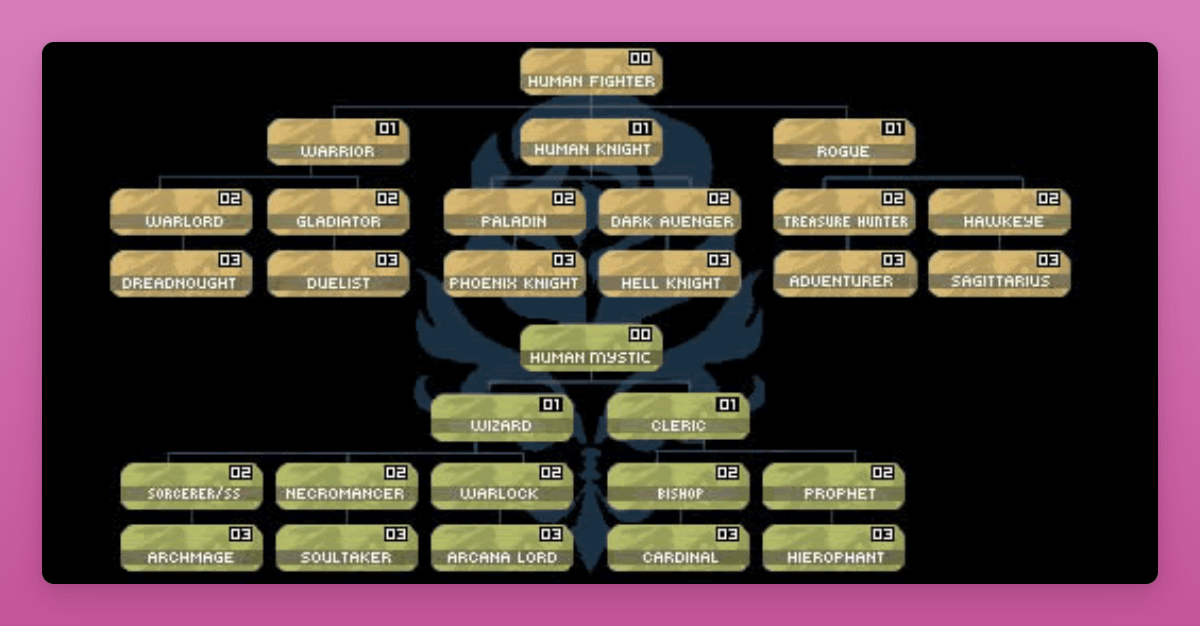
I chose Human Mystic, then focused on Warlock, later evolving into Arcana Lord. This class was unpopular because it relied heavily on pets to defeat enemies.
Similarly, in crypto, after learning the basics, you can specialize in active trading, DeFi yield farming, meme coins, DAO delegation, and more.
Many lack the discipline to master a specific skill, jumping between narratives without truly understanding them. As a result, they miss out on the intricate game theory needed to dominate a niche, eventually becoming exit liquidity.
In reality, hopping between narratives while profiting can itself be a valuable skill—if you can identify capital rotation patterns and exit before funds shift elsewhere. Are you good at that?
Still, I believe focusing on one area yields significant advantages in today’s market:
-
Crypto Koryo excels at creating and monetizing content via Dune dashboards.
-
USD Denominated on X focuses on stablecoin markets, skillfully navigating complexity for maximum yield.
-
Andy goes all-in on modular blockchain narratives, despite skepticism in the broader crypto community.
-
wale.moca runs a great account focused on NFTs (what a commitment!)
But always watch influencers closely—their motivations may differ from what they claim. The game they play internally may not match the one they publicly promote. Don’t end up playing a game rigged against you. For example, Ansem attracts celebrities and monetizes in certain ways :) .
Why do you think I post on X?
I post on X to: 1) stay aligned with the market, 2) attract clients to my DeFi creator studio Pink Brains, and recently, 3) expand my influence and secure token delegations for voting.
This strategy lets me explore diverse topics, even if I'm not an expert in any single one.
But as you grow your following on X, pick a field you genuinely love. Then gradually diversify your content. Posting builds influence—so everyone should do it.
Becoming an influencer is like becoming a hero in Lineage 2. Your character gains a special aura—not only boosting stats but allowing you to broadcast messages across the entire server. Ironically, I chose the least popular class because it reduced competition for hero status.
Many of you work at crypto companies, forcing you to specialize in marketing, market-making, or private sales. This gives you an edge over hobbyists—access to relationships, insights, and even the ability to influence game rules.
Today, focus is key to uncovering real opportunities.
While holding BTC or ETH is safe, achieving 100x returns now requires deeper digging—like searching for gold in a thoroughly mined field. As Naval says, find work that feels like a game to you.
Whether it’s DeFi, on-chain wallet tracking, or spotting opportunities in DAO forums, let curiosity guide you. By building specific knowledge, you’ll discover opportunities others miss.
This niche—small enough to fly under big players’ radar, yet large enough to win—might be your goldmine in the crypto game.
Join TechFlow official community to stay tuned
Telegram:https://t.me/TechFlowDaily
X (Twitter):https://x.com/TechFlowPost
X (Twitter) EN:https://x.com/BlockFlow_News
 Ignas | DeFi Research






