In the era of encryption, the boundaries between payment and investment are vanishing.
TechFlow Selected TechFlow Selected
In the era of encryption, the boundaries between payment and investment are vanishing.
For the first time ever, users can earn returns from two distinct yield-generating tracks simultaneously—using the same balance and the same interface.
 Navigating Web3 tides with focused insights
By Jack Simison
Translated by Chopper, Foresight News
Payments and investment management collectively generate $3 trillion in annual revenue—exceeding the total market capitalization of all cryptocurrencies. These two domains rely on entirely distinct user behaviors and fundamentally different underlying infrastructures; even today, they correspond to wholly separate product ecosystems. Here, I aim to directly compare these two worlds.
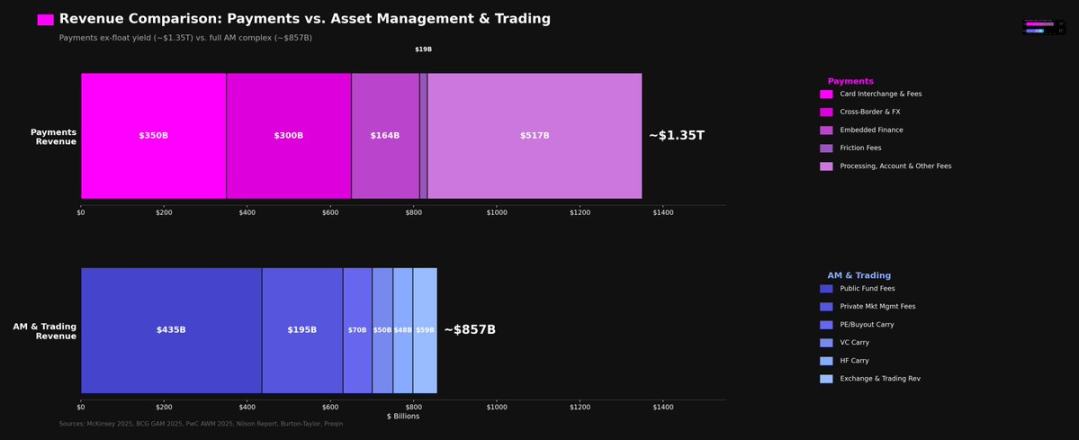
One sector earns money from payments everyone must make—payments are essential for survival, a necessity. The other earns money from investments most people will never choose to make—investment is a luxury.
Payments and investment management are the two largest revenue-generating segments within financial services. For decades, they have operated within entirely independent systems: different products, different accounts, different regulatory frameworks, and different user interfaces. This separation stems both from legacy system architecture and from the historical absence of any practical need to integrate payments with investment.
Programmable money is now breaking down this barrier. Today, the same balance—held in a single wallet, on a single public blockchain, or within a single application—can simultaneously participate in both revenue streams. These two worlds are converging into a unified account model.
To understand why this matters, we must first recognize the profound differences in their underlying behavioral logic.
Payments: A Universal Behavior
Payment is the only financially mandatory behavior required to participate in daily economic life. Purchasing food, paying rent, settling utility bills—without payment, human survival is impossible.
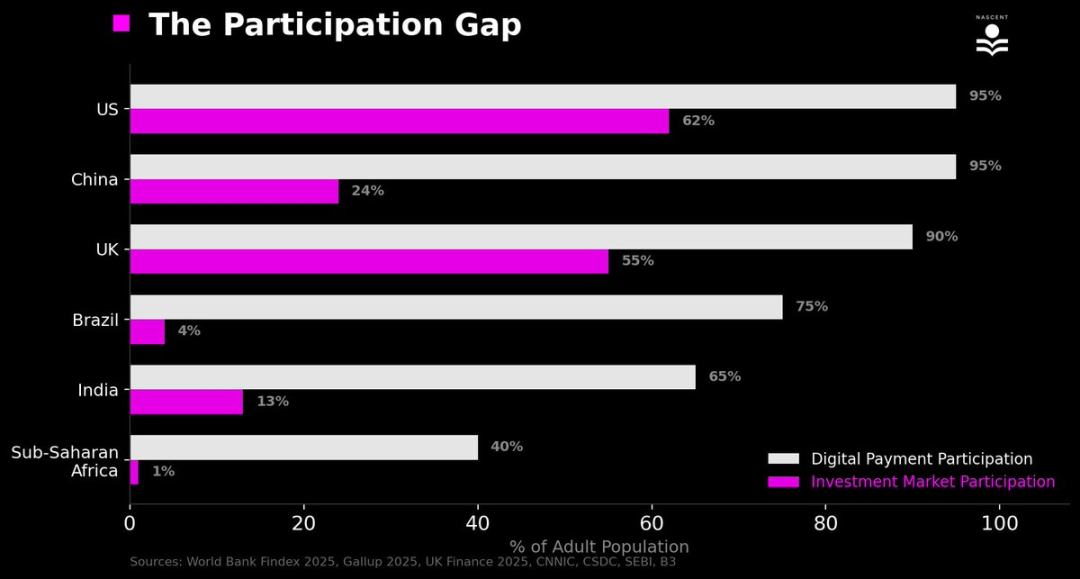
In 2025, approximately two-thirds of adults worldwide made or received digital payments. In the U.S., consumers complete roughly 48 payments per month; India’s UPI boasts over 500 million unique users; Brazil’s Pix has raised the average annual transaction volume per person to about 193; and in parts of Sub-Saharan Africa, mobile payments have evolved beyond mere convenience—they are now integral components of the financial system.
Payment is not an optional financial activity reserved for a small group of active participants—it is a routine behavior for the masses. It is instantaneous, high-frequency, and psychologically low-friction, with costs typically negligible. Consumers do not consciously calculate transaction fees at checkout. Compared to cash, digital payments reduce “payment pain,” further increasing usage frequency. The lower the friction, the higher the transaction volume.
This behavioral foundation delivers massive business reach. According to McKinsey, global payment systems process approximately 3.4–3.6 trillion transactions annually, with annual fund flows totaling roughly $1.8–2.0 quadrillion. Payroll disbursement, merchant payments, cross-border remittances, bill payments, subscription services, and peer-to-peer transfers—every link in this chain offers intermediaries an opportunity to capture value.
Every layer of the payment chain profits.
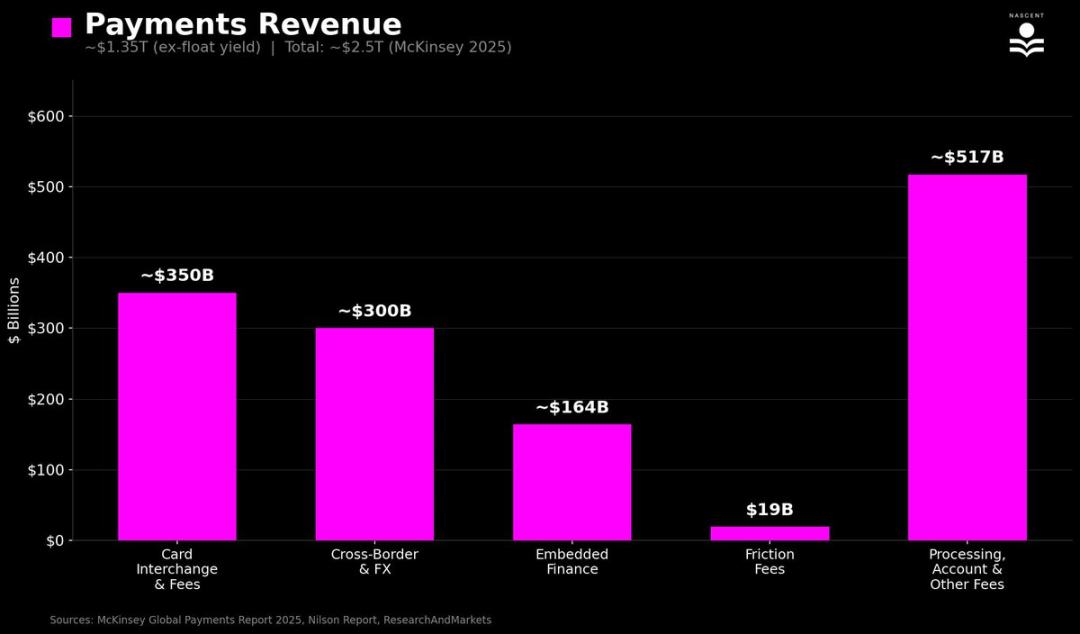
McKinsey’s 2025 Global Payments Report estimates global payment revenue at approximately $2.5 trillion. However, nearly half ($1.15 trillion) consists of net interest income—the yield banks and payment providers earn on idle funds held between transactions. This is more accurately described as idle-capital yield rather than pure payment processing fees. Excluding that portion, core payment revenue—including funds transfer, interchange fees, processing fees, embedded finance (e.g., Shopify, installment payments, Stripe), and friction-based charges (ATMs, overdrafts, on-chain fees)—still amounts to around $1.35 trillion.
Investment: A Luxury Behavior
By contrast, investment is a financial behavior no one is compelled to undertake. A person can live their entire life without buying stocks, opening a brokerage account, or consulting a financial advisor—and still navigate economic life fully. Most people do exactly that. Active individual traders constitute only a statistical minority.
Unlike payments, investment directly confronts loss aversion and imposes heavy cognitive burdens. People instinctively avoid trading, so most retail investors’ capital sits passively in pension accounts, portfolio allocations, ETFs, and index funds—bought once and left untouched. Among those participating in investment via pension plans, 94% make no subsequent adjustments after enrollment and almost never trade.
The result: investment rests on a narrow, passive—but highly sticky—behavioral foundation.
Participation rates illustrate this starkly: even in countries with the highest investment penetration, only about half the population engages with investment markets in any form, while digital payment penetration reaches up to 95%.
- U.S.: ~62% of adults hold some form of investment, mostly in low-activity pension accounts
- U.K.: ~55%, closely following the U.S.
- China: ~24% of adults hold securities accounts
- India: ~13%
- Brazil: 4%
- Sub-Saharan Africa: ~1%
Having an account does not equate to active participation.
This dynamic enables professional intermediaries to manage approximately $147 trillion in global assets under management (AUM), including ETFs, mutual funds, pensions, and private-market funds—representing 43% of global household financial wealth (~$305 trillion). The vast majority of this is passive index investing, with extremely low fees: equity ETFs average just 14 basis points, bond ETFs 10 basis points. Even so, the fund industry—managing roughly $135 trillion in assets—generates ~$43.5 billion in annual revenue.
Assets managed by private equity, venture capital, real estate, and hedge funds (~$13 trillion) charge 1%–2% management fees plus 12.5%–20% performance fees, generating ~$36.3 billion annually.
Adding advisory fees from private markets, hedge fund performance fees, PE/VC carry, securities lending, and trading commissions, the investment industry’s total annual revenue stands at ~$85–90 billion.
Overall, the payments industry still generates higher total revenue than investment—but the investment industry yields far higher revenue per participant.
The Collapse of Boundaries
This asymmetrical structure remained stable for decades because the two domains long existed in isolated systems with separate infrastructures.
Payment operations are fragmented across banks, card networks, and payment processors. Asset management resides with fund companies, wealth advisors, and pension platforms, while trading is handled by brokerages.
Even when a single bank offers both checking accounts and investment services, they operate as discrete products—with separate customer onboarding, compliance processes, and user experiences. Institutional structures have further reinforced the behavioral divide between “spending” and “investing.”
The real shift lies in blockchain infrastructure: modern payment applications can now deliver genuine investment services, and investment applications can offer authentic payment functionality—all built atop shared underlying systems.
Investment balances can be used directly for payments, eliminating the need for inter-system transfers. Traditional brokerage workflows require: deposit → buy → sell → withdraw to bank → spend. Crypto infrastructure compresses this into a single step.
Wallets, neobanks, trading apps—or any programmable balance—enable the same dollar to settle a cross-border transfer while simultaneously earning yield in a lending protocol, or to be exchanged for another asset—all within the same interface and single session. Account holders can profit simultaneously from both payment and investment channels.
For the first time ever, the same balance—and the same interface—can generate revenue from both sectors.
Join TechFlow official community to stay tuned
Telegram:https://t.me/TechFlowDaily
X (Twitter):https://x.com/TechFlowPost
X (Twitter) EN:https://x.com/BlockFlow_News
 @JackSimison