








Legendary investor Tudor Jones: All great wealth comes from holding long-term trends.
TechFlow Selected TechFlow Selected
Legendary investor Tudor Jones: All great wealth comes from holding long-term trends.
Paul Tudor Jones apologized to Warren Buffett in an interview, calling him the “pioneer of compounding.”
 Navigating Web3 tides with focused insights
By Long Yue
Source: WallStreetCN
Recently, legendary investor and Tudor Investment Corporation founder Paul Tudor Jones delivered a candid, in-depth interview reflecting on his 50-year trading career and offering sharp insights on critical topics including AI risks, U.S. equity valuation bubbles, gold markets, and Warren Buffett’s investment philosophy.
He distilled five decades of market experience into three powerful statements: compound interest is the most underestimated force; Warren Buffett is the most underestimated genius; and AI is the most underestimated threat. Selected highlights from the interview:
- Buying the S&P 500 at current valuations implies a negative 10-year return, based on historical data.
- We are living inside a sovereign debt bubble. The stock market capitalization-to-GDP ratio stands at 252%—compared to 65% in 1929 and 170% in 2000.
- Gold’s annual supply increase is roughly 2%, whereas Bitcoin’s total supply is finite and decentralized.
- On gold’s largest single-day decline in history, silver plunged 33% in one day. On days like that, you must monitor every minute’s price action.
- The consensus answer to AI safety is: we won’t act until 50 million—or even 100 million—people die in a single incident. That is utterly insane.
- I entered this profession because I wanted to make a lot of money—and then give it all away. I believe that is pursuing a noble cause.
- Anyone who achieves true success in investing or trading must first be a great risk manager.
- The most important principle: you profit by riding trends for as long as possible. All great wealth is accumulated by holding onto a trend over the long term.
- Warren Buffett is the OG of compound interest. He understood its power at age nine—while I spectacularly avoided it throughout my entire career. I sincerely apologize to him.
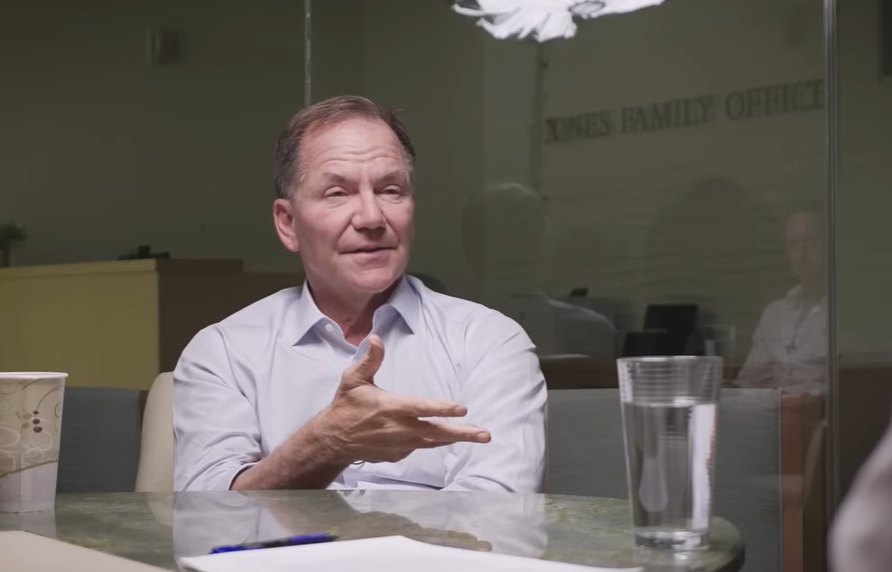
Apologizing to Buffett: “I’ve Been a Total Fool”
At the outset of the interview, Jones drew a sharp distinction between investors and traders—and offered a self-deprecating, humorous “confession.”
“I used to sit there year after year criticizing Warren Buffett,” he said. “My thinking was: he just happened to be in the right place at the right time, catching this bull market. If he’d been in Japan, starting from the Nikkei in 1989, it would have been an entirely different story.”
Yet his perspective shifted completely after listening to a podcast episode about Berkshire Hathaway.
“I remember thinking: ‘Oh my god, this guy is a genius—and I’ve been the biggest fool.’ He grasped the power of compound interest at age nine, while I brilliantly managed to avoid it for my entire career.”
He specifically highlighted Buffett’s partnership with Charlie Munger: “Buffett buys $1 assets for 50 cents, while Munger understands the compounding power of businesses with enduring growth. Together, they’re unstoppable.”
He concluded: “Warren—if you happen to hear this episode—I’m truly sorry. You’re the undisputed OG of compound interest, and I wish I had even one-tenth of your wisdom.”
Jones likened his own trading style to an NFL right tackle: “I’ve played right tackle in the NFL for 50 years—every day fighting in the trenches. Whenever someone tells me they want to get into trading, I tell them: go do long-short equities, go do value investing.”
His Schedule: Waking at 2:30 a.m. to Watch London Open
When asked about his daily routine, Jones shared an astonishing schedule—one he has maintained for over 40 years:
- 6:15 a.m.: Wake up and work until 7:00 a.m.
- 7:00–7:45 a.m.: Exercise—45 minutes of high-intensity cardio
- Pre-market until 10:00 a.m.: Monitor markets
- 10:00–12:00 p.m.: Meetings
- Afternoon: Lunch, meetings, plus one hour before and one hour after market close for review and next-day planning
- 5:00 p.m.: Return home and walk with wife for one hour
- 7:00 p.m.–evening: Work for one hour, watch news, watch Netflix
- 9:30–10:15 p.m.: Work again
- 2:30 or 3:00 a.m.: Wake up, work for 30 minutes, watch London open for ~45 minutes
“I’ve probably done this since the 1980s,” he said. “I feel like I’m working harder now than 40 or 30 years ago—because information volume has exploded. I receive 800,000 emails per day.”
He admitted that information overload is eroding his capacity for “precision execution”: “What does precision execution mean? It means buying when blood is flowing in the streets—and selling when euphoria reigns. When you’re trading 25 instruments simultaneously—and 48 emails arrive, each potentially actionable—information overload distracts you and prevents precision execution.”
U.S. Equity Valuation: The 252% Warning Line
On market outlook, Jones issued a clear warning.
Buying the S&P 500 at today’s P/E ratio implies a negative 10-year return, according to historical data.
He explained: “The S&P 500 is an excellent long-term investment tool—but that’s a 100-year average, which includes decades when the P/E ratio stood at six, seven, or eight—just one-third of today’s level. Valuation matters. Right now, the stock market is genuinely expensive.”
What worries him more is overall leverage.
“Our country is dangerously over-concentrated in equities,” he said. “The stock market capitalization-to-GDP ratio is now 252%. At the 1929 peak it was 65%; in 1987, 85–90%; in 2000, 170%; and now it’s 252%.”
He modeled an extreme scenario: “If valuations mean-revert to the past 25–30-year average P/E, that implies a ~35% market decline. Multiply that 35% drop by GDP’s 250% stock market weight—and you get 80–90% of GDP vanishing. Reverse wealth effect, zero capital gains tax revenue, exploding budget deficits, bond market collapse, and a self-reinforcing negative spiral—that’s deeply unsettling.”
He stated plainly: “We are inside a sovereign debt bubble. In equities, individual equity ownership in this country is at an all-time high.”
He also flagged liquidity risks in private equity: “From 2007–2008, private equity accounted for ~7% of institutional portfolios. Today it’s 16%. Liquidity is far worse than in 2008—you must account for this when allocating assets.”
AI Threat: Waiting Until People Die to Regulate? That’s Insane
On artificial intelligence, Jones revealed a systemic concern that transcends typical investor anxieties.
He described attending a small, closed-door meeting roughly 18 months ago with 35–40 participants—including one modeling expert from each of the four leading AI model companies.
“When I directly asked them how AI safety will be resolved, the near-unanimous answer was: we’ll likely wait until 50 million—or even 100 million—people die in a single incident before acting seriously,” he said. “That’s insane.”
He framed AI development’s core danger as the perilous application of the “build–break–iterate” model: “This has always been humanity’s invention pattern—build, break, iterate. But we’ve never faced a situation where the ‘break’ tail event could kill hundreds of millions—or billions.”
Jones stressed that AI regulation is the most urgent leadership test of our time: “If this were a problem at one of my own companies, it would already be contained. That’s what a great risk manager does. Yet here—there is virtually no risk management happening.”
He proposed a concrete policy: “I believe the single most important and immediate step we can take is mandating watermarks on all AI-generated content. Make it a federal felony—if someone knowingly violates this three times, send them to prison. I need to know what’s authentically human-created—and what isn’t.”
He added that shortly before the interview, he’d already received two calls from serious individuals asking about specific videos or statements—both turned out to be deepfakes.
“If we can return to honest, trustworthy, normal discourse, I think we must,” he said.
Gold & Trading: In Big Moves, Every Second Counts
On concrete trading opportunities, Jones cited USD/JPY as a major opportunity “currently brewing.”
“The yen is severely undervalued—and has been for quite some time,” he said. “Japan holds ~$4.5 trillion in net international investment position, ~60% of which is in U.S. assets—and mostly unhedged. That’s a massive dollar exposure. Now Japan has its most dynamic leader in half a century, one whose ‘Japan-first’ agenda will reshape the economy with strong entrepreneurial energy.”
He compared trading to boxing: “You enter the ring with your opponent—the market. You probe, feint, sense their rhythm, look for openings. Occasionally you spot a perfect opportunity—and throw a knockout punch.”
Describing the “largest single-day decline in gold and silver history,” he recalled: “Silver surged (including volatility) 33% in one day. You must stay laser-focused on every minute—what you do at the open, how you react if price breaks through a level you hadn’t anticipated that day. You must have a pre-defined plan—and it must execute automatically, thought out well in advance.”
Full Transcript: Paul Tudor Jones Interview
Legendary investor Paul Tudor Jones sat down with Patrick for an in-depth conversation covering his 50-year market career and life philosophy. Paul contrasted the radically different life states of traders versus long-term investors, shared firsthand reflections on the 1987 crash and the 1980 silver crash, and recounted his evolving view of Warren Buffett. He detailed his rigorous daily routine, macro assessment of today’s sovereign debt bubble, and profound concerns about AI safety and regulation. Beyond finance, Paul recounted the founding story of the Robin Hood Foundation, the transformative power of compassionate action, and offered guidance to younger generations: find deeper meaning beyond professional achievement.
Chapter One: The Kindest Thing (Opening)
Paul: My most important insight is this: the way to make big money is to ride a trend for as long as possible—go with the flow, persistently. Of course, you could choose to be a value investor like Warren Buffett, spending not a cent unnecessarily. For years, I criticized Buffett relentlessly, thinking he merely landed in the right place at the right time, catching this bull market. I’d mutter to myself: “God, if only I could be like Buffett—believing in America so firmly that even a 50% paper loss wouldn’t faze me, knowing America will carry us through.” Warren—if you happen to hear this, I sincerely apologize. You are the undisputed OG of compound interest.
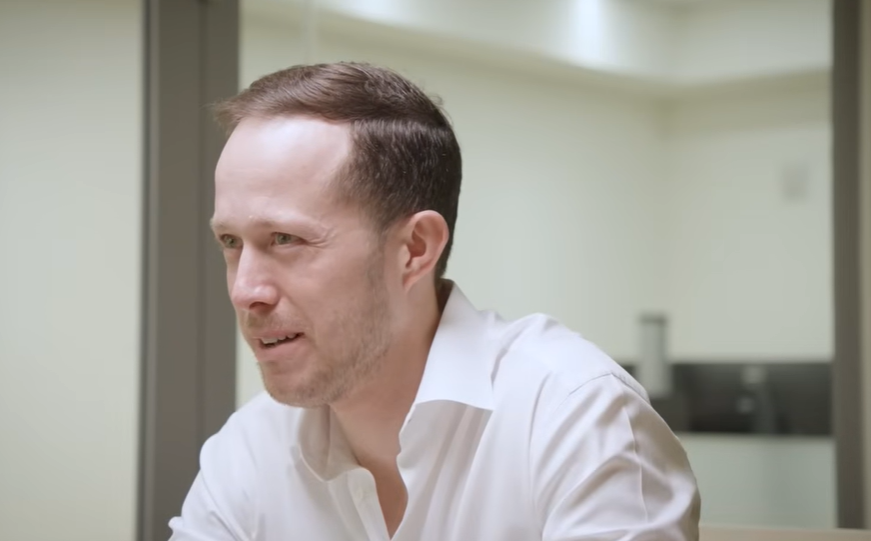
Patrick: At our last meeting, something you mentioned struck me deeply—and it’s the perfect opening for today’s conversation: the difference between investors and traders. You said you often wished you were an investor, because life would be so much easier. I’d love for you to describe the differences between these two lives—and what a trader’s daily reality looks like.
Paul: Absolutely—I’ll cover that. We’ll talk markets, AI, and much more. But there’s one segment on your podcast I consider most important—and if you don’t mind, I’d like to start there: the question you ask every guest at the end of each episode.
Patrick: Not at all—I love it!
Paul: Here’s why: Once I was giving a speech at what’s now Rhodes College in Memphis. As I prepared, a sudden thought hit me: Who was my commencement speaker? I couldn’t recall—not at all. It struck me as funny. No one remembers, right? Do you remember yours? You’re younger—you might.
Patrick: It was the President of Ireland. I went to Notre Dame—and as you know, I’m Irish.
Paul: Got it. But here’s the point—no one remembers their commencement speaker, because the setting itself invites distraction. I thought: “Good lord, I’ll speak for 15–20 minutes—and no one will remember a word. How do I make it unforgettable?” Same logic applies to your podcast: listeners hear many shows daily, and most fade from memory—only a few fragments stick. So if just one thing from this episode endures, I hope it’s what comes next.
Patrick: Perfect. As everyone knows, I always close each episode with the same question: What’s the kindest thing anyone has ever done for you?
Paul: That’s such a beautiful question—because the kindest thing is also my earliest memory. I was about two-and-a-half or three—around 1957. My mom and I were at a place called the Curb Market—and I got separated from her. Can you imagine? A two-and-a-half-year-old, terrified, convinced his mother had abandoned him. I stood there sobbing uncontrollably.
Then an elderly Black man approached and asked, “What’s wrong, little fellow?” I said, “I can’t find my mom.” He replied, “Don’t worry—we’ll find her together.” He took my hand and led me through rows of stalls—an open-air produce market. Even today, I faintly recall the scent of fruits and vegetables. We rounded a corner—and there was my mom.
I was overjoyed. Mom saw me, laughed—laughed so hard she couldn’t stop. She rushed over, picked me up, and tried to hand the man $5—a significant sum in 1957. He waved it off: “No, ma’am. You’d do the same for my child.”
Such a simple act of kindness left a deep imprint on me. That night, Mom helped me say bedtime prayers. We had a fixed list we recited nightly: God bless Mom, Dad, Peter, Paul, Alberta, Grand, Pete, Judy Lynn, Sid… I asked Mom, “What’s that man’s name?” She said, “I didn’t ask.”
From then on—for ten to twelve years—that man remained on my prayer list simply as “that man.” I repeated it perhaps four or five thousand times—every single night.
Fast forward to 1986. I was 32, living in New York, lying on the couch watching 60 Minutes. Harry Reasoner interviewed Eugene Lang—a businessman who returned to his Harlem alma mater to address elementary school graduates. Over the prior 60 years, the neighborhood had transformed completely—from affluent to overwhelmingly Black and Latino.
Eugene asked the principal: “Of these 12-year-olds, how many will go to college?” The principal replied: “Statistically? Maybe 8 or 9 percent.” Eugene was stunned—he’d gone to that school, then college, then built a successful career. So on the spot, he pledged to pay college tuition for every child who graduated high school. It moved me deeply.
He launched the “I Have a Dream” program for that graduating class. I thought: I can do this too. The next day, I called him. He said: “Interesting—three or four others have reached out. Let’s meet Tuesday night at my place.” I arrived late. I expected Harlem or the Lower East Side—but was assigned to Bed-Stuy, then New York’s most crime-ridden neighborhood, worse than the Bronx.
And so began a journey. I threw myself in—attending every Tuesday, showing up for the elementary graduation, pledging college funding for every student who completed high school—just as Eugene had. Everyone cheered; parents were emotional.
That journey lasted nearly 14 years—as I kept funding new classes. I became passionate—launching after-school tutoring, sports, life-skills training. After about three years, I noticed students performed poorly once they scattered across different middle schools—so I hired tutors.
Four years in, one child died in gang violence; several girls became teenage mothers. I realized I wasn’t just facing academic challenges—I was confronting vastly more complex social problems. I learned immensely from failure—and gained deep insight into what escaping poverty truly requires.
Incidentally, the Robin Hood Foundation launched the following year—in 1987. This hands-on experience shaped its trajectory profoundly. As Robin Hood grew, we adopted quantitative evaluation, set clear goals and benchmarks—and by the late 1990s, founded the Bed-Stuy Charter School of Excellence nearby.
It started as an all-boys school. We named it “Excellence” to signal our expectations. We assembled a dream-team faculty—and within four or five years, it ranked #1 among New York City’s 543 elementary schools.
The lesson? Passion matters—but methodology is essential. In education, methodology is everything.
Why does this connect to your question? Think: a simple act of kindness—by an elderly Black man helping a lost white boy. When I saw Harry Reasoner interviewing Eugene Lang, it felt like a mirror image of my childhood experience—triggering an instinctive resonance. That’s the power of kindness—a simple act creates ripples, amplifies impact.
I’m certain those four or five thousand nightly prayers for “that man” primed my response when I saw Eugene Lang’s story—and sparked my desire to emulate him.
I keep thinking: what if each of us consciously started each day with one simple act of kindness? Not grand—just as small as what happened to me at age three. Imagine the possibilities—if 350 million Americans did one kind thing daily, what kind of world would that be?
To young people: Around 2000, something changed. That atmosphere of mutual hostility, malicious criticism, winner-take-all mentality—it didn’t exist before. That’s not how our generation was raised, nor was it the culture of the ’70s, ’80s, or ’90s. Back then, civility and respect ran deeper. I believe we’ll return to that state.
So I tell young people: Don’t accept today’s climate as normal for this country. It’s not how this nation has historically been—and it won’t be how it remains.
Chapter Two: Aim High and Shoot Straight
Patrick: That story is breathtaking—the best answer I’ve ever heard to that question. And it’s the first time I’ve opened with it—delightfully fitting. So—what message did you ultimately deliver at that commencement speech?
Paul: I walked onstage and asked everyone over 50 or 60: “Do you remember your commencement speech?” Not a single person did. I love hunting and fishing, so I talked about everyday challenges—and shared my own struggle to craft something memorable.
Finally, I said: “Whatever you do…” Then I pulled out a bow and arrow and said: “Aim high and shoot straight.” The crowd erupted. I had an apple placed beside me—I shot it clean through.
Patrick: Really?
Paul: Yes—really. I don’t know if they still remember, but everyone ducked. I thought: “Now they’ll definitely remember.” I’d warned the president: “Don’t rush the stage—you don’t need to stop me. It’s part of the speech—I just want to give them an unforgettable night.”
Chapter Three: Trader vs. Investor
Patrick: That story sets up perfectly for my earlier question—how do traders’ and investors’ lives differ?
Paul: I entered the business in 1976, amid rampant inflation. I started on the floor of the Commodity Exchange, where prices were wild—doubling or halving yearly, with staggering volatility.
For example: Bunker Hunt was manipulating the silver market, buying ~200 million ounces at an average ~$3.12/oz. From 1976–1980, ultra-loose monetary policy and surging inflation sent silver soaring. By 1979, it hit ~$30/oz. Bunker’s net worth rocketed to ~$5–6 billion—making him the world’s third-richest person, worth three times the second-richest. He declared: “I believe silver is the most valuable asset and resource on Earth.” Asked what he’d do with it, he said: “Bury it. I’m going to bury it. In fact, I’ll buy another 20 million ounces—and bury that too.”
So he bought 20 million oz at $35/oz. News leaked—price spiked to $50/oz. His net worth ballooned to ~$11 billion—five to six times the second-richest person’s wealth. I couldn’t believe how much money one person had made.
Then COMEX imposed a rule allowing only liquidation—not new long positions—because physical holders were cornered, facing daily margin calls banks couldn’t sustain. Silver collapsed from $50 to under $10 in roughly eight weeks. Watching Bunker Hunt go from world’s richest to near-bankrupt profoundly shocked me—and permanently shaped my investment philosophy.
From that moment, I vowed never to hold anything long-term—and never to trust any asset blindly. My grandfather told me, when I was very young: “Son, your net worth equals only the check you can write tomorrow.” That stuck with me. So liquidity isn’t just a concept for me—it’s bone-deep instinct.
My early trading career confirmed this. With just a $10,000 account, I could grow it to $100,000—or lose it all. In my early twenties, a friend could turn $2,000–$3,000 into $2 million—but market swings were unprecedented. We were both EF Hutton brokers, and nicknamed him “the undertaker”—because he’d grow a $10,000 account to $1 million, generating $100,000 in commissions en route—then drive it negative.
So liquidity’s importance is coded into my DNA—because volatility was so extreme, and we all lived on the edge.
Back then, “buy and hold” was pure comedy—short-term returns were staggering.
Later, a mentor taught investing at the University of Virginia—and invited me to guest-lecture in 1982. I’ve returned each semester since. My favorite story for that class: how history’s greatest fortunes were built. I’d ask: Who’s the world’s richest person? Then it was Bill Gates and Warren Buffett. How did they do it? My conclusion: They rode trends for the long haul. That’s my most vital lesson.
I distill it into two or three points—the core idea: To make big money, ride a trend as long as possible. Paths vary—you can own a company like Gates or Jobs, or do value investing like Buffett, spending not a cent unnecessarily.
I criticized Buffett year after year, smugly thinking: He just happened to be in the right place at the right time, catching this bull market. If he’d been in Japan, impossible; if he’d started from the Nikkei in 1989, impossible. Pure timing—a bull market creating a genius.
This year marks roughly my 50th year in the business. My biggest distinction between trading and investing lies in my BBI Fund: Over 40 years, its correlation with the S&P 500 is -0.12. So 100% of our returns are alpha—zero beta.
I’ve often thought: If only I could be like Buffett—believing in America so firmly that even a 50% paper loss wouldn’t shake me, trusting America will lift us through. Of course, he works hard like anyone—but that belief system is extraordinary. Meanwhile, I feel like I’ve played right tackle in the NFL for 50 years—every day battling in the trenches, no respite. Whenever someone says they want to trade, I tell them: Go do long-short equities, go do stocks—do anything else. I’ve always envied that belief system—it works so well, enduring so long.
But I must admit—if I were Buffett, suffering a 50% drawdown in 2008, the psychological toll would be immense. I doubt I possess his calm, patience, and resilience.
Then I heard the “Acquired” podcast episode on Berkshire Hathaway—and learned Buffett grasped compound interest’s power at age nine. My reaction: “This man is a genius—and I’ve been a fool.”
I’ve long wanted to write a book titled Now I Get It, chronicling my lifelong series of cognitive errors. Now I get it—I’ve been incredibly foolish. That man is a complete genius—grasping compound interest at age nine—while I spent my entire career successfully avoiding it. He got it at nine; at 17, he sought out Benjamin Graham at Columbia. What foresight.
That podcast also revealed he was smart enough to find Charlie Munger as a partner. Charlie is clearly a genius in his own right: Buffett buys $1 assets for 50 cents; Munger deeply understands the compounding power of enduringly growing enterprises. Their pairing is perfection.
Warren—if you happen to hear this, I sincerely apologize. You’re the undisputed OG of compound interest—and I wish I had one-tenth of your brilliance.
Patrick: You later spoke with him about AI—what did he say?
Chapter Four: AI’s Existential Risk
Paul: Whether trader or investor, true success in this field demands being an exceptional risk manager. Every genuinely successful person starts there.
Roughly 18 months ago, I attended a conference—and what I heard shocked me deeply. I mentioned it on CNBC afterward, and Buffett—who watches CNBC daily—sent me a message: “I agree 100%—but the genie is out of the bottle, and I don’t know if we can put it back in.” I believe he fully acknowledges AI’s real threat.
AI’s biggest problem? News in the past 12 hours has only deepened my unease. Current AI deployment follows a “build–break–iterate” model: build, let it fail, fix it, iterate. That’s humanity’s ancient invention pattern—nothing new.
But we’ve never faced a scenario where the “break” tail risk could kill hundreds of millions—or billions. At that conference, ~35–40 attendees included one modeling expert from each of the four largest model firms. When I asked directly how AI safety would be solved, they almost unanimously answered: We’ll likely wait until 50 million—or 100 million—people die in one incident before acting seriously. That’s appalling.
My top AI concern: First, this technology was deployed without any public vote—no one got to say “yes” or “no”—unlike most technological innovations. Yet its tail risk is unprecedented.
Recall: Just 18 months after the atomic bomb, Congress and the U.S. government showed enough foresight to create the Atomic Energy Commission—to regulate a technology with massive tail risk. We’ve now developed AI for three years—and talk of regulation? What?
If any leadership challenge deserves a president’s immediate attention, it’s regulating AI now—not just in the U.S., but convening all relevant parties to ensure we avoid catastrophic outcomes. And that’s just safety—before even addressing AI’s societal disruption.
Matt Shumer recently published a long piece detailing how two new models released six days ago will devastate labor markets in unimaginable ways. To me, these developments grow increasingly alarming. If this were any other domain, internal risk management standards would have imposed strict controls long ago. That’s what a competent risk manager does. Yet here—risk management is nearly absent.
Patrick: You say great investors and traders are great risk managers. Facing AI as this massive exogenous variable—how do you think about it?
Paul: I believe the simplest—and most important—thing we can do in the next election is mandate watermarks on all AI-generated content. This would be the most transformative action we could take for our nation—and the world. And it should be codified as law: Knowingly violating this three times constitutes a felony—jail time.
I need to know what’s authentically human-created—and what isn’t. Only then can we begin rebuilding social trust—which I believe is one of our biggest challenges today.
This year, I’ve already received two calls from credible people asking about specific information—both turned out to be deepfakes. I believe watermark legislation is essential to restore honest, respectful, normal social dialogue.
Another reason this urgency exists: At that 18-month-old conference, many scientists envisioned a future where chips are implanted in human brains to access vast knowledge and capability. I looked ahead—and realized we urgently need clarity on what we’re reading and viewing. Because that group—without consulting other Americans—deems human-machine hybrids acceptable, inevitable, and entitled to inalienable rights.
I disagree—and would vote against it. I believe most people would too.
Chapter Five: Riding Trends
Patrick: Returning to trader vs. investor distinctions, risk management, etc. I know you learned much from Eli Tullis. Those experiences were pivotal to becoming the trading legend you are. What did he teach you—and what experience benefited you most?
Paul: He was brilliant—especially at striking precisely when fear and greed both peaked. He traded almost exclusively cotton—sitting quietly, intently waiting—until market sentiment reached extremes—then acted. That skill is invaluable.
The most important lesson came from this: One weekend, we held large long cotton positions. Severe drought gripped the region—but rain fell over the entire planting belt that weekend. Monday opened limit-down. We were crushed. I thought: “It’s over.”
Yet at noon that day, his wife arrived with four friends for lunch. His office was the most impressive I’d ever seen. He emerged, smiling broadly, charming the ladies effortlessly. I sat dumbfounded: “This man just went bankrupt—and he’s playing Rock Hudson?”
That moment is seared in my memory: In adversity, stand tall. Hide pain inwardly—project confidence outwardly—believe fiercely in your comeback. That’s critically important.
Patrick: It feels timely to ask: What does trading mean to you? You’ve said the world is an interconnected network of capital flows—and trading means standing atop that network, positioning based on unfolding global events. But most people I interview buy company equity; few operate across asset classes and instruments with such large positions. I’d love you to describe: What is trading to you—and what do you actually do, day after day, for decades?
Chapter Six: The Essence of Trading
Paul: Several metaphors fit well. Boxing first—because you have an opponent: the market. You enter the ring—and your opponent attacks constantly. I envision not Mike Tyson-style brawling—but classic boxing: probing, jabbing, feeling out rhythms, seeking openings. Occasionally you spot a perfect chance—and land a knockout punch.
For knockout examples: Bitcoin in 2020 was a KO; the 2-year Treasury yield in 2022 was a KO. These rare, monumental opportunities arise only after long periods of waiting and accumulation. Most of the time, you gather intel, seek openings, aim to win each round—but truly decisive moments occur only a few times.
Patrick: I love the boxing metaphor. Bitcoin, 2-year yields, precious metals—you’ve seen it all. Could you pick one—and tell us exactly what you’re doing, watching, researching when those key windows open? What supply-demand imbalance did you spot?
Paul: Looking back at all truly massive moves, causes are often similar: markets run too far, imbalances persist too long, central banks or governments act unwisely. That’s the root of most big moves—and central banks or governments usually drive them.
Right now, a promising opportunity is brewing: USD/JPY. The yen is severely undervalued—and has been for quite some time. Key question: What’s the catalyst? Recently, Japan elected a new Prime Minister—possessing traits reminiscent of Ronald Reagan, Margaret Thatcher, or Trump post-second-term. Historically, when such leaders took office, their currencies appreciated ~10% rapidly. Japan holds ~$4.5 trillion in overseas net investment position—~60% in U.S. assets, mostly unhedged—meaning massive dollar exposure. Now Japan has its most dynamic leader in half a century, governing with “Japan-first” principles—and reshaping the economy entrepreneurially.
So you seek assets that are cheap, lightly positioned, and mispriced—and await the catalytic moment.
Same logic applied to the 2-year yield opportunity in 2022. We had massive fiscal stimulus overhang—and Fed Chair Powell prolonged loose policy excessively, seeking Biden’s re-nomination. Once Biden nominated him, shorting 2-year Treasuries became viable—because the Fed would inevitably normalize rates.
In 2020, seeing massive central bank and Treasury intervention signaled the inflation trade’s launch. Among inflation-hedge assets, which was best? Bitcoin—undeniably the best inflation hedge, better than gold, because its supply is capped.
Of course, Bitcoin has vulnerabilities: In hot war, cyberwar would disable electronic assets—including Bitcoin. That’s risk one. Risk two is quantum computing—no one knows if rapid AI advancement will accelerate its realization. If quantum computing arrives, anyone could crack any bank, breach any system. Gold’s supply increases a few percent annually; Bitcoin’s total supply is finite and decentralized—giving it unparalleled scarcity value.
Chapter Seven: Bubbles
Patrick: You’ve lived through 1987, the Global Financial Crisis, COVID-19—and countless asset bubbles. Could you start with those big events? You’re most famous for 1987—I’d love your firsthand account. Then—what do those experiences teach you about today? “Are we in a bubble?” is a hot question—usually answered by investors; traders’ perspectives are rare—I’d love yours.
Paul: Looking back at truly massive crashes, one root cause dominates: excessive leverage somewhere. And in every major event I’ve experienced, leverage was derivative-driven—futures or options.
The 1987 crash was 100% caused by portfolio insurance strategies—100%. Without derivatives, the maximum decline would’ve been ~10–15%.
Long-Term Capital Management in 1998—also massive derivatives, enormous balance sheet, all bets wrong.
2000 was different—the easiest bear market I’ve ever seen. It mirrored today in many ways—the 2001–2002 bear market followed massive 1999–2000 IPOs. As those stocks unlocked, selling pressure cycled continuously.
Similar dynamics are brewing now. I estimate planned IPOs over the next year equal ~5–6% of market cap. Over the past decade, buybacks removed ~2–3% of market cap annually—supporting prices. Now that logic reverses entirely.
It won’t happen instantly—but once IPOs unlock, rolling tops may emerge—18 months out, 6 months out. Watch buyback plans and unlock schedules closely—because they’ll steadily increase stock supply. Meanwhile, hyperscalers have committed massive capex—draining cash flow and weakening buyback capacity. So tech stocks remain stagnant—and will stay pressured, as much IPO financing drains from existing tech stocks.
Are we in a bubble? I’m unsure if it strictly qualifies—but we’re clearly over-reliant on equities to sustain the economy. By “high leverage,” I mean the stock market cap-to-GDP ratio is 252%. 1929’s peak was ~65%; 1987’s ~85–90%; 2000’s ~170%; now it’s 252%.
Looking at major bear markets since 1970, major mean-reversions occur roughly every 10 years. Mean-reversion means P/E returning to the past 25–30-year average. If that happens, the market falls ~35%—and 35% times today’s 250% GDP-weight equals 80–90% GDP wealth vanishing. Reverse wealth effect, zero capital gains tax revenue, exploding deficits, bond market carnage, self-reinforcing negativity—deeply troubling. Very deeply troubling.
So—are we in a bubble? We’re certainly in a sovereign debt bubble. In equities, individual ownership is at an all-time high. Bigger issue: liquidity. Private equity was ~7% of institutional portfolios in 2007–2008—now it’s 16%; real estate and infrastructure allocations rose too. Our liquidity is far worse than 2008—don’t ignore this when allocating assets.
A friend—a wealth advisor—hates hedge funds, deeming fees too high, and advocates full S&P 500 allocation. He asked: “If you were investing for the next 20 years, what would you advise?” He assumed I’d say “Buy the S&P 500 and forget it.” But if you buy the S&P 500 at today’s valuations—historical data shows a negative 10-year nominal return when buying at a 22x P/E. So yes—the S&P 500 is an outstanding long-term tool—but “long-term” is a 100-year average, including years when P/E was 6–8x—just one-third of today’s level. Valuation matters. Today’s equity valuations are high—making profits extremely difficult from here.
Chapter Eight: A Trader’s Day
Patrick: If I shadowed you today—what’s your daily routine? I know you’re always reachable by your execution traders—it’s intense. Can you walk us through your day?
Paul: Wake around 6:15 a.m., work until 7:00 a.m.; 7:00–7:45 a.m.: exercise—aim for 45 minutes of high-intensity cardio; then sit before screens awaiting open; no meetings before 10 a.m.; 10 a.m.–12 p.m.: meetings; lunch with colleagues, then another meeting; ensure one hour before and one hour after market close for next-day planning—and consider Tokyo and Hong Kong sessions that evening.
Return home ~5 p.m., walk with wife for one hour; upstairs to work one hour, then downstairs to eat; typically watch news and light entertainment—I used to read 1.5 books weekly, but the internet killed my nighttime reading. Last year I read one book—highly recommend it: David Wood, a newsletter writer, penned a book on globalization and markets. I believe it’ll become a bestseller—and maybe even a Netflix series.
Then work again ~9:30–10:15 p.m., then sleep. Wake ~2:30 or 3:00 a.m., work 30 minutes, watch London open for 45 minutes—quiet, productive time—then sleep until 6:15 a.m.
Patrick: You’ve done this for 50 years?
Paul: At least since the 1980s. I feel like I work harder now than 30 or 40 years ago—because information volume exploded. Good lord—I get 800,000 emails daily.
When I was a floor trader—even in the info-heavy 1980s—I could focus more deeply on one thing: tracking that day’s highs and lows—critical for execution. Like my boss Eli—I’d settle in, wait patiently, attuned: Is this the peak of pain? Is this panic the ideal buy point? Does it feel like it’ll rise forever? Is that the ideal sell point? Capturing those precise moments demands intense focus.
Managing 25 distinct instruments—sometimes correlated, sometimes not—requires conscious, deliberate judgment for each. While focused on that, 48 emails flood in—each potentially actionable. Today’s work is harder than ever—information overload sabotages precision execution.
Patrick: What does “precision execution” mean?
Paul: Buying when blood flows in the streets—and selling when cheers erupt. Take last Friday—the largest single-day decline in gold and silver history. Silver’s intraday volatility hit 33%. You must stay hyper-focused minute-by-minute—planning your open move, and how you’ll react if price breaches an unexpected key level. This circles back to my Bed-Stuy lesson: You must have a plan—pre-thought, pre-defined, auto-executable. My macro-trader friends echo this—they say: “I always feel two or three hours behind.” Last Friday was a textbook case—being slow cost dearly.
Chapter Nine: Passion for Markets
Patrick: Doing this daily requires immense passion for markets. Could you discuss discovering, cultivating, and sustaining that passion throughout your career?
Paul: On traders—especially “alpha creators” like me, not ordinary investors—we debated this at a Christmas dinner a year ago: Are great traders born or made? Almost everyone at the table agreed: 70% nature.
At 21, I was obsessed with games—chess, backgammon, parcheesi, Monopoly, war games, gin rummy—anything with rules, I played. In college, I gambled. I hold a degree in probability theory—but learned it not in math class, but through practice.
If I distill trading talent’s core trait, it’s: Type-A personality, intensely curious and knowledge-hungry, loves competition and games—because our field is probability theory in another form. To this day, I play bridge with friends constantly—I love all games of chance. I love trading.
I have another reason for loving trading. My wife is Australian—we married in 1989. She always said: “You live in New York—but I grew up by the sea. When our youngest graduates college, you’ll take us to live by the sea.” Sure enough, in 2014, our youngest turned 18—and we moved to Palm Beach. She arranged a family doctor for me—he’s 83 and still practicing. I asked: “You live here—everyone’s fossilized. What’s the secret to longevity?” He replied: “Simple—you die the day you retire.”
That resonated deeply. Because I realized: If you don’t use it, you lose it—and that truth intensifies with age. That’s why I exercise two hours daily—and why I keep trading: I need mental sharpness. My father lived to 100—and I have too much I want to do in my 90s. Trading is superb mental exercise.
Another reason I love trading: I want to earn a huge amount—and give it all away. I support so many causes that earning money feels like a noble pursuit. I enjoy the process—I wake each day grateful for the privilege—and I aim to go all-in, then donate it all.
Chapter Ten: The Robin Hood Foundation
Patrick: Could you tell us the Robin Hood Foundation’s origin story? It’s a vital part of your life and legacy.
Paul: Robin Hood launched the day after the 1987 crash. Ironically, that crash may have triggered my worst macro call ever—I was convinced we’d plunge into a Great Depression. I’d spent a full year studying 1929 patterns—and when it suddenly unfolded, I thought: “Perfect historical replay.”
So I called friends—and we sprang into action. That journey was magical. I strongly urge everyone to engage deeply in a cause they truly believe in. The most beautiful thing about charity is the people you meet—the greatest, kindest, most generous people—and they brighten every corner of your life.
We believed the economy would crater, poverty would surge—but almost no charities focused on poverty alleviation. So I believed: If you want something done, do it yourself. We started small—applying basic business principles to find the most effective anti-poverty methods. We stumbled, learned, and realized this was science—so we recruited top talent and built an organization.
The 1990s had a special spirit in finance—people eagerly participated and gave back. The era’s generosity moved me deeply. I don’t know exactly when—but we nurtured many outstanding philanthropists then. The 1980s weren’t like that—people linked themselves to orchestras, etching names on buildings—seeking status-based charity. After the crash, people found meaning in helping others. Perhaps because they’d amassed real personal wealth—and felt deep inner urges to give back. The financial and hedge fund community’s support for Robin Hood was moving—and remains so today.
Chapter Eleven: The Post-Work Era
Patrick: Broadly speaking—what aspects of today’s world make you most optimistic—and most vulnerable?
Paul: I’m trying to envision a “post-work era”—where AI does so much that work becomes unnecessary. I used to view this pessimistically—because many of us define ourselves through work. Imagining a world where “meaning”—a core component of human happiness—vanishes because work is obsolete—worried me.
But lately, I’ve grown more optimistic—because I notice athletes find meaning in sport, and I find meaning in competitive bridge. Perhaps humanity is adaptable enough to discover other forms of meaning. Perhaps it’s daily kindness—or something else. I believe our species is resilient and intelligent enough to find new paths to happiness.
I think the biggest challenge—within four or five years, as AI displaces so many jobs—will be: How do we live? How do we find meaning?
Chapter Twelve: The Power of News Writing
Patrick: Many young people struggle to find direction. You’ve written and spoken about communication’s importance—and news writing is an effective way to cultivate it. Could you tell young people why this matters?
Paul: I’ve long insisted journalism 101 should be mandatory at all universities—more valuable than an MBA. It was crucial to my development.
My father published a small trade and finance newspaper in Memphis—2,500 subscribers. I worked there as copy editor, front-page editor, and wrote many articles—while taking journalism classes. Journalism teaches one vital thing: lead with the conclusion.
Unlike other writing, it demands stating the most important point in the first sentence. Format is rigid: the lead paragraph must be ≤2 sentences—covering who, what, where, when, why, and how. The second paragraph covers the next-most-important point—also ≤2 sentences. And so on.
This is essentially principal component analysis: distilling any event into its most concise, logical structure—with the most critical information first, then descending order. In today’s attention-scarce world—time is money—you must convey full information in minimal space. An old adage says: If you can’t tell your story in 15 seconds, no one will listen. That’s truer today than ever.
As a macro thinker, this training is vital for every trading decision. I rapidly perform PCA on variables—separating signal from noise, identifying the dominant driver. In trading, 10 things matter—and each rotates as the most critical factor. The yen is an example: Undervalued for two years, timing never aligned—until this new PM’s election became the catalyst—making valuation—the overlooked factor for two years—the decisive variable.
Newspaper writing style is essential for building any logical framework: In any specific instrument and moment—what’s the most actionable information? What’s my checklist? How do I prioritize? That’s trading in its entirety.
Chapter Thirteen: The Principal Components of a Good Life
Patrick: If you applied the same framework to describe the principal components of a good life—what would they be?
Paul: God, family, friends—and by friends, I mean joy—so: God, family, friends, joy, and service to others.
Meaning won’t come from trading. Meaning begins with family. Sometimes I even look forward to my own funeral—I’ve selected the songs to be played, carefully chosen. I almost wish I could witness it—because it’ll be a beautiful gathering, and I believe my family and friends will thoroughly enjoy it.
At life’s final moment, I won’t think about the 1987 crash or Bitcoin—I’ll reflect: Whom did I love? Who loved me? What relationships and moments defined us? Professional achievement is merely a tool—to do more meaningful things: What did I do for my family? For my friends? How did I serve others? What legacy of happiness and kindness did I leave for those fortunate enough to cross my path?
And when I say “legacy,” I mean action—not words. What did I do to make others’ lives better, happier? To me—that’s the most important thing. Period.
Patrick: Have you always believed in God?
Paul: I waver sometimes. I do believe—but my faith is tested, as anyone’s is. I wish I were 100% certain I’ll go to heaven—but I pray every night.
I think faith matters because you need behavioral guidelines—a foundation for life. Christianity, Judaism, and many religious traditions beautifully provide stability, order, and goodness—enabling sustainable living and joyful coexistence with others.
Patrick: What does Africa mean to you?
Paul: I love Africa—because I love nature. Let me share something I took 70 years to realize: My favorite thing now is finding the “peak of spring” and “peak of autumn.” You don’t need Africa—your neighborhood suffices. When spring is most vibrant—colors most vivid, scents most rich—you can pinpoint that aliveness to a specific minute, a specific place—and feel more alive than ever.
Join TechFlow official community to stay tuned
Telegram:https://t.me/TechFlowDaily
X (Twitter):https://x.com/TechFlowPost
X (Twitter) EN:https://x.com/BlockFlow_News


