








First Day of Musk’s Lawsuit Against Altman: “No Me, No OpenAI”
TechFlow Selected TechFlow Selected
First Day of Musk’s Lawsuit Against Altman: “No Me, No OpenAI”
At the heart of this trial lies an AI giant valued at over $1 trillion—and the complete collapse of trust between two former friends.
 Navigating Web3 tides with focused insights
By: Jin Lu
Edited by: Boyang
On April 28, U.S. time, Elon Musk’s lawsuit against OpenAI commenced in the U.S. District Court for the Northern District of California in Oakland.
Musk appeared as the first witness, attempting to explain to the nine-member jury why he originally intended OpenAI to be a nonprofit organization. Sam Altman, CEO of OpenAI, and Greg Brockman, President of OpenAI, attended the hearing as observers.
A decade ago, they were partners jointly envisioning AI’s future. Today, Musk is demanding that Altman and Brockman resign from OpenAI and return all “unjust enrichment” to the OpenAI charitable foundation.
At the heart of this trial lies a trillion-dollar AI giant—and the complete collapse of trust between two former friends.
01 Three Core Disputes
On April 27, jury selection for this case was completed. The presiding judge is Yvonne Gonzalez Rogers of the U.S. District Court for the Northern District of California, who previously presided over Epic Games’ antitrust lawsuit against Apple in 2021.
Musk’s 2024 complaint originally included 26 allegations. Following pretrial rulings, only two claims advanced to trial: breach of charitable trust and unjust enrichment. The trial is divided into two phases—the liability phase, decided by the jury (with advisory force), and—if liability is found—the remedies phase, determined solely by the judge.
On the morning of April 28, opening statements proceeded sequentially. Legal teams representing Musk, OpenAI (including Altman and Brockman), and Microsoft engaged in argumentation centered on three core issues.
Dispute One: What is OpenAI’s mission, and were Musk’s $38 million donations conditional?
Steven Molo, Musk’s attorney, presented OpenAI’s 2015 founding charter during the hearing. The document states the organization was “not organized for the private benefit of any individual” and aimed to develop “open-source technology serving the public interest.” Molo argued that Musk’s approximately $38 million donation constituted a charitable trust, obligating OpenAI to remain a nonprofit organization permanently.
In his opening statement, Molo posed three questions for the jury to bear in mind:
- Does OpenAI have a charitable mission as a nonprofit—namely, developing safe, open-source AI for humanity’s benefit?
- Did Altman and Brockman violate that mission by establishing a for-profit business?
- Did Microsoft know about this mission and assist Altman and Brockman in violating it?
He directly declared, “Without Musk, there would be no OpenAI,” and characterized OpenAI’s pivot to for-profit operations as having “broken every promise.” “No one should be allowed to steal a charitable organization,” he stated.
Musk echoed this stance while testifying. “It explicitly refers to a charitable organization that benefits no individual,” he said, pointing to the founding charter. “I could have founded it for profit—but I chose not to. I chose to make it something that benefits all of humanity.”
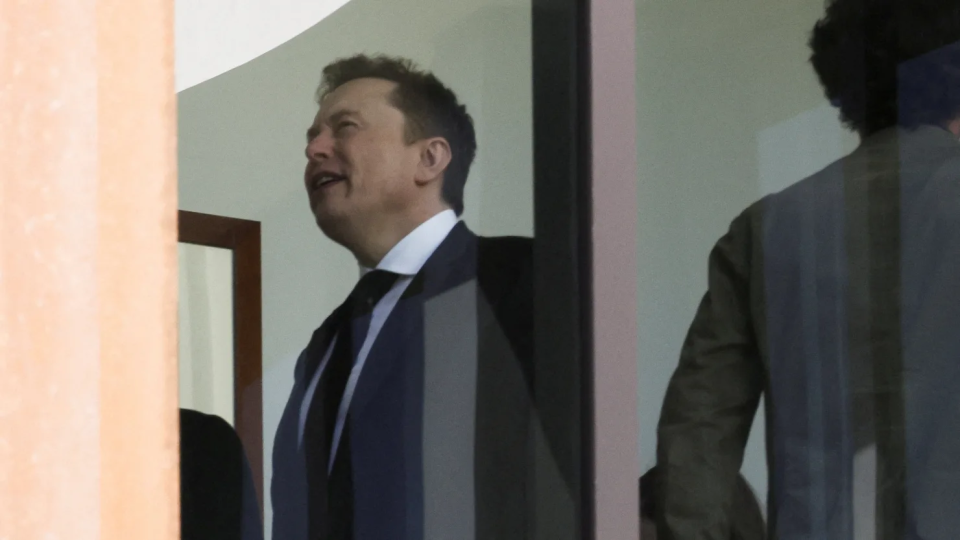
Musk testified as the first witness.
Musk also framed the case as fundamental to the integrity of charitable giving: “Stealing from a charitable organization is wrong. If Altman and OpenAI prevail, it will open the door to plundering every charitable organization in America.” He further warned: “The consequences of this case extend far beyond me—or anyone present here. The entire foundation of American charitable giving will be destroyed.”
William Savitt, OpenAI’s attorney, offered a sharply contrasting response. He told the jury: “The question is whether OpenAI made any specific commitment to Musk at the time of his donation. The answer is no.” Savitt insisted the donation carried no conditions. He also revealed that Musk never fulfilled his full pledge, forcing the organization to seek additional funding.
Savitt further attempted to rebut Musk’s claims by referencing OpenAI’s current structure. He informed the jury that, despite Musk’s allegations, the organization has not abandoned its nonprofit mission: the nonprofit foundation “still controls the organization” and “is conducting cutting-edge work in disease treatment and economic diversification.” He noted that Altman holds no equity in OpenAI but profits through various companies doing business with OpenAI—and has indicated he may acquire equity in OpenAI in the future.
Dispute Two: Did Musk ever approve OpenAI’s shift toward for-profit operations?
Savitt submitted, during the hearing, an email from Shivon Zilis—a former OpenAI board member—to Sam Teller, who had previously worked for Musk.
The email discussed two restructuring options: consolidating everything under a B Corp (i.e., a benefit corporation), or separating into a C Corp and a nonprofit. Savitt claimed Musk “never expressed the view that OpenAI must remain purely nonprofit” and asserted he “supported for-profit structures—as long as he controlled everything.”
Savitt also provided details regarding equity distribution. Evidence he showed the jury indicated Musk’s chief of staff had discussed granting Musk 55% equity in the for-profit entity, and Altman 7.5%.
Molo preemptively addressed this issue in his opening statement. He acknowledged Musk had indeed discussed creating a for-profit version of OpenAI—but emphasized Musk’s consistent condition was that “the nonprofit must retain control over the for-profit entity.” Molo stated the original plan envisioned Musk controlling the for-profit subsidiary, whose importance would “diminish over time,” serving merely as a short-term fundraising mechanism.
Musk himself directly responded to the structural dispute while testifying. He admitted OpenAI internally discussed establishing a for-profit entity between 2017 and 2018. He remained open to “a small for-profit entity that funds the nonprofit”—but only on the condition that “the tail does not wag the dog”: the nonprofit must retain control.
He also explained his eventual departure: when other founders demanded excessive equity in the proposed for-profit division, he expressed in a 2017 email to the executive office that this was “extremely frustrating” and signaled his intention to leave. He formally resigned from OpenAI’s board in 2018.
Dispute Three: What is Musk’s true motive for filing suit?
Savitt summarized: “We’re here because Musk didn’t get his way at OpenAI.”
He outlined a timeline: Musk left OpenAI in 2018 following a power struggle, declaring “they will certainly fail,” yet Altman and others “had the courage to move forward without him—and succeeded”; ChatGPT launched globally at the end of 2022, igniting worldwide enthusiasm; Musk founded his own for-profit AI company, xAI, in 2023, and filed suit in 2024.
Savitt characterized Musk’s motivation as “sour grapes,” stating, “Mr. Musk doesn’t like it—but that’s not grounds for litigation.” He bluntly added, “Mr. Musk isn’t very knowledgeable about artificial intelligence.”
Savitt further refined this timeline, asserting Musk only voiced objections to OpenAI’s pursuit of for-profit status after ChatGPT ignited the global AI arms race—and by then, Musk had already founded xAI.
Russell Cohen, Microsoft’s attorney, aligned with OpenAI’s position on this point and offered two specific arguments.
First, he cited a September 2020 post by Musk on X—“OpenAI has essentially been captured by Microsoft”—as evidence that Musk knew about the arrangement but failed to sue promptly, thereby invoking a statute-of-limitations defense. Second, he revealed a more personal communication channel between Musk and Microsoft CEO Satya Nadella: “Musk knows how to contact Nadella. For five years after the partnership announcement, Mr. Musk never picked up the phone to say, ‘You can’t do this.’”
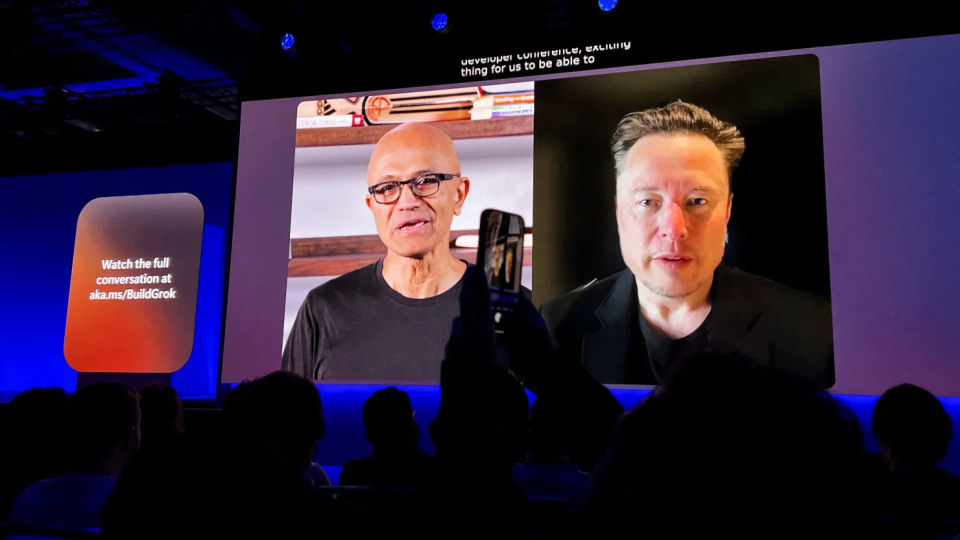
Microsoft’s attorney stated Musk could easily reach Nadella.
He emphasized that Musk personally holds Nadella’s phone number. Cohen concluded that Musk launched xAI after ChatGPT’s success—and “then suddenly filed claims against Microsoft.”
Molo, however, sought to decouple the case from Musk’s personal interests. “This case is not about Elon Musk,” he stressed to the jury—it is about defendants who “enriched themselves at the expense of the organization’s foundational principles.” Molo described the case as being “in the interest of all humanity,” not economic gain. He urged jurors to set aside preconceptions about Musk: “Everyone seems to know Musk—and everyone seems to have an opinion about him. Not all opinions are positive, nor are they all negative.”
Molo also acknowledged Altman holds no equity in OpenAI—a fact that might weaken Musk’s claim that Altman enriched himself through the nonprofit. Yet he argued Altman profited via multiple companies doing business with OpenAI—and had stated he may obtain equity in OpenAI in the future.
02 A Side Note: Musk on AI Doomsday
The hearing also featured numerous moments unrelated to the three core disputes. These segments did not address the nature of the donations, the legality of structural changes, or the motives behind the lawsuit—but formed the dramatic highlights of Day One.
Musk’s self-presentation occupied significant time. Through a series of questions, Molo painted a comprehensive portrait of Musk as an entrepreneur for the jury: Musk grew up in South Africa; before moving to the U.S., he worked as a lumberjack and waiter in Canada; he entered university carrying “$100,000 in student debt.” He serves simultaneously as CEO of Tesla and SpaceX, working “80 to 100 hours per week,” with “no vacations, no vacation homes.”
Discussing SpaceX, Musk said the company’s goal is “making life multiplanetary”—calling it “life insurance for all life we know.” On Neuralink, he described its long-term objective as “AI safety”: “If we can achieve symbiosis between AI and humans, we can realize an AI that benefits humanity more.”
On AI itself, Musk issued stark risk warnings. He likened training AI to raising a child: “Eventually, when the child grows up, you can’t truly control that child—but you can try to instill the right values.” He forecast AI’s development pace: “It could become as intelligent as any human as soon as next year.”
He then concluded: “It could make us more prosperous—or it could kill us all.” To illustrate both possibilities, he referenced two films: “We want *Star Trek*, not *The Terminator*.”
A minor deviation from the main thread occurred during cross-examination. When Molo asked, “Who is Shivon Zilis?”, Musk paused briefly, stammered a few words, then laughed and called her his “chief of staff.” In fact, Zilis is a former OpenAI board member—and the mother of several of Musk’s children.
Altman remained extremely low-key on Day One of the trial. He did not use his opening statement to address the media or public. Trial records describe him only as: “arms crossed, looking concerned, speaking with his attorneys and team members”; typing on his phone during recess; and remaining silent—merely agreeing to the judge’s request—when the judge warned both sides to cease online attacks.
03 Off-Court Battles
Beyond the courtroom, public clashes between the parties continued.
Before the trial began, Judge Rogers summoned Musk and Altman to the bench, ordering them to halt online attacks on social media and urging both sides to begin proceedings “with clean hands”—and “speak as little as possible” on social platforms. Both complied.
Regarding the trial’s industry impact, AI safety expert Vivian Dong predicted it would “primarily affect OpenAI alone.”
“No specific AI safety policy or industry practice is on trial,” she said. “It would be unprecedented for a court, in a private lawsuit alleging breach of charitable trust, to order the kind of structural reform Musk seeks for OpenAI.” She added that the officials responsible for overseeing OpenAI’s fulfillment of its charitable mission are the Attorneys General of Delaware and California—not Musk himself.
Nate Elliott, Chief Analyst at Emarketer, offered another perspective: “If Musk wins, it would represent a rare instance of holding a tech CEO accountable. It could also mean the end of OpenAI’s business—and grant xAI and Grok a competitive opportunity they currently lack.”
Following today’s hearing, Musk is scheduled to return to court on April 29, U.S. time, to continue direct examination by attorney Molo—and subsequently face cross-examination by Savitt. The judge has explicitly instructed Musk not to speak with his attorneys overnight.
Additional witnesses will testify in subsequent hearings. Musk’s legal team stated Jared Birchall—who manages Musk’s multibillion-dollar assets at his family office Excession LLC, and also serves as an executive at xAI and Neuralink—will testify after Musk.
Musk’s expert witnesses include Stuart J. Russell, AI researcher at UC Berkeley, and David M. Schizer, law professor at Columbia University.
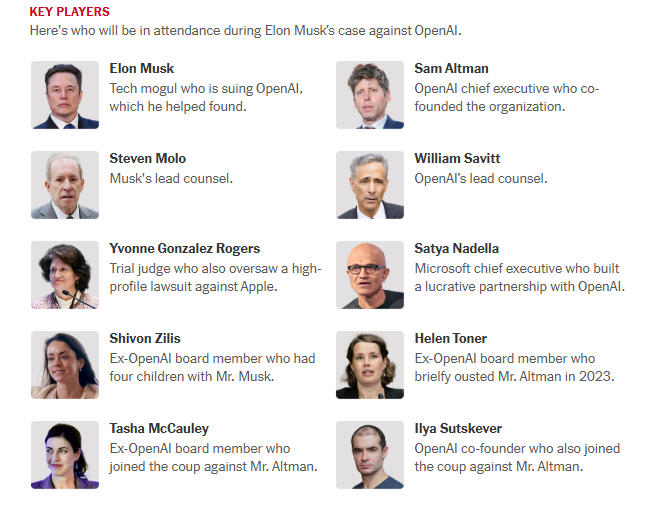
Key expected witnesses include Altman, Nadella, Murati, and Sutskever.
Other anticipated witnesses include Microsoft CEO Satya Nadella; Mira Murati, former CTO of OpenAI; and Ilya Sutskever, an early key researcher at OpenAI. During his testimony, Musk specifically highlighted the difficulty of recruiting Sutskever—calling it a “massive effort” and “extremely difficult” process, which caused Larry Page to “refuse to speak to me again.” He described Sutskever as OpenAI’s “most important” researcher.
The trial is expected to last approximately four weeks. In the upcoming cross-examination phase, Musk’s testimony regarding OpenAI’s founding intent, the nature of his charitable donation, and structural changes will undergo its first rigorous scrutiny by opposing counsel.
Join TechFlow official community to stay tuned
Telegram:https://t.me/TechFlowDaily
X (Twitter):https://x.com/TechFlowPost
X (Twitter) EN:https://x.com/BlockFlow_News


