exSat Mainnet Launch: Seeking the Next Breakout in the BTC Ecosystem
TechFlow Selected TechFlow Selected
exSat Mainnet Launch: Seeking the Next Breakout in the BTC Ecosystem
Bitcoin ecosystem consensus will still take 3 to 5 years to establish. The next breakout is more likely to be Bitcoin-native lightweight assets, such as inscriptions and runes, supported by liquidity from centralized exchanges.
 Navigating Web3 tides with focused insights
Host: Joe Zhou
Guests: Joshua, Chief Growth Officer of exSat; Sunny, Merlin Chain Infra Lead; Director Zhao (aka "Jewish Zhao"); Laobai, Investment Partner at ABCDE; Chen Jian, Independent Researcher.
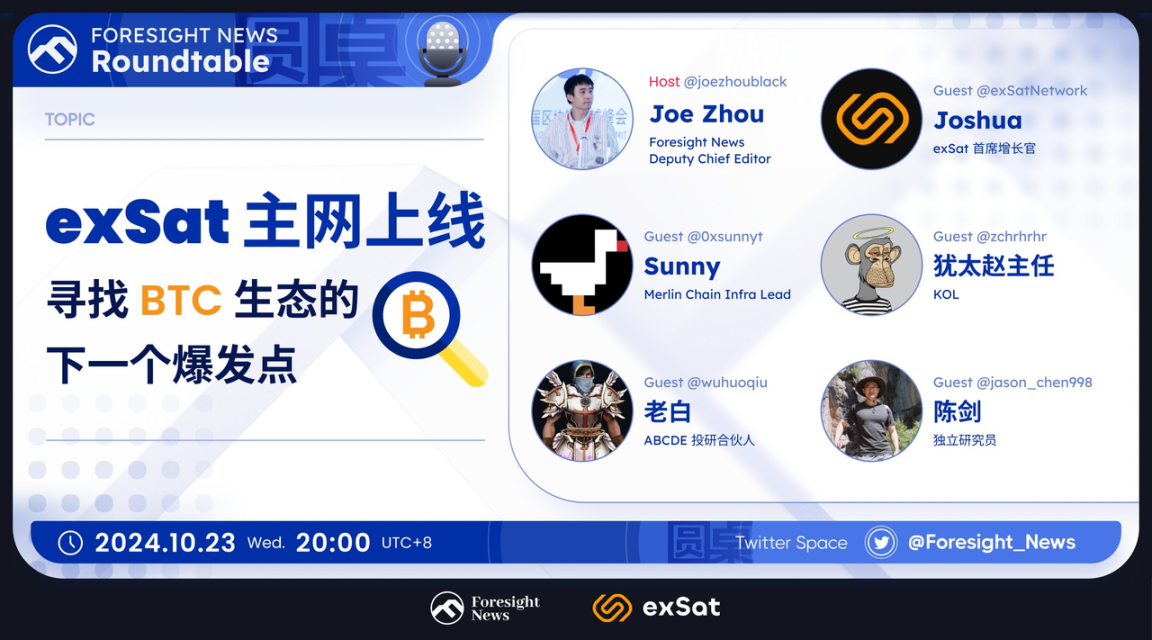
As one of the core narratives in this market cycle, the Bitcoin ecosystem has drawn significant attention. Today we’re honored to have the Chief Growth Officer from exSat and several OGs from the industry. With exSat's mainnet launch as a catalyst, let’s dive into the topic: "How do we find the next breakout moment in the BTC ecosystem?"
Host: Could everyone briefly introduce yourselves and share the latest progress of your projects?
Sunny: I'm Sunny, serving as the Infra Lead at Merlin Chain. Merlin is a BTC L2 that launched its mainnet earlier this year. We're currently exploring collaboration opportunities with exSat.
Director Zhao: I’ve been following the Bitcoin ecosystem for quite some time. Back at TOKEN2049 in 2023, we discussed future opportunities in the BTC ecosystem. At that time, I proposed an analogy: if Bitcoin is gold, then the Bitcoin ecosystem—and particularly the inscription ecosystem—is like gold jewelry.
Laobai: Hi everyone, I’m Laobai, a research and investment partner at ABCD. We might be one of the most active VCs in Asia—or even globally—investing in the Bitcoin ecosystem, especially in infrastructure. We've invested in about 10 projects so far, including Merlin, Babylon, and Bitlayer.
From a VC perspective, the future of the Bitcoin ecosystem is highly unpredictable. Each major narrative has its own logical foundation, and unlike Ethereum, where the Foundation often sets the direction, the Bitcoin ecosystem is completely decentralized and diverse. It may take another three to five years before we see which path ultimately prevails.
Chen Jian: I'm Chen Jian. My involvement in the Bitcoin ecosystem isn’t particularly deep—I’ve primarily focused on Ethereum. However, since I’ve participated in the development of several Bitcoin-related projects, I’ve maintained long-term interest in its evolution.
Host: Merlin has become a validator node for exSat. Can you elaborate on the reasons and details behind this partnership?
Sunny: This year, the primary narrative around Bitcoin L2s has revolved around expanding application layers. But this raises a key question: what kind of chain truly qualifies as an application layer for Bitcoin, and how can such a layer achieve sufficient security? Different validation mechanisms have emerged in response. Merlin’s current approach is to identify complementary mid-layer projects from a specific angle and ultimately integrate Merlin directly onto Bitcoin.
Since the beginning of the year, we’ve seen various solutions emerge—for example, schemes aiming to make Bitcoin staking possible via PoS to generate yield, which is also gaining traction. exSat’s mechanism stands out because it employs a dual-mining model, combining Bitcoin’s mature PoW mining pool infrastructure with PoS elements borrowed from the Ethereum ecosystem. We’re excited to participate and explore the balance between these two distinct approaches.
Host: exSat officially launched its mainnet today. Could you share updates on the project and explain how ordinary users can get involved?
Joshua: I’m the Chief Growth Officer at exSat. exSat is a Bitcoin scaling solution. We believe there should be multiple paths for Bitcoin scalability, so exSat doesn’t limit itself to just being an L2 or sidechain. We’ve designed three core use cases for BTC: first, issuing native assets on the Bitcoin chain; second, enabling BTC payments and applications; third, securely bridging BTC into environments like BitcoinVM or EVM-compatible systems.
In the current phase focused on achieving consensus, our first step is synchronizing raw Bitcoin data onto exSat to establish data-level consensus. Data, assets, and users are the three pillars of blockchain. By mastering data, you effectively control asset flows, enabling manipulation and utilization of those assets. However, unlike Ethereum, Bitcoin lacks an account-based architecture. So we aim to build an account model on top of Bitcoin’s UTXO framework. Using the UTXO model, we can index on-chain BTC assets, enable secure BTC transfers, support BTC asset issuance, and ultimately achieve fully decentralized custody of BTC assets—these are the three core goals of exSat.
As for user participation, there are two main avenues. First, both individual users and institutions can join the consensus layer through staking. While partners have already deployed numerous nodes, regular users can still participate via these partner-operated nodes. Second, users can enter our ecosystem using the cross-chain bridge we’ll release next week. Initially, users can start by staking. Later, we’ll launch a new asset issuance protocol—this is part of our short-term roadmap.
Host: Is it necessary for BTC to evolve from a store of value toward building an ecosystem? Where do you think the next breakout in the BTC ecosystem might occur?
Sunny: We can generally categorize Bitcoin holders into two groups. The first group consists of newer entrants whose belief in Bitcoin centers purely on price appreciation. For them, moving Bitcoin off-chain to hedge positions, earn stable yields, or engage in DeFi activities across other ecosystems may be appealing—this naturally leans toward ecosystem development. The second group comprises Bitcoin OGs who view BTC similarly to how traditional investors view gold—primarily as a store of value. These holders tend to have little interest in ecosystem expansion and prefer simply holding.
We adopt different strategies to serve these two distinct user bases.
Based on market data, the next breakout in the Bitcoin ecosystem is more likely to come from lightweight assets, while foundational protocol developments will take longer—perhaps three to five years, or even a decade, as Laobai mentioned earlier, to solidify base-layer consensus.
For smaller-scale breakouts, I believe momentum will start with lighter assets. Recently, the Rune ecosystem has shown signs of speculation. Runes allow more metadata storage—they can encode full sentences or carry tags—so we’ve been investing significant effort into Runes. Additionally, integration between the Bitcoin ecosystem and Telegram could also become a powerful breakout vector.
Director Zhao: Currently, market liquidity is tight. The industry broadly recognizes three main liquid assets: BTC, ETH, and USDT. Therefore, overall market growth largely depends on USDT issuance. Aside from direct fiat onboarding in regulated jurisdictions, most capital enters crypto via USDT. However, USDT’s supply has now reached around $120 billion, and the pace of new issuance has slowed significantly compared to 2021, when we’d sometimes see $1 billion issued per week.
During the previous cycle, when people built apps across various chains, pricing gradually reverted back to BTC and ETH. We noticed that inscriptions, runes, and NFTs within the Bitcoin ecosystem were mostly priced in BTC. Similarly, when people rushed into Solana memes, pricing shifted to SOL. Each ecosystem is becoming increasingly self-contained rather than relying solely on USDT for universal pricing. This shift highlights growing utility—it’s no longer just about value storage. Developing the Bitcoin ecosystem essentially means creating more pricing scenarios for BTC. Once BTC starts pricing other assets, its circulation increases. When people begin using BTC to purchase goods or services, it expands BTC’s practical applications. To strengthen BTC’s pricing power, we need to build real-world use cases—including BTC L2s.
We’re also seeing declining willingness to hold USDT compared to 2021. Now, people are more open to holding alternative pricing currencies like BTC, SOL, and ETH. Ethereum and Solana ecosystems are already mature. Now, Bitcoin must similarly build its own ecosystem and continuously expand its pricing scenarios. BTC as both a pricing asset and an interest-bearing asset represents a major strategic direction.
Laobai: Building an ecosystem on Bitcoin is essential. Back in 2019, I supported the large-block technical path. The logic was simple: after five or even ten halvings, if on-chain transaction volume remains insufficient, Bitcoin’s security model would be jeopardized—eventually leaving inflation as the only option. Hence, larger blocks could stimulate more on-chain transactions. After BRC-20 took off, many thought Bitcoin was saved—the surge in inscription-related transactions generated substantial block fees, briefly surpassing block rewards. But that boom lasted only about five months.
From a VC standpoint, we’ve identified four distinct development routes. Which one will become the core of the Bitcoin ecosystem remains unclear. The first route involves asset issuance—like inscriptions and runes—issuing assets natively on Bitcoin’s mainnet. The second is the emerging BTCFi trend, reinforcing Bitcoin’s status as digital gold while connecting it to DeFi across multiple public chains, somewhat akin to decentralizing wBTC. The third is the scaling route, leveraging familiar tech stacks like EVM, ZKVM, or other VM variants to port Bitcoin onto these platforms and rebuild ecosystems atop them. The fourth path is the most native and technically challenging, but recently showing promising momentum—native UTXO-based solutions. For instance, UniSat launched Fractal Bitcoin last month, a mirrored version of Bitcoin with adjusted block times, difficulty settings, and added flexibility. Additionally, many teams are now deeply investing in the Lightning Network. Previously, Lightning struggled to scale due to three main issues: node setup complexity for average users, lack of stablecoins on the network (making everyday Bitcoin payments impractical), and insufficient node count requiring broader participation.
Now, various teams are tackling these challenges—some introducing incentive layers for Lightning nodes, others promoting home-based router-like devices to encourage node operation, and some abstracting node deployment entirely so users can set up nodes with one click.
The technical and ecosystem hurdles facing the Lightning Network now appear solvable. If resolved, Lightning theoretically offers infinite TPS since it operates on payment channels. Personally, this is the path I’m most bullish on—though it’s extremely difficult and may take three to five years to mature.
Chen Jian: About 58% of all crypto assets reside in Bitcoin. Every entrepreneur and VC is trying to unlock even a fraction of this massive asset base to release its liquidity, which would greatly boost internal market circulation.
The logic is straightforward and compelling. The BTC ecosystem, especially BTCFi, will undoubtedly continue climbing. The most viable direction right now is enabling holders to safely unlock secondary liquidity without locking or custodizing their BTC. People are generally reluctant to spend Bitcoin—that’s a critical insight. Holders want safer ways to extract liquidity from their BTC holdings.
I struggle to envision gaming or social applications built directly on Bitcoin given its current state—it goes beyond technical limitations. However, if Bitcoin holders could earn stable staking yields similar to Ethereum’s PoS under strong security guarantees, they’d be highly receptive. Beyond simple yield, they’d also welcome double-leveraged liquidity models akin to Ethereum’s restaking—unlocking multiple layers of value securely.
Gaming and social apps on Bitcoin don’t align well with these core incentives. But stablecoins and BTCFi applications? Those make logical sense. I don’t deny that games or social features could exist on Bitcoin—they might generate profit—but establishing solid foundational logic for them is challenging.
Joshua: A few days ago, we discussed a hypothetical: if SpaceX took you to Mars, what asset would you use there? In terms of asset classes, Earth-based productive assets like land obviously can't be transported. How much gold could you realistically bring? And would Mars even have gold? Fundamentally, digital assets are the most portable. In humanity’s next great frontier, digital assets are best suited for interplanetary use.
Long-term, we firmly believe BTC will transcend mere value storage—it will have real utility and genuine demand. Looking at BTC’s inherent properties, while often labeled “digital gold,” it differs in key aspects. Both gold and BTC are durable stores of value, but BTC lasts longer—it’s data, and as long as data persists, the asset exists. Historically, gold’s fungibility as money had geographical limits, whereas BTC enables seamless, highly liquid on-chain settlement, far exceeding gold’s historical usability. If we step outside the dollar-defined financial system, BTC could genuinely function as real currency.
The BTC ecosystem always has two types of users. One treats BTC purely as an asset, focusing exclusively on preservation and appreciation. Since 94% of BTC has already been mined—with only 6% left—it resembles mature NFT markets: initial explosive growth followed by a focus on maintaining existing value. In this environment, users’ sole concern is preserving or increasing value, leading to products like savings accounts or fixed-income instruments.
The other type views BTC as a consumable. From younger users’ perspectives, BTC, ETH, or even meme coins aren’t fundamentally different—they’re all consumption tools. You might trade BTC for higher-yield inscriptions or other assets, turning BTC into a consumable good. This creates a consumption logic.
Through this consumption lens, social applications on Bitcoin become plausible. Think of it like Pinduoduo or Taobao—you spend BTC to acquire a specific asset or service, generating diverse user needs. Thus, game-like or search-like scenarios could organically emerge within the Bitcoin ecosystem.
BTC’s price is entirely driven by liquidity surges. Unlike most assets, BTC yields zero interest—it’s a non-yielding asset, so its volatility differs significantly from gold, which is relatively stable. BTC’s price swings wildly based purely on liquidity dynamics. Current BTC staking effectively injects BTC liquidity into other public chains, draining liquidity from those ecosystems. Native tokens on these chains get absorbed by BTC’s liquidity, and eventually, BTC holders cash out profits back into BTC.
Beyond on-chain asset issuance—which everyone discusses—we see strong potential linking BTC with RWA (Real World Assets). When real-world assets offer stable returns—similar to fixed-income products—BTC holders could access consistent yield streams independent of speculative liquidity booms. This provides sustainable income uncorrelated with market cycles, adding long-term value to BTC beyond its own price appreciation.
Consumption-oriented BTC users are essentially chasing arbitrage from information asymmetry and liquidity velocity—a model strikingly similar to TikTok. Faster information flow drives better liquidity, which boosts asset prices. However, current inscription and rune assets haven’t experienced true liquidity explosions because they lack support from centralized exchanges. For native Bitcoin assets to go mainstream, they must gain liquidity backing from major CEXs.
Host: Does Bitcoin have the potential to become the next major DeFi platform? What constraints currently limit its development?
Sunny: Currently, the technical conditions aren’t in place for Bitcoin to serve as a DeFi platform. The Bitcoin network doesn’t support smart contracts, and block size is limited, making complex programming impossible. But ironically, these very limitations are also Bitcoin’s greatest security strengths. Projects attempting to use Bitcoin as a foundational platform face strong consensus resistance—Bitcoin holders and miners may oppose such changes. This is a major bottleneck. That said, we’re already seeing growing BTCFi applications across various chains, with usage patterns resembling Ethereum’s restaking trend post-PoS upgrade—using BTC as collateral to leverage positions.
A recent report shows only 2% of BTC is actively used in DeFi protocols. With 98% still idle, this represents enormous untapped potential. Since Bitcoin itself supports limited functionality, Merlin has built an application layer to fulfill user demands.
Joshua: As an asset, BTC is already widely present across public chain ecosystems and participates in DeFi activities. With only 2% of BTC engaged in protocols, the remaining 98% is either观望or locked in wallets—indicating massive growth potential. The primary reason this majority remains sidelined is the absence of sufficiently secure methods for holders to participate. Most existing BTC implementations rely on centralized or semi-centralized custody models, where users trust institutions. Centralized custodians have advantages—regulatory compliance in places like the U.S. gives users confidence to deposit assets. However, strict compliance requirements inherently exclude anonymous BTC holders from participating. Therefore, we believe asset management must offer dual pathways: one through trusted centralized entities, and another via decentralized mechanisms allowing BTC holders to engage with DeFi.
From day one, when designing exSat and syncing UTXO data, we envisioned building a decentralized custody platform within six months. Our goal is to advance the BTC ecosystem through greater decentralization, helping native BTC assets integrate seamlessly into broader public chain networks. Only when we solve secure, untraceable, anonymous BTC transfers—without reliance on centralized intermediaries—can we truly unlock the doors to BTCFi.
Host: Are players in the BTC ecosystem different from users on other chains? What kinds of on-chain applications and interactions do they prefer?
Chen Jian: Bitcoin users’ needs fall into two categories. First is earning yield on holdings. Second is unlocking secondary liquidity securely without locking up assets—essentially staking BTC safely to receive a portion of stablecoins in return. There’s also the consumption angle: spending BTC as gas for inscriptions, potentially evolving into communities or games. I don’t rule out the possibility of such use cases emerging.
Director Zhao: Recently, we’re seeing a trend where more institutions and large players are actively or passively engaging in Bitcoin ecosystem development. First, Bitcoin’s market dominance continues to rise. Second, as the foundational index product of the entire industry, BTC—and BTC ETFs—are the default allocation choice. BTC ETFs have brought in substantial new capital.
All risk assets are priced marginally—that is, by the last traded price. The approval of BTC ETFs caused a structural shift in the market. When BTC reached $50K–$60K, it attracted massive inflows of liquidity.
Moreover, the liquidity fueled by BTC ETFs has stabilized BTC’s price, reducing extreme bubbles. This contrasts sharply with meme coins, which often exhibit massive valuations disconnected from fundamentals. Take GOAT, for example—recently valued at $600 million. But if sold en masse, how much could actually be realized? We’ve seen $1 million in liquidity prop up a $30 million meme valuation—meaning $1M inflow defines a $30M asset.
In contrast, BTC currently exhibits minimal price bubbles. Many addresses have become permanently dormant due to lost keys, and hardcore believers may never sell. As a result, the effective circulating supply shrinks, and the average holding cost across the market steadily rises. A key challenge for entrepreneurs now is how to increase liquidity among these inactive holdings and amplify Bitcoin’s network effects.
Laobai: We classify Bitcoin holders into three groups. The first are the old-school OGs who hold and never move. They entered early, often missed the DeFi bull run, and don’t care much about it. Even with safe yield-generating tools available, these OGs won’t budge their BTC for 5% or 10% APY—they’re financially secure and indifferent to small gains.
The second group includes last year’s inscription and rune traders. Their behavior mirrors today’s Solana Pump.Fun meme participants. They don’t treat Bitcoin as sacred; they hold relatively small amounts and use BTC merely as seed capital or a tool for minting inscriptions and runes.
The third group includes many typical retail speculators like myself. Until recently, we preferred altcoins and favored holding Ethereum over Bitcoin, perceiving BTC as too large-cap and slow-moving. But this cycle revealed that aside from memes, almost no sector outperformed Bitcoin. Consequently, many of us were forced to rebalance into BTC. This group treats Bitcoin purely as a value asset and portfolio cornerstone, without much concern for what you can *do* with it on-chain.
Join TechFlow official community to stay tuned
Telegram:https://t.me/TechFlowDaily
X (Twitter):https://x.com/TechFlowPost
X (Twitter) EN:https://x.com/BlockFlow_News
 Foresight News