Lumoz Leads OP Stack and ZK Technology Innovation, Reshaping Blockchain Scalability and Security
TechFlow Selected TechFlow Selected
Lumoz Leads OP Stack and ZK Technology Innovation, Reshaping Blockchain Scalability and Security
Lumoz is leading the development of blockchain scalability by optimizing the integration of the OP Stack with ZK technology.
 Navigating Web3 tides with focused insights
Abstract
This article introduces Lumoz's technical breakthrough in combining the OP Stack with ZK Proof, significantly enhancing performance and security. The new zk-proposer component simplifies integration, reduces maintenance complexity, and ensures network stability. The upgraded solution synchronizes on-chain data with the proving process, optimizes contract logic, and eliminates vulnerabilities. This innovative approach reduces verification latency and cost, laying a solid foundation for security. The new architecture enables seamless transformation of OP-Stack nodes into zk-Verifier nodes, enhancing ecosystem flexibility and reinforcing Lumoz’s leading position.
Lumoz is driving blockchain scalability by optimizing the integration of OP Stack and ZK technologies. Lumoz’s latest solution seamlessly combines OP Stack’s flexibility with the robust security of ZK technology, accelerating network validation while improving compatibility with blockchains like Ethereum. Specifically, Lumoz provides computational power support for this architecture while streamlining the integration process of ZK-Fraud Proof through innovative architectural optimizations, making the technology more efficient, secure, and easier to maintain.
The combination of OP Stack and ZK modifies the original optimistic consensus of OP Stack by replacing the traditional fraud proof challenge mechanism with non-interactive ZK proofs. In the OP Stack + ZK framework, op-batcher and op-proposer retain their original roles from the standard OP Stack, submitting transaction data and corresponding state roots generated on Rollup to Layer 1. The key difference lies in the introduction of a new ZK Fraud Proof module, which synchronizes and executes Rollup chain states and data in real time, directly generating proofs when needed and submitting them to Layer 1 for verification. This greatly shortens the waiting time for validity checks. However, this added ZK-Fraud Proof module increases system complexity compared to the original architecture, requiring validators to specially maintain ZK-Verifier nodes.
Lumoz’s latest optimization improves upon this design by integrating the entire ZK-Fraud Proof module into the op-proposer, upgrading it into a zk-proposer—significantly reducing node maintenance complexity. In this new architecture, the zk-proposer retains all original functionalities while introducing a new ZK interaction option. This feature allows the proposer to directly send proof generation requests to the compute network layer based on execution results from on-chain data, then submit the generated proof on-chain for verification.
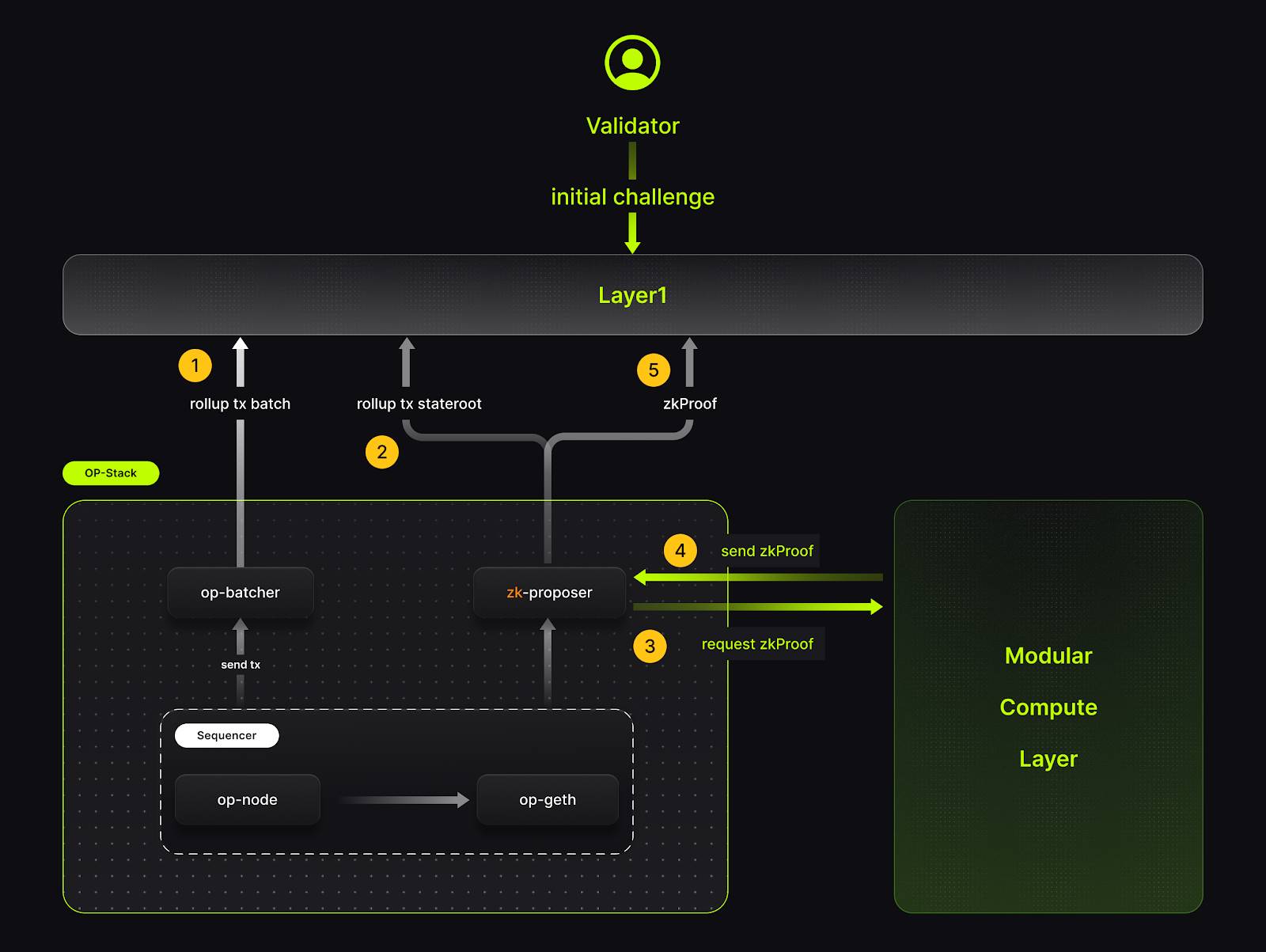
As shown in the diagram, this design enables any OP-Stack full node to quickly transform into a zk-Verifier node using native OP-Stack components and participate in network validation without additional maintenance overhead. Moreover, since the Layer 1 contract protocol remains unchanged, existing zkVerifier nodes can continue providing validation services, ensuring network continuity and stability.
The updated solution also optimizes the verification contract logic to better ensure consistency between contract data and off-chain states. In the previous architecture, the proof process only verified Layer 2 block height, potentially leading to mismatches between proofs and actual on-chain data—posing security risks. By adding verification of the previous batch’s state root within the contract logic, the new scheme ensures each proof is generated based on the correct and most recent state root. This tight coupling between proof generation/verification and real-time on-chain data significantly enhances network security and reliability.
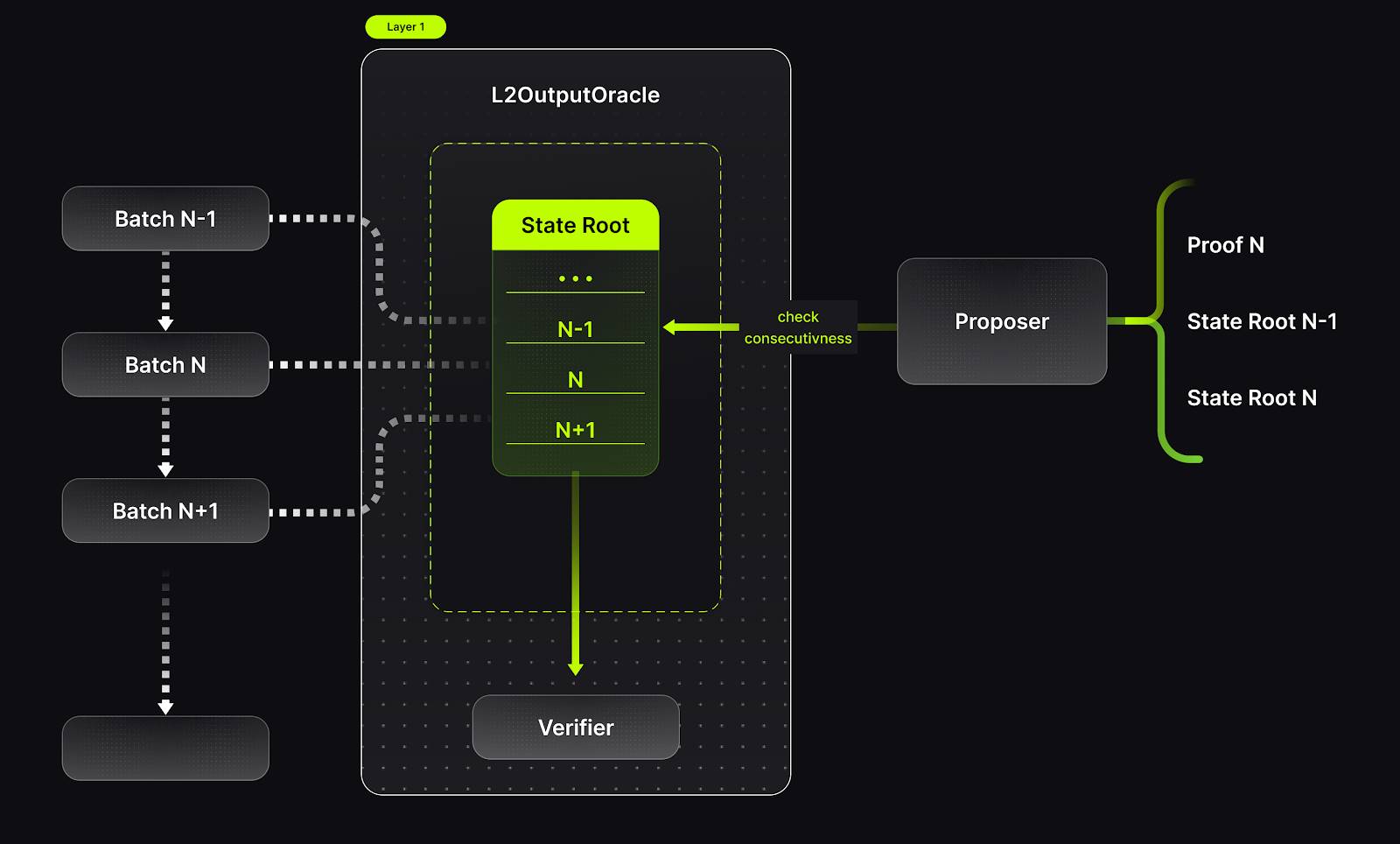
As illustrated, after each batch is submitted on-chain, the proposer simultaneously writes the corresponding state root of that batch into a designated array in sequence. Whenever a proof needs to be submitted for contract verification, the proposer passes both the current batch’s state root and the preceding batch’s state root to the contract. Only after successfully verifying the continuity of these state roots does the Verifier contract proceed with proof validation.
Lumoz is also exploring further possibilities for OP Stack + ZK. In the current model, network trust still relies on optimistic assumptions, meaning security largely depends on challengers continuously monitoring and disputing transactions to ensure validity. Compared to ZK-Rollups using validity proofs, there remains room for improvement in security. From this perspective, Lumoz is experimenting with simulating correct state transition processes within verifier nodes, generating ZK-based validity proofs for every state change within a given interval. Similar to ZK-Rollups, these proofs serve as direct evidence of state validity on-chain, eliminating reliance on interactive challenges. This approach allows the network to significantly enhance overall security at minimal computational cost, all while preserving the existing service architecture.
Lumoz’s optimized OP Stack + ZK architecture marks a significant milestone in blockchain innovation, achieving a perfect balance among speed, security, and simplicity. By replacing the original challenge mechanism with non-interactive ZK proofs, Lumoz enables faster, more reliable transaction validation and a seamless verification experience. Beyond improved scalability, the network’s trust model becomes more robust, reducing dependence on interactive challenges and paving the way for more efficient, proactive security solutions in the future.
Conclusion
As Lumoz continues refining this architecture and exploring new frontiers, it remains committed to empowering users and partners with reliable, scalable blockchain solutions. This OP Stack + ZK innovation is just the beginning—Lumoz’s technological advancements are opening a new chapter for decentralized innovation. Stay tuned and witness the next step in blockchain evolution—powered by Lumoz!
Join TechFlow official community to stay tuned
Telegram:https://t.me/TechFlowDaily
X (Twitter):https://x.com/TechFlowPost
X (Twitter) EN:https://x.com/BlockFlow_News
 @LumozOrg