From WBTC to BTC-LST on Ethereum: An Early Exploration of the BTC-LST Ecosystem
TechFlow Selected TechFlow Selected
From WBTC to BTC-LST on Ethereum: An Early Exploration of the BTC-LST Ecosystem
This article will conduct an early exploration of the BTC LST ecosystem.
 Navigating Web3 tides with focused insights
Author: IOSG Ventures
1. Introduction
Why BTC-LST?
With the emergence of Babylon, a new revenue stream has been unlocked for BTC through a security service known as timestamping. This restaking service protects protocols built on Babylon by increasing the cost of attacks and enables BTC staking via a time-lock mechanism.
Although there are no actual staking rewards in the initial phase—only points are distributed—the potential for BTC yield has sparked a wave of BTC liquidity restaking tokens (BTC-LSTs), such as Lombard, babypie, FBTC, and SolvBTC.
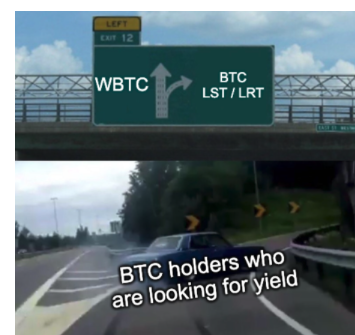
Compared to wrapped BTC, which serves as a native cross-chain representation of BTC, BTC LSTs leverage the Babylon protocol to introduce yield-bearing cross-chain representations of BTC.
At the time of writing, the BTC LST market has reached $1.07 billion (excluding 9B WBTC assets on Ethereum). The market is primarily dominated by SolvBTC and Lombard, with no signs of slowing growth.
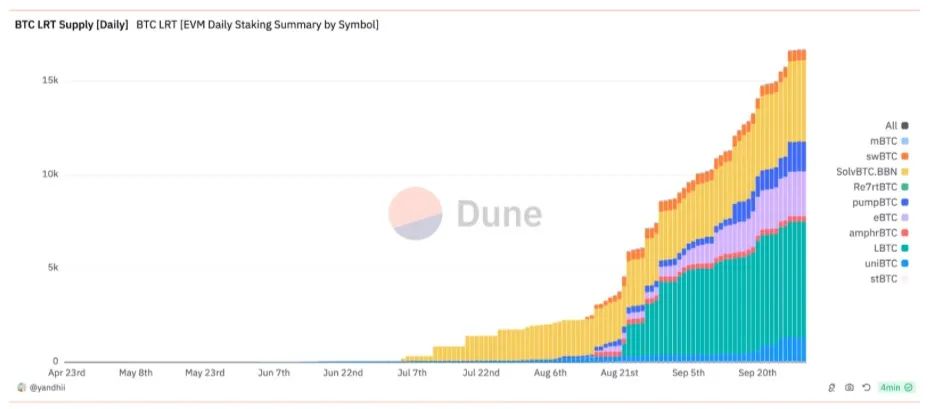
Source: @yandhii, Dune dashboard
On the other hand, many DeFi or restaking platforms on Ethereum (e.g., Symbiotic, Karak) have recognized the opportunity presented by the influx of yield-generating BTC assets and have begun integrating these assets into their protocols to bootstrap total value locked (TVL) and trading volume.
This trend is highly positive, as the inflow of assets can strengthen Ethereum's position as the liquidity hub within the DeFi landscape and continuously generate economic activity.
As BTC gains greater institutional and public acceptance—as seen in recent developments like BTC ETFs and cbBTC—and considering BTC’s dominant market share (~58%), adoption is expected to continue growing until new innovations emerge. Therefore, understanding the current BTC LST-fi landscape is essential.
Source: Henry
This research aims to comprehensively map existing BTC-LRTs, BTC wrappers, and DeFi protocols following the emerging trend of BTC on Ethereum, enabling easier navigation in the future.
2. BTC-LST Ecosystem
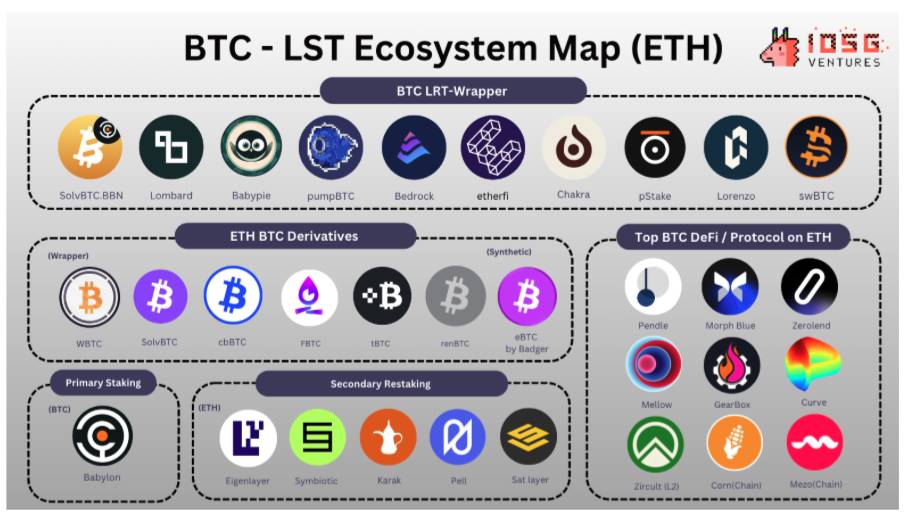
Source: IOSG
Bitcoin LST Wrappers are the "newcomers" of this cycle, specifically designed to unlock liquidity for tokens staked in Babylon’s BTC restaking protocol.
BTC liquid wrappers generally come in three forms:
-
One-way cross-chain wrappers backed 1:1 by BTC staked on the BTC mainnet via Babylon. Yield-bearing tokens minted on ETH serve as receipts for staked BTC.
-
Examples: LBTC, pumpBTC, babypie’s mBTC, etc.
-
Wrappers that use LBTC or standard BTC (like WBTC) as collateral and re-stake assets into restaking platforms such as Symbiotic and Karak. On Ethereum, LBTC or regular BTC (WBTC) is used as collateral, then re-staked into restaking platforms like Symbiotic and Karak.
-
Examples: Etherfi’s eBTC, Swell’s swBTC
-
"Reverse mode," where WBTC on ETH is used as collateral, and proof of staking is relayed via oracle to Bitgo, allowing native BTC unlocked from Bitgo to be staked in Babylon for yield. In reverse mode, users can collateralize WBTC to unlock native BTC on the mainnet and stake it into Babylon. They relay staking proofs via oracle to Bitgo, which unlocks BTC and stakes it on Babylon to earn yield.
-
Example: Bedrock
While the first two types focus on bridging or unlocking more BTC assets from the BTC mainnet into the ETH ecosystem, the third type extracts WBTC assets from ETH and "reverse-stakes" them into the Babylon protocol. Architecturally, a common feature among these wrappers is that BTC is held in custody by custodians (such as Cobo or Copper) on the BTC mainnet to secure the assets—an approach that is currently the most cost-effective and convenient. To provide a clearer picture of the overall BTC LST/LRT landscape, below is a summary of how some BTC LST/LRTs operate:

Source: Henry
BTC LST Market Size
At the time of writing, LBTC dominates with a 37% market share, followed by SolvBTC at 26% and pumpBTC at 9.5%. 79.6% of BTC LSTs reside on the Ethereum mainnet, while the remaining 21.4% are distributed across networks like BNB Chain, Arbitrum, and Avalanche.
The two major players in the BTC LST market have adopted different strategies. Lombard focuses exclusively on Ethereum, while SolvBTC pursues a multi-chain approach, supporting various networks including BNB and ARB.

Source: @yandhii, Dune dashboard
2.1 ETH BTC Derivatives (Wrappers & Synthetics)
ETH BTC derivatives are wrapped BTC bridged from the BTC mainnet to the ETH network, typically facilitated through custodians. These wrappers are not competitors to BTC LSTs but rather key drivers fueling LST growth.
Unlike BTC LSTs, these derivatives are not staked into the Babylon protocol and do not inherently generate yield. Instead, they function as standard representations of BTC on the ETH blockchain. Despite not being yield-bearing assets, ETH BTC derivatives have become a critical component of today’s ETH DeFi landscape.
Most DeFi and restaking platforms accept WBTC because:
-
They are battle-tested
-
They have maintained high market dominance throughout the 2024 cycle
At the time of writing, over $9 billion in assets have been bridged from BTC to ETH via Bitgo’s WBTC since 2018. Of this, 21.5% (approximately $1.9 billion) has been deposited into Aave for lending, accounting for about 20% of Aave’s total assets on Ethereum.
Most DeFi and restaking platforms accept WBTC because:
-
They are battle-tested
-
They have maintained high market dominance over the years

Source: @yandhii, Dune dashboard
On the other hand, next-generation wrappers (e.g., FBTC) have also accumulated over $152 million on ETH, with a monthly growth rate of 38% according to DefiLlama. Another wrapper, SolvBTC, has attracted over $800 million in TVL on BSC and BTC L2s like Merlin.
These figures not only highlight the importance of BTC assets within the ETH ecosystem but also underscore the immense potential for ETH DeFi to capitalize on this opportunity.
As noted above, the primary concern with WBTC lies in trust in its custodian.
Recently, growing concerns have emerged regarding WBTC’s ties to Justin Sun, prompting Sky (formerly Maker) to consider removing WBTC variants from their vaults. BA Lab outlined the main concerns, centering on arguments that Justin Sun may exert significant influence or control over the joint venture managing WBTC. However, Justin Sun himself claims he has no control over WBTC or its underlying assets. Nonetheless, this association should still be viewed as a risk factor for WBTC.
2.2 BTC Restaking
BTC restaking refers to BTC-related assets on ETH (in the form of wrapped BTC or BTC LSTs) that are further restaked to generate yield.
The table below shows the assets accepted by each restaking platform and their respective TVL:

Source: Henry
In total, approximately $150 million worth of BTC is currently being restaked on ETH, with the majority held by Symbiotic and a portion deposited into SatLayer. Symbiotic alone holds $124 million in BTC products, including WBTC and tBTC, along with $10 million in staked BTC LSTs. Karak holds only around $100,000 in BTC assets. These BTC assets collectively contribute 7% to Symbiotic’s TVL.
On the other hand, Pell Network has successfully attracted substantial BTC LSTs through various BTC Layer 2 solutions (such as Bitlayer and B2network) for restaking. These assets will be used to provide shared security services and generate yield, similar to models adopted by Babylon Finance and EigenLayer.
While BTC LSTs already earn first-layer yields from Babylon, some protocols (like EtherFi) leverage BTC-LSTs by restaking them into other restaking platforms (such as Eigenlayer, Symbiotic, and Karak) to generate second-layer yields.
While this strategy allows stakers to enjoy leveraged returns and maximize capital efficiency from a single asset, they also face the same risks as ETH LSTs—namely, being slashed simultaneously across multiple platforms (e.g., slashing by both Babylon and Symbiotic).
Anti-slashing policies can mitigate slashing risks on Ethereum to some extent, but details regarding protections under Babylon remain unclear.
2.2.1 BTC-DeFi
Undoubtedly, DeFi has remained one of the most important sectors driving blockchain-based economic activity. With a $9.5 billion BTC asset market on Ethereum, ETH-based DeFi stands to benefit from the stability, institutional recognition, and potential yield offered by BTC.
Overall, beyond swapping, BTC/BTC-LST-related DeFi activities can be divided into two main categories:
-
Money Markets & Interest Rate Swaps: Morpho Blue, Aave, Pendle, Zerolend, Curve
-
BTC Staking / Points Strategies: Corn, Meso, Gearbox, Mellow

Source: IOSG
2.2.2 Money Market
As the most "secure" asset, BTC is commonly used as collateral in the ETH DeFi landscape. Aave, the oldest and most reputable money market, holds over $2 billion in WBTC deposits, yet only $218 million in borrowings—resulting in a relatively low utilization rate of 7.69%, compared to stablecoins (86.7%) or WETH (85%).

Source: @KARTOD, Dune dashboard
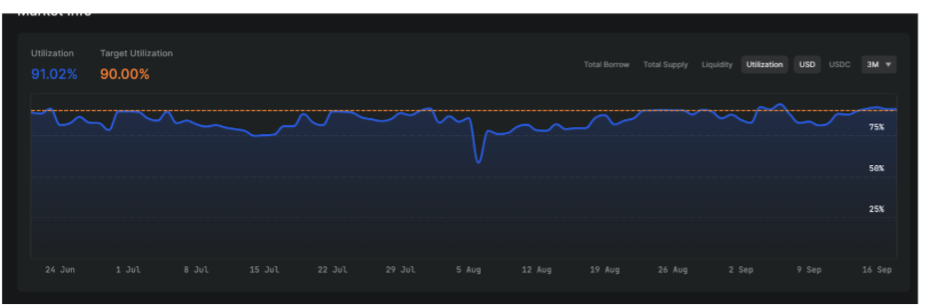
On the other hand, Morpho Blue, despite having a smaller deposit base (20% of Aave’s), achieves significantly higher utilization. The most popular market on Morpho Blue is WBTC/USDC, with a utilization rate as high as 90%.
Source: WBTC/USDC Vault, Morpho Blue
To date, Aave and Morpho only accept WBTC. To differentiate itself in the competitive lending market, Zeroland is the first platform dedicated to BTC LST tokens and supports PT-eBTC. So far, they have attracted $17 million in eBTC supply, with approximately $3.28 million borrowed, resulting in a 20% utilization rate.
Additionally, Curve is not only a safe haven for stablecoin swaps but also a popular destination for BTC-related assets. On Curve, BTC providers can do two things: first, provide liquidity to the tri-pool; second, use tBTC and WBTC as collateral to borrow crvUSD.
At the time of writing, approximately $50 million in BTC assets have been deposited to borrow crvUSD. Among available pools, the tBTC-WBTC pool stands out with $25 million in assets and $2.24 million in daily trading volume. Unfortunately, despite active BTC-related asset usage on Curve, no $CRV incentives are currently offered to attract users.
2.2.3 Interest Rate Swap (IRS) Platforms
Besides money markets, interest rate swap (IRS) products offered by Pendle are among the most popular destinations for BTC LST DeFi.
Pendle leverages the future yield of BTC LSTs and speculation on points to create multiple dedicated markets: PT/YT for SolvBTC.BBN, LBTC, eBTC, etc. These markets have collectively attracted over $136 million in funds, growing 150% month-on-month, driven by points and incentive farming.
New rounds of voting incentives also reflect increasing interest in BTC LRTs. For instance, SolvVBTC on Corn was selected to receive the highest emissions from Pendle. As such, BTC LRT asset supply is expected to continue growing in the near future, especially given emission incentives.

Source: Pendle Dashboard
2.2.4 TVL Bootstrapping Vaults / Points Strategies
While money markets and IRS products generate additional yield for BTC assets based on supply and demand on ETH mainnet, TVL bootstrapping vaults prioritize using BTC to boost their respective chain’s TVL to foster ecosystem growth. Additionally, some vaults offer leveraged points farming strategies by looping or borrowing BTC to maximize returns with the same capital.
Gearbox offers up to 27x Lombard points through leveraged WBTC borrowing (up to 7x). However, this service is not widely adopted, as supplies on Gearbox remain very limited (only about $3 million).

Source: gearbox.fi
Beyond points strategies, some Layer 2 networks, such as Thesis’s Mezo and Binance Labs-backed Corn, are leveraging BTC value by allowing nodes to "stake" bridged BTC LSTs as collateral. In return, nodes earn $BTC fees by participating in validation—a promising attempt to utilize BTC and bootstrap TVL for future ecosystem growth. To date, Mezo has attracted $121 million in BTC-related assets and $20 million in Corn.
It is now evident that most BTC LST-related DeFi activity is primarily incentive-driven. While BTC adoption is rising, long-term real demand for BTC LSTs will heavily depend on Babylon’s yield performance, which could make BTC LSTs more attractive than ETH LSTs.
2.2.5 Liquidity Issues
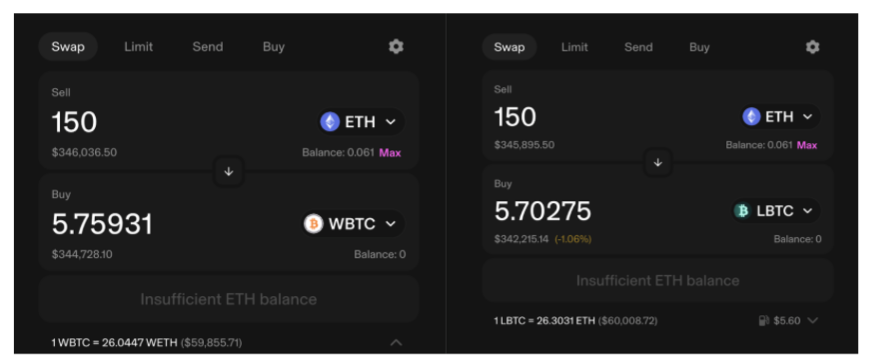
Despite having $300 million in TVL, the deepest pool on Uni v3 has only about $10 million in liquidity (according to Nansen). Swapping $345,000 worth of ETH into LBTC would result in a 1.06% slippage—four times higher than WBTC (~0.4%). This gap highlights a key challenge BTC LSTs must overcome: liquidity issues during large-scale exits from LBTC positions.
Source: Uniswap
3. Conclusion
Bridging BTC mainly takes two forms: standard BTC, such as Wrapped BTC (WBTC), and BTC restaked within Babylon, known as BTC-LST.
The BTC LST/LRT-Fi landscape is still in its early stages but shows healthy signs of bridging more TVL from BTC into the ETH DeFi ecosystem.
Given BTC’s growing recognition and market dominance in this cycle, its adoption is expected to increase. The opportunity to generate yield on BTC has also created a speculative and trading market on Ethereum.
WBTC remains one of the most widely adopted BTC forms on Ethereum. However, due to recent challenges related to its association with Justin Sun, alternatives like tBTC or LBTC are expected to gain greater adoption.
It is becoming increasingly common to see BTC restaking tokens being further restaked into platforms like Symbiotic or Karak for leveraged farming. While this may yield higher returns, users must bear the risk of facing multiple slashing events.
Money markets and interest rate swaps are the most in-demand BTC DeFi activities on Ethereum, while attempts by Layer 2s to use BTC as fees in the validation process are also noteworthy.
Currently, most BTC-related DeFi activity on Ethereum is primarily driven by points or reward incentives. To generate real demand, BTC LSTs need to create value (potentially in yield form) that exceeds that of ETH LSTs.
Custody risk, slashing risk, and liquidity risk are the primary concerns in the BTC LST landscape.
* Note:
This research aims to provide a high-level overview of the rising trend of BTC LSTs on Ethereum and hopes to raise awareness of the opportunities and risks involved in handling this new generation of BTC assets. Further research will be needed to assess the cross-chain financial potential and impact of BTC assets on Ethereum and other chains.
If anything is missing, please reach out to @poopmandefi on Twitter, and I will do my best to keep this research updated.
Join TechFlow official community to stay tuned
Telegram:https://t.me/TechFlowDaily
X (Twitter):https://x.com/TechFlowPost
X (Twitter) EN:https://x.com/BlockFlow_News
 IOSG Ventures