








Project Preview: Windfall, Solana's First Gamified Liquid Staking Protocol, A New DeFi Approach to Lowering Barriers
TechFlow Selected TechFlow Selected
Project Preview: Windfall, Solana's First Gamified Liquid Staking Protocol, A New DeFi Approach to Lowering Barriers
Windfall has taken the idea of "lowering barriers" to a whole new level.
 Navigating Web3 tides with focused insights
Author: TechFlow
Solana's ecosystem has recently regained attention, though much of the buzz still stems from an endless stream of memes.
Beyond memes, some established sectors and narratives are undergoing self-evolution—such as the evergreen topic of LST (liquid staking).
The logic behind LST has always been straightforward: you deposit, you stake, you earn rewards. But this simplicity is only apparent to seasoned DeFi users. Solana, often nicknamed the "retail chain," aims to bring more non-crypto-native retail investors into LST without exposing them directly to its underlying mechanics.
A recent Solana-based LST protocol named Windfall has taken lowering barriers to a new level—making users feel like they're playing a game rather than participating in DeFi.
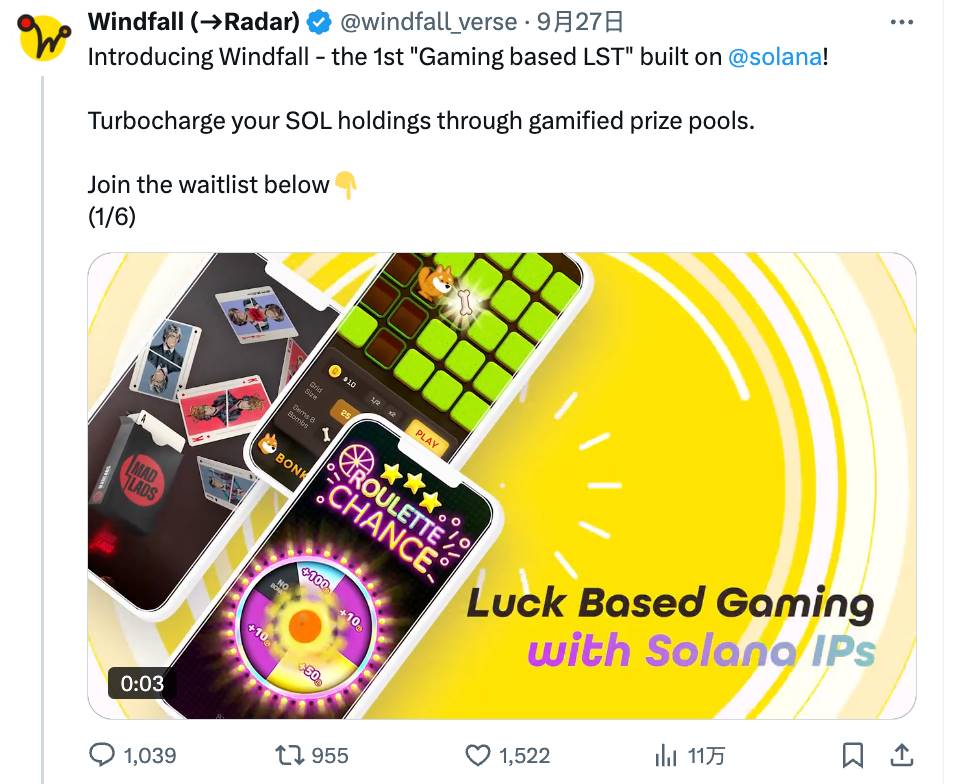
After reviewing the project, the mechanism is roughly this: play games to earn rewards, with those rewards funded by yields from LST/LRT staking.
When new narratives are hard to emerge, tweaking existing ones to align with the new trend of "consumer-grade crypto applications" becomes noteworthy.
Front Store, Back Factory
If you're completely new to crypto and DeFi, there’s a key gap in understanding LST:
You might not even know why staking matters, let alone grasp the hardcore rationale of securing a PoS network. The truth is, LST has long been designed not for mass adoption, but as a slightly gated playground where degens and whales directly chase yield.
Be honest—even within the space, those who don’t actively engage in DeFi would struggle to understand layered yields, asset nesting, leveraged lending, and other financially complex designs.
So Windfall flips the script entirely: If users don’t need to understand it, just hide it from view.
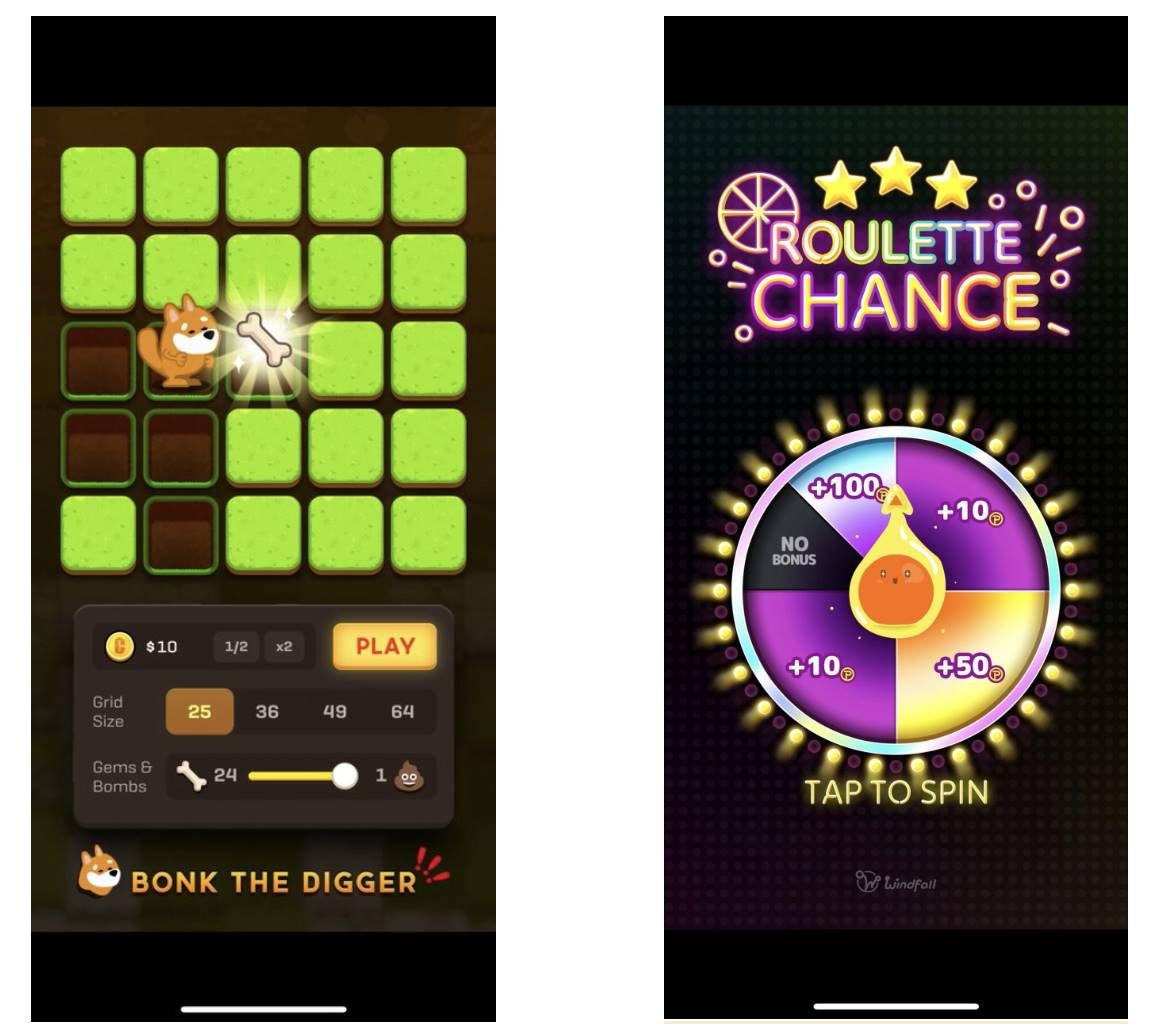
From the user’s perspective, all you see on Windfall are simple mini-games—interfaces like the one pictured above. These games are easy to grasp, often incorporating reward tiers, lucky draws, and prize pools.
Throughout the experience, you’re simply playing casual games and earning in-game rewards based on different rules.
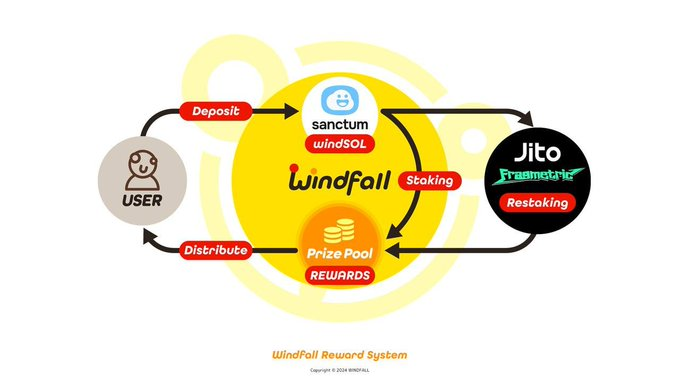
These in-game rewards are actually sourced from various LST/LRT protocols on Solana:
-
Staking Yield: When players deposit SOL into Windfall, it feels like paying to play a lottery-style game. In reality, the deposited SOL is converted into windSOL via Sanctum’s liquid staking protocol, generating base staking yield.
-
Restaking Yield: Similarly, the resulting LST token (windSOL) is further restaked through fragmetric—a restaking protocol backed by Jito—creating another layer of yield compounding.
-
The combined staking and restaking yields from all user deposits form a prize pool, which is then distributed among players according to game rules.
This is a classic “front store, back factory” model: consumers are sold a fun product, while behind the scenes lies a complex production line.
To retail users, it’s a rewarding game; behind the curtain, it’s a nested mechanism of liquid staking and restaking generating yield.
Users don’t need to understand the factory’s inner workings—they just play and enjoy.
Clearly, this front-store approach is far easier to grasp than diving into the intricate mechanics of yield generation, making it far more accessible to outsiders.
Collaborative Growth
Gameified LST can't succeed on Windfall alone. The project wisely chooses to collaborate with other ecosystem players, primarily to attract more users.
From an operational standpoint, how do you make such games more appealing?
There are essentially two paths:
First, increase the game’s intrinsic appeal; second, allow holders of diverse assets to participate.
Following these principles, Windfall is building a broad alliance:
First, to boost game appeal, Windfall maximizes the IP value of popular memes. Its collection of casual, luck-based mini-games partners with Solana NFTs, memes, and other IPs (like @bonk_inu and @MadLads)—for example, the Bonk block-mining game shown earlier.
Second, to expand asset eligibility, Windfall integrates with more DeFi protocols, allowing participation beyond just SOL. For instance, users can deposit stablecoins via @KaminoFinance, Ethereum via @EclipseFND, or Bitcoin via @ZeusNetworkHQ.
Additionally, regarding fairness—since these are essentially lucky draw games—randomness, transparency, and efficiency in reward distribution become critical. According to Windfall’s official X account, the project is collaborating with magicblock and Light Protocol, leveraging ZK compression technology to efficiently process large volumes of lottery-style rewards generated by gameplay.
This collaborative strategy—teaming up to address weaknesses and fulfill needs around core business KPIs—is likely to become increasingly common among new projects built on top of old narratives.
For new projects, leveraging existing infrastructure avoids reinventing the wheel. For established protocols, offering modular services allows them to share in future revenue—no downside.
That said, Windfall hasn’t yet fully launched its website or revealed full product details. It remains in the social media hype and pre-launch phase.
For early-degen users, the current move is to submit your SOL address to join the official waitlist via this link, aiming for early access and additional benefits.
No grand narrative has emerged—yet small optimizations continue.
The current crypto market may still be waiting for a glimmer of light.
Join TechFlow official community to stay tuned
Telegram:https://t.me/TechFlowDaily
X (Twitter):https://x.com/TechFlowPost
X (Twitter) EN:https://x.com/BlockFlow_News
 深潮TechFlow


