Dialogue with Qiao Wang: Reviewing Hot Crypto Trends at Token2049
TechFlow Selected TechFlow Selected
Dialogue with Qiao Wang: Reviewing Hot Crypto Trends at Token2049
Imran and Qiao discussed cryptocurrency product trends at Token2049, including tokenization in consumer sectors, applications in social networks and real-world assets, as well as the rise of infrastructure projects.
 Navigating Web3 tides with focused insights
Compiled & Translated: TechFlow
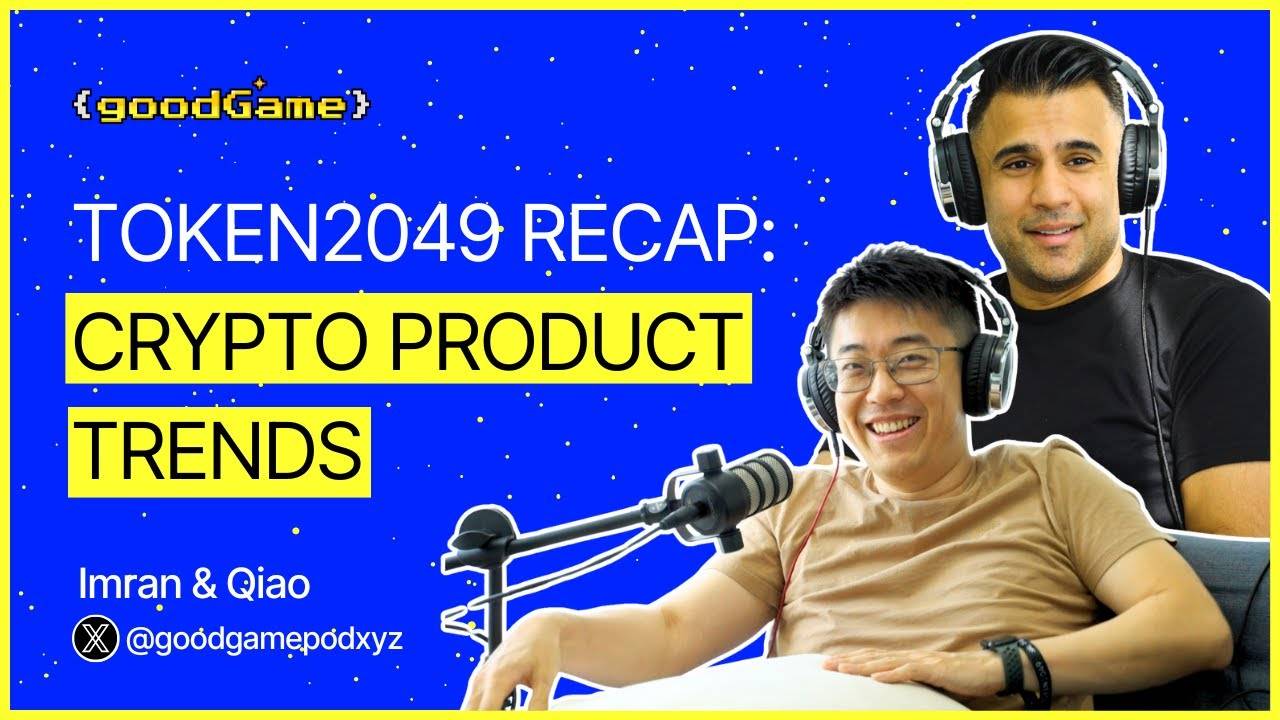
Guests: Imran Khan, Founding Supporter of @alliancedao; Wang Qiao, Customer Support at @alliancedao
Source: Good Game Podcast
Original Title: Token2049 Recap | Crypto Product Trends
Air Date: September 22, 2024
Background
In this episode, Imran and Qiao discuss crypto product trends observed at Token2049, including tokenization in consumer applications, social networks and real-world assets (RWAs), and the rise of infrastructure projects—offering founders direct, no-nonsense insights into the current state of crypto.
Interesting Trends at Token2049
-
Imran discussed several notable trends he observed at Token2049. He mentioned hosting a founder therapy session with around 30 randomly selected founders to talk about their ongoing projects. These conversations gave him broader insight into current crypto development directions.
-
Imran noted several key trends: first, tokenization in consumer-facing applications, especially prediction market-related projects. He also highlighted developments in social networking and real-world asset (RWA) use cases, as well as new infrastructure initiatives—such as Layer 1 blockchains aiming to compete in ultra-liquidity markets. While he didn’t see many radically novel ideas, he acknowledged there are still plenty of solid concepts emerging.
Have We Reached Peak Innovation?
-
Imran raised the question of whether the industry has hit a creative ceiling.
-
Qiao agreed that the industry may feel stagnant, but emphasized that both he and Imran still have many ideas. The bottleneck, he said, lies not in ideas but in the lack of founders willing to execute them—even though people can be found to participate.
-
Qiao added that “depth” has become a dominant narrative lately because when the crypto space runs low on new ideas, it tends to double down on an existing story. He cited Helium as the largest example of this “depth” narrative, particularly its successful implementation in mobile network data offloading—use cases directly tied to tokens and demonstrating strong practical application.
-
Imran asked about Keyname’s product-market fit. Qiao said they are gradually achieving it but expressed uncertainty about the backend capabilities of the entire network, especially regarding data offloading and bandwidth handling.
PayFi – The Huma Project
-
Qiao introduced a new narrative called PayFi.
-
Imran explained it as a short-term financing model focused on inter-company lending.
-
Qiao noted that many startups need such short-term loans, especially during cash flow transitions.
-
Qiao shared that he met PayFi’s founder the previous night and plans to learn more about the project. He believes PayFi’s core idea is leveraging crypto to shorten settlement times, boosting capital efficiency through instant settlements. This increases lending efficiency between businesses and brings them closer to profitability—indicating real users and genuine problem-solving.
-
Additionally, Qiao mentioned another interesting project: a Signal alternative using onion routing to hide users’ IP addresses, enhancing communication security. He pointed out that Signal currently poses privacy risks, such as storing encrypted mappings of phone numbers, which could be exploited.
-
Qiao also noted recent security incidents at Signal that have raised concerns about its transparency.
Session – Focused on Messaging, Not Metadata
-
Imran and Qiao discussed the Session app.
-
Qiao emphasized that most Session users aren’t crypto natives but ordinary people who value privacy.
-
Qiao mentioned that the Swiss government has praised Session due to Switzerland’s strong emphasis on privacy protection.
-
Imran shared his experience creating a Session account, noting the onboarding was fast and required no personal information.
-
Qiao explained how onion routing works, stressing it's central to the project. Users can choose to run nodes and earn tokens in return.
Bio.xyz – The Molecule Project
-
Qiao mentioned a new project called Molecule (biomolecules), currently developing one named "The Cooking."
-
Qiao explained that the project aims to tokenize scientific intellectual property—especially drug discovery-related IP—enabling crowdfunding and immediate liquidity for these assets.
-
Imran supported the concept and asked about token mechanics—how token purchases and transaction fees would be allocated during DNA research, for instance.
-
Qiao responded that the design space is open, with specific crowdfunding models and revenue distribution still under discussion.
-
The two discussed rebranding “meme coins,” with Imran noting that current naming causes misunderstanding. He suggested adopting more accurate names reflecting actual utility and value. Qiao agreed, proposing descriptive terms like “interceptive token” or tokens involving third-party staking and restaking.
-
Overall, they were optimistic about Molecule’s innovation and potential, seeing the fusion of crypto and scientific research as a promising direction.
Direct Bluetooth and WiFi Messaging Technology
-
Qiao mentioned a new project building a mesh network based on Bluetooth and WiFi Direct. The goal is enabling message exchange without internet access, using Bluetooth (up to 30 meters) or WiFi (up to 200 meters).
Imran expressed interest and asked if this technology could gain widespread adoption in certain regions.
-
Qiao believed this could be highly relevant in countries with strict internet controls, especially during peaceful protests. Historically, governments have shut down internet or messaging apps during protests, leaving people unable to self-organize.
-
They referenced examples from Turkey and Egypt, emphasizing how mesh networks could help maintain communication under government-imposed restrictions. The technology’s potential lies in offering users new ways to self-organize and share information, particularly in politically unstable regions.
"It Seems We're Returning to the Original Vision"
-
Imran observed that current trends seem to echo crypto’s early vision. Recalling his entry into the space, he remembered frequent exposure to innovative ideas and projects. He mentioned emerging concepts like new cryptography ("new cipher"), expressing nostalgia for those foundational ideals.
-
Qiao agreed, noting that much of crypto’s original spirit of innovation and experimentation is resurfacing. They discussed the positive implications of this return and how it might drive further technological development. Both expressed optimism about future possibilities and looked forward to seeing more projects rooted in early crypto principles.
"Crypto May Have Attracted the Wrong People"
-
Qiao argued that crypto has attracted unsuitable participants. Projects like messaging apps and mesh networks don’t offer quick riches—they require long-term commitment and effort. For example, one session app has been in development for six years. He stressed that these are not get-rich-quick schemes.
-
Imran agreed, noting such projects are often open-source and demand significant time and dedication from founders. These builders aren’t motivated by wealth but by belief in the mission.
-
Qiao added that such technologies are inherently anti-government and anti-authoritarian, which deters many founders. Centralized exchanges, unwilling to challenge governments, avoid listing potentially risky tokens—making fast profits even harder.
-
Imran expressed interest in more censorship-resistant products—like messaging, internet access, and domain systems. They discussed DNS as a centralized point vulnerable to censorship, underscoring the need for more resilient, decentralized alternatives.
Anyone.io – A Decentralized TOR Network
-
Qiao mentioned an upcoming meeting with Anyone.io, a decentralized TOR network aiming to “make TOR great again.”
-
He pointed out a major flaw in TOR: many nodes are reportedly controlled by agencies like the CIA and NSA, meaning users don’t truly enjoy privacy. Anyone.io aims to build a new, open-source version of TOR, fixing technical issues and improving decentralization.
-
More intriguingly, Anyone.io plans to use token incentives to encourage node operation, reducing the risk of centralization. Qiao believes this design enhances network resilience.
-
Imran asked whether all messages can be routed through the network. Qiao admitted details are unclear—he plans to learn more during his in-person meeting. They discussed decentralized TOR, VPNs, mesh networks, and offline messaging, seeing these privacy-preserving, decentralized technologies as highly promising.
Decentralized VPN Technology
-
Imran noted that many decentralized VPNs already exist, but Qiao said the space is highly competitive. Imran added that no clear winner has emerged because average users can’t easily distinguish decentralized from traditional VPNs.
-
Qiao shared his preferred mainstream VPNs—Proton and Nord VPN—praising their product quality. They discussed Nord VPN’s reliability; despite one outage, its uptime remains high overall.
-
Imran acknowledged uptime matters but stressed bigger concerns: whether centralized VPNs store user data and could be compromised. He admitted he believes all VPNs are potentially hackable, possibly containing backdoors.
-
Qiao added an interesting point: countries now maintain their own GPS systems to prevent adversaries from tracking leaders’ exact locations and enabling drone strikes. They discussed trade-offs between privacy and security, and how modern tech reshapes power dynamics.
-
Imran referenced an interview with old-school mafia figures, noting modern technology makes hiding evidence far harder—contributing to the decline of organized crime. This sparked a broader discussion on centralized vs. decentralized networks, suggesting decentralized solutions may offer greater privacy and security in the future.
The U.S. Still Has the Most Developers
-
Qiao mentioned a brief chat with Kartik, a global event organizer, who told him the U.S. still leads in developer count—and numbers have actually grown over recent years.
-
Qiao noted this contradicts their observations. Many developers appear as hackers—often full-time workers elsewhere, not deeply involved in crypto. They join hackathons mainly for weekend projects, free food, or prize money. Despite harsh U.S. regulations, hackathon participation has risen in recent years.
-
Additionally, Qiao said Japan is seen as East Asia’s top developer nation, while India remains stable—highlighting differing developer ecosystem performances across countries.
Japan Is a Major Participant in ETHGlobal
-
Imran expressed confusion about Japan’s developer scene, saying he rarely sees Japanese founders. Qiao said he’s met a few but not many. He referenced a friend’s insight on Japan’s ecosystem, citing Sony’s recently announced project Sonia as an example.
-
Qiao explained that Japan’s tech development lags one cycle behind frontier markets. Technologies Japan is now exploring (e.g., “cheese”) are already outdated in leading markets. He also noted Japan’s crypto ecosystem is relatively isolated internationally, attributing this partly to language barriers that make communication with Japanese founders difficult.
-
Imran agreed language is a global issue, but Qiao emphasized Japan’s case is uniquely challenging. Though Vietnam also has language barriers, Qiao found communication with Vietnamese founders easier.
-
Qiao added that while Japan has high ETHGlobal participation, attendees aren’t always Japanese—many fly in from abroad, creating sample bias. In contrast, Indian participants are mostly local, revealing structural differences in hackathon engagement across nations.
Largest Hackathon Ever Hosted by ETHGlobal
-
Imran recalled attending ETHGlobal’s largest hackathon in Bangalore last year, drawing 2,500 developers—most of them Indian. He joked that while a few came from outside India, they were so few they could be counted on one hand.
-
He also shared a recent experience in Singapore, where Coin DCX (dubbed “India’s Coinbase”) hosted a consumer-focused event with many attendees flying in from India. He noticed many Indians in Singapore, but this event was almost entirely Indian.
-
Qiao said he saw many Indians flying into Singapore during his stay. Imran expressed optimism about India’s potential, expecting interesting products to emerge from this rising market.
-
Qiao mentioned a conversation with Ajit, who believes Bangalore has many founders but doubts the best ideas will come from there. He hopes Indian founders spend three months in New York to get closer to frontier markets. Imran countered that many Indian developers want to start startups but lack real entrepreneurial experience. He sees them more as hackers wanting to be founders, rather than seasoned entrepreneurs. He stressed that experience—learning from failure—is key to building successful startups, not just geographic proximity.
Vitalik’s Musical Performance
-
Qiao mentioned Vitalik singing at an event. Imran found it confusing, feeling it didn’t align with Vitalik’s image as a founder. Qiao agreed—it wasn’t very founder-like.
-
Imran added it wasn’t founder mode or manager mode, but something else entirely. He speculated Vitalik might be doing it for visibility.
-
Qiao shared a humorous tweet suggesting Ethereum Classic (ETC) dropped 24%–25% after Vitalik got a girlfriend—an ironic take linking his personal life to market performance.
Our View on the Current Market
-
Qiao and Imran discussed Federal Reserve Chair Jerome Powell’s market impact. Imran said Powell “controls everyone,” while Qiao praised his economic management, despite poor handling of inflation in 2021–2022.
-
Qiao noted Trump shares blame for inflation due to massive money printing during the pandemic, while Biden increased fiscal spending during recovery. Imran said Powell made decisions under Trump’s influence but successfully achieved a “soft landing” or even “no landing” over the past two years—leaving markets puzzled.
-
Qiao sees a bullish outlook, especially if rate-cut cycles begin. Imran believes markets need time to absorb changes and hopes for no recession.
-
They then discussed Peter Thiel’s remarks at a summit. Imran said Thiel believes Trump may win but underperform, and if the race is close, Kamala Harris might prevail due to superior funding.
-
Finally, Imran and Qiao touched on Thiel’s AI views, likening today’s AI boom to the 1999–2000 dot-com bubble—only companies like Nvidia profit while others lose money. Thiel advised entrepreneurs to build competitors to OpenAI or Nvidia, a view they support.
Nvidia’s Competitive Landscape
-
Qiao noted Nvidia faces competition from well-funded startups launching AI-specific ASICs for training and inference. While Nvidia GPUs hold market share, they weren’t originally designed for AI.
-
Qiao emphasized Nvidia’s real advantage lies in CUDA—a software platform widely adopted by AI developers.
-
Imran added that Nvidia’s brand strength, built since 1993 (Lindy effect), is another edge. Qiao also mentioned CEO Jensen Huang’s close relationship with TSMC’s CEO, giving Nvidia preferential support during tough times.
-
They discussed Nvidia’s struggles in recent years, especially after Ethereum’s shift from Proof-of-Work to Proof-of-Stake, which drastically reduced GPU demand. Imran pointed out Nvidia’s omission of crypto miner sales data in earnings reports, causing market confusion.
-
Qiao stressed that beyond startup rivals, Nvidia faces pressure from major clients—Facebook, Google, Amazon, Microsoft—who are building custom hardware to reduce reliance. Google’s TPU, developed with Broadcom, exemplifies this trend.
-
Imran argued that as these companies develop proprietary GPUs, AI hardware may eventually commoditize. Qiao disagreed, noting rapid iteration keeps AI chips far from commodity status. But Imran believes long-term convergence in infrastructure will lead to commoditization.
-
On personal investments, Qiao said he only holds TSM stock, viewing it as the safest bet—TSMC will secure business regardless. However, he warned that war in the Taiwan Strait within the next four years would be catastrophic. He predicted such a conflict could surpass the Ukraine-Russia war in severity, being a direct clash between superpowers rather than a proxy war.
Challenges Facing China Today
-
Qiao noted that many talented individuals are leaving China—a trend confirmed through conversations with multiple founders, especially in crypto. He mentioned company formations peaked around 2018–2019 and have declined since.
-
Imran added that many fund managers’ limited partners (LPs) are actually Chinese, and numerous founders face debt, wage garnishment, and frozen bank accounts. These factors collectively worsen China’s startup environment, pushing promising entrepreneurs to leave.
The 21st Century: Asia’s Century?
-
Qiao mentioned independent conversations with three Hong Kong residents recently, all agreeing that Hong Kong’s economy is in its worst state in 30–40 years—even worse than during the 2009 global financial crisis. Despite social media narratives claiming the 21st century belongs to Asia, he expressed skepticism.
Why Did China Grow Faster Than India?
-
Qiao pointed out that China and India had similar starting points in the 1960s–1970s, with comparable populations and GDP.
-
Imran attributed China’s rapid growth to its political system, which enables unified national goals and faster economic execution. In contrast, India’s religious and linguistic diversity makes consensus harder, slowing progress.
-
Discussing India’s religious makeup, Imran estimated India’s 1.4 billion population includes about 300 million Muslims, with the rest mostly Hindu. He noted internal divisions within Hinduism—including caste groups—that historically made India easier to conquer.
-
Imran also highlighted severe corruption in India, especially at local government levels, hindering economic growth. Citing Charlie Munger, he expressed greater optimism about China due to India’s more fragmented corruption.
-
Qiao added that despite challenges, India’s economic potential remains strong as countries like the U.S. shift manufacturing there. Imran agreed, believing India is entering a new growth phase.
-
They discussed India’s economic transformation and rising middle class. Imran shared a cousin’s success story in India, signaling positive momentum. Ultimately, while Qiao remained cautious, he acknowledged India could become a globally influential power in the future.
Join TechFlow official community to stay tuned
Telegram:https://t.me/TechFlowDaily
X (Twitter):https://x.com/TechFlowPost
X (Twitter) EN:https://x.com/BlockFlow_News
 深潮TechFlow