IOSG Ventures founder: The industry calls for real users and new capital; Ethereum can't just talk about sentiment and ideals
TechFlow Selected TechFlow Selected
IOSG Ventures founder: The industry calls for real users and new capital; Ethereum can't just talk about sentiment and ideals
The crypto industry needs to return to practical applications and avoid false prosperity.
 Navigating Web3 tides with focused insights
Author: Jocy Lin, Founder of IOSG Ventures
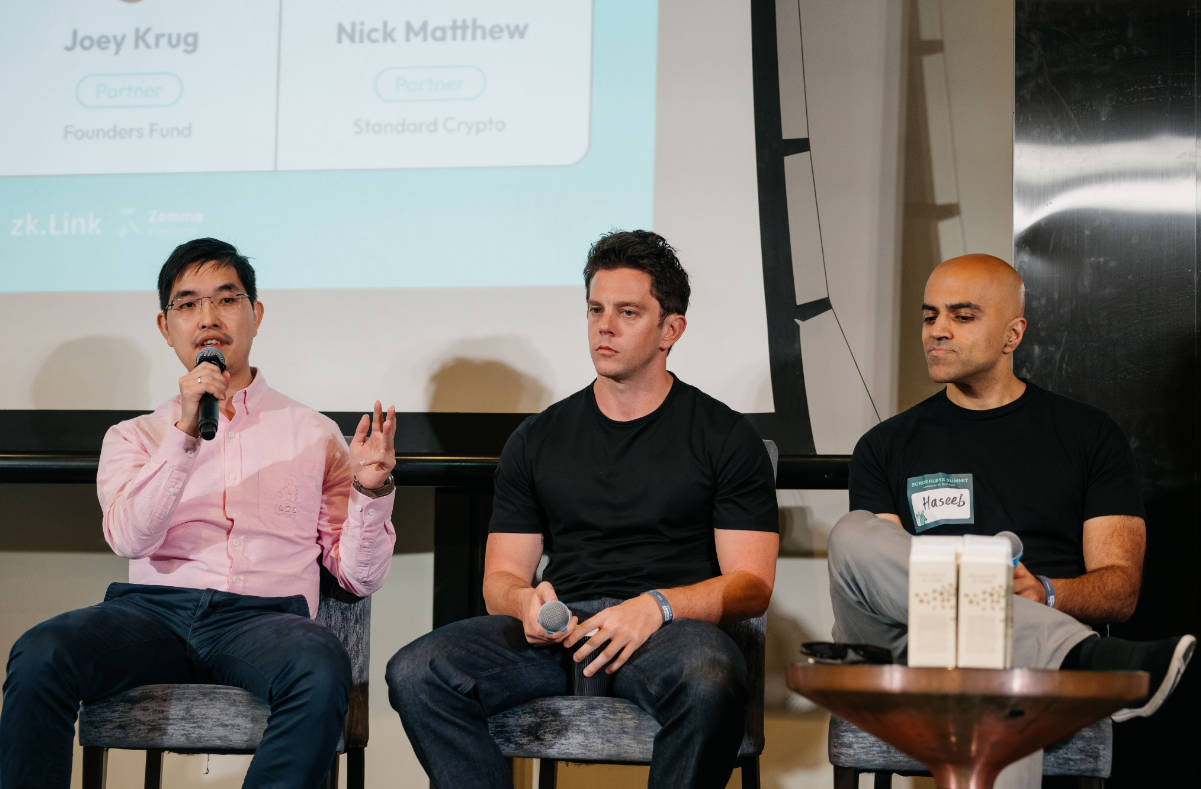
This year’s Token2049 event reached an impressive scale, with attendance doubling last year's numbers and surpassing 20,000. Even Grab drivers remarked that this week, more people attended crypto events than came for the F1 race. Overseas attendees and speakers made up over half of participants across multiple sessions, making this edition undoubtedly the most successful—and profitable—in Token2049 history.
Why Are U.S. GPs and “Top-Tier” Projects Flooding Into Asia?
Why are so many U.S. GPs coming to Asia? Why are numerous “top-tier” projects traveling all the way here? The answer lies in the source: fresh capital. Facing a tight funding environment, top-tier GPs and projects have specifically come to Asia hoping to tap into Asian communities to meet their fundraising goals.
During this week alone, many LPs averaged meetings with three U.S.-based GPs per day. We’re now seeing PM Fund’s new fund size reduced to $800 million, another P Fund cutting its target from $800 million down to $200 million, and D Fund’s first-time raise expected at around $250 million. This clearly reflects a new wave of fundraising challenges across global crypto funds: due to poor DPI performance in the previous cycle, fund sizes are shrinking and LPs are becoming increasingly cautious. LPs are influencing VC GPs, who in turn are applying stricter criteria when selecting early-stage founders—making fundraising even harder for startups. At the same time, listing requirements from exchanges like Binance are also rising.
Funds that aggressively raised capital earlier this year (some inflating valuations by creating three different price points within a single round) are now being pressured by LPs to reflect and reform. Many funds and large players who were actively buying OTC or trading secondaries at the beginning of the year are now questioning the industry itself. The volatility and reflexivity of crypto demand respect. The fundraising market is deteriorating—becoming very poor—with active deals mostly occurring only at low valuations or in entirely new directions.
Projects valued around $100M that haven’t completed TGE are abandoning plans to list on Binance due to the difficulty involved. Infrastructure projects valued between $300M and $500M are struggling through fundraising (essentially accepting any investor willing to participate). For projects that have already completed TGE, if their launch strategy was weak, FDV has on average dropped 80% compared to their last VC round valuation. Projects with liquidity on Binance are still waiting for a bull market rebound, while those not listed are already planning next-phase initiatives or new ventures.
Industry Confidence Is Severely Damaged; Innovation Support Hangs by a Thread
Everyone in the industry seems busy: some fabricate data and revenue to deceive exchanges and investors; others engage endlessly in academic discussions within technical communities but forget that solid infrastructure exists to serve real applications and users. Exchanges, benefiting from strong revenue models, have become the biggest winners, offering the best short-term working conditions and compensation—yet they make it harder for startups to attract top talent. This mirrors the prosperity of the 2049 conference: beneath the surface spectacle, few are discussing how to acquire real users and generate sustainable revenue, or what stable business models could look like.
Altcoin performance may be worse than anticipated, forcing industry participants to reevaluate innovation and genuine use cases. VCs, exchanges, project teams, and retail investors all have misaligned incentives, and every party ends up harmed by the market. With zero trust or collaboration among these four groups, without reform we’ll hit a dead end—unable to bring in new capital, talent, or users. Even if Bitcoin succeeds, the broader Web3 ecosystem will still fail.
I advocate for adjustments to token utility and unlock terms. Traditional IPO lock-up periods require only 6 months to a year, yet for crypto seed-stage startups, overall liquidity locks extend to 3–4 years.
Most project tokens lack any real utility. During the first six months after listing, market makers may support price stability, but afterward neither the project team nor the exchange cares about the price. No one takes responsibility for VCs or retail investors who bought in later. After repeated cycles of losses and broken trust, confidence in supporting innovation erodes significantly.
If everyone is deluding themselves, waiting only for a bullish rebound without considering which applications will bring in real users, we’re headed toward depletion. Those who enjoyed early industry advantages don’t understand the current struggles. The largest 16-letter U.S. fund operates independently, managing tens of billions over a decade-long cycle, thriving without needing to collaborate with other institutions or market forces. Meanwhile, most successful founders show little concern for younger entrepreneurs facing the same hurdles they once did five or ten years ago. Yet the industry is now in a fragile state—we need these successful figures to provide guidance and restore faith, enabling others to persevere and glimpse the light of the next bull market.
Where Should Ethereum Go From Here?
Ethereum is undergoing unprecedented scrutiny. Since the ETF launch, net outflows have exceeded $1.2 billion. A major crisis of confidence is emerging—from core researchers and the Ethereum Foundation (EF), to developer communities, Consensys-affiliated commercial entities, and external investors. Vitalik Buterin needs to better define clear direction and goals for diverse stakeholders, because Ethereum has evolved into a massive decentralized business entity—unlike anything seen before in either crypto or traditional markets. The challenges facing the Ethereum community and Vitalik will only grow more intense, reaching a point where radical transformation becomes inevitable.
About five years ago, scrolling to the bottom of the Ethereum website would reveal a transparent comparison with several competing L1s, openly acknowledging Ethereum’s shortcomings. Today, Ethereum is stronger than ever—but how can we ensure the network remains open and pluralistic? That is the urgent issue we must address.
To clarify our stance: IOSG continues to strongly back Ethereum in our investment strategy. We have yet to see a more successful technological ecosystem. Ethereum’s total ecosystem TVL has grown from approximately $34B a year ago to $88B—an increase of 159.5%—a significant rise underscoring Ethereum’s potential to drive future innovative projects.
Crypto Must Return to Real-World Use Cases and Avoid False Prosperity
Recent MetaMask monthly active user data shows a drop from a peak of 30 million during the bull market to just 1 million—a sharp decline. User activity on EVM-compatible L1/L2 chains has also fallen by over 50%. This fragmentation of liquidity has led to widespread dispersion among applications, developers (asset issuers), and users. Developers and users are rapidly migrating to chains offering subsidies and memes. Liquidity across different chains and L2s remains highly siloed, and high-performance blockchains have not delivered high-performance applications.
Airdrops and incentives yield limited genuine user growth, and fatigue with airdrop-driven user acquisition is setting in. Third-party research indicates user retention drops by as much as 80% post-airdrop—hurting both founders and projects alike. Take FriendTech as an example: once a high-profile and attention-grabbing project, it lost nearly all its users after launching its token and failing to sustain price momentum. The restaking sector faces similar bottlenecks—after airdrops end, TVL drains away or shifts to new protocols.
Western funds remain skeptical about Ton and Web2 platforms, citing unresolved foundational issues with Russia and the Ton blockchain. While unconvinced, they haven't ruled out investment either. Nevertheless, it's evident that in this difficult cycle, Ton has injected new vitality into the crypto market. Among Telegram’s 900 million monthly active users, roughly 3 million are active gamers, with customer acquisition costs per Ton user at just $0.70. It’s likely that Ton’s model of bringing Web2 users into Web3 will be adopted by new L1s and L2s for growth. We can expect platforms to allocate dedicated budgets to subsidize such user acquisition. Additionally, there’s a clear opportunity: after completing strategic deployments in crypto financial ETFs, the U.S. may begin encouraging tech companies to integrate and penetrate Web3, with seamless, chain-agnostic user experiences becoming the new standard.
In gaming, conversations with several specialized game funds—including Bitkraft and Makers Fund, which transitioned from Web2—reveal underwhelming Web3 portfolio performance. Despite this, compared to the more mature Web2 gaming industry, they remain committed to raising new Web3 funds and believe in emerging Web3 gaming paradigms. The gaming sector has become exceptionally challenging. Long-term-oriented players are asking "what’s next?" after listing. Most native crypto gaming funds are struggling even more—over the past two years, 90% of GameFi projects have traded below their final VC round valuation post-listing. It appears that everything—from AAA games to fully on-chain games to degenerate gaming community platforms—is being abandoned by retail users. That said, a16z’s early investment in Pirate Nation and the recently funded Small Brain still maintain solid community foundations. The gaming space is extremely tough; all participants are losing confidence. Crypto gaming is pushing players to either exit or innovate dramatically by building better, more engaging products. Still, we continue searching for teams with conviction in gaming and shared understanding of the crypto market.
During this event, I spoke with a senior listing executive at a top-tier exchange who shared that their current internal priority and consensus is identifying long-term entrepreneurs. Founders who previously faked metrics to get listed often cash out immediately afterward, leaving behind liabilities for the community. In contrast, founders with a long-term vision consistently focus on growth and discovering reliable, sustainable business opportunities regardless of stage.
We also saw more founders at this 2049 event transitioning from traditional AI into Web3 entrepreneurship.
@gensynai and @hyperbolic_labs represent the computing frontier, while @SchellingAI exemplifies full-in Web2-style entrants. Meanwhile, http://Title.xyz focuses on generating images/videos in Midjourney-style artistic formats. AI + Consumer + DePin is emerging as a new frontier actively backed by industry funds. More talent entering the space will inevitably drive better utility and growth. Stay optimistic and Move Forward positively!
I call upon more of those who’ve benefited from industry tailwinds to pay greater attention to the root challenges we now face, support public goods development, and help create a healthier environment for long-term entrepreneurs. IOSG will lead by example—providing 0-to-1 support for early-stage founders, continuously refining our investment thesis, and guiding entrepreneurs to rethink business models and user acquisition strategies.
Join TechFlow official community to stay tuned
Telegram:https://t.me/TechFlowDaily
X (Twitter):https://x.com/TechFlowPost
X (Twitter) EN:https://x.com/BlockFlow_News
 IOSG Ventures