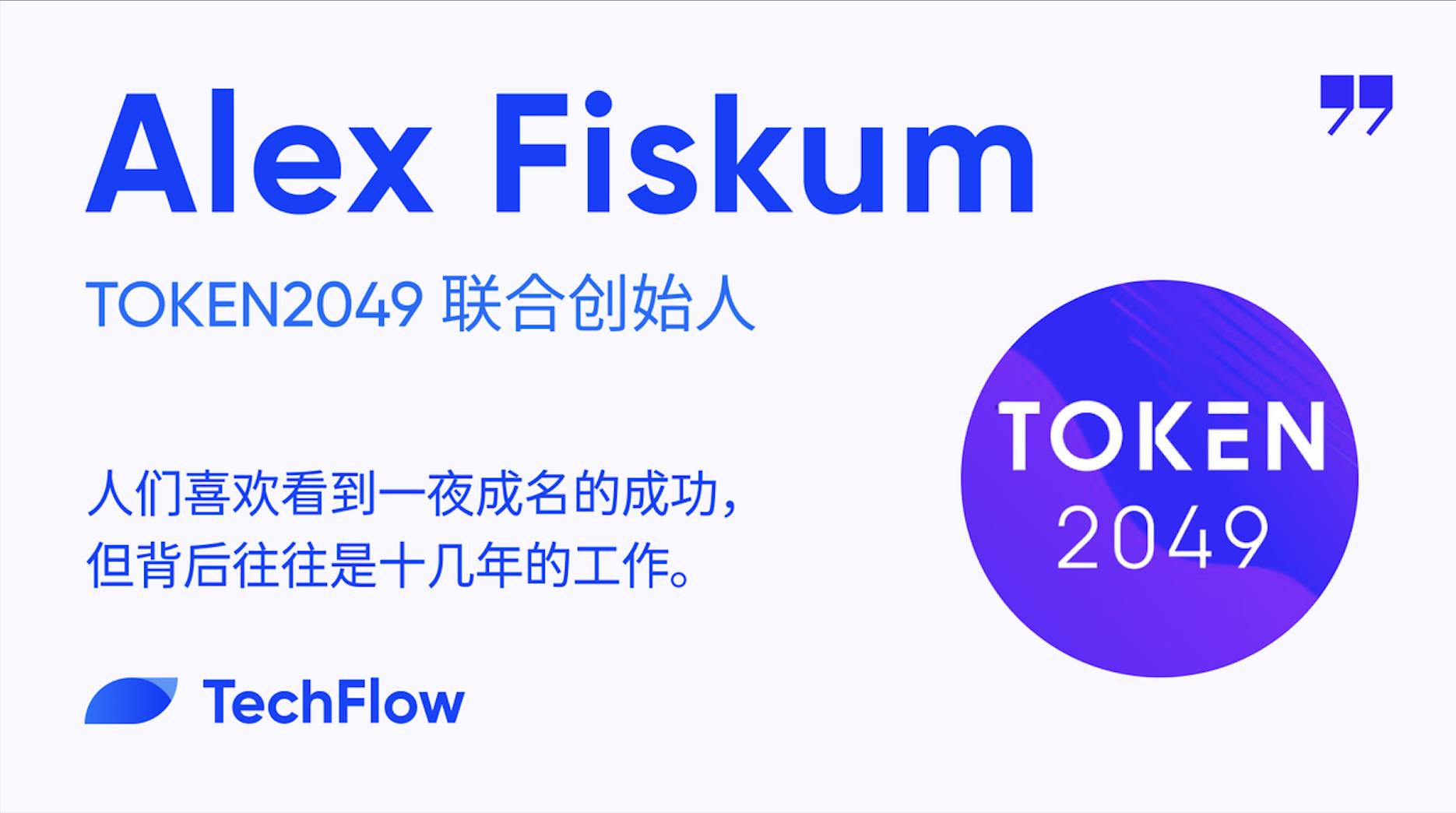
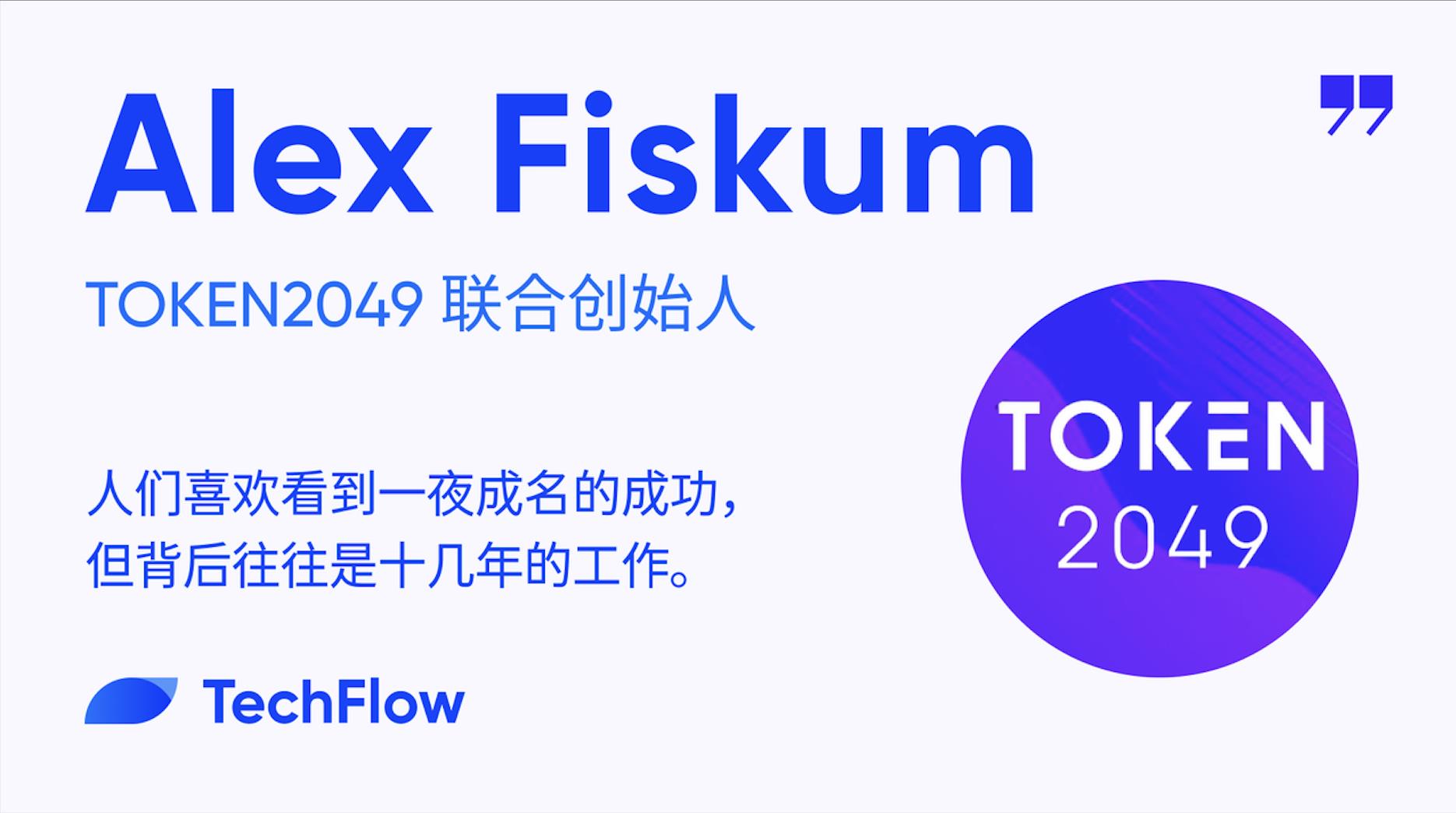
Interview with Alex, Founder of Token2049: People love to see overnight success, but underestimate the struggles behind it
TechFlow Selected TechFlow Selected
Interview with Alex, Founder of Token2049: People love to see overnight success, but underestimate the struggles behind it
I want people to see me, but not know who I am.
 Navigating Web3 tides with focused insights
Interviewer: Sunny
Editors: Min & Sunny
Prologue
"He gave you a name. You must be special."
-- K (protagonist of *Blade Runner 2049*)
In 2017, on Hong Kong’s big screens, the sci-fi blockbuster still revolved around bioengineering replacing future humans. Desolate wastelands, ruins, futuristic cities—guns and spaceships intertwined in light and shadow. Under golden, warm lighting stood the confrontation between human clones and their hunters.
At that time, the concept of a blockchain-driven global financial system had not yet swept mainstream culture. The same year, *Blade Runner 2049*, winner of Hollywood film awards, primarily explored themes of humanity, identity, memory, and the blurred boundaries between humans and artificial life forms.
While most people were still drifting hazily through vague illusions about future artificial beings, Alex Fiskum was someone living out cinematic scenes in reality.
This European from Norway, based in Hong Kong, built Singapore’s largest-ever crypto event in 2023—TOKEN2049. This year's TOKEN2049 attracted over 10,000 participants, 400+ sponsors, 250 speakers, and spawned more than 450 side events. Over 70% of attendees came from outside Asia, with 10% to 15% hailing from the United States. TOKEN2049 has truly evolved from a regional Asian crypto summit into a global crypto phenomenon.
Beneath the buzz and excitement of Token2049, rumors swirled among attendees that Alex and his Token2049 team might be the biggest winners of this bear market. "I heard the organizers made $15 million this time!" The figures being passed around left people stunned.
Regarding these rumors, Alex frankly stated that people often underestimate the material costs, time, and effort required to organize such events—and they’ve already begun planning for Token2049 Singapore 2025.
So who exactly is Alex, co-founder of TOKEN2049? What does TOKEN2049 really represent? TechFlow sat down with Alex to uncover the story behind it all.
TechFlow: What’s your background in the crypto space? People are very curious about you—can you share a bit?
Alex:
My background is in venture capital, focused on fintech, and I work in Hong Kong.
Around late 2016, cryptocurrency started coming onto our radar. At first, we began engaging with it from a research perspective and made some personal investments. I still clearly remember taking screenshots on my phone when I saw Ethereum (ETH) prices rise past $10, then $50. We became increasingly interested, but at that time, we didn’t have many connections in the Web3/crypto space.
So, the original idea behind Token 2049 was actually our way of exploring how to rapidly expand our network in this field. We decided to host an event, inviting the smartest people we knew in the industry, who would then recommend other speakers and projects. It really snowballed from there.
I remember our first event in 2018 drew about 1,500 attendees. Clearly, it was an excellent opportunity to meet everyone in the space, because it provided us with valuable networking resources.
So, my entry into crypto actually began from a venture capital perspective. Back then, we saw it as an interesting and potentially lucrative investment opportunity, so we started exploring ways to get involved—attending conferences, building projects, investing in exchanges. From that point on, the Token2049 business began to grow.
TechFlow: Why did you choose to develop Crypto in Hong Kong right now?
Alex:
My past experiences are indeed quite complex. I’ve lived in Sweden, Switzerland, and Norway; studied in Norway, Singapore, and China; worked as a data scientist in the Philippines; and gradually moved to Hong Kong.
I think where I am today is the result of many coincidences and random circumstances. Initially, I never imagined settling in Hong Kong, but I’m glad I chose it—I’ve now been living here for eight years. In fact, the only other place on Earth I’d consider moving to is Singapore.
Most of our team is also based in Hong Kong. In line with the spirit of crypto, our team and organizational structure are relatively decentralized. We have five core team members in Hong Kong, and others in the UK, Thailand, and the Philippines. We also have extended team members in Singapore and elsewhere.
Hong Kong is an incredibly vibrant city. To me, it’s almost an international hub—highly connected and interconnected. For me, Hong Kong is undoubtedly unique—you can quickly access pristine beaches or go hiking within 10 to 30 minutes. As a Norwegian, the climate, food, and lifestyle here feel exotic and refreshing.
Of course, from a corporate standpoint, since we hosted our first event in 2017, we’ve steadily grown here—we’ve hired staff and built a team in Hong Kong. That said, nothing stops us from relocating to Singapore—it could well be our future choice.
TechFlow: Why did you originally name it 2049? What does 2049 mean?
Alex:
There were several reasons. One was to make it sound mysterious—I wanted our audience to grasp its meaning. It also hints at something in the future. The number itself is sticky and memorable. So behind the name lies an intention to embed a sense of technology and futurism.
For example, if a conference name is hard to pronounce, it might resonate well in China, Korea, or Japan, but Western audiences may struggle to remember it. We found numbers easier to recall, which is why we often hear people refer to it simply as “2049.” Participants from different countries find the name easy to remember. Overall, one key aspect is that this number carries an implicit message, pointing toward the future of 2049 and beyond.
TechFlow: This year at Singapore 2049, besides Asian faces, we saw many attendees from Europe and America. Do you have any statistics? How many came from the U.S.? And what do you think attracted them?
Alex:
I think this is one area where we've done exceptionally well. 2049 is absolutely still an international event, not a local one. When I look at our data and see how it's changed over time, it's fascinating. Last year, about 70% of attendees came from overseas. This year, over 80% came from abroad. With more than 10,000 participants, this means we attracted a massive number of international attendees to Singapore. If I dig deeper, I estimate roughly 10% to 15% of attendees were from the U.S.
And this happened during Formula 1 (F1) race week, when hotel prices weren't cheap. I think it's an achievement that we managed to draw so many people to fly to Singapore specifically for TOKEN2049 that week.
Why does TOKEN2049 attract so many international attendees?
I think there are multiple reasons. First, 2049 itself is inherently a global event. We've held it in Hong Kong, Singapore, and London. I think people underestimate the time and effort required to organize such events. To give you a sense, we’ve already started preparing for the 2024 and 2025 Singapore events.
If we focused solely on localized content—say, just Hong Kong’s ecosystem or Asia’s crypto landscape—or took a narrow view of regulations in the U.S. or Europe—we wouldn’t attract a global audience. Instead, we blend Eastern and Western perspectives, which I believe gives people a compelling reason to travel to Singapore.
Singapore is a crossroads between East and West, making it easier to connect onward—to China, Japan, or further east. We focus on positioning 2049 as a truly international event, and that remains our top priority—from speakers and sponsors to community engagement.
TechFlow: From a crypto investment perspective, after speaking with investors attending this event, what insights did you gain?
Alex:
We spoke with major crypto investors who told us their investment volume increased significantly post-FTX. They believe the market reached near-bottom levels last November, both in terms of liquidity and private deals. However, we’ve also noticed secondary market trading has slowed, possibly reflecting retail caution. Now may not be the best time to overly emphasize venture capital.
As for market sentiment during 2049, most believe the market has bottomed out—but I don’t make price predictions. Compared to September last year, November was less panicked but more uncertain.
Currently, there’s a widespread belief that new projects and startups are emerging, especially in Asia, which appears more active than the West. Additionally, many prominent crypto VCs continue investing and allocating capital.
TechFlow: Everyone’s curious—how much did the organizers earn this time? There are rumors of $15 million. I know this is sensitive, but can you say anything?
Alex:
I want to emphasize that many people likely underestimate the actual costs of hosting an event in Singapore during F1 weekend. For instance, as F1 approaches, hotel prices in Singapore can triple. For large-scale events, costs are even higher due to extensive manpower and resource needs. By scheduling TOKEN2049 just before F1, we have to book venues early and invest significant time and resources upfront. When evaluating TOKEN2049’s economics, people should understand that organizing such an event requires massive investment—in venues, equipment, personnel, etc. The workload is enormous, and we’re already planning for 2025.
Funding related to the event is typically secured years in advance—it’s a capital-intensive business model. We won’t disclose specific figures for now, but thanks to our outstanding team, the business is doing very well.
As for how to plan a sustainable, successful crypto conference—that’s our secret recipe. It’s like the chicken-or-egg dilemma: to succeed, you need to attract speakers, attendees, and sponsors, but without any one element, the others suffer.
TechFlow: TOKEN2049 canceled London and added Dubai—what was behind that decision?
Alex:
I deeply love London and identify strongly as European. But this year, we chose not to hold 2049 in London and instead moved it to Dubai. This doesn’t mean we’ve permanently abandoned London—it was a decision based on multiple factors.
London’s crypto ecosystem is active, but in scale it still lags behind Singapore and Dubai. Expanding the event size in central London is difficult. In 2022, we used a venue in West Greenwich—still central, but requiring 20–30 minutes of travel for attendees. To scale up to 10,000 people, we’d likely need a location farther from central London. Combined with London’s high costs, this presents a major challenge in the short term.
In contrast, Dubai is surging forward. Its abundant venues, accommodations, logistics, and transportation make it our preferred choice. While Dubai hosts many small events, we aim to bring it a unique, truly global Web3 brand.
TechFlow: Were there any unforgettable moments for you at this year’s TOKEN2049?
Alex:
I’ve been organizing the 2049 conference for seven years, and this year felt different. Organizing such a large event is always emotionally intense and stressful, involving huge amounts of money and people. But this year, I feel we’ve reached a new level.
In the past, despite thorough preparation, stress kept mounting as the event approached. I always felt that after 2049 ended, it was like watching a sandcastle you built on the beach get washed away by waves—suddenly, everything you spent a whole year building, all the time and resources invested, just disappears.
But this year, I feel we achieved something unprecedented. 2049 is no longer just a fleeting moment—it has become a lasting community, evident from our social media engagement. I’m confident that over time, our community will generate stronger network effects.
I’m extremely proud of the overall success, especially seeing the sponsor booths and main stage. It brings me great satisfaction. People love stories of overnight success, but behind them are often decades of work. As I keep saying, this is a team effort—without our team, we could never have accomplished such a feat.
TechFlow: It seems you’re also doing investments. Can you share other businesses beyond the events?
Alex:
Working on Token 2049 excites me. We often get early access to secret projects—some reach out long before going public because they want to showcase at our event. Having insight into these behind-the-scenes projects is a privilege—not everyone gets this opportunity.
At our events, we see diverse decentralized projects—including major ones spanning decentralized storage, computing, and especially AI-related fields. Many such projects participated in 2024 and plan to join the Dubai event. I’ve noticed strong interest in the AI theme for the Dubai event.
Although I run TOKEN2049 full-time, we operate more like a family office, and we’re also looking for opportunities to make strategic investments in select projects.
Epilogue
Alex is a low-key figure, standing quietly behind the dazzling stage of Token2049, much like the lyrics from "Wandering Monk":
I want people to see me, but not know who I am. No success comes without cause. What people see is the spectacle of Token2049 and rumors of massive profits for the organizers. But behind it all lies seven years of dedication by Alex and his team. Hard work never goes unrewarded—seven years sharpening the sword, and now it’s time to reap the harvest.
*Blade Runner 2049* ends with many unresolved questions. And just like that, TOKEN2049 isn’t over either. See you again in April 2024, in Dubai.
Join TechFlow official community to stay tuned
Telegram:https://t.me/TechFlowDaily
X (Twitter):https://x.com/TechFlowPost
X (Twitter) EN:https://x.com/BlockFlow_News
 深潮TechFlow