Fed loosens stance, total crypto market cap rises 6% to $2.3 trillion
TechFlow Selected TechFlow Selected
Fed loosens stance, total crypto market cap rises 6% to $2.3 trillion
Ethereum outperforms Bitcoin in rebound.
 Navigating Web3 tides with focused insights
Author: Mu Mu
The Federal Reserve has finally completed its first interest rate cut since March 2020, shifting monetary policy from a tightening cycle to an easing one.
On September 18 local time, the U.S. Federal Reserve announced a 50-basis-point reduction in the target range for the federal funds rate, bringing it down to between 4.75% and 5.00%. Fed Chair Jerome Powell described the 50-basis-point cut as a "strong action."
The crypto market seemed to welcome the dawn. On September 19, Bitcoin's price became more volatile, surging from $59,000 to above $63,000—a daily gain of 6%. By September 23, it climbed further to around $64,600. Ethereum also rose from $2,200 past $2,400, reaching above $2,600 on September 23. The total market capitalization of the crypto asset market increased by 6% within five days after the rate cut, reaching $2.3 trillion.
Following this initial rate cut, markets broadly expect further cuts in the fourth quarter. Outside of emergency cuts during crises, a 50-basis-point reduction by the Fed is uncommon. The last significant rate cut occurred in 2020 when, facing the shock of the pandemic, the Fed implemented aggressive rate cuts, lowering rates nearly to zero. At that time, Bitcoin did not immediately surge but broke through $30,000 by year-end.
Historically, rate cuts have typically driven up Bitcoin prices. Will the crypto market repeat history this time?
The Long-Awaited Rate Cut Arrives
Since the second half of this year, Bitcoin has led the crypto market through repeated roller-coaster swings. From August onward, prices remained in a prolonged low-level consolidation phase, with the U.S. federal funds rate becoming a focal point for the crypto market.
A rate cut refers to the Fed lowering the federal funds rate—the benchmark interest rate at which U.S. banks lend to each other overnight. Rate cuts reduce borrowing costs, making it easier for businesses and individuals to obtain loans, thereby stimulating economic activity, increasing employment, and managing inflation. Lower funding costs encourage investment and economic activity, prompting investors to favor higher-risk, higher-return assets—not only stocks but also cryptocurrencies like Bitcoin.
From 2008 to 2022, the U.S. federal funds rate remained in an extremely low range of 0–0.25%. Starting in 2016, it saw a modest rise, though never exceeding 2.25%.
During the U.S.'s more than two-year battle against inflation, the Fed steadily raised the federal funds rate. In the 2022 hiking cycle, from March to year-end, the Fed hiked rates seven times, totaling 425 basis points. By December 2022, the Fed had raised the target range for the federal funds rate to 4.25%–4.50%, the highest level since the 2008 global financial crisis.
As of September 8, 2024, the Fed’s target range for the federal funds rate stood at 5.25%–5.50%. From the chart, the current U.S. federal funds rate is at its highest level in over a decade.
The hiking cycle has finally paused in September. On September 18 local time, the Fed announced a 50-basis-point cut, reducing the target range to 4.75%–5.00%. Fed Chair Powell called the 50-basis-point reduction a "strong action," emphasizing that such a large cut does not signal an imminent recession. Instead, he described it as a precautionary move aimed at preserving the strength of the economy and labor market.
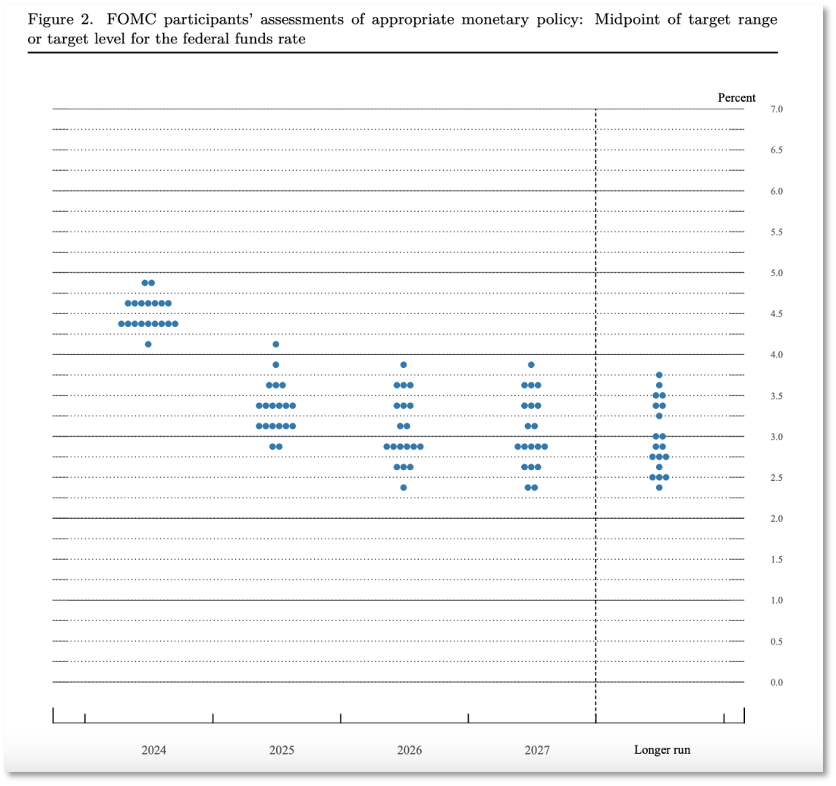
Federal Funds Rate Dot Plot
The dot plot shows that the median projection among 19 policymakers for the Fed’s rate at the end of 2024 falls between 4.25% and 4.50%. This suggests they collectively anticipate an additional cumulative 50-basis-point reduction by year-end.
ETH Outperforms BTC in the Rally
After the Fed’s rate cut, all three major U.S. stock indices closed lower on September 18, failing to achieve the expected boost in equities. In contrast, the crypto market showed greater optimism—especially Bitcoin and Ethereum, the two largest cryptocurrencies by market cap, both of which were added to U.S. ETF product lineups in the past two years.
On September 19, following the rate cut announcement, Bitcoin (BTC) surged from $59,000 to above $63,000, gaining 6% on the day. Ethereum (ETH) climbed from $2,200 past $2,400 and broke above $2,600 on September 22.
However, Ethereum outperformed Bitcoin overall, posting a 7-day gain of 16.3% compared to Bitcoin’s 9.7%.
In addition, SOL gained over 20% on the day of the rate cut announcement, meme coin DOGE rose 3%, and Bitcoin-native inscription tokens ORDI and SATS each gained nearly 10%.
Alongside the broad price rally in crypto assets, spot Bitcoin ETFs ended eight consecutive days of net outflows. Since September 12, spot Bitcoin ETFs have seen four straight days of net inflows, signaling a gradual return of confidence among off-exchange investors.
Many market professionals view the Fed’s rate cut positively, believing it will boost Bitcoin and the broader crypto market. Anthony Scaramucci, founder of hedge fund SkyBridge, said it’s good news for U.S. and global asset prices. With a series of rate cuts and clearer crypto regulation in the U.S., he predicts Bitcoin will hit a new all-time high of $100,000 by year-end.
Theoretically and historically, rate cuts do tend to drive up Bitcoin prices.
In 2019, the Fed cut rates in July, September, and October, lowering the federal funds rate target range to 1.5%–1.75%. Before the cuts, Bitcoin had already risen from around $4,000 at the start of the year to $8,000. After the July cut was announced, Bitcoin reached $10,000 but later pulled back.
In 2020, amid the pandemic shock, the Fed enacted even more aggressive rate cuts, bringing rates nearly to zero. Still, Bitcoin didn’t surge immediately—it broke $30,000 only by year-end.
Yet while rate cuts bring a “money printing” effect, they also cast a shadow of economic recession. Some Fed officials worry that cutting too quickly could revive demand and keep inflation elevated. Republican presidential candidate Donald Trump argued the cuts reflect a weak economy: “If they’re not playing politics, such a big cut indicates the economy is in very bad shape.”
Peter Cardillo, chief market economist at Spartan Capital Securities, said the Fed’s move is clearly dovish, primarily due to concerns about a weakening labor market. While equity markets reacted positively to the rate cut, sentiment may shift in the coming days as investors begin worrying about the economic outlook.
Compared to traditional financial markets like equities, CryptoSea founder Crypto Rover remains more bullish on Bitcoin’s future, stating: “The last time this happened, Bitcoin’s bull run began.” Lark Davis, founder of Wealth Mastery, is also more optimistic about Bitcoin’s long-term trend: “If history repeats itself, the next 6–12 months will be crazy.”
Regardless, the easing cycle has begun. Among the 19 Fed officials, 7 believe there should be another 25-basis-point cut in 2024, 9 favor a 50-basis-point reduction, 7 support a 75-basis-point cut, and only 2 think no further cuts should occur at remaining meetings this year.
Employment data will shape the pace and endpoint of future rate cuts. As time passes and rate cuts continue, market liquidity will gradually improve, and some capital may shift from bonds and bank deposits into equities and crypto assets.
Join TechFlow official community to stay tuned
Telegram:https://t.me/TechFlowDaily
X (Twitter):https://x.com/TechFlowPost
X (Twitter) EN:https://x.com/BlockFlow_News