Redefining the BTC Ecosystem Blueprint: exSat's Innovative Path
TechFlow Selected TechFlow Selected
Redefining the BTC Ecosystem Blueprint: exSat's Innovative Path
What Does the Bitcoin Ecosystem Expansion Actually Need?
 Navigating Web3 tides with focused insights
Author: Chandler, Foresight News
Bitcoin's ecosystem expansion is facing a series of complex and profound challenges, particularly as limitations in network scalability and transaction efficiency become increasingly evident. Since the second half of 2023, with the surge in Bitcoin inscriptions and runes, the Bitcoin network has frequently encountered congestion and rising transaction costs when processing large volumes of transactions. During peak periods, significantly increased fees have further dampened user enthusiasm. These technical bottlenecks not only negatively impact Bitcoin’s broader adoption but also expose structural shortcomings in areas such as DeFi and cross-chain liquidity.
Compared to Ethereum’s DeFi ecosystem, Bitcoin appears relatively lagging. According to DefiLlama data, Ethereum’s ecosystem currently holds a total value locked (TVL) of approximately $89.1 billion. In contrast, despite Bitcoin maintaining over 55% market dominance within the cryptocurrency space, its TVL remains disproportionately low relative to its market capitalization. This indicates that a significant portion of Bitcoin assets remain underutilized—idle BTC sitting on-chain has failed to be effectively activated, becoming a key constraint on further ecosystem development. At the root of this issue lies Bitcoin’s lack of cross-chain liquidity and limited support for smart contracts, which restricts its potential expansion into the DeFi landscape.
Roots of Ecosystem Bottlenecks: Analyzing Bitcoin Network Constraints
One major challenge currently facing the Bitcoin network is the absence of robust infrastructure. Compared to blockchains like Ethereum that offer strong smart contract capabilities and cross-chain functionality, Bitcoin lacks a comprehensive infrastructure capable of supporting complex use cases. Over the past couple of years, various technological innovations have emerged within the Bitcoin ecosystem aiming to alleviate these issues by enhancing scalability and expanding application scenarios. For instance, Layer2 solutions such as Merlin, BEVM, and B² attempt to build scalability layers atop Bitcoin’s base layer to address throughput constraints and high transfer fees.
However, these innovations reveal numerous limitations in practice. On one hand, implementing Layer2 technologies often requires users to perform complex operations between on-chain and off-chain environments, increasing friction and reducing participation willingness. On the other hand, trade-offs related to security and decentralization have led some users to remain cautious or hesitant, further limiting adoption and scalability.
Additionally, while innovative projects like inscriptions and runes initially attracted widespread market attention, they ultimately failed to sustainably advance the Bitcoin ecosystem. Although these initiatives introduced new use cases to Bitcoin, the network’s inherent limitations in handling microtransactions and executing complex smart contracts prevented them from achieving lasting market impact. This suggests that application-layer innovations alone cannot fundamentally resolve Bitcoin’s scalability challenges.
In short, although current Layer2 solutions have somewhat alleviated pressure on the Bitcoin network, there remains a significant gap in terms of technical maturity and user acceptance. Moreover, Bitcoin’s shortcomings in cross-chain technology limit interoperability with other blockchain ecosystems, weakening its role in decentralized finance and application development. To achieve comprehensive growth in the Bitcoin ecosystem, deep reforms at the infrastructure level are essential to enhance network scalability and functional capabilities.
A New Perspective Through the Expansion Dock Concept
Within today’s Bitcoin ecosystem, exSat presents a radically different developmental path through its unique "expansion dock" concept—one that diverges from traditional Layer2 approaches. Rather than relying solely on off-chain scaling, exSat builds an intermediary layer that establishes efficient connections directly between the Bitcoin mainnet and multiple Layer2 networks, thereby improving overall ecosystem scalability, compatibility, and interoperability.
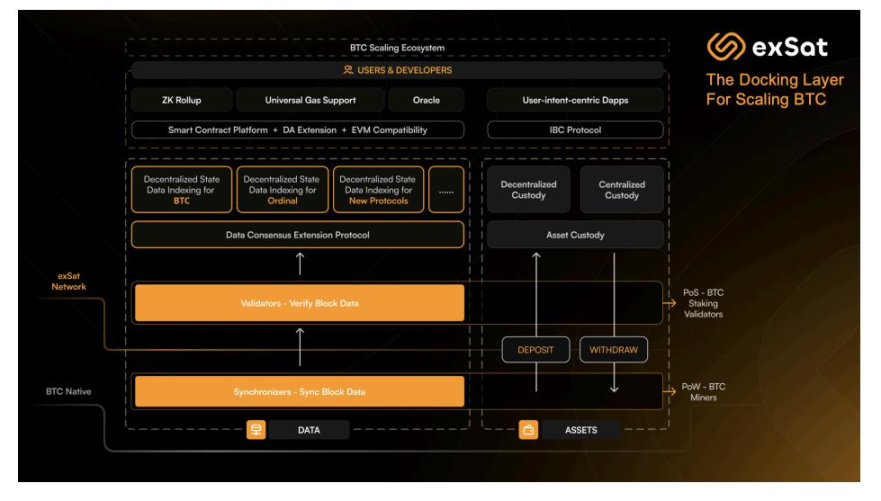
Traditional Layer2 solutions primarily focus on accelerating off-chain transactions and lowering fees, yet often fall short in meeting more diverse and sophisticated application demands. Unlike conventional Layer2 models centered on single-dimensional off-chain scaling, exSat’s expansion dock aims to deliver a multifunctional, multi-network integrated solution for the Bitcoin ecosystem. Through this connecting layer, the Bitcoin network can maintain its core security and decentralization properties while integrating various innovative Layer2 technologies and achieving interoperability with other blockchain networks.
Relatively speaking, exSat’s architectural design breaks through traditional technical barriers in Bitcoin scalability, offering a more efficient and holistic approach. First, via the docking layer concept, exSat integrates Bitcoin’s UTXO model with a decentralized indexing system, enabling more efficient and transparent data management. This structured approach enhances data availability while improving system transparency and verifiability, further strengthening network security.
Second, beyond supporting connections to Layer2 scaling solutions, exSat introduces EVM compatibility, allowing Bitcoin to execute more complex smart contract operations. It also supports smart contracts, multi-chain interoperability, decentralized indexing, and even implementation of advanced cross-chain protocols. With these functionalities, exSat enables a wider range of applications within the Bitcoin ecosystem, driving broader adoption across DeFi, GameFi, NFTs, and beyond—unlocking entirely new possibilities for Bitcoin.
Furthermore, while enhancing network performance, exSat simultaneously optimizes user experience. Traditional Layer2 solutions typically require cumbersome and time-consuming interactions between on-chain and off-chain systems. By creating a unified docking layer, exSat streamlines these processes, reducing operational complexity and boosting overall transaction efficiency—enabling Bitcoin to better support future, more complex applications. Regarding transaction cost optimization, exSat offloads部分 transaction processing to Layer2 networks, significantly relieving mainnet load and effectively lowering overall costs. Especially during high-volume periods, the system maintains higher stability and faster processing speeds, ensuring continuous improvements in user experience.
exSat’s Unique Innovation: More Than Just Technical Extension
Facing ongoing scalability challenges, exSat proposes a dual-consensus mechanism combining PoW (Proof-of-Work) and PoS (Proof-of-Stake), aiming to merge PoW’s security with PoS’s efficiency to create a more flexible and resilient network architecture.
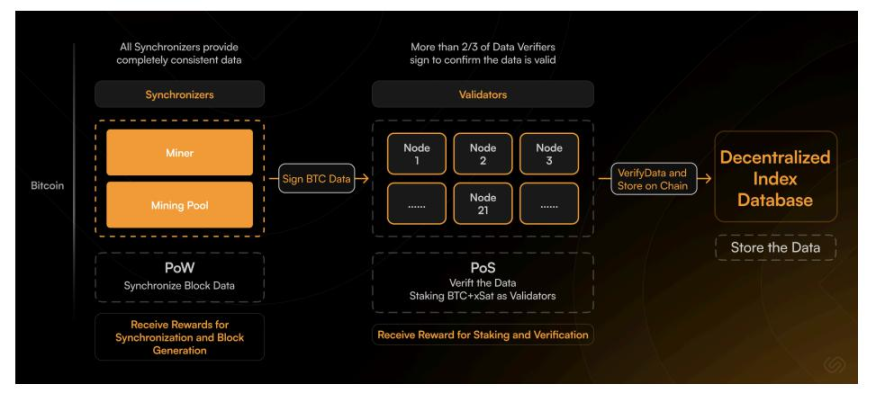
This dual-consensus model combines the strengths of both PoW and PoS to establish a more adaptable and robust network structure. Specifically, block data generated by Bitcoin miners within a 72-hour window is pushed to exSat validators, who then verify and record this data using the PoS mechanism. Once validated, this data can be stored on the Bitcoin mainchain and accessed by other compatible networks. The appeal to both miners and validators is clear. For miners, traditional PoW rewards heavily depend on Bitcoin price fluctuations; during bear markets, profit margins shrink dramatically. Under exSat’s dual-consensus framework, however, miners receive not only standard PoW rewards but also additional income from participating in PoS validation. This diversified revenue stream mitigates the financial risks associated with volatility, helping miners maintain stable earnings even amid market downturns. For validators, the introduction of PoS creates new incentives. By staking BTC to participate in validation, they help secure the network while earning consistent returns.
The implications of this dual-consensus mechanism for the Bitcoin ecosystem are profound. Through a multi-tiered verification system, the network achieves enhanced attack resistance without sacrificing decentralization, while making notable progress in scalability and efficiency. This provides strategic support for Bitcoin’s long-term evolution and strengthens its adaptability in complex application environments.
On another front, as foundational infrastructure, data integrity and immutability are directly tied to network security and trust. exSat ensures accurate, complete, and real-time mapping of critical Bitcoin data through its innovative on-chain data mapping technology. The process begins with comprehensive parsing and storage of on-chain Bitcoin data. During this phase, exSat structures Bitcoin’s Unspent Transaction Output (UTXO) data and manages it via a decentralized indexing system.
exSat’s data mapping initiative is supported by the EOS Foundation, whose low-latency EOS RAM memory perfectly meets the requirements for structuring and managing UTXO data at scale. The high efficiency of RAM enables rapid access and processing of on-chain data, ensuring timeliness and accuracy. During data extraction and storage, exSat’s smart contracts first parse raw data from the Bitcoin blockchain, converting it into formats usable by the decentralized indexing system. This indexing system covers not only BTC but also supports important protocols and assets such as inscriptions and runes, forming a multidimensional on-chain data management platform.
exSat’s data mapping capability is rigorously safeguarded through a multi-layered validation mechanism. Before any transaction data is written into the decentralized index, it must be confirmed by validator nodes within the exSat network. These validators leverage the combined PoW and PoS consensus mechanisms to ensure data authenticity and consistency, significantly enhancing overall network security. exSat’s advantage in data integrity also extends to its precise analysis of on-chain information. For example, through detailed analysis of UTXO data, exSat discovered that the actual circulating supply of Bitcoin is already below the expected 21 million cap, with approximately 1 million BTC permanently lost due to forgotten private keys. Such insights provide valuable decision-making inputs for market participants and developers alike. Based on this knowledge, developers can design and optimize new applications more effectively, fostering innovation and advancement throughout the Bitcoin ecosystem.
Community First: The Philosophy Behind Fair Launch Mechanics
XSAT token distribution follows decentralized design principles, striving for new heights in fairness and transparency. The issuance excludes team allocations, pre-mining, or investor reservations—relying entirely on community-driven growth. The total supply of XSAT is capped at 21 million, mirroring Bitcoin’s supply cap, serving both as a symbolic gesture and a deliberate measure to control inflation. Additionally, the token implements a strict halving schedule, reducing issuance by half every 210,000 blocks.
The XSAT issuance process unfolds across several key phases. Initially, during network initialization, the exSat Foundation synchronizes the first 840,000 blocks of the Bitcoin blockchain to establish a solid data foundation. No token rewards are distributed during this stage—it exists purely to build a reliable base layer. Subsequently, upon official network launch, exSat begins real-time synchronization with the Bitcoin blockchain, continuously receiving and processing the latest BTC block data. At this point, the XSAT mining reward mechanism activates, providing economic incentives for participants. However, becoming a validator requires a minimum stake of 100 BTC.
After the first halving event, the XSAT staking mechanism officially launches. Only the top 21 participants ranked by staked XSAT quantity qualify as active network validators and become eligible for block-signing rewards.
From an economic incentive perspective, exSat’s token allocation creates a model tightly coupled with Bitcoin mining, ensuring fair distribution while carefully designed reward structures uphold network security and decentralization. For instance, syncers who successfully submit and validate BTC block data earn token rewards—and if the syncer is also the original miner of that BTC block, their reward ratio increases substantially.
XSAT’s fair launch model is deeply integrated with decentralized governance, providing strong momentum toward achieving exSat’s long-term ecological goals. This design not only reinforces network security and decentralization but also promotes broad community engagement through an effective token economy, ultimately ensuring exSat’s capacity for sustained innovation and expansion in future complex application scenarios.
Conclusion
As an emerging force in the Bitcoin ecosystem, exSat demonstrates significant innovative potential through its distinctive technical architecture and equitable tokenomics. By eliminating team reserves, pre-mining, and VC allocations, exSat redefines Bitcoin’s decentralization principles and lays a solid foundation for community governance. During its testnet phase, exSat has already drawn participation from major institutions including Antpool, F2Pool, SpiderPool, Bitget, OKX, and HashKey—providing strong backing ahead of its mainnet launch scheduled for October 23. Additionally, during Token2049, exSat announced a partnership with MatrixPort, a digital asset financial services platform, which will inject $300–600 million in liquidity into the ecosystem, aiming to set a new TVL record.
As blockchain technology continues to evolve, Bitcoin’s ecosystem inevitably faces mounting challenges in scalability, compatibility, and interoperability. Exploring new solutions to drive continuous progress in Bitcoin and the broader blockchain ecosystem has become a focal point for industry stakeholders. The emergence of exSat may offer fresh perspectives and viable answers to these persistent issues. Establishing an efficient docking layer between the Bitcoin mainchain and multiple Layer2 networks represents an innovative approach to expanding the ecosystem. Whether exSat can become a cornerstone of Bitcoin’s future, however, will ultimately depend on its ability to consistently drive technological advancement and ecosystem growth in real-world applications.
Join TechFlow official community to stay tuned
Telegram:https://t.me/TechFlowDaily
X (Twitter):https://x.com/TechFlowPost
X (Twitter) EN:https://x.com/BlockFlow_News
 Foresight News