









How a $1.4 Billion Crypto Prediction Market Rose to Prominence
TechFlow Selected TechFlow Selected
How a $1.4 Billion Crypto Prediction Market Rose to Prominence
Represented by Azuro and Polymarket, the future of prediction markets seems full of promise.
 Navigating Web3 tides with focused insights
Source: cryptoslate
Translation: Blockchain Knight
Crypto prediction markets are growing with the rise of platforms like Polymarket.
Castle Capital notes in its latest deep-dive report that prediction markets enable users to bet on future events using crypto assets, shifting traditional gambling into a decentralized realm.
This shift allows participants to trade directly with one another rather than through centralized intermediaries, increasing transparency and resistance to manipulation.
Castle Capital outlines how historically, prediction markets were centralized, limiting user participation and flexibility.
The introduction of blockchain technology has decentralized these markets, enabling users to create their own markets and conditions.
Prediction markets have been recognized as a prominent blockchain application since the launch of Augur in 2015, though mainstream attention has only recently intensified.
The sector now holds a total value locked (TVL) of $162 million, with significant increases in user engagement and trading volume.
Platforms such as Azuro and Polymarket have driven this growth by offering different approaches.
Polymarket, built on Polygon, operates using an order book model and focuses on major political and news-related events.
To date, Polymarket has processed over $1.4 billion in trading volume, becoming a key betting platform for events like the U.S. presidential election.
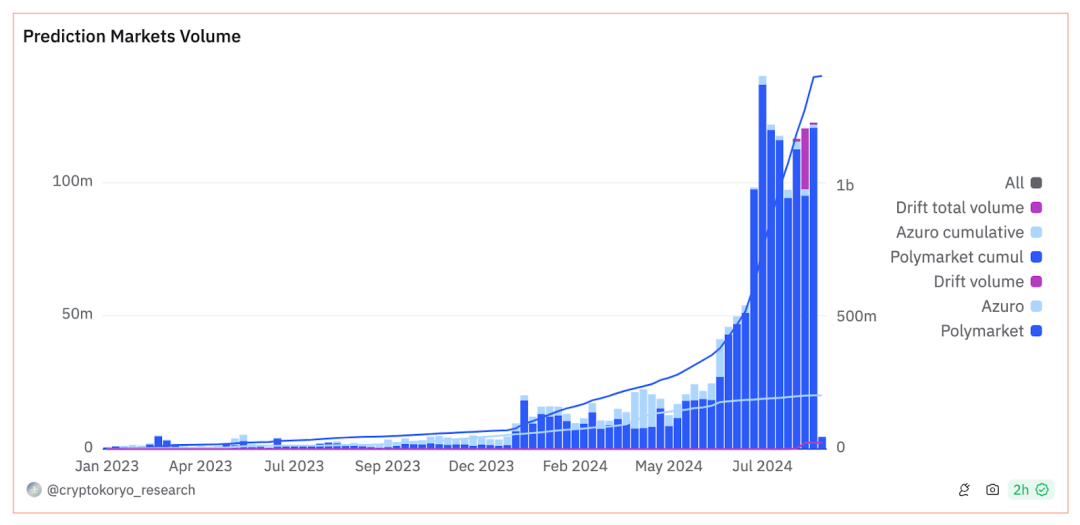
Castle Capital explains that Azuro uses a peer-to-pool design, allowing users to provide liquidity to pools serving multiple markets. This model diversifies risk and improves capital efficiency, primarily targeting sports betting.
Azuro has already handled over $200 million in predicted volume, attracting users who repeatedly bet across various sporting events.
Both platforms aim to expand their market share.
Polymarket seeks to reduce its reliance on political events by adding more diverse markets, while Azuro reportedly plans to extend beyond sports into political and news markets.
The development of these platforms highlights increasing interest in decentralized prediction markets as tools for gauging public sentiment.
Castle Capital outlines ongoing challenges to mainstream adoption, including liquidity issues, regulatory uncertainty, and the need to improve user experience.
Ensuring reliable oracles and data accuracy is critical, as is addressing blockchain network scalability. Overcoming these hurdles will require innovation and cooperation with regulators.
As Castle Capital points out, prediction markets have the potential to provide accurate public sentiment on a wide range of topics, evolving beyond seasonal hype into indispensable decision-making tools.
Integrating artificial intelligence and expanding market offerings could enhance their utility and appeal. Prediction markets could supply disaggregated sentiment data to news organizations and influence political discourse.
With platforms like Azuro and Polymarket leading the way, the future of prediction markets appears promising.
Their continued growth and adaptability may solidify their position within the crypto ecosystem, offering users valuable insights and opportunities for forecasting future events.
Castle Capital's report indicates that the evolution of prediction markets reflects the broader trend toward greater adoption of decentralized applications.
However, whether these platforms can sustain momentum, overcome future challenges, and achieve mainstream recognition remains to be seen.
Join TechFlow official community to stay tuned
Telegram:https://t.me/TechFlowDaily
X (Twitter):https://x.com/TechFlowPost
X (Twitter) EN:https://x.com/BlockFlow_News
 @CryptoSlate






